A Walk Through Chania's Old Town
What makes a walk through Chania's Old Town worthwhile?
Chania's Old Town is a working harbour city where Venetian arcades, an Ottoman mosque and minaret, and a hammam sit within a few hundred metres of each other, the result of Venetian rule from 1204 to 1669 followed by Ottoman rule to 1898. It rewards slow walking rather than a checklist, and it sits close to Souda Bay, tied to the Battle of Crete of May 1941.
Two Empires on One Waterfront
Most travellers arrive in Chania already holding a picture of it in their head: a curved harbour, pastel façades, a lighthouse at the end of a stone mole. That picture is real, but it is not the whole story, and the best way to understand it is to walk it slowly rather than photograph it quickly. Chania’s Old Town is the clearest place in Crete to see two empires layered on top of each other. The Venetians held the city from 1204 to 1669, nearly four and a half centuries, and built a harbour, an arsenal and a merchant quarter meant to last.
The Ottomans took over after a long siege and ruled until 1898, more than two centuries during which they converted buildings, added a mosque and a minaret to the harbour front, and left a bathhouse tucked into the backstreets. Nothing about this is ancient in the Minoan sense. There is no palace ruin here and no Bronze Age foundation to inspect; this is a living historic centre, still lived in, still fed by tavernas and workshops, where the walls themselves carry the record of who governed the city and when.
Why Chania Is the City Most Visitors Picture
Crete is genuinely large, roughly 260 km end to end, and it is really four regions rather than one destination. Heraklion is the administrative capital and the largest city, but Chania is the second city and, for most first-time visitors, the one that matches their mental image of the island. That reputation is earned by the harbour rather than by size. Where Heraklion’s old core is broken up by modern traffic and Rethymno’s is smaller and quieter, Chania’s waterfront curve, its lighthouse silhouette and its density of Venetian and Ottoman detail give it a coherence the other two cities don’t quite match.
It is worth being honest about scale before you arrive: Chania to Sitia, at the island’s eastern tip, is around 270 km and over four hours by road, so this walk covers one corner of a large island, not a miniature of the whole thing. For a wider sense of how the three old towns compare, the guide on Chania versus Rethymno versus Heraklion lays out the differences in more detail.
The Venetian Layer: Harbour, Arsenal and Merchant Houses
Start at the water. The harbour itself is Venetian in conception, built to shelter galleys and merchant ships trading between Crete and the maritime republic that controlled it. Along the eastern arm you can trace the outline of the old Venetian arsenals, vaulted structures originally built for building and repairing ships, and now standing as some of the oldest intact harbour architecture on the island. The lighthouse at the end of the breakwater began under Venetian rule too, though its current form was reworked later; it remains the single most photographed structure in Crete for good reason, framing the whole curve of the harbour behind it.
Walking the waterfront and the lanes just behind it, you’ll notice Venetian details repeat: arched doorways, stone window surrounds, the occasional coat of arms worked into a lintel, and narrow merchant houses that once opened directly onto the quay for loading goods. None of this is behind glass or roped off. It’s simply the fabric of streets where people still live and run small businesses, which is part of what makes the walk feel different from a museum visit. For a closer look at the harbour and lighthouse specifically, the dedicated guide on the Venetian harbour and lighthouse goes further into that stretch alone.
The Ottoman Layer: Minarets, a Hammam and a Changed Skyline
Keep walking and the layers start to overlap rather than sit neatly apart. After the long Ottoman siege that finally took the city in the 17th century, more than two centuries of Ottoman administration followed, and it changed the skyline in ways still visible today. A minaret rises near the harbour front, attached to what was converted for use as a mosque; it’s one of the clearest single markers of the Ottoman period anywhere on the waterfront, and it stands close enough to the Venetian arsenals that both eras are visible in a single glance from the right angle.
Further into the backstreets, a domed hammam survives, a bathhouse built for a daily ritual that had no equivalent in Venetian-era Chania. These additions weren’t built over the earlier city so much as inserted into it, which is exactly why the streetscape reads as blended rather than as two separate districts. This mixing is the whole point of the walk: nowhere else in Crete puts Venetian and Ottoman architecture into such close, walkable proximity. For deeper background on how Venetian rule gave way to Ottoman control across the island, the guide on Venetian Crete, 1204 to 1669 covers the handover in more depth than fits into a single walking route.
Splantzia, the Backstreets and the Market
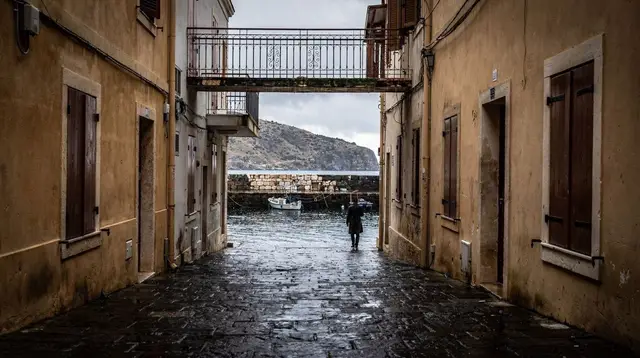
Move away from the harbour itself and the old town opens into a looser grid of lanes, most usefully explored around the Splantzia district, historically home to Chania’s Jewish quarter alongside its Ottoman-era residents. This is where the walk slows down naturally: narrow streets, small squares shaded by plane trees, doorways that mix Venetian stonework with later additions, and far fewer people than the harbour front carries in peak season.
It’s also where the city’s covered market sits, a cross-shaped 20th-century building that, while newer than the harbour architecture around it, has become part of how locals and visitors alike experience the old town’s daily rhythm. Wandering from the water into Splantzia and back again, ideally without a fixed route, is the best way to feel how the old town actually functions as a neighbourhood rather than a stage set. The guide to Chania’s market and food streets is worth pairing with this walk if food and produce interest you as much as architecture.
a private sightseeing walk through the old town’s artisan workshops and backstreets is one way to get context on these layers without piecing it together from plaques alone, and it works well as a first orientation before you go back and wander independently.
Nearby: Souda Bay and the Battle of Crete
The old town doesn’t sit in isolation from the island’s more recent history. A short drive east toward the Akrotiri peninsula brings you to Souda Bay, a deep natural harbour that holds the Commonwealth war cemetery for Allied soldiers killed during the Battle of Crete. That battle began on 20 May 1941, when German forces launched one of the first large-scale airborne invasions in military history, with paratroopers dropping around Maleme airfield west of the city. The German war cemetery sits at Maleme itself, while Souda’s cemetery holds the Allied dead, and the two sites together frame a battle that Cretan civilians joined as well, not only regular troops.
This isn’t distant history here. Families in and around Chania still speak about the occupation and the resistance that followed as part of living memory, and it’s worth knowing the outline before you see the cemeteries themselves, rather than treating them as an afterthought on a day built around the harbour. The guides on the Battle of Crete, 1941 and on Cretan resistance and the war cemeteries cover both sites and the wider campaign in more depth than a walking-route page can hold.
A Glass of Raki at the End of the Walk
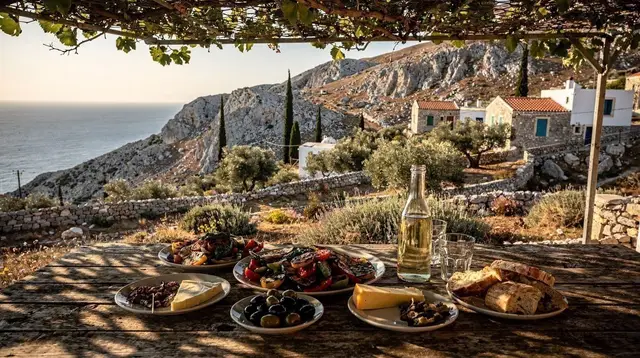
If your walk ends, as many do, with a meal in one of the old town’s tavernas, don’t be surprised if a small glass of a clear spirit arrives unordered once the plates are cleared. That’s raki, sometimes called tsikoudia depending on the region, distilled from the grape marc left over after winemaking. It carries no anise flavouring, which sets it apart from ouzo, and despite the similar name it has no relation to Turkish raki either.
Offering it free at the end of a meal is simply a local gesture of hospitality rather than a menu item to request, and it pairs naturally with the kind of unhurried walk this old town rewards. If Cretan drink and food history interests you beyond that one glass, the dedicated guide on raki and tsikoudia explains how it’s made and how it differs from its more famous cousins.
Different Ways to Walk the Same Streets
Because the old town rewards slow attention, several structured ways to cover it exist alongside simply wandering on your own. A themed walk built around tastings adds food and drink stops to the architectural route, useful if you’d rather combine the history with a meal than treat them separately, such as an old town walk that mixes local tastings with culture and storytelling.
A more general orientation walk works well for a first visit, laid out as a guided walking tour through the old town’s Venetian and Ottoman landmarks, giving you a framework you can then wander back through independently later the same day. For visitors who’d rather see the same streets after dark, when the crowds thin and the lit facades change character entirely, an evening storytelling walk through the old town’s darker history takes a different angle on the same lanes.
What Not to Expect
It’s worth being direct about what this walk is not, since Crete’s marketing sometimes blurs categories that are worth keeping separate. The old town and its harbour are not an archaeological site in the Minoan sense; there are no palace ruins here to compare with Knossos or Phaistos, and nothing on this walk predates the Venetian period by more than incidental fragments. It is also not a single monument you tick off in ten minutes.
The value of the walk is cumulative, built from noticing repeated details, arched doorways here, a minaret there, a hammam dome half-hidden behind a taverna, rather than from reaching one headline sight. And while the old town is compact, it sits within a much larger city and a much larger island; if you’re planning more than a single day here, the itinerary for Chania in two days sets out a sensible pace for the wider area, including the harbour, the market and a trip out toward Akrotiri.
Planning the Walk
There’s no single correct route through the old town, and that’s part of what makes it work as an unhurried walk rather than a checklist. A practical approach is to start at the harbour, work along the waterfront past the arsenals toward the lighthouse, then turn inland through Splantzia before finishing near the market. Early morning and the hour before sunset both suit the harbour particularly well, when the light sits low across the water and the crowds along the waterfront thin out. Comfortable shoes matter more than a fixed itinerary, since much of the appeal lies in the narrower backstreets rather than the main harbour promenade, and those streets are cobbled and uneven in places.
If you’re combining the walk with other harbour activities, the general things to do in Chania hub groups walking routes alongside other options in the same area, and the broader city walking tours category covers similar structured walks across Crete’s other old towns if you plan to compare them. For getting to the city in the first place, the Chania airport guide covers arrival logistics separately from this walk itself.
Frequently Asked Questions About Walking Chania’s Old Town
Is Chania’s Old Town a Minoan or archaeological site?
No. The Old Town is a living historic city centre, not an excavation. Its oldest visible layer is Venetian, from the 13th to 17th centuries, overlaid by Ottoman-era building from 1669 to 1898. Crete’s Minoan sites, such as Knossos and Phaistos, are separate places on the island’s central and southern coasts.
Why do some buildings in Chania Old Town have minarets?
The Ottomans held Chania from 1669 to 1898, after the Venetians surrendered the city, and converted or built structures for Muslim worship and daily life during that period, including mosques and at least one hammam. What survives today stands alongside earlier Venetian merchant houses and arcades, which is why the skyline and the streetscape read as mixed rather than uniform.
How is Chania different from Crete’s other old towns?
Chania is the island’s second city and the one most visitors picture when they think of Crete, thanks to its curved Venetian harbour and lighthouse. Rethymno and Heraklion also carry Venetian and Ottoman layers, but Chania’s waterfront is the most intact and the most photographed, and its old town extends further back into residential lanes than either.
What is raki and will I be offered it in Chania?
Raki, also called tsikoudia, is a clear spirit distilled from grape marc, the skins and stems left after winemaking. It has no anise, so it is not ouzo, and it is unrelated to Turkish raki despite the similar name. Tavernas in the old town commonly offer a small glass free at the end of a meal, a local gesture rather than a menu item.
Is Souda Bay part of the old town walk?
No, Souda Bay is a separate area a short drive east of the old town, on the way toward the Akrotiri peninsula. It holds the Commonwealth war cemetery linked to the Battle of Crete of May 1941, while the German cemetery from the same campaign is further west at Maleme. Neither sits inside the walkable old town itself.
What happened in Chania during the Battle of Crete?
The Battle of Crete began on 20 May 1941 as one of the first major airborne invasions in military history, with German paratroopers landing around Maleme, west of Chania, and Cretan civilians joining Allied troops in the resistance. Chania itself endured occupation afterward, and the war remains part of how local families describe the island’s recent history rather than a distant subject.
Can I combine the old town walk with other harbour sights?
Yes. The harbour walk naturally connects to the lighthouse and the old Venetian arsenals along the waterfront, and to the covered market and food streets a short walk inland. Both make sensible extensions of the same outing without needing separate transport.
Is Chania Old Town walkable without a guide?
Yes, the core harbour and backstreets are compact and easy to cover on foot independently. A guided walk adds context on the Venetian and Ottoman layers, food streets, or evening storytelling that is harder to piece together alone, which is why several themed options exist alongside independent wandering.
City Walking Tours in Crete on GetYourGuide
Verified deep-linked GetYourGuide tours. Book through these links and we earn a small commission at no cost to you.
GetYourGuide does not provide a product photo for this activity — the image shows the meeting point, photographed by us.