Most travellers meet Souda for the first time half-asleep, walking off an overnight ferry with a bag over one shoulder and Chania still ten minutes up the road. That is a fair introduction to what this place actually is. Souda is a working port and a naval base on a deep, sheltered bay, not a resort, and the peninsula above it, Akrotiri, is a quiet mix of monasteries, olive groves and a handful of coves rather than a beach destination. This page is about what is genuinely here once the gangway drops: a war cemetery with a story that reaches into how modern Crete talks about itself, two working monasteries a short drive apart, and a coastline better suited to a slow morning than a packed itinerary.
The port before the peninsula
Souda Bay is one of the deepest natural harbours in the Mediterranean, which is exactly why it has been fought over and built up rather than developed for tourism. The overnight ferry from Piraeus docks here, a roughly nine-hour crossing that runs in parallel with the separate Piraeus-Heraklion route on the other side of the island. Travellers flying in instead usually land at Chania airport at Souda itself, a detail that surprises people expecting the airport to sit near the old town; in fact the runway is a few minutes from the port and the naval base shares the same stretch of coast.
None of this makes Souda a place to linger. There is no old town here, no waterfront promenade to speak of, and no beach worth changing plans for. What Souda gives a traveller is logistics: a ferry terminal, a fuel stop, car rental counters near the airport, and a road junction where the decision is really whether to head into Chania town or up onto the Akrotiri peninsula. Treat it as a gateway rather than a stop, and it makes complete sense on the map.
The one exception, and the reason this page exists at all, is the war cemetery on the bay’s northern shore. It is worth the detour even for travellers with no ferry to catch and no flight to make.
The Commonwealth war cemetery at Souda Bay
On a low rise above the water, the Souda Bay War Cemetery holds close to 1,500 Commonwealth graves, most of them from the Battle of Crete, which began on 20 May 1941 with the first invasion in history carried out mainly by airborne troops. German paratroopers dropped in force around Maleme and Chania while the Royal Navy and Allied and Cretan defenders fought to hold the island; the battle was lost within ten days, but the resistance that followed, and the losses recorded here, shaped how the island still marks the war.
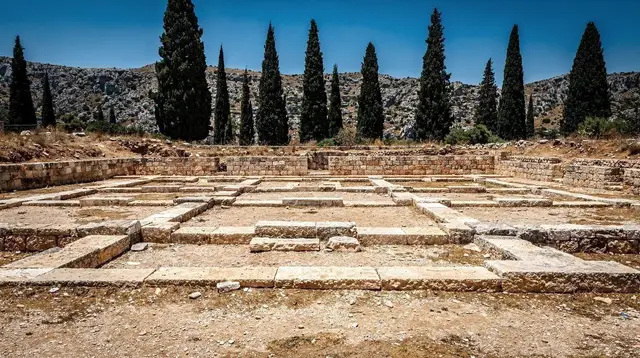
The cemetery itself is simple: rows of white headstones under cypress and eucalyptus, facing the bay, maintained by the Commonwealth War Graves Commission. It is free to visit, open daily, and unmarked by any commercial presence, which is part of what makes it affecting. Reading the ages on the stones, many of the dead barely into their twenties, does more explaining than any plaque could.
For visitors who want the history filled in properly rather than absorbed silently, a guided tour that pairs the cemetery with the wartime bunkers and gun positions around Chania covers the ground the headstones only gesture at, and travellers building a full day around 1941 sometimes take the two-day route through the Battle of Crete’s key sites out of Chania instead of trying to compress it into an afternoon.
For background before or after the visit, the full account of the Battle of Crete and a companion piece on how Cretan resistance and the island’s war cemeteries fit together are the better starting points than trying to reconstruct the campaign from a single site.
Maleme is not Souda: two cemeteries, two armies
It is an easy mix-up, and worth untangling before a visit rather than after. The Commonwealth cemetery sits at Souda Bay, close to the ferry port and the airport. The German military cemetery is a separate site entirely, above the village of Maleme, about 20 km to the west along the coast road, near the airfield where the first wave of paratroopers landed on 20 May 1941 and where some of the war’s fiercest early fighting took place.
The two sites were built by different commissions, hold different armies’ dead, and sit in different landscapes: Souda low by the water, Maleme on a hill with sea views the paratroopers themselves would have looked down on as they came in. Travellers with time for both usually see them as two separate stops on a day that also takes in Chania rather than as a single excursion, since the drive between them runs through, not around, the town.
Akrotiri: monasteries and quiet coast
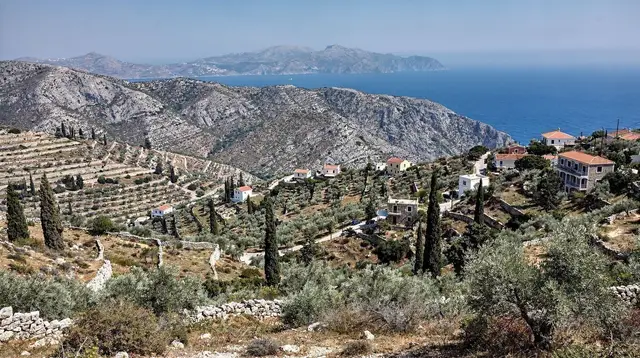
North and east of Souda, the Akrotiri peninsula rises into a plateau of scrubland, olive terraces and a scatter of villages, closed off at its tip by the naval base and, on its eastern shore, by cliffs dropping to the sea. It is not a peninsula built for beach holidays and it does not pretend to be one; there is no resort strip here, no organised nightlife, and no chain of sunbed concessions. What it offers instead is quiet, and two monasteries worth the drive on their own terms.
Agia Triada (Holy Trinity), built in the 1600s by monks of Venetian-Cretan origin, is the more visited of the two: a honey-coloured Renaissance facade, an active community, and a shop selling the monastery’s own oil and wine. A narrow road continues from there to Gouverneto, older and starker, from which a rough path drops through a ravine to the ruined, cave-set monastery of Katholiko, one of the oldest monastic sites on the island and, for the walk alone, the more memorable of the two.
| Site | Distance from Souda | What it is |
|---|---|---|
| Agia Triada monastery | About 15 minutes by car | Active 17th-century monastery, shop with its own oil and wine |
| Gouverneto monastery | About 20 minutes by car | Older, quieter monastery, starting point for the Katholiko walk |
| Katholiko ruins | 30-40 minute walk from Gouverneto | Cave monastery ruins down a rocky ravine, no facilities |
| Seitan Limania cove | About 25 minutes by car, plus steps | Narrow cliff-lined cove, steep descent, no shade |
Both working monasteries keep the same dress code as Arkadi and Preveli: shoulders and knees covered. For a route that links the two monasteries with the quieter corners of the plateau in one loop, see the Akrotiri monasteries walk.
The coast is a smaller part of the story here, and it is honest to say so. Seitan Limania, a narrow, cliff-walled cove reached down a steep flight of steps, is the best known, and Marathi, a sheltered bay on the peninsula’s south side, the calmer alternative. Neither has the infrastructure of a resort beach; both are covered in more detail, along with a few lesser-known coves, in the guide to Seitan Limania and the Akrotiri coves.
Getting around: a car, not a coach
The KTEL bus network is a genuinely practical way to move along Crete’s north coast highway, linking Chania, Rethymno, Heraklion and Agios Nikolaos on a reasonably frequent schedule. Akrotiri is a different matter. The peninsula’s monasteries, viewpoints and coves sit off that corridor, connected by narrow secondary roads with little or no scheduled service, and Souda’s own role is as a port and transport hub rather than a stop worth reaching by bus in its own right.
In practice this means a rental car or a taxi from Chania. For visiting logistics before committing to a plan, the guides on renting a car in Crete and driving in Crete cover contract terms and road habits worth knowing before setting off toward Gouverneto’s ravine road or the Seitan Limania steps.
Travellers without a car, or arriving on a tight ferry connection with a few hours to fill, are usually better served by a private transfer or a guided day trip that already accounts for Souda’s layout, such as the private day trip from Souda Bay that runs inland to Knossos Palace for ferry or cruise passengers who want to use a short window well rather than navigate it themselves.
Boats that happen to leave from Souda
Souda’s port does more than receive the overnight ferry: several boat trips along this stretch of coast also depart from it, heading out to Marathi Bay, Seitan Limania or further along the coastline rather than running any activity on Akrotiri’s own shore. A pirate-themed cruise with swim stops leaving from Souda and a private boat trip from Marathi out to Seitan Limania are both built around reaching a cove that is otherwise a steep walk down, not around any watersports base at Souda itself.
Fuller day trips along the Cretan Blue coastline, and catamaran cruises with lunch on board, also use Souda as their starting point rather than their destination, which is worth knowing if a booking confirmation lists Souda as the meeting point: the interesting part of the trip happens further along the coast, not at the port.
How much time and money to give this area
Half a day covers the essentials well: an hour or so at the war cemetery, a drive up to Agia Triada and Gouverneto, and time for lunch either on the peninsula or back in Chania. Adding the walk down to Katholiko or a cove stop pushes that toward a full day.
| Item | Typical cost |
|---|---|
| Fuel for a half-day loop from Chania | €10-15 |
| Monastery entry (Agia Triada) | Small donation, usually a few euros |
| Lunch at a taverna near Souda or Chania | €12-20 per person |
| Guided WWII history tour with cemetery and bunkers | Varies by operator, typically a half-day rate |
| Boat trip from Souda to Marathi or Seitan Limania | Varies by operator and season |
A day that combines the cemetery, the monasteries and a simple lunch comfortably fits within a €30-70 per person budget, before any guided tour or boat trip is added on top.
Where to base yourself
Nobody sleeps in Souda by choice, and there is little reason to try. Chania town, with its Venetian harbour and old quarter, sits close enough to make Souda and Akrotiri a half-day loop rather than a relocation, and it gives access to everything else in the west of the island besides.
For help choosing where to stay and for how long, see where to stay in Crete and how many days in Crete; for a two-day plan that already folds in a Souda and Akrotiri morning, Chania in two days is the more efficient starting point than assembling one from scratch. Activity listings specific to this stretch of coast are gathered at things to do in Souda and Akrotiri.
Souda and Akrotiri: frequently confused questions, answered
Is Souda a place to stay, or just a ferry stop?
Souda is a working port and naval town, not a holiday base. Almost everyone who passes through is either boarding or leaving the overnight ferry to or from Piraeus, or visiting the nearby war cemetery. For a bed, base yourself in Chania town, ten to twenty minutes away.
How long is the ferry crossing between Piraeus and Souda?
The overnight ferry from Piraeus to Souda, Chania’s port, takes about nine hours, the same as the separate route to Heraklion. Boats usually leave Piraeus in the evening and dock in Souda the following morning, or the reverse in the other direction.
Is the Commonwealth war cemetery at Souda the same as the German cemetery?
No. The Commonwealth War Graves cemetery sits on the shore of Souda Bay and holds Allied dead from the Battle of Crete, which began on 20 May 1941. The German military cemetery is a separate site above the village of Maleme, roughly 20 km to the west, near where the first paratroopers landed.
Are there good beaches on the Akrotiri peninsula?
Akrotiri is not known for its beaches in the way west Crete’s other coasts are. It has quiet coves rather than a resort strip, the best known being Seitan Limania, reached down a steep set of steps or by boat, and Marathi, a sheltered bay more often visited on a boat trip out of Souda than driven to directly.
Can I visit Souda and Akrotiri by bus?
It is difficult. The KTEL coach network is genuinely useful along the north coast highway between Chania, Rethymno, Heraklion and Agios Nikolaos, but it does not serve the Akrotiri peninsula’s monasteries or viewpoints in any practical way. A rental car or a taxi from Chania is the realistic option.
Do I need to dress a certain way for the Akrotiri monasteries?
Yes. Agia Triada and Gouverneto are working monasteries with the same dress code as Arkadi or Preveli: covered shoulders and knees for both men and women. Some keep a supply of wraps at the entrance for visitors who arrive unprepared, but it is safer not to rely on it.
Is there nightlife or organised watersports at Akrotiri?
No. Akrotiri is a mix of monasteries, farmland, the naval base and a few quiet coves; it has no resort nightlife and no beach clubs with jet skis or banana boats. The boat trips that leave from Souda’s port head out to Marathi Bay or Seitan Limania rather than running activities on Akrotiri’s own shore.