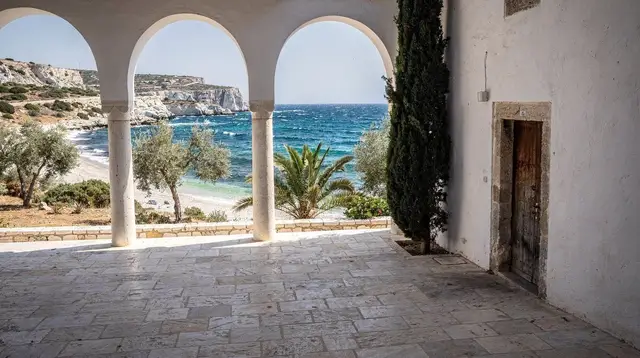
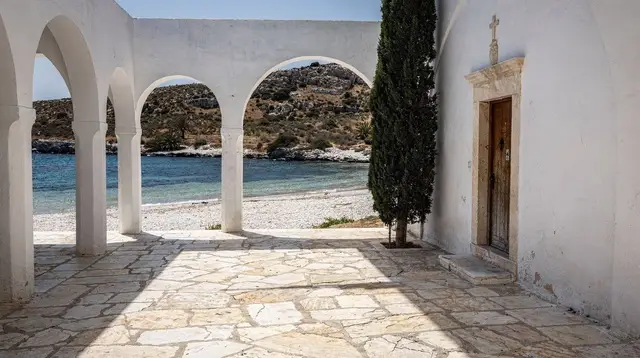
The Monasteries of Akrotiri
Which monasteries can I visit on the Akrotiri peninsula near Chania?
Akrotiri holds three monasteries reached from the same road north of Chania town: the walled Agia Triada, the smaller Gouverneto a little further on, and the ruined, unstaffed Katholiko reached on foot down a ravine. All three sit above Souda Bay, and all three expect covered shoulders and knees, the rule that applies at every working monastery in Crete.
Above Souda Bay: where Akrotiri fits on the map
Akrotiri is the peninsula that closes off Souda Bay to the north, a short drive from Chania town and its Venetian harbour. It is not a single sight but a scattering of them: a military airport, a university campus, sheer coves on its northern shore, and, running up its spine, the road that links three monasteries of very different character. This guide covers that road — what each monastery is, what it asks of a visitor, and what sits below it in the bay that gives the peninsula its weight in modern Cretan history.
It is worth saying plainly at the start: Akrotiri is one corner of one region of an island that runs for roughly 260 km from west to east. A morning on this peninsula tells you a great deal about Chania and almost nothing about Rethymno, Heraklion or Lasithi, which lie hours away along the coast. Crete rewards travellers who accept that no single base, however good, covers the island — a point this guide returns to at the end.
The three monasteries, in the order you meet them
Agia Triada, sometimes called Zangarolo after the Venetian family associated with its founding, is the first and grandest of the three. It sits behind a substantial gated entrance, with a courtyard, a working church, cypress trees and a small museum room holding icons and vestments. It is an active monastery, with monks in residence, and it functions as a place of worship first and a sight second — a distinction that shapes how a visitor should behave inside its walls.
A short drive further along the same road brings you to Gouverneto, smaller and plainer than Agia Triada, tucked closer to the peninsula’s edge. It, too, is an active monastery, quieter on most days than its larger neighbour, with a fortress-like façade that reflects centuries when isolated religious houses needed to defend themselves as much as shelter them. Visitors who arrive expecting a scaled-down copy of Agia Triada tend to be struck instead by how plain and unadorned it is inside.
The third stop is not really a monastery you visit so much as one you walk to. Katholiko lies down in a ravine below Gouverneto, a ruin rather than a functioning church: roofless in places, its stone worn by weather and time, standing beside the cave associated with Saint John the Hermit, a figure honoured locally as an early ascetic of the region. There is no gate to pass through and no dress code to observe, because there is no service held there — only the walk down, over uneven ground, and the walk back up.
| Site | Status | What it takes to visit |
|---|---|---|
| Agia Triada | Active, working monastery | Gate, courtyard, small museum; dress code applies |
| Gouverneto | Active, working monastery | Smaller, plainer; dress code applies |
| Katholiko | Ruined, unstaffed | On foot down a ravine from Gouverneto; no dress code enforced, but sturdy shoes matter |
Visitors who want the three sites covered without driving and parking at each in turn sometimes book a guided run of the peninsula that folds the monasteries into a wider look at Akrotiri; the Akrotiri Chania guided tour with beach and monastery visit is built around exactly that combination, pairing the monastery road with time on the peninsula’s coast.
The rule that applies at every one of them
Both Agia Triada and Gouverneto are working religious communities, and the expectation is the same one that applies at Arkadi, at Preveli, and at every other active monastery on the island: shoulders and knees covered, for men and for women alike. This is not a suggestion aimed at tourists specifically — it is the standard a Cretan visitor would also be expected to meet, and monks at the gate can and do turn away visitors dressed for the beach.
In practice this means packing a layer that can go over shorts or a sleeveless top before you set out, rather than relying on finding something at the site. Some monasteries keep wraps or sarongs near the entrance for visitors caught out, but treating that as a guarantee is a poor plan on a day when several coach groups arrive at once. A scarf, a light shirt and a pair of trousers folded in the car cost nothing to carry and solve the problem before it arises.
Because Katholiko has no resident community and no service, this expectation does not follow you down into the ravine — but it does apply again the moment you are back at Gouverneto’s gate, and it applies at any other monastery you fold into the same trip, from Toplou in the far east to any church you step into along the way.
Souda Bay below: the war cemetery and 20 May 1941
The view from much of the Akrotiri road takes in Souda Bay, one of the deepest natural harbours in the Mediterranean and, since 1941, a name carried in Crete’s modern memory as much as its geography. On the shore of the bay lies the Commonwealth war cemetery, where soldiers killed in the Battle of Crete are buried in rows facing the water they fought over.
The battle itself began on 20 May 1941, when German forces launched what is generally described as the first invasion in history carried out mainly by airborne troops — paratroopers dropped over Maleme, Chania and the surrounding country rather than landed from the sea. The fighting that followed, and the Cretan civilian resistance that continued long after the formal battle ended, are not background colour for this peninsula; they are part of why the bay below Akrotiri’s monasteries carries the weight it does for Cretan families today.
A visitor who wants the fuller account of that campaign, or of the resistance that followed it, will find it covered on its own terms in the Battle of Crete, 1941 and in Cretan resistance and the war cemeteries — this guide is about the monastery road above the bay, not the battle fought below it, and keeps that distinction rather than folding one into the other for effect.
The monasteries themselves predate that war by centuries, sitting within the longer arc of Venetian rule over Crete, which is part of why Agia Triada carries a Venetian family name alongside its religious one. Akrotiri’s layered history — Venetian-era monastic building, a twentieth-century battlefield, a present-day military installation and university campus sharing the same small peninsula — is unusually compressed for such a short stretch of coast.
Getting there and planning the walk
Akrotiri is reached by car from Chania town in well under half an hour, along a road that climbs gently past the airport and university before reaching the monastery turn-offs. A rented car is the practical way to link Agia Triada, Gouverneto and the walk down to Katholiko in one outing, on your own schedule rather than a coach’s; general guidance on renting and on the habits of driving in Crete is covered in renting a car in Crete and driving in Crete.
Travellers who would rather not drive, or who want the history explained on the spot, can book a seat on a shared or private run out from Chania; the private van tour from Chania to the monasteries covers this road without requiring a rental car, and pairs naturally with other monastery sites inland if the operator’s route extends further, as some do toward Arkadi and the caves near Melidoni on a longer day out — a combination also offered as the Souda Bay, Arkadi monastery and Melidoni private tour for visitors who want to see more of the region’s religious sites in a single booking.
This guide deliberately does not quote opening hours, an entrance fee, or the name of any particular tour operator or driver for the monasteries themselves. Hours at working monasteries shift with the season and with the community’s own needs, donation amounts are not fixed prices, and operator listings change year to year — printing a figure here would go stale faster than this page can be corrected, and a wrong number is worse than none. Confirm hours locally on the day, or through whichever tour or transfer you book, rather than relying on a fixed schedule written months in advance.
Beyond the monasteries: what else sits on this peninsula
The monastery road is not the only reason to come to Akrotiri. The peninsula’s northern edge holds some of the sharpest coastal scenery near Chania, including the cove walk covered separately in Seitan Limania and the Akrotiri coves — a different kind of outing from the monasteries, on foot along cliff paths rather than through gated courtyards, and worth treating as its own half-day rather than an add-on squeezed in after Katholiko.
Visitors basing themselves in Chania for several days sometimes prefer to see Souda Bay from the water rather than from the monastery road above it; cruises out of Souda port, such as the Souda Bay cruise with swim stops, cover the same bay from a different angle and are worth knowing about even though they are not a substitute for the walk to Katholiko.
One corner of a much larger island
It bears repeating because it is easy to lose sight of once a monastery road has filled a satisfying morning: Chania and Akrotiri sit at the western end of an island that runs roughly 260 km to its eastern tip at Sitia, through four distinct regions with their own mountains, gorges and coastlines. A guide built around this one peninsula is, by design, a guide to a fraction of Crete — useful for planning two or three days around Chania, not for judging the rest of the island by it.
Travellers weighing how much of that wider island to see on a single trip, and how many days a base in Chania can realistically cover before it makes sense to move on, will find that question addressed directly in how many days in Crete, which treats Akrotiri as one stop among many rather than a destination in its own right.
Questions about visiting Akrotiri’s monasteries
What is the dress code for visiting a monastery on Akrotiri?
Covered shoulders and knees, for men and women both. It is the same rule that applies at Arkadi, Preveli and Toplou, and at working monasteries across Crete generally. A light scarf or a pair of trousers kept in the car solves it; some monasteries keep wraps at the entrance for visitors who arrive without.
How do Agia Triada, Gouverneto and Katholiko differ?
Agia Triada is a walled, working monastery with a grand entrance and a small museum. Gouverneto, further along the same road, is smaller and quieter, also active. Katholiko is neither staffed nor roofed in the usual sense: it is a ruined monastery down in a ravine below Gouverneto, reached on foot, with no dress code to enforce because no service is held there.
Is Katholiko monastery still in use?
No. Katholiko was abandoned generations ago and stands as a ruin cut into the ravine wall, alongside the cave associated with Saint John the Hermit. There is no attendant, no opening hours and nothing to buy there; it is a walk to a historic site, not a functioning church.
What is the connection between Akrotiri and the Battle of Crete?
Akrotiri sits directly above Souda Bay, where the Commonwealth war cemetery holds the graves of soldiers killed in the Battle of Crete, which began on 20 May 1941 as the first invasion in history carried out mainly by airborne troops. The peninsula’s monasteries predate that war by centuries, but the bay below them is part of how that history is marked on the ground today.
Can I walk between the three monasteries?
Agia Triada and Gouverneto sit on the same paved road a short drive apart. The walk to Katholiko starts near Gouverneto and goes down into a ravine on foot, over uneven stone, which is a different kind of outing from stepping between the first two. It is not a flat stroll, and footwear matters more than the short driving distance suggests.
Do I need a car to reach Akrotiri from Chania?
A car or an organised tour is the practical way to see all three sites in one outing. Akrotiri is a peninsula of scattered points rather than a single walkable centre, and public transport does not serve the monastery road in a way most visitors can rely on.
Is there an entrance fee for the monasteries?
Working monasteries in Crete typically ask for a small donation rather than publishing a fixed ticket price, and what is asked can change. This guide does not quote a figure for Agia Triada or Gouverneto; carry some cash in case a donation box is the only option on the day.
Is Akrotiri a full day trip or can it be combined with other sights?
The three monasteries alone are a half day at an unhurried pace. Many visitors pair them with the rest of the Akrotiri peninsula, or with Chania old town and its Venetian harbour on the same day, rather than treating the monastery road as a standalone excursion.
Monastery Tours in Crete on GetYourGuide
Verified deep-linked GetYourGuide tours. Book through these links and we earn a small commission at no cost to you.
GetYourGuide does not provide a product photo for this activity — the image shows the meeting point, photographed by us.