A River-Mouth Village Between Two Cities
Georgioupoli sits where a small river meets the Cretan Sea, roughly midway along the north coast between Chania and Rethymno, inside the region known as Apokoronas. It is not a headline destination on the scale of Elafonissi or Knossos, and it does not try to be. What it offers instead is straightforward: a long stretch of sand, a river mouth shaded by eucalyptus trees, an easy position on the main coastal route, and a slower pace than the resort strip further east around Hersonissos and Malia.
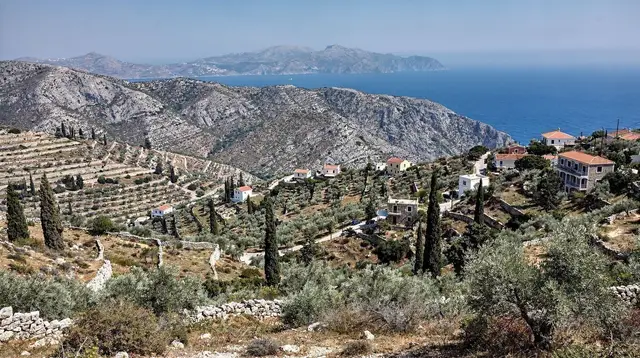
Apokoronas itself is the fertile, hilly strip of land behind this part of the coast, running from the sea up into the foothills of the Lefka Ori, the White Mountains. It takes in Georgioupoli along with Kalyves and Almyrida further west and the villages around Lake Kournas inland. None of these places carry a major historic site or an old quarter of Venetian mansions — that kind of sightseeing belongs to Chania and Rethymno, both within reach for a day out. Apokoronas is a quieter register: beaches, orchards, village life, and a landscape that stays green later into the year than the drier east of the island.
For a traveller building a west-to-east route across Crete, Georgioupoli functions as a natural pause. It breaks up the drive between the two western cities, and its beach gives a reason to stop rather than pass through. It suits a short visit of a night or two far better than it suits a full week as a single base.
Getting There by Car or by KTEL Coach
Reaching Georgioupoli is one of the simpler logistics on the island. By car, it sits about 35-40 minutes east of Chania and 25-30 minutes west of Rethymno along the VOAK, the north coast highway that also carries traffic on to Heraklion and Agios Nikolaos. The village lies just off this main road, close enough that a short detour brings you straight to the beach and the river mouth.
The same corridor is one of the few stretches of Crete where the KTEL coach network genuinely works as a way to get around without a rental car. Services run regularly along the coast between Chania, Rethymno and Heraklion, and Georgioupoli sits directly on that line, with a stop in the village itself.
That makes it realistic to visit for a day from either city, or to stay here and use the coach to reach Chania or Rethymno for sightseeing, without ever needing to drive. This is worth noting, because south of the mountains and away from this coastal spine, public transport on Crete thins out to a handful of seasonal runs — Georgioupoli is squarely inside the part of the island where a car is a convenience rather than a necessity.
That said, most visitors still arrive with a rental car, since it opens up Lake Kournas, the hill villages of Apokoronas and the wider run west to Chania or east to Rethymno on your own schedule. Either approach works; the choice depends on how much of the surrounding countryside you want to see beyond the beach itself.
The Beach: Sand Reaching Away from the River
The core appeal of Georgioupoli is its beach, and it earns the description. Unlike many of Crete’s coves and pocket beaches tucked between headlands, the sand at Georgioupoli runs in a long, mostly uninterrupted stretch that extends well away from the river mouth in both directions — one of the longer continuous sand beaches on this part of the north coast. The width and gentle slope of the sand make it easy to find space even in peak season, and the shallow water near the river mouth in particular suits younger children who need a gradual entry rather than a sudden drop.
Near the river mouth itself, freshwater and seawater mix, and the shaded eucalyptus grove along the riverbank gives a break from direct sun that few Cretan beaches offer so close to the sand. Sunbeds and umbrellas are available on the organised sections, typically in the same €10-20 range found across the island’s beaches, and by Greek law every beach must keep a free stretch and a clear path to the water, so paying for a sunbed is never required to use the beach itself. Blue Flag status is common along this stretch of the north coast, and Georgioupoli’s beach has held that standard in past seasons, reflecting the water quality and beach management along this part of Apokoronas.
What the beach does not offer is drama — no dramatic rock formations, no turquoise lagoon, no pink-tinged sand. It is, straightforwardly, a long, family-friendly sand beach at a river mouth, and that plainness is precisely why it works so well for a short, relaxed stop rather than a bucket-list photograph.
When to Swim: A Season from May to October
The swimming season here follows the same pattern as the rest of Crete’s north coast, running from May through October. Early in the season, from late April into May and June, the sea is still cool by midsummer standards but swimmable, warming to roughly 21-25 degrees Celsius by June. By September, the sea has had a full summer to warm and typically sits at 24-27 degrees, arguably the most comfortable stretch of the year for swimming, paired with softer light and thinner crowds than July or August.
July and August are the hottest months, with air temperatures commonly in the 30-35 degree range, and they are also the busiest and most expensive time to visit Georgioupoli, as they are across the island. The beach fills up, accommodation prices rise, and the village’s small number of tavernas and cafés run at full capacity. Visitors who can shift their trip into June or September generally find a more comfortable balance between warm water and manageable crowds — a pattern worth weighing against Crete’s broader weather calendar when planning dates.
Outside this window, from November through March, Georgioupoli quiets down considerably, in line with what closes across Crete in winter. The sea stays mild by northern European standards but the beach empties of both sunbeds and swimmers, and much of the village’s tourist infrastructure closes for the season.
Lake Kournas: A Short Trip Inland
One of the more distinctive things within easy reach of Georgioupoli is Lake Kournas, Crete’s only natural freshwater lake, sitting a short drive south into the hills of Apokoronas. It is a modest body of water by international standards, but it stands out on an island otherwise defined by its coastline and its gorges — there is nowhere else on Crete quite like it. Turtles and eels live in its waters, a handful of tavernas line the shore, and pedal boats are available for hire in season.
The lake makes a natural half-day pairing with a morning or afternoon at the Georgioupoli beach: swim in the sea, then drive the short distance inland for a change of scenery and a lakeside meal. It is not a large attraction and does not need a full day, which is exactly why it fits comfortably alongside a beach stay rather than requiring its own separate base. Combined with the surrounding villages of Apokoronas, it gives Georgioupoli a modest hinterland to explore beyond the sand, even though none of it rises to the scale of the island’s headline sights.
What Georgioupoli Is — and Isn’t
It is worth being direct about what Georgioupoli does not offer, because expectations set the tone for a short stop like this one. There is no Venetian old town here, no fortress, no archaeological site, and no landmark museum. Travellers looking for that kind of sightseeing should look to Chania’s old town and harbour or Rethymno’s Venetian quarter instead — both are close enough to visit from Georgioupoli in under an hour, which is arguably the more honest way to use the village: as a beach base with two historic cities within easy driving distance, rather than as a historic destination in its own right.
Georgioupoli is also modest in scale compared to the resort strip further east. It has none of the density of bars, clubs and package hotels found around Hersonissos or Malia, and it is considerably smaller than either Chania or Rethymno. That smaller scale is part of its appeal for travellers who want a calmer beach stop, but it does mean a shorter list of restaurants, shops and evening activity — plan accordingly if a lively nightlife scene is part of what you are looking for on this trip.
Day Trips from Georgioupoli
Its position on the VOAK highway makes Georgioupoli a workable base for several day trips, even for a stay of just one or two nights. Chania’s old harbour and market streets sit around 35-40 minutes west; Rethymno’s Fortezza and old town about 25-30 minutes east. Inland and south, the mountain villages and gorges of the Lefka Ori are within reach for a longer day out, including a route toward the Therisso gorge, historically significant as a site of Cretan resistance and now a scenic drive lined with tavernas.
Further afield, the Samaria gorge and the palm beach at Preveli both sit within range of an organised day trip departing from Georgioupoli, given the village’s position between the two national parks. For travellers who would rather not drive the mountain roads themselves, a guided one-day hike through the Samaria gorge departing from Georgioupoli covers the full 16-kilometre descent with transport handled for you, while a bus-and-boat day trip to Preveli’s palm beach reaches the Libyan coast without requiring a rental car.
Those who want gorge scenery on an easier walk might prefer an easier gorge walk at Imbros, a shorter and less demanding route than Samaria. And for the western lagoons, a bus transfer to Kissamos for the Balos lagoon boat cruise covers the long drive out to Kissamos so you arrive ready for the boat rather than behind the wheel.
Georgioupoli Out of Season
The contrast between Georgioupoli in August and Georgioupoli in December is stark, and it is worth planning around honestly rather than discovering it on arrival. Through the winter low season, roughly November to March, a large share of the village’s tavernas, beach bars and small family-run hotels close their doors, following the same pattern seen across Crete’s smaller coastal villages. What remains open does so at a far quieter pace, with the beach largely empty and the river mouth at its most tranquil.
This quiet has its own appeal for travellers who prioritise calm over convenience — an off-season stop here can feel genuinely peaceful, with the mountains behind the village often carrying snow visible from the shore. But it comes with real trade-offs: fewer dining options, shorter opening hours where anything is open at all, and none of the beach infrastructure — sunbeds, watersports, boat trips — that operates in summer. Anyone planning a winter visit to Apokoronas should check specific opening hours in advance rather than assume a summer-season level of activity.
Where to Base Yourself in Apokoronas
For most visitors, Georgioupoli works best as a one- or two-night stop within a longer west-coast route, paired with a base in Chania or Rethymno for the rest of a Crete itinerary. Its strength is convenience: close to the highway, close to Lake Kournas, close to two historic cities, and anchored by a beach long enough to spend a full afternoon on without feeling crowded. Families with young children in particular tend to appreciate the shallow water near the river mouth and the village’s manageable, walkable scale.
Travellers chasing dramatic scenery, historic sites, or an old town to wander in the evening should weight their itinerary toward Chania or Rethymno instead and treat Georgioupoli as what it is: a well-placed, low-key beach stop in the Apokoronas countryside, not a headline destination in its own right.