The Capital of Its Own Corner of Crete
Ask whether Rethymno deserves a stop of its own, or whether it is just the town you pass through between Chania and Heraklion, and the honest answer is that it has been getting asked the wrong question. Rethymno is not a layover — it is the capital of its own regional unit, one of the four that divide Crete from west to east, and its old town holds a mix of Venetian and Ottoman architecture that neither of its larger neighbours quite repeats.
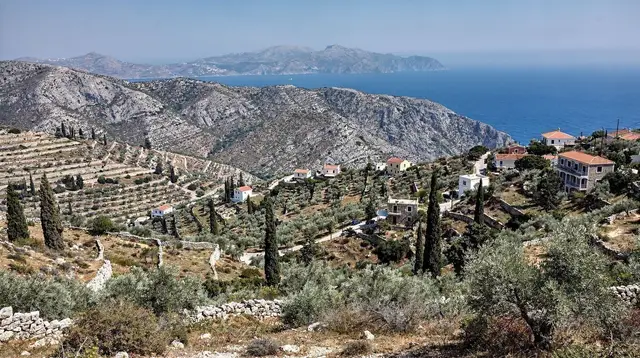
Behind it, the town is also the natural base for a cluster of short excursions inland: the monastery of Arkadi, the pottery workshops of Margarites, and the foothill villages leading up toward Anogia under Mount Psiloritis. None of that is visible from a car window on the coastal highway. It has to be walked, or driven into, on purpose.
This page treats Rethymno as what it is on the map: the middle of three old towns on Crete’s well-connected north coast, with its own character, its own short list of nearby sights, and its own limits. It is not a resort with a beach at the hotel door, and it is not a base from which the whole island is a day trip. Both of those claims get made about it online, and both are wrong.
An Old Town That Layers Venetian and Ottoman, Not Just One
Chania’s harbour reads as Venetian almost end to end — a lighthouse, arsenali, a waterfront built by one power and lightly used by the next. Rethymno’s old town tells a longer story. The Venetians built the core between the 13th and 17th centuries: narrow lanes, stone doorways, the small Rimondi fountain, and the Fortezza, the fortress that still stands over the town rather than surviving as a fragment. When the Ottomans took Rethymno in 1646, more than two decades before they finally took Candia (Heraklion), they built onto that core instead of replacing it.
Minarets rise over Venetian streets, wooden Ottoman-era balconies called sachnisia overhang narrow lanes, and mosques converted from churches sit a few doors from Venetian loggias. A short walk through the guide to the Rethymno old town covers this layering street by street; the Fortezza guide does the same for the fortress itself, which is large enough — and open-air enough — to need its own visit rather than a quick loop.
That two-layer character is Rethymno’s real distinction from Chania and Heraklion, not prettier photographs or a quieter harbour. Heraklion is a working capital city with Knossos as its headline draw; Chania is close to pure Venetian in its old quarter. Rethymno sits in between, both geographically and architecturally, and a page comparing the three directly — Chania vs Rethymno vs Heraklion — is worth reading before deciding where to base a trip.
On the Coastal Axis, Not Off It
One practical point in Rethymno’s favour: it sits directly on the VOAK / E75, the highway that runs the length of Crete’s north coast, and it is one of the stops the KTEL coach network serves well and often. Coaches connect Rethymno with Chania, Heraklion and, with a change, Agios Nikolaos, several times a day in season.
That makes Rethymno one of the easiest towns on the island to reach and leave without a rental car — a genuine exception to the general rule on Crete, where a car is the practical default everywhere south of the mountains. The KTEL buses guide lays out routes and frequencies, and the driving in Crete guide covers the alternative for anyone planning to explore beyond the coast road, where the bus network thins out fast.
That north-coast connectivity is also why Rethymno works well as one stop on a longer, multi-base itinerary rather than a single fixed camp. A route like Crete in 7 days, west to east uses Rethymno as the natural midpoint between a Chania base and a Heraklion or Agios Nikolaos base, and a shorter 2 days in Rethymno itinerary is enough to cover the old town and one inland excursion without rushing either.
What’s Within Easy Reach: Arkadi, Margarites, and the Psiloritis Foothills
The short excursions that make Rethymno worth a dedicated stop, rather than just a photogenic old town, are all inland and all reachable in well under an hour by car.
Arkadi monastery, about 25 minutes south-east of town, is one of Crete’s most visited sites for reasons that have nothing to do with scenery. In 1866, during a Cretan uprising against Ottoman rule, the defenders and refugees sheltering inside chose to blow up their own powder magazine rather than surrender, killing hundreds on both sides. It remains a working monastery today, with the dress code that implies — covered shoulders and knees — and it is treated in Crete less as a tourist stop than as a national memorial. The Arkadi monastery guide covers the visit and the history in full.
Margarites, a further 15 minutes on, is a hillside village that has made pottery for centuries, using local clay and, in some workshops, techniques passed down through the same families for generations. It is a slower stop than Arkadi — a village to wander rather than a site to tour — and it pairs naturally with the monastery on the same half-day out.
Further inland and higher, the road climbs toward Anogia, a mountain village under the northern flank of Mount Psiloritis, at 2,456 metres the highest point on Crete. Anogia has its own difficult history from the Second World War, discussed in the Battle of Crete coverage, and it sits at real altitude — snow lingers on Psiloritis’s upper slopes into May or June in most years, long after the coast has turned into beach weather.
The village is also the trailhead area for hikers heading toward the summit itself; the Psiloritis summit hike guide has the route, the season, and what the ascent actually demands. None of this is a casual add-on to a beach afternoon — it is a shift from coastal Crete to mountain Crete in under an hour’s drive, which is precisely what makes Rethymno a useful base rather than just a pretty stopover.
| Excursion | Distance from Rethymno | What it is |
|---|---|---|
| Arkadi monastery | About 25 min drive | 1866 siege memorial, working monastery |
| Margarites | About 40 min drive | Pottery village, hillside setting |
| Anogia | About 1 hour drive | Mountain village under Psiloritis |
| Psiloritis summit trailheads | 1-1.5 hours drive | High-altitude hike, snow into May/June |
The Beach Question, Answered Honestly
Rethymno does have a beach in town — a long stretch of sand backing the New Town — and it is a genuine, usable urban beach. What it is not is a resort cove with sunbeds stepping straight off a hotel terrace into turquoise water. That picture belongs a little further along the coast, at Panormos to the east or, further still, at Plakias on the Libyan Sea to the south, both under an hour’s drive.
Anyone choosing Rethymno specifically for a resort-style beach at the hotel door is choosing the wrong town; anyone choosing it for a walkable old town with a functional town beach and beach villages a short drive away has the right idea. The same gap in expectations comes up for Hersonissos, Malia and Stalida further east, which are genuinely built around the resort model Rethymno is not.
Rethymno as One Base, Not the Only Base
The clearest limit on Rethymno as a base is distance. It sits at the centre of the north coast, which makes it well placed for its own region and for short hops toward Chania and Heraklion, but the island’s other extremities stay firmly out of day-trip range. The south-west — Samaria gorge, Loutro, Elafonissi — belongs to Chania’s side of the island and is a long day from Rethymno even before factoring in mountain roads.
The east — Agios Nikolaos, Elounda and Spinalonga, Sitia and Vai — is over an hour and a half past Heraklion again. A traveller who plants a single base in Rethymno for a ten-day trip and expects to reach both ends of the island comfortably each day will spend more time on the highway than anywhere worth seeing. The itinerary planning guide how many days in Crete sets out why splitting a longer trip across two or three bases — Chania or Rethymno in the west, Heraklion or Agios Nikolaos in the east — works better than treating any one town, Rethymno included, as a single hub for the whole island.
Booking a Day Out From Rethymno
For visitors who would rather not self-drive every excursion, a handful of organised options run directly out of Rethymno and cover the ground described above without the logistics of parking, fuel or navigating unfamiliar mountain roads.
A walking and tasting itinerary through orchards and villages above the coast is covered by the Rethymno Flower Adventure through the countryside, a slower-paced alternative to a driving day for travellers who want the inland scenery on foot. Those wanting the Psiloritis foothills with a guide rather than a rental car can join the private Patsos gorge trekking day from Rethymno, which reaches a shaded mountain gorge without the driving.
For the two gorges most visitors ask about by name, there is the Imbros gorge hike organised from Rethymno, a shorter and less crowded alternative to Samaria on a day when the bigger gorge’s schedule does not line up. And for a single day that reaches all the way to the Minoan palace and the Lasithi plateau, the full-day Knossos and Lasithi plateau tour from Rethymno covers ground that would otherwise take a rental car and a very long day to link together.
Rethymno Old Town: Frequently Asked Questions
Is Rethymno worth a separate stop, or can it be seen on the way between Chania and Heraklion?
It rewards a stop of its own. The old town takes a full day to see properly, and it is also the base for Arkadi, Margarites and the lower slopes of Psiloritis, none of which fit into a drive-through afternoon.
How is Rethymno’s old town different from Chania’s?
Chania’s harbour is almost entirely Venetian in feel. Rethymno layers a large Ottoman quarter, minarets and wooden Turkish-era balconies over its Venetian core, plus the Fortezza, a fortress that still dominates the skyline rather than sitting as a ruin at the water’s edge.
Can I get to Rethymno by bus from Chania or Heraklion?
Yes. The KTEL coastal route runs along the VOAK / E75 highway and connects Chania, Rethymno, Heraklion and Agios Nikolaos with frequent daily services, making Rethymno the easiest of the north-coast towns to reach without a car.
Is there a good beach right in Rethymno town?
There is a long sandy town beach, but it is an open urban strand backed by the New Town, not a resort cove. For the kind of protected bay or organised beach club many travellers picture, you need to drive out to Panormos or Plakias.
What time zone is Rethymno in?
Eastern European Time, UTC+2 in winter and UTC+3 in summer. That is one hour ahead of Paris, Berlin and Rome, so opening times and boat schedules quoted in central European time need an hour added.
Can I visit the south coast or Agios Nikolaos as a day trip from Rethymno?
Only partly. Plakias and the Libyan coast south of the Psiloritis range are within reach in about an hour, but Agios Nikolaos and the east are well over an hour and a half away, and the Samaria gorge is closer to Chania than to Rethymno.
Is Rethymno a good single base for exploring all of Crete?
No single town is. Rethymno covers its own region and the mountains behind it well, but the far west (Balos, Elafonissi) and the far east (Sitia, Vai) each sit two to three hours away, which argues for splitting a longer trip across two or three bases.
What is the best time of year to visit Rethymno’s old town?
Late April to June and September to mid-October give warm weather without the July-August crowds and heat, and the Psiloritis foothills and gorges nearby are fully open, unlike in winter.