Lake Kournas and the Argyroupoli Springs
What is there to see at Lake Kournas and Argyroupoli in Crete?
Lake Kournas and the springs of nearby Argyroupoli sit inland in the Apokoronas hills between Chania and Rethymno, reached by narrow mountain roads with no rail or reliable coach link. It is a quiet detour rather than a headline sight, best treated as part of a rental-car day between late April and mid-October.
An inland detour, not a headline sight
Between Chania and Rethymno, away from the north-coast highway and the resort strip, the Apokoronas hills hold two low-key stops that keep coming up in the same breath: Lake Kournas and the spring village of Argyroupoli. Neither is the kind of place that anchors a whole itinerary on its own. Both are the sort of thing you fold into a day that already has a destination — a morning in Rethymno’s old town or an afternoon around Chania — rather than a reason to drive out and back for nothing else.
This page is written to stay inside what we can actually confirm. That means no invented figures for the lake’s surface area, depth, or water temperature, and no claims about wildlife or swimming conditions that we have not verified ourselves. Where the honest answer is “we don’t know, check locally,” that is what you will read here, rather than a number that sounds plausible.
Where this fits on the map
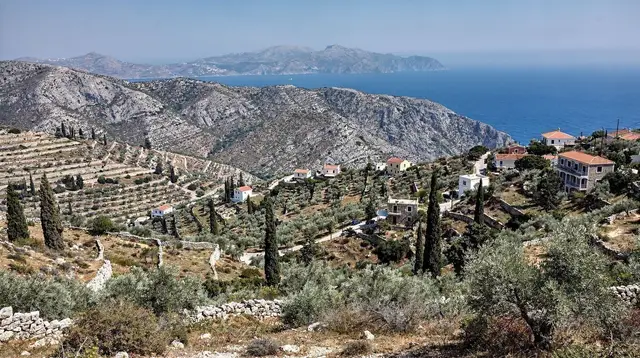
Lake Kournas and Argyroupoli both sit inland, in the belt of hill country that separates the Chania and Rethymno regional units. They are not on the coast, and they are not on the main VOAK/E75 corridor that carries most north-coast traffic — you leave that road and climb into the Apokoronas countryside to reach them, through or near villages such as Georgioupoli and Kalyves and Almyrida, which sit closer to the coast and serve as a more familiar reference point if you are working out where you are on the map.
If you already know the mountain road up to Therisso west of Chania, the character of the roads here is similar in kind, if not identical in route: narrow, winding, shared with local traffic, and not built for speed.
Getting there: what is actually reliable
Crete has no train anywhere on the island, and that includes this stretch of Apokoronas — it is not a gap specific to Kournas or Argyroupoli, it is true everywhere. The KTEL coach network is genuinely useful along the north coast, running Chania to Rethymno to Heraklion to Agios Nikolaos on the main highway, but it thins out fast once you leave that corridor. Inland villages like these are not well served by scheduled coach routes, and we are not going to invent a bus timetable that may not exist in the form we describe it.
In practice, that leaves two realistic ways in:
| Approach | What it involves | Who it suits |
|---|---|---|
| Self-drive (rental car) | Leaving the coastal highway and following secondary roads inland, then narrow village roads | Visitors already renting a car for the island, comfortable with mountain driving |
| Organised tour or private transfer | A driver handles the roads and route-finding, often bundled with a wider Apokoronas stop | Visitors without a car, or who would rather not navigate unfamiliar mountain roads themselves |
For general guidance on the first option, see our pages on renting a car in Crete and on driving in Crete, both of which cover the habits and hazards of Cretan roads in more depth than we will repeat here.
The hard-shoulder habit
One thing worth knowing before you drive this kind of road anywhere on the island: Cretan mountain roads are narrow, and the local habit is for a slower car to pull half onto the hard shoulder so a faster car behind can pass. It is a courtesy, done deliberately, and it is common on the roads into Apokoronas as much as anywhere else inland. Do not read it as an invitation to overtake on a blind bend, and do not assume every driver ahead of you will do it — treat it as something you may be offered, not something you are owed.
If you would rather not do this kind of driving yourself, a guided option removes the decision entirely. A tour built around this stretch of the island, such as the Lake Kournas and Argyroupoli springs day trip from Chania, hands the driving to someone who already knows the roads.
Lake Kournas: what we can and can’t tell you
Lake Kournas comes up often in general lists of things to see in this part of Crete, usually described in loose, superlative terms — “the only,” “the biggest,” “the deepest” — that we are not able to verify to a standard we would publish as fact. So we are choosing not to repeat those claims here. What we can say with confidence is narrower: it is a freshwater lake in the Apokoronas hills, reachable by road, and it functions as a stop on organised tours of the area alongside Argyroupoli.
We are also not going to make claims about swimming conditions, water clarity, temperature, or any wildlife associated with the lake, because none of that is something we have confirmed firsthand and current enough to stand behind. If swimming or wildlife-watching is the reason you would make this detour, treat anything you read elsewhere — including specific temperatures or species claims — as something to confirm locally rather than plan around in advance.
A guided visit that includes the lake as a stop, like the private guided walk around Kournas with transfer, at least puts someone with current, local knowledge in charge of what you actually see and whether the conditions on the day are worth it.
Argyroupoli: a village built on springs
Argyroupoli is generally known as a village organised around a cluster of natural freshwater springs, set under old plane trees on ground that stays shaded and noticeably cooler than the open hillside around it. Beyond that general description, we are not going to attach a specific number — not a flow rate, not an age for the springs, not a count of how many separate outlets there are — because we do not have a figure we trust enough to publish.
What is safe to say is that the village sits in the same general Apokoronas hill country as Lake Kournas, close enough that the two are routinely paired on the same day trip or the same tour itinerary, including some built explicitly around both stops together, such as the eco and nature tour from Rethymno that takes in this stretch of countryside.
When to go: the general Crete pattern applies here too
Nothing about this inland pocket of Apokoronas exempts it from the seasonal pattern that governs the rest of the island. If you want the clearest guidance, our page on the best time to visit Crete covers it in full; the short version, as it applies to a rural, inland stop like this one:
- Late April to June and September to mid-October are the best balance for most visitors — mild enough to be comfortable walking around outdoors, with smaller crowds than midsummer.
- July and August are the hottest stretch of the year, typically 30 to 35 degrees Celsius, and the busiest and most expensive across the island. Shaded ground, like the plane trees at Argyroupoli, is more of an asset in this window than a nice-to-have.
- The meltemi, the strong north wind that blows mainly in July and August, is a north-coast and open-water phenomenon — it affects boat trips to places like Balos or Chrissi far more than an inland village. See our page on Crete in July and the meltemi if wind is a factor in your wider trip planning.
- November to March is the island’s honest low season, and it reaches inland areas too: expect quieter roads, cooler weather, and the possibility that some local businesses are closed for the season. For a month-by-month breakdown, see Crete weather month by month.
Fitting it into a wider day
Neither Lake Kournas nor Argyroupoli works well as a single, isolated errand — the drive alone does not justify the trip on its own terms. They make more sense as one stop within a day that already has a shape: a loop out of Chania or Rethymno that also takes in a coastal village, or a segment of a longer route across the island such as our 7-day west-to-east itinerary, which passes through this general part of the island on its way between the two regions.
If you would rather have someone else assemble that day for you, a private tour built around both stops — for instance the private SUV tour of Lake Kournas and Argyroupoli — removes the route-planning and the driving in one move, which matters more here than on the main coastal roads given how much of the appeal (and how much of the uncertainty) sits in the drive itself.
Practical notes that carry over from the rest of Crete
A few things that are true of Crete generally, and worth keeping in mind on this kind of inland detour specifically:
- No train, anywhere on the island. This is not a gap unique to Apokoronas; it applies island-wide, so do not expect to find a rail option here that does not exist elsewhere.
- Coach coverage thins inland. KTEL buses are reliable on the north-coast corridor and weaker once you leave it — plan on a car or a transfer rather than assuming a scheduled service will get you there and back on a convenient timetable.
- Mountain-road courtesy, not mountain-road speed. The hard-shoulder habit described above is common on these roads; treat it as courtesy offered and returned, not as licence to drive faster than the road allows.
- We are not publishing a price or an opening time for either site. Fees, seasonal closures, and access arrangements change, and neither the lake nor the springs functions like a ticketed monument with a single official gate — confirm current details locally, or through whoever operates your transfer or tour, before you build a schedule around them.
FAQ: visiting Lake Kournas and the Argyroupoli springs
Where exactly are Lake Kournas and Argyroupoli?
Both sit inland in the Apokoronas hills, in the belt of countryside between the Chania and Rethymno regional units, away from the north-coast highway and the coastal resorts.
Can I reach Lake Kournas or Argyroupoli without a rental car?
It is harder than reaching the coastal towns. KTEL coach coverage is solid along the north coast but thins inland, so a rental car or an organised tour/transfer is the practical route for most visitors.
Is it possible to swim at Lake Kournas?
We are not stating a water temperature, depth, or safety claim here, because we do not have a verified current figure. Check conditions locally before assuming anything about swimming.
What is Argyroupoli known for?
It is generally known as a village built around natural freshwater springs under old plane trees. We do not have a verified figure for the springs’ flow, age, or number of outlets, so none is given here.
Are the roads to this area difficult to drive?
They are narrow mountain roads, typical of inland Crete. The local habit is for a slower vehicle to pull onto the hard shoulder to let a faster one pass — a courtesy, not an invitation to overtake blind.
When is the best time to visit?
The same window that works across Crete: late April to June and September to mid-October for the best balance, avoiding the 30-35°C heat and crowds of July and August.
Is there an entrance fee or fixed opening time?
We are not publishing a specific price or opening hour for either site, since neither operates like a single ticketed monument and details change. Confirm locally or with your tour operator.
Can this be combined with a day out of Chania or Rethymno?
Yes, in general terms — both places sit within a plausible day-trip radius of either city. We are not attaching an exact driving time, since it depends on your starting point and the state of the road on the day.
Popular Crete Tours on GetYourGuide
Verified deep-linked GetYourGuide tours. Book through these links and we earn a small commission at no cost to you.
GetYourGuide does not provide a product photo for this activity — the image shows the meeting point, photographed by us.