Imeri Gramvousa: A Venetian Fortress on a Desert Islet
What is there to see on Imeri Gramvousa?
A roofless Venetian fortress built in 1579, standing on the summit of an uninhabited islet off Kissamos. There is no village, no restoration, and no shade beyond the fortress walls themselves. Boats from Kissamos land at a small jetty below and combine the visit with time at Balos lagoon on the same trip.
Where Imeri Gramvousa Sits Off the Kissamos Coast
Imeri Gramvousa is a small, uninhabited islet at the north-western tip of Crete, guarding the entrance to the bay that shelters the Balos lagoon. It sits a short crossing off the coast near Kissamos, the port town that is the practical starting point for nearly every visit — whether by sea or, for Balos alone, by the long dirt track described below. The islet has no permanent population, no facilities beyond a small jetty, and a single reason most people climb it: a Venetian fortress that has stood on its summit since 1579.
This guide treats Imeri Gramvousa on its own terms, separate from the lagoon it is usually paired with. If you are weighing the sand-and-water side of the trip, the dedicated Balos lagoon guide covers that in depth. Here the focus is the islet itself: the fortress, the climb, the boat that gets you there, and the road that does not.
The 1579 Venetian Fortress on the Summit
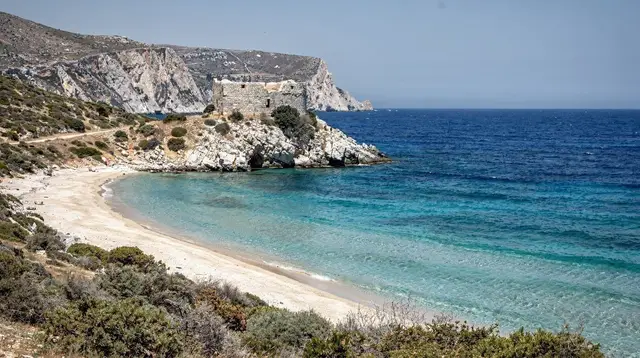
The fortress on Imeri Gramvousa was built by the Venetians in 1579, during the final stretch of their long hold on Crete, to guard the strait between the islet and the mainland and to give the Venetian fleet a lookout and refuge at the island’s exposed north-western corner. It is worth being clear about what that means in practice today: this is a ruin, not a restored monument. There is no roof, no rebuilt interior, no lighting, and nobody living inside its walls. What remains is stone perimeter walls, gun positions, cisterns and the footprint of buildings that once stood within them, all open to sun, wind and rain exactly as they have been for centuries.
That exposure is part of what makes the place worth the climb. Standing inside the walls, the view runs south over the turquoise water of the Balos lagoon and north across open sea toward the small island of Antikythira and, on a clear day, further still. The fortress changed hands from Venetian to Ottoman control in the later Ottoman conquest of Crete, and it saw use again in the nineteenth century during Cretan uprisings, when Gramvousa’s isolation made it a useful refuge.
None of that history is signposted in any elaborate way on site — there is little interpretive material on the islet itself — so it helps to arrive already knowing what you are looking at. Readers who want the wider context of Venetian Crete, roughly 1204 to 1669, will find it laid out in the guide to Venetian Crete, and the harbour fortifications the same rulers left in Chania town make a useful comparison a day or two later, described in the Chania Venetian harbour guide.
The climb from the jetty to the fortress gate is steep and unshaded, on a stone path that is uneven in places rather than a formed staircase. Most visitors take 20 to 30 minutes to reach the top, and the same again coming down, though pace varies a great deal with fitness and the midday heat. There is no water source and no shop on the islet, so what you carry up is what you have — sturdy shoes and a hat matter here more than at almost any other stop in this corner of Crete.
Getting There: The Boat from Kissamos
Imeri Gramvousa has no bridge, causeway or any other land connection to Crete. The only way onto the islet is by boat, and the boats that serve it depart from Kissamos, the port town on the northern coast that anchors this whole corner of the island. A typical excursion boat runs a combined route: it calls first at the Gramvousa jetty, giving passengers time to climb to the fortress, then continues on to anchor off the Balos lagoon for swimming time, before returning to Kissamos later in the day. This guide deliberately avoids naming a specific departure time or operator — schedules shift by season and by company, and the practical way to check current timings is at the point of booking rather than from a fixed figure printed here.
a combined day excursion by boat to both the Gramvousa fortress islet and the Balos lagoon is the standard way most visitors do this trip, and it removes the need to think about the dirt road at all. Travellers who would rather set their own pace, or who are travelling as a smaller group, can look at a private midday cruise that spends around six hours between Gramvousa and the Balos lagoon, which allows more flexibility around how long to spend on the islet itself.
For those who want snorkelling gear built into the day rather than arranged separately, a speedboat cruise from Kissamos to Balos and Gramvousa with snorkelling included covers both the fortress stop and time in the water.
Sea conditions matter on this stretch of coast more than on the sheltered north shore further east. The prevailing summer wind here, the meltemi, blows hardest in July and August and can cancel or reroute boats to both Gramvousa and Balos with little notice, since the crossing runs through open, exposed water rather than a protected bay. That is worth building into any plan that has a flight or a ferry booked for later the same day — treat a Gramvousa and Balos trip as weather-dependent, not as a fixed appointment.
Why the Dirt Road Is Not a Free Alternative
It is tempting to look at a map, see that Balos and the coast opposite Gramvousa are reachable by road, and assume that driving there is simply the free version of the boat trip. That assumption skips an important distinction: the road reaches a viewpoint above Balos lagoon, not the islet of Imeri Gramvousa. There is no road route onto the fortress at all — the boat from Kissamos is the only way to set foot on the islet, whatever a rental car can or cannot manage.
Even setting that aside, the road itself deserves a clear-eyed look before anyone treats it as the economical choice. The final stretch in from the paved network is roughly 8 kilometres of unpaved, rutted track, followed by a walk down to the lagoon shore and back up again that takes most people 20 to 30 minutes each way, on top of the driving. Most standard rental car agreements in Crete specifically exclude unpaved roads from their insurance cover.
That is not a minor technicality: it means a puncture, a suspension knock, a scrape against rock, or a genuine accident on that track is very often not covered, and the financial exposure falls on the driver rather than the rental company. Full detail on how that exclusion typically works, and what it means for a claim, is in the guide to the Balos road and rental insurance, and the wider mechanics of Cretan car hire terms are covered in the renting a car in Crete guide.
Framed against that, the boat from Kissamos is not a premium upgrade over a free option — it is the way most visitors reasonably reach this coast at all, since it is the only way to reach Gramvousa and it removes the uninsured risk of the dirt track for those who only want Balos. Travellers who are drawn to a rougher, dedicated off-road route for its own sake, with a driver who knows the track, can look at a guided off-road excursion from the Chania and Kissamos area to Balos rather than attempting the drive in a standard rental car. General notes on driving conditions elsewhere on the island are in the driving in Crete guide.
Combining the Fortress and the Lagoon in One Day
Because nearly every boat from Kissamos runs a Gramvousa-and-Balos combination, the practical question for most visitors is not whether to combine them but how to divide the time once aboard. A rough pattern worth planning around: allow closer to an hour, once the boat has moored, for the climb up to the fortress, time inside the walls, and the climb back down, since the path is slow going in heat. That leaves the remaining time at anchor for the lagoon itself — swimming, the shallow sandbar area, and the pink-tinged sand that gives Balos its reputation, covered in full in the Balos lagoon guide.
Travellers weighing whether Balos or Elafonissi fits their trip better, since both sit in the same south-western corner of Crete and both get compared constantly, will find a direct comparison in the Balos versus Elafonissi guide; the short version is that a Gramvousa fortress visit is only on offer from the Balos side, since Elafonissi has no equivalent islet or fortress attached to it.
Those who would rather spend a sunset on the water than a full day can look at a private afternoon cruise toward Balos and Gramvousa on a smaller boat, which trades the earliest and latest hours for a shorter, later window.
For a base, Kissamos itself works well for an early departure and is covered in the Kissamos town and port guide; travellers staying further east around Chania should expect a transfer time before the boat even leaves the dock, which most excursions build into their published length.
Anyone assembling a wider western Crete plan around this stop can see how it slots into a short trip in the three-day west Crete itinerary, alongside the beach at Falassarna, covered separately in the Falassarna sunset beach guide — a much easier, paved-road alternative for an evening if a boat day has already used up the schedule.
What to Bring and What to Expect on the Islet
There is no shade structure, kiosk or shop on Imeri Gramvousa beyond the fortress walls themselves, and no fresh water source. Everything needed for the climb — water, sun protection, closed shoes rather than sandals — needs to come from the boat. The path underfoot is uneven natural stone rather than a maintained staircase, and it can be slippery where it is worn smooth, so the climb is not well suited to anyone unsteady on their feet or travelling with very young children who cannot manage 20 to 30 minutes of steep walking each way.
Inside the fortress, the ruined state of the walls means there are drops and unguarded edges in places, so supervision matters more here than at a paved viewpoint. What visitors are rewarded with, in exchange for the effort, is one of the more striking views on this coast: the pale turquoise water of Balos below, the open Cretan Sea beyond, and stone walls that have stood since the late sixteenth century with almost nothing added or taken away since.
For travellers building out the rest of a west Crete stay, the things to do around Balos and Gramvousa hub lists the wider set of boat trips, snorkelling stops and combined excursions that run out of Kissamos, including options such as an evening wine tasting and food pairing at Falassarna beach for a very different kind of day once the boat trip is behind you.
Questions About Imeri Gramvousa and the Boat from Kissamos
Can you visit Imeri Gramvousa without going to Balos?
In practice the two are visited on the same trip. Boats from Kissamos typically call at both the Gramvousa jetty and the Balos lagoon shore, and the dirt road option leads only to Balos, not to the islet.
Is Imeri Gramvousa fortress restored or open at night?
No. It is a Venetian ruin from 1579, open to the sky and the weather, with no roof, no lighting and no accommodation on the islet. Visits happen during the hours the boats operate, by daylight.
Is the walk up to the fortress difficult?
It is a steep, exposed climb on uneven stone paths with no shade, usually taking 20 to 30 minutes each way. Sturdy shoes, water and a hat matter more here than on most Crete beach stops.
Can I drive to Imeri Gramvousa?
No. The islet has no bridge or causeway. The only way onto Imeri Gramvousa is by boat from Kissamos; a rental car can only get you to the Balos viewpoint by the dirt road, and even that route never reaches the islet itself.
Is the Balos dirt road a cheaper alternative to the boat?
It avoids a boat ticket, but it is not a safe substitute. The road is roughly 8 kilometres of unpaved track that most rental agreements exclude from cover, so a breakdown or accident there is typically uninsured, and the road does not reach Gramvousa at all.
How long does a Gramvousa and Balos boat trip take?
Most itineraries run the better part of a day once transfer time from Chania or Kissamos is included, with stops at both the fortress islet and the Balos lagoon shore. Exact timings vary by operator and season.
Balos & Gramvousa Tours on GetYourGuide
Verified deep-linked GetYourGuide tours. Book through these links and we earn a small commission at no cost to you.
GetYourGuide does not provide a product photo for this activity — the image shows the meeting point, photographed by us.