Falassarna Sunset Beach: Is It Really Crete's Best?
Is Falassarna really the best sunset beach in western Crete?
Falassarna's long, pale sweep of sand and its open west-facing horizon make it a genuine contender, close to Kissamos and Balos. But it is an organised beach with sunbed rows and a road behind it, not an empty cove, and the meltemi wind can rough up the sea and haze the horizon in July and August. Late spring and September give it the best odds of a clear, calm evening.
A West-Coast Beach, Not a Postcard Guarantee
Ask around Chania for the best sunset in the region and Falassarna comes up more than any other name. It is a fair reputation, earned by geography as much as by beauty: this is one of the few stretches of western Crete where the coast faces almost due west, open to the horizon with nothing blocking the last hour of light. But a reputation like that gets repeated so often it starts to sound like a guarantee, and it isn’t one.
Falassarna is a real place, with a road behind it, sunbed rows on part of the sand, and a wind pattern that can flatten the whole effect on the wrong evening. This page tries to give you the honest version: where it sits, what the sand actually looks like, what a chair costs, and when the sea and sky are actually likely to cooperate.
Where Falassarna Sits, Between Kissamos and Balos
Falassarna belongs to the far west of Crete, in the Chania region, a short run past the town of Kissamos on the road that continues on toward the boat departure point for Balos and Gramvousa. It is not a detour from that route so much as a stop along it, which is why most visitors fold it into a single day rather than driving out for it alone. It sits under an hour from Chania town by car on the north coast road, considerably closer than Elafonissi at the island’s south-west corner, which helps explain why Falassarna, rather than Elafonissi, is the sunset beach most people from Chania actually reach on a weeknight.
The bay itself is broken into a few connected coves rather than one unbroken strip, backed by low dunes and a scatter of tavernas and small hotels rather than a resort strip. Just inland, easy to miss from the road, are the low stone remains of ancient Falassarna, a Hellenistic port city. Around the fourth century AD a great earthquake lifted this stretch of the Cretan coastline by several metres, and the harbour that once served ships now sits stranded well back from the modern shoreline — a reminder that this coast has been reshaping itself long before anyone came here for a sunset photograph.
Sand, Colour and What “Best” Actually Means
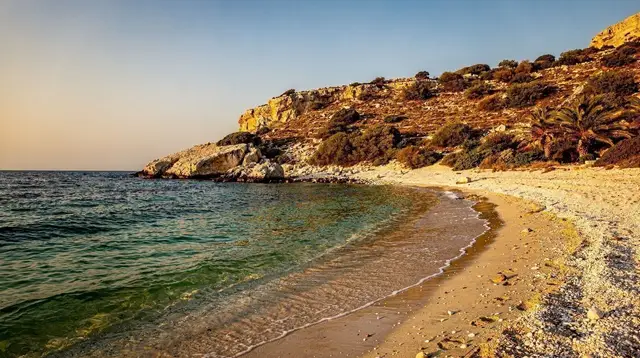
The sand at Falassarna is pale and coarse, closer to a warm gold than the near-white of Elafonissi or the pink-tinged patches Elafonissi is known for. It is worth saying plainly: Crete is not a volcanic island. There is no caldera here, no black or dark volcanic sand anywhere on the coast, and Falassarna’s pale colour comes from crushed shell, coral and limestone, not basalt. If a photo of Falassarna looks unusually bright or saturated, treat it the way you’d treat any beach photo on a clear afternoon — flattering light, not a different beach.
What “best sunset beach” really measures here is orientation and openness, not sand colour. Falassarna faces close to due west across open sea, with no headland or island close enough to block the horizon, which is genuinely rarer on this coastline than it sounds — much of Crete’s north shore faces north or north-east, and the dramatic west-facing coves further south, like the boat-only bay at Loutro, are hard to reach for an evening trip. Falassarna’s advantage is that this open horizon comes with a paved road and parking, not a hike or a boat.
Sunbeds, Umbrellas and the Law on Every Organised Beach
Parts of Falassarna are run as an organised beach, with rows of sunbeds and umbrellas set out by the tavernas and hotels behind the sand. A set for the day typically runs somewhere in the €10 to €20 range, depending on the season and how close you are to the water. That is a guideline, not a fixed number — prices vary taverna to taverna and rise in August.
What does not vary is Greek beach law, and it is worth knowing before you set foot on any organised stretch of coast in Crete, not just here: every beach must keep a free public strip where anyone can lay a towel without paying, and a clear, unobstructed corridor down to the water that no row of sunbeds is allowed to block.
Falassarna, Elafonissi and every other organised beach on the island are required to follow the same rule. If a section looks fully claimed by sunbeds with no way through, that is a beach not following the law rather than the law not applying. For the fuller picture of how this works and what to do if a beach ignores it, see the guide to sunbed rights on Cretan beaches.
| Section | What to expect | Rough cost |
|---|---|---|
| Organised rows near the tavernas | Sunbeds and umbrellas, shade, drinks service | €10-20 per set, per day |
| Free public strip | Guaranteed by law on every organised beach | No charge |
| Quieter northern and southern coves | Fewer or no sunbeds, more open sand | No charge |
The Meltemi: Why July and August Can Ruin the View
The single biggest threat to a good Falassarna sunset isn’t crowding, it’s wind. The meltemi is a strong, dry wind out of the north that blows through the Aegean and along Crete’s coasts mainly in July and August. It is the same wind that regularly cancels the boat trips to Balos lagoon and Imeri Gramvousa on the worst days, because a hull-side landing at Gramvousa gets genuinely unsafe in a strong blow.
On a west-facing beach like Falassarna, a meltemi day means a choppier sea, sand blown around the open stretches, and — for the sunset specifically — a hazy, dust-laden horizon that dulls the colour just when you want it sharpest. It doesn’t blow every single evening in July and August, but it is common enough that a clear, calm sunset can’t be counted on in peak summer. For more on how this wind pattern shapes an entire trip, not just one evening, see what the meltemi does to your holiday and the month-specific notes in Crete in July and the meltemi.
Best Months for a Calm Sea and a Clear Horizon
If a calm, clear Falassarna sunset matters more to you than warm sea, aim outside the two peak meltemi months. Late April through June, and September into early October, are the better bets: the wind pattern is gentler, the sea is closer to swimmable already, and the beach itself is noticeably less crowded than in August.
| Period | Sea temperature | Meltemi risk | Crowds |
|---|---|---|---|
| Late April-June | 21-25 °C | Low | Light to moderate |
| July-August | Warmest, but windiest | High | Heavy |
| September | 24-27 °C | Lower than midsummer | Moderate |
| October | Cooling | Low | Light |
None of these windows change the underlying honesty of the situation: even in the calmest month, a given evening can still bring in cloud, haze or a stiff onshore breeze. Treat any of these months as better odds, not a booking guarantee.
Getting There from Chania, Kissamos and Balos
Falassarna is a paved-road beach, which sets it apart from Balos in one practical way: you can simply drive there, park, and walk onto the sand, no dirt track and no boat required. From Chania town it’s a straightforward run along the north coast past Kissamos, and most car-based visitors combine the two, or extend the loop toward the Balos boat departure point on the same afternoon. For a look at whether a hire car or an organised tour suits your trip better, see renting a car in Crete.
If you’d rather not drive, or want the sunset timing handled for you, an organised pickup removes the guesswork of when to leave. A timed pickup tour from Chania that gets you to the beach for golden hour takes care of the return drive on unlit rural roads after dark, which is worth factoring in even if you have your own car.
Travellers basing themselves further out, closer to Balos or Kolymvari, can instead combine both stops in one outing with a private day that pairs the Balos lagoon with an afternoon and sunset at Falassarna, which avoids doubling back along the same road twice in one week.
Watching the Sunset: What to Expect, Realistically
Arrive with an hour or more to spare. The beach fills up in the last two hours before sunset in high season, and the best unobstructed spots — away from the sunbed rows, close to the waterline — go early. Bring water and a light layer; even in August, the wind off the sea picks up as the sun drops, and the meltemi, when it’s blowing, makes that noticeably stronger here than on a sheltered north-coast beach.
Resist the urge to plan a trip around a sunset with nothing else built in. Some evenings the sky is genuinely spectacular — deep orange fading through violet, the water gone still and mirror-flat. Other evenings it’s a flat grey smear behind haze, or the wind is kicking up enough spray that nobody’s lingering on the sand. Both are normal for this coast. If the sunset is the entire reason for the trip, a organised sunset evening that includes free sunbed use while you wait for the light at least guarantees a comfortable spot regardless of how the sky performs.
For travellers who want the moment on the water rather than the sand, a boat gives a different angle on the same light, and a different set of odds on the wind — worth checking the boat options in Balos lagoon: boat or road before deciding between a beach evening and a cruise.
Beyond the Sunset: Things to Do Nearby
Falassarna rewards more than one visit if it’s on your route more than once. Beyond the tavernas and swimming, the ruins of ancient Falassarna are a short, free stop worth ten minutes if you’re curious about the earthquake-lifted harbour mentioned above. For an active afternoon before the evening light, options nearby range from watersports to a private sunset cruise that loops past Gramvousa fortress before the light drops, weather and wind permitting on the day.
Comparisons come up constantly on this coast, and it’s worth being clear-eyed about them: Falassarna is not Elafonissi, and Balos is not either — each has a different mix of sand, access and crowd pattern. The side-by-side in Balos versus Elafonissi is a useful read if you’re trying to choose one beach day rather than three, and for the wider question of how this coast compares to the island’s other shoreline, see north coast versus south coast Crete.
Travellers building a full west-Crete route from scratch can start with the three-day west Crete itinerary, which slots Falassarna in alongside Kissamos, Balos and Chania rather than treating it as a stand-alone trip.
Booking a Tour or Going Independently
Most visitors do Falassarna independently: drive out, pay for a sunbed or find the free stretch, watch the sunset, drive back. That works well if you have a hire car and don’t mind the return drive after dark. The case for booking something instead is mainly logistical — no car, a base further out near Kissamos or Balos where a loop tour saves backtracking, or simply wanting the pickup and drop-off handled so nobody has to skip the wine with dinner because they’re driving home.
Day-trip pickups such as a Falassarna beach day trip with hotel pickup from Chania cover the daytime version of the same beach, useful if sunset timing doesn’t fit your schedule but you still want to see the sand and the ruins.
Whichever way you get there, keep the two honest caveats from this page in mind: the sunbeds cost roughly €10-20 and the free strip is always there by law, and the sky itself is never guaranteed — especially in a meltemi-blown July or August evening. Falassarna earns its reputation often enough to be worth the trip. It just isn’t owed to you on any single night.
Falassarna Sunset Beach: Your Questions Answered
Is Falassarna beach sand or pebbles?
Sand, pale and coarse rather than the fine powder further south. It is not volcanic sand — Crete has no volcanic geology — and the paler patches are shell and coral fragments, not basalt.
How far is Falassarna from Kissamos and from Balos?
Falassarna sits a short drive south-west of Kissamos, on the same stretch of coast that leads on to the Balos and Gramvousa boat departure point, so the three are usually visited as one loop rather than three separate trips.
Do you have to pay to sit on Falassarna beach?
No. Greek law requires every organised beach to keep a free public stretch and a clear corridor to the water, so you can always lay a towel for nothing. A sunbed and umbrella set on the organised sections typically runs in the €10 to €20 range for the day.
Does the meltemi affect Falassarna?
Yes. This is a west-facing coast, and the meltemi, a strong north wind that blows mainly in July and August, can roughen the sea here and hazes the sunset, and it is also the wind that cancels boat trips to Balos and Gramvousa on the worst days.
Is the sunset at Falassarna guaranteed to be spectacular?
No. On a clear, calm evening it can be genuinely beautiful, but summer haze, meltemi cloud on the horizon, or a windy sea can flatten the effect on any given night. Nobody can promise you a postcard sunset here.
Is Falassarna beach ever quiet?
Not in July and August, when it draws day-trippers from Chania and Kissamos alongside its own small resort. Late April to June and September into early October are noticeably calmer, and the beach empties out almost entirely from November to March.
Can you drive to Falassarna, or do you need a boat?
You drive. Unlike Balos, which needs a dirt track or a boat, Falassarna is reached on a paved road and has parking near the beach, which is part of why it is easier to fit into an afternoon than Balos or Gramvousa.
Beach Tours in Crete on GetYourGuide
Verified deep-linked GetYourGuide tours. Book through these links and we earn a small commission at no cost to you.
GetYourGuide does not provide a product photo for this activity — the image shows the meeting point, photographed by us.