Kissamos: Crete's Gateway to Balos and Gramvousa
What is Kissamos for, and why do visitors go there?
Kissamos is a small port town in western Crete, the main departure point for boat trips to the Balos lagoon and the fortress islet of Imeri Gramvousa, and a ferry link toward Kythira and Antikythira. It is a base for a morning on the water, not a resort or a volcanic sight.
Where Kissamos Sits on the Coast
Kissamos sits at the far north-western corner of Crete, in the Chania region, roughly 40 km and about 40 to 45 minutes by car from Chania town. It occupies a wide, gently curved bay looking north across the Cretan Sea, with the Rodopos peninsula to the east and the Gramvousa peninsula, ending in the dirt track to Balos, stretching away to the west. Most travellers who mention Kissamos are not talking about the town itself but about its port, the departure point for the most photographed day trip in western Crete: the boat to Balos lagoon and Imeri Gramvousa.
It is worth being honest about what Kissamos is and is not. It is not a volcanic landscape, it has no thermal springs, and while it has a town beach, it is not a beach resort on the scale of Platanias or Agia Marina closer to Chania, nor of Falassarna a short drive south-west. Kissamos is, first and foremost, a point of passage: a place travellers pass through, board a boat from, or catch a ferry from, rather than a destination that fills a week on its own.
The Port: Boats to Balos and Imeri Gramvousa
The port of Kissamos is the reason most visitors come. From here, tour boats run out along the Gramvousa peninsula to two connected sights: the fortress islet of Imeri Gramvousa and the shallow, pale-blue Balos lagoon behind it. A typical outing combines both in one morning or half-day, with time to climb up to the Venetian fortress, built in 1579 to guard this corner of the island, and time to wade into the lagoon itself.
a port boat cruise from Kissamos to the Balos lagoon is the most straightforward way to see both sights without touching the unpaved road described below. Boats generally take several hours round trip and land passengers directly at the lagoon’s edge, which is otherwise a walk down from the car park above.
Travellers who prefer a smaller or more specialised boat have other options departing the same port. A shorter option, useful for anyone tight on time, is a shorter, lower-cost cruise to Balos lagoon that trims the visit to about four hours rather than a full day. For travellers who want their booking to support local conservation work on the peninsula, there is also a Balos and Gramvousa cruise run in partnership with a conservation cause, covering the same route.
None of these boats run to a schedule this page can responsibly quote — departure times, operators and exact fares shift by season and by boat, and printing a specific hour or euro figure here would be a guess dressed up as fact. Check the current timetable and price when booking, and treat any hour you read elsewhere as provisional until confirmed.
The Balos Road: Why Most Visitors Skip It
There is a land route to Balos, and it deserves a clear warning rather than a casual mention. From the village of Kaliviani, a dirt track runs roughly 8 km out to a car park above the lagoon, followed by a 20 to 30 minute walk down a rough path, and the same walk back up in the heat. The track itself is manageable in a suitable vehicle, but the detail that matters is contractual, not scenic: most standard rental car agreements in Crete explicitly exclude unpaved roads from coverage. A puncture, a stone chip or a minor accident out there can leave a driver personally liable for repair or damage costs that travel insurance and the rental company’s own cover will not touch.
That is precisely why the boat from Kissamos exists as the recommended alternative, and why this guide treats it as the default rather than an option among equals. For travellers who do want the overland route, whether for the drive itself or because a boat is not sailing that day, an off-road bus service removes the insurance question entirely: a daily off-road bus from Kissamos out to Balos beach covers the dirt track in a vehicle built for it, with a driver who knows the road.
A guided jeep alternative covering both this coastline and the beach at Falassarna is also available as a jeep safari linking Balos lagoon and Phalassarna bay, useful for travellers who want the off-road experience with someone else driving. For the fuller picture of which approach suits which traveller, see the dedicated comparison of the boat versus the road to Balos.
Kastelli’s New Airstrip Is Not the Port
One confusion is worth heading off directly, because the two names sound close enough to cause real trouble when planning a trip. A new international airport is under construction at Kastelli, inland from Kissamos and not far from it as the crow flies. It is not open. As of this review, no commercial flights land there, no visitor can fly into Crete through Kastelli, and nothing about the port of Kissamos changes because of it.
Travellers flying to the island still arrive through Chania airport or Heraklion airport, and should plan transport from one of those two exactly as they would today. If a booking, a map or a search result mentions “Kastelli airport” as though it were operating, treat that as outdated or mistaken information, not a shortcut worth chasing.
When the Meltemi Cancels the Boats
Western Crete’s most disruptive weather pattern is the meltemi, a strong, sustained wind out of the north that is most frequent and most forceful in July and August, though it can appear in other months too. It matters enormously for anyone planning a Balos or Gramvousa trip from Kissamos, because these crossings run along an exposed north-facing coast that the meltemi hits directly. When it blows hard, operators cancel sailings to Balos and Gramvousa for safety, sometimes for a full day or more at a stretch.
The frustrating part is that this cancellation can happen on an otherwise clear, sunny day, which is why it catches travellers off guard. The wind does not touch every coast equally: while the north is closed to boats, Crete’s south coast, on the Libyan Sea, is often calm at the very same time. Travellers visiting in peak summer should build in flexibility rather than anchoring a single irreplaceable day to this excursion, and should expect an operator’s cancellation call to arrive on short notice rather than days in advance. For a fuller picture of how this wind shapes a whole visit, see the guide to Crete in July and the meltemi.
Ferries Toward Kythira and Antikythira
Beyond the Balos day boats, Kissamos also functions as one of western Crete’s seasonal ferry ports, with links running north toward the small islands of Kythira and Antikythira. This is a different service from the tourist cruises to Balos: it is a point-to-point ferry connection, used by a mix of islanders and travellers extending a trip beyond Crete itself, and it runs on its own seasonal pattern rather than a daily tourist schedule.
Anyone planning to use it should confirm the current timetable directly with the ferry operator rather than relying on a fixed date printed here, since island ferry schedules shift between seasons. For the bigger picture of how Crete connects by sea, including the overnight routes from Piraeus, see ferries to Crete.
Kissamos Town Itself
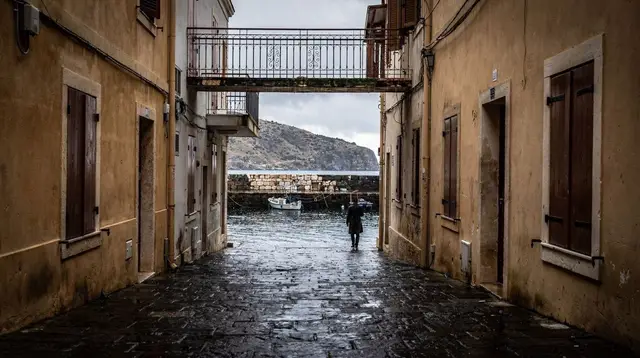
Away from the port, Kissamos is a low-key, workaday Cretan town rather than a curated tourist stop. Its waterfront has a run of tavernas facing the bay, useful for a meal before or after a boat trip, and a town beach that is serviceable rather than remarkable next to what lies further along this coast. The town sits near the site of ancient Kissamos, and a small archaeological collection in town reflects that older layer, though it is a modest stop measured in tens of minutes, not hours.
Travellers based here for a night or two typically use Kissamos as a staging point for a short list of nearby sights rather than for the town’s own attractions: the boat to Balos and Gramvousa, the long sandy sweep of Falassarna a short drive south-west, and the inland villages of the Topolia and Elos area if there is time to explore further into the hills.
Where to Base Yourself
Most independent travellers weigh Kissamos against basing in Chania and driving out for the day, and the honest answer depends on how many mornings a visitor plans to spend on this side of the island.
| Base | Distance to Kissamos port | Best for |
|---|---|---|
| Chania town | About 40 km, 40-45 min drive | One or two day trips west, otherwise stay in Chania for its old town and food |
| Kissamos itself | On site | An early boat departure, or a night either side of visiting Falassarna and the west |
| Platanias / Agia Marina | About 55-60 km, under an hour | Beach-focused stays that still allow a west-coast day out |
A single night in Kissamos mainly pays off for an early departure on a Balos boat, avoiding a pre-dawn drive from Chania, or for travellers working their way anticlockwise around the island who want to break the drive rather than double back.
Getting to Kissamos
The coast road linking Chania to Kissamos is a straightforward, well-maintained drive, and it is by far the most common way travellers arrive. Renting a car gives the most flexibility for combining the port with Falassarna or the inland villages on the same day; see also the general notes on driving in Crete for how mountain roads and overtaking etiquette work here. A KTEL coach service also runs along this stretch of the north coast, usable for travellers going to Kissamos without a car, though schedules thin out compared with the busier Chania-Rethymno-Heraklion corridor.
Booking a Boat or Tour from Kissamos
Several options depart from or operate around the port, beyond the ones already mentioned above. A shorter, more flexible route for a small group is a private catamaran booking, and travellers who prefer sailing under their own charter rather than a shared boat can look at cruises operating from this stretch of coast more broadly, including sunset sailings later in the day. Anyone weighing the trip against inland alternatives, such as a countryside and village tour rather than a day on the water, can compare it against a traditional villages tour departing the same town.
Whichever option is booked, two practical habits serve travellers well here: confirm the sailing the evening before or the morning of departure, since meltemi cancellations can arrive with little warning, and arrive at the port with time to spare, since parking near the harbour fills up quickly on a clear July or August morning when every boat is running.
Kissamos Port FAQ: Boats, Balos and the Kastelli Confusion
Is Kissamos the same as the new Kastelli airport?
No. Kastelli’s new airstrip is being built inland, not at the port, and it is not open to any traffic. No visitor can fly into Crete through Kastelli today; travellers still land at Chania or Heraklion.
Should I drive to Balos or take the boat from Kissamos?
The boat from Kissamos is the sane default for most visitors. The road to Balos is an unpaved track of roughly 8 km, and most rental car contracts exclude unpaved roads, so any breakdown or accident there is uninsured.
Can the meltemi wind cancel boats to Balos and Gramvousa?
Yes. The meltemi, a strong north wind common in July and August, regularly cancels sailings to Balos, Gramvousa and other exposed north-coast crossings while leaving Crete’s south coast calm.
What is Imeri Gramvousa, and can I visit it from Kissamos?
Imeri Gramvousa is a small islet off the north-west tip of Crete with a Venetian fortress built in 1579. Most Balos boat trips from Kissamos also stop there, letting passengers climb up to the fort before continuing to the lagoon.
Does a ferry to Kythira leave from Kissamos?
Kissamos is one of the western Crete ports used for seasonal ferry links toward Kythira and Antikythira, in addition to its role as the boat departure point for Balos and Gramvousa.
Is Kissamos a beach resort worth basing a whole trip around?
Not really. Kissamos is a working port town with a modest town beach, useful mainly as a jumping-off point. Travellers who want a longer beach stay in the west usually base in Chania, Platanias or near Falassarna instead.
How far is Kissamos from Chania?
Kissamos is about 40 km west of Chania, roughly 40 to 45 minutes by car along the coast road, making it an easy half-day or full-day excursion from a Chania base.
City Walking Tours in Crete on GetYourGuide
Verified deep-linked GetYourGuide tours. Book through these links and we earn a small commission at no cost to you.
GetYourGuide does not provide a product photo for this activity — the image shows the meeting point, photographed by us.