Gortyna, Not Knossos, Was Rome's Capital of Crete
The Palace Everyone Photographs, the Capital Almost No One Visits
The first time I stood in the ticket queue at Knossos, a woman behind me was explaining to her kids that this was “the capital of ancient Crete.” I didn’t correct her — it wasn’t my place, and to be fair, it’s an easy thing to believe. Knossos is the site every guidebook cover uses, the one with the red columns and the reconstructed throne room. But it was never Rome’s capital on this island. That was Gortyna, and I think Crete’s history makes a lot more sense once you know that.
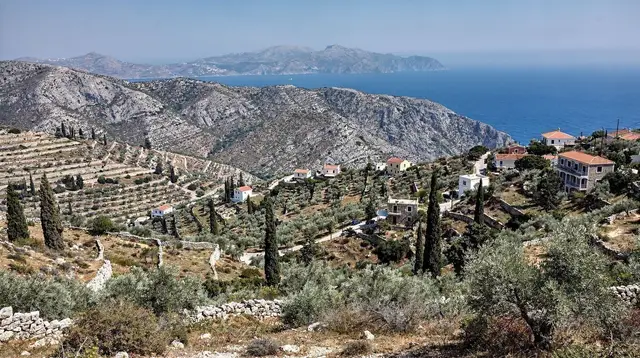
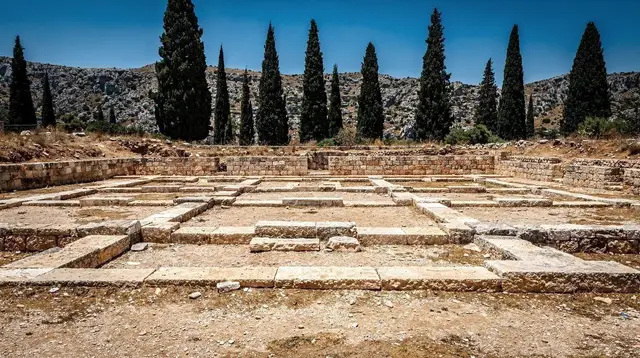
I’d driven past the Gortyna turn-off twice before I actually stopped. It sits on the Messara plain in the island’s south, a short hop from Phaistos, and from the road it barely announces itself: a low fence, a scatter of stones under olive trees, a coach or two in the car park if you’re unlucky with timing. Nothing like the queues at Knossos. And that’s exactly the problem with how most people understand this island’s history — they arrive expecting one long story that starts and ends with the Minoans, when in fact Crete changed hands and capitals more times than most countries manage in a millennium.
What Gortyna Actually Was
Gortyna became the administrative capital of the Roman province of Creta et Cyrenaica in the late first century BC, and it kept that role through the Byzantine period until an Arab raid largely destroyed it in the ninth century. That’s close to nine hundred years as the island’s seat of government — longer than Knossos was ever anything more than a large town with an impressive past behind it.
Walking the site today, you get pieces of that: the shell of the Roman odeon, the basilica of Agios Titos with its worn arches, stretches of a theatre and public baths, and the thing I actually came for — the Law Code of Gortyn, a set of legal inscriptions carved into curved stone blocks, among the oldest and most complete law codes to survive from the ancient Greek world. It covers inheritance, marriage, property, even the treatment of slaves, in language specific enough that historians still use it to reconstruct daily life in Roman Crete. Nobody was selling postcards of it. I stood there reading a translation panel for twenty minutes and had the whole enclosure to myself.
If you want the fuller version of what’s on the ground here, and how to pair it sensibly with Phaistos on the same day, I’ve written a separate walkthrough — see the guide to Phaistos and Gortyna.
Knossos Was Never Out of the Story — It Just Changed Roles
None of this makes Knossos unimportant. It’s still the reason most people fly to Heraklion in the first place, and it earned that reputation honestly — as the largest and most complex Minoan palace complex ever excavated, and as the site where Arthur Evans built the modern idea of Minoan civilisation, reconstructions and all. What trips people up is the leap from “Knossos was hugely important once” to “Knossos stayed the capital.” It didn’t.
By the Roman period it was a Roman colonia, a real and reasonably prosperous town, but the government of the island sat at Gortyna. I’d recommend reading the frescoes guide before you go, if only because the frescoes at Knossos are replicas and the originals live at the Heraklion Archaeological Museum — a fact that catches almost everyone off guard on their first visit.
For the fuller Bronze Age context — Minoans, palace culture, what came before Rome arrived at all — The Minoans in One Hour is the shortest honest version I know of.
One Island, Several Capitals
| Period | Approx. dates | Capital | Ruling power |
|---|---|---|---|
| Minoan (peak) | c. 2000–1450 BC | Knossos | Minoan palace states |
| Roman / Byzantine | 1st century BC – 9th century AD | Gortyna | Rome, then Byzantium |
| Venetian | 1204–1669 | Candia (Heraklion) | Republic of Venice |
| Ottoman | 1669–1898 | Candia / Kandiye | Ottoman Empire |
Once you lay it out like this, the pattern is obvious: Crete has had at least three different capitals under at least four different rulers, and Knossos accounts for only the earliest of them. What struck me, once I started paying attention to this, is how each transition left something physical behind rather than erasing what came before. The Venetians who took over in 1204, after the Fourth Crusade carved up Byzantine territory, built the fortifications and harbours you still walk through in Chania and Heraklion today — see Venetian Crete, 1204 to 1669 if you want the full arc of that period.
The Siege That Ended It, and What Came After
The Venetian era ended, slowly and violently, with the Ottoman conquest. Most of the island fell quickly in the 1640s, but Candia — Heraklion — did not. Its fortifications were among the strongest built anywhere in the Mediterranean, and for as long as the city could be resupplied by sea, it held. The siege ran from 1648 to 1669: twenty-one years, one of the longest sieges in recorded history, ending only when Venice’s exhausted defenders finally surrendered the city.
Ottoman rule followed from 1669 to 1898, its own long chapter with its own administrative centre, still Candia, now renamed and reorganised under new masters. That period, and the resistance that eventually ended it, is a story I’ve covered separately — The Battle of Crete, 1941 comes later still, and belongs to yet another occupying power and yet another chapter of the same defensive geography that made Candia so hard to take in 1669.
Visiting Gortyna the Way I’d Actually Do It
Go early, before the coach tours that stop en route between Heraklion and the south coast. Combine it with Phaistos, which is close enough that skipping one to save time defeats the point of coming this far south at all. Bring water and shade — there’s very little of either on site, unlike the tree-lined approach at Knossos. And read the Law Code panel properly rather than photographing it and moving on; it’s the single most specific window into how people actually lived under Roman rule that this island has to offer.
If your interest runs toward the Minoan side of the story rather than the Roman one, a guided look at Knossos itself — the myths, the excavation history, the parts a self-guided walk tends to miss — is worth booking rather than winging it: a small-group walk through Knossos covering its legends and everyday Minoan life.
And if the later chapters of the island’s story interest you as much as they interest me — Venetian walls, Ottoman sieges, the twentieth century that followed — a historical tour tracing the Battle of Crete or a Chania-based WWII history tour that includes the wartime bunkers fill in the period that came after Candia’s fortifications had already done their work once, three centuries earlier.
Crete doesn’t need to be flattened into a single story to be worth visiting. It’s more interesting as what it actually is: an island that has been fought over, governed from at least three different towns, and shaped by rulers who left their fortresses, their law codes and their churches stacked on top of each other. Knossos is one layer of that. Gortyna is another, and it deserves the trip on its own terms.
tours.History
Verified deep-linked GetYourGuide tours. Book through these links and we earn a small commission at no cost to you.
GetYourGuide does not provide a product photo for this activity — the image shows the meeting point, photographed by us.