Two ancient capitals, twenty minutes apart
Most visitors to Crete see one archaeological site, Knossos, and assume that is the whole story. It is not. South of the mountains that separate Heraklion from the Libyan Sea lies the Messara, the island’s largest agricultural plain, and inside it sit two sites that between them cover almost 2,000 years of Cretan history: Phaistos, a Minoan palace on the scale of Knossos but visited by a fraction of the crowd, and Gortyna, sprawled ruins that most people drive past without realising they were once the seat of Roman power over the entire island. Visiting them together, in a single morning, gives a more accurate picture of ancient Crete than Knossos alone ever could.
The fact worth fixing before anything else: Gortyna, not Knossos, was the Roman capital of Crete. It is one of the most commonly inverted facts about the island, repeated often enough in casual conversation that it has become a kind of accepted error. Knossos was the great Minoan Bronze Age centre, abandoned and buried long before Rome ever set foot on Crete.
Gortyna came later, rose under Roman rule from 67 BC, and became the administrative capital of the combined Roman province of Crete and Cyrenaica, in modern-day Libya. Its ruins, not the reconstructed corridors north of Heraklion, are where you find the physical evidence of Roman government on Crete: a basilica, an odeon, baths, and the famous inscribed law code that is still one of the longest surviving legal texts from the ancient world.
Phaistos: the second Minoan palace, without the queue
If Gortyna corrects a common mistake, Phaistos corrects a common oversight. It was one of the four major Minoan palatial centres, alongside Knossos, Malia and Zakros, and in scale it rivals Knossos directly: a similar footprint of storerooms, a central court, staircases and workshop quarters, built and rebuilt across the same Minoan periods, roughly 1900 to 1450 BC. What sets Phaistos apart is not the site itself but what happened to it afterwards.
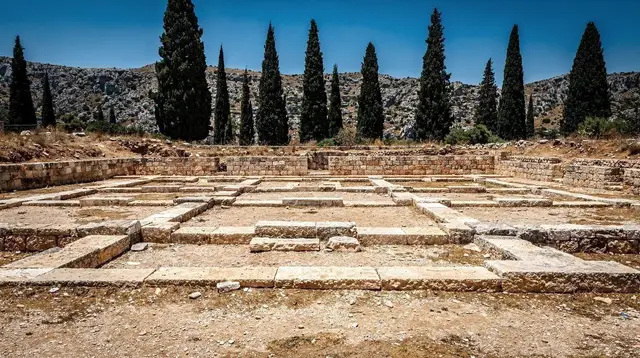
Where Knossos was excavated by Arthur Evans and partly reconstructed with concrete and paint, Phaistos was excavated by Italian archaeologists who left the ruins largely as they found them. There is no rebuilt throne room, no repainted corridor, no attempt to recreate what the palace might have looked like in colour. What stands is stone: foundations, staircases, storage magazines and the outline of a grand court, set on a hilltop with a genuinely spectacular view across the Messara toward the Psiloritis massif.
That absence of reconstruction is not a shortcoming. It is the reason serious visitors to Cretan archaeology tend to rate Phaistos above Knossos for atmosphere, even while Knossos keeps the larger crowd and the bigger name. A related guide on the Minoan palaces lays out the excavation history in more depth, and the comparison with the north-coast palace at Malia is useful if you are trying to decide how many Minoan sites belong on one itinerary.
Where the Messara actually is, and why the coach will not get you there
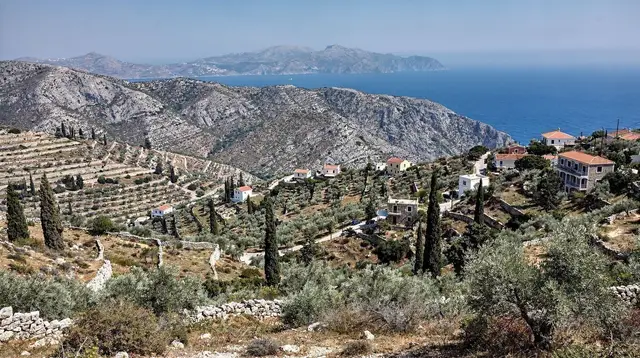
Both sites sit inside the Messara plain, Crete’s largest lowland, an agricultural belt of olive groves, vineyards and greenhouses running east to west south of the Psiloritis foothills and north of the Libyan coast around Matala and Agia Galini. This is not a coastal stretch and it is not a resort area: it is the inland breadbasket of the island, and it should not be mistaken for a beach day. Phaistos and Gortyna are ruins in farmland, not a stop along a seafront promenade.
Because the Messara is agricultural interior rather than the tourist-served north coast, the KTEL coach network does not serve it reliably. KTEL is genuinely useful along the Chania-Rethymno-Heraklion-Agios Nikolaos corridor, but services into the Messara toward Phaistos and Gortyna are thin, seasonal and not built around a same-day round trip for a visitor without a return connection already planned.
In practice, this destination assumes a rental car or an organised tour. From Heraklion, the drive to Gortyna takes around 40-45 minutes, and continuing on to Phaistos adds another 15 minutes or so; from Matala on the south coast, Phaistos is barely ten minutes away, which makes the pairing a natural add-on for anyone already based there.
For visitors who would rather not drive the mountain roads themselves, several organised options run the same loop. A day trip from Heraklion covering Zaros, Phaistos and a stop at Matala beach handles the whole circuit in one coach, including the mountain spring village of Zaros on the way.
A similar itinerary, an organised day out from Heraklion taking in Gortyna, Phaistos, Matala and Zaros together, is the more complete option if seeing both the Roman and Minoan sites in one go matters more than beach time. Travellers who want to pair Phaistos directly with Knossos, without driving themselves between the two, can book a private tour linking Knossos and Phaistos for a single Minoan-focused day.
No shade, no frescoes: what actually happens on site
Two expectations need correcting before you go, because both trip up visitors who arrive having seen photographs of Knossos.
First: there is almost no shade at either site. Phaistos sits exposed on its hilltop, and Gortyna’s ruins are scattered across open ground with only a scattering of old olive trees for relief. In July and August, when temperatures on the Messara plain regularly reach 30-35 degrees Celsius, walking either site at midday is genuinely uncomfortable and, for anyone sensitive to heat, unwise. The only sound plan in summer is an early start: aim to be at the first site by opening time, roughly 08:00-08:30, and be finished before 11:00. Outside summer, from late spring through autumn, the same sites are pleasant well into the afternoon.
Second: neither site offers anything like the painted corridors and reconstructed throne room of Knossos. There are no frescoes on display at Phaistos, no repainted columns, no staged walkways designed to suggest what a Minoan court looked like in colour. What you are looking at is stone: foundations, storerooms, drainage channels, the shape of a civilisation without the decoration filled back in.
Gortyna is similar in spirit, though later in period — its highlights are structural and epigraphic (the basilica of Agios Titos, the odeon, the famous law code) rather than pictorial. If frescoes are the reason for the visit, the real ones, taken from Knossos and elsewhere, are in the Heraklion Archaeological Museum, not on site at either Phaistos or Gortyna. Visitors who come expecting a colourful reconstruction leave disappointed; visitors who come for the layout, the history and the view leave satisfied.
What to see at Phaistos
The site is compact enough to cover properly in 60-90 minutes. The main points:
- The Grand Staircase and Central Court, the ceremonial heart of the palace, comparable in scale to the one at Knossos but without a single repainted step.
- The storage magazines, rows of narrow rooms that once held the palace’s oil, wine and grain reserves — a direct, physical sense of how a Minoan palace functioned as an economic centre for the surrounding Messara.
- The Phaistos Disc find spot, a small marker noting where the famous fired-clay disc, stamped with an undeciphered script, was excavated in 1908. The disc itself is in the Heraklion museum, not on site.
- The hilltop view, arguably the single best reason to visit: the whole Messara plain laid out below, the Psiloritis range behind, and on a clear day a line of sight toward the Libyan Sea.
What to see at Gortyna
Gortyna is larger and more spread out, and rewards a slower, more deliberate walk:
- The Basilica of Agios Titos, a substantial early Christian church, evidence that Gortyna remained an important centre well after Rome.
- The Roman odeon, a small theatre built into the site, next to which the famous law code is displayed — twelve columns of inscribed Doric Greek, one of the oldest and most complete legal codes surviving from the ancient world, covering property, marriage and inheritance.
- The Praetorium and Roman baths, the administrative core of the site, confirming Gortyna’s status as the seat of the Roman governor.
- The scattered outer ruins, a stadium, an amphitheatre and further temples spread across farmland beyond the fenced core — a reminder of how large the Roman city actually was.
Combined ticket, timing and getting the order right
| Phaistos | Gortyna | |
|---|---|---|
| Period | Minoan Bronze Age, c. 1900-1450 BC | Roman capital of Crete, from 67 BC |
| Character | Palace ruins, largely unreconstructed | City ruins: basilica, odeon, baths, law code |
| Shade | Almost none | Some, under scattered olive trees |
| Typical visit | 60-90 minutes | 60-90 minutes |
| Crowd level | Moderate, far below Knossos | Light, many visitors just drive past |
A combined ticket covering Phaistos, Gortyna and the nearby site of Agia Triada is sold at each of the three, and it is worth buying if you plan to see more than one. Opening hours follow the general pattern of Crete’s outdoor archaeological sites: roughly 08:00 to 16:00 or later in summer, shorter in winter, and always worth checking on the day, since hours shift with the season and with staffing. As with any outdoor site on Crete, sun hat, water and proper shoes matter more than at an indoor museum — there is genuinely nowhere to shelter for long once you are inside the fence.
Most visitors do Gortyna first, since it sits directly on the road in from Heraklion, then continue the short drive on to Phaistos, finishing at the hilltop with the best view of the day. Reverse the order if you are coming up from Matala instead.
Where this fits in a longer trip
Phaistos and Gortyna work best as a half-day add-on rather than a destination in their own right. The natural pairings are a stop at Matala for its caves and red beach afterward, a night or two around Agia Galini on the south coast, or a loop back north through the wine villages of Archanes and Dafnes on the way to Heraklion.
For anyone building a broader archaeology-focused route, the five-day archaeology itinerary sequences Knossos, Phaistos and Gortyna alongside the museum, and the Minoan sites category lists the full set of palatial and Bronze Age sites across the island if you want to go further than the Messara alone.
Phaistos and Gortyna: your questions answered
Is Gortyna or Knossos the real Roman capital of Crete?
Gortyna. Knossos was the great Minoan Bronze Age centre, long since abandoned by Roman times. Gortyna became the capital of the Roman province of Crete and Cyrenaica from 67 BC, and its ruins, including a basilica, an odeon and an inscribed law code, are the physical evidence of that Roman administration.
Are there frescoes to see at Phaistos?
No. Phaistos was excavated and left largely unreconstructed, so there are no painted corridors or reproduced frescoes on site, unlike the reconstructed sections of Knossos. The real Minoan frescoes, including those associated with Knossos, are displayed in the Heraklion Archaeological Museum.
Can I visit Phaistos and Gortyna without a car?
It is difficult. The Messara plain is agricultural interior and the KTEL coach network does not serve it with reliable, tourist-friendly schedules the way it does the north coast. A rental car or an organised day tour from Heraklion or Matala is the practical way to see both sites.
How much time do I need for both sites?
Around 60-90 minutes at each, so roughly half a day including the drive between them. Add Matala or a wine-village stop at Archanes or Dafnes and the outing becomes a full day.
Is there shade at Phaistos and Gortyna?
Very little at either site. Phaistos sits exposed on an open hilltop; Gortyna has some relief under scattered olive trees but no real cover across most of the ruins. In July and August, when the Messara plain reaches 30-35 degrees, a morning visit before 11:00 is strongly recommended.
Can I combine Phaistos and Gortyna with a beach day?
Yes, but not directly — the Messara plain itself is inland, not coastal. The natural pairing is Matala, about ten minutes from Phaistos, or Agia Galini a little further south, both on the Libyan coast.
What is the actual difference between Phaistos and Knossos?
Both were major Minoan palaces of similar scale and period. Knossos was partially reconstructed with concrete and paint by its excavator, Arthur Evans, giving it a more dramatic, colourful appearance and a much larger crowd. Phaistos was left as excavated, with no reconstruction, which means fewer visitors, more shade-free open ground, and a rawer sense of the original stone.
Do I need a guide, or can I visit independently?
Either works. Independent visitors with a car can walk both sites at their own pace using on-site information boards; a guide adds context on the law code, the Roman administration and the excavation history that boards alone do not cover, and removes the need to navigate the inland roads yourself.