Knossos and the Heraklion Archaeological Museum
Are the frescoes at Knossos the original paintings?
No. The scenes you see at Knossos are reconstructions and replicas built over the excavated walls; the surviving original fragments are conserved and displayed in the Heraklion Archaeological Museum, 5 km away. A combined ticket covers both sites, and each one takes a couple of hours, so a single morning is enough for both.
Almost every photograph taken at Knossos includes a fresco: the Prince of the Lilies striding through a meadow, the Bull-Leaper somersaulting over a charging animal, the Dolphins swimming across a queen’s private rooms. Almost none of those photographs show an original. Knossos is one of the most visited archaeological sites in Greece, and it is also one of the most misunderstood, because the thing most people come to see — the painted walls — is not, in the strict sense, still there.
The frescoes you are photographing aren’t the originals
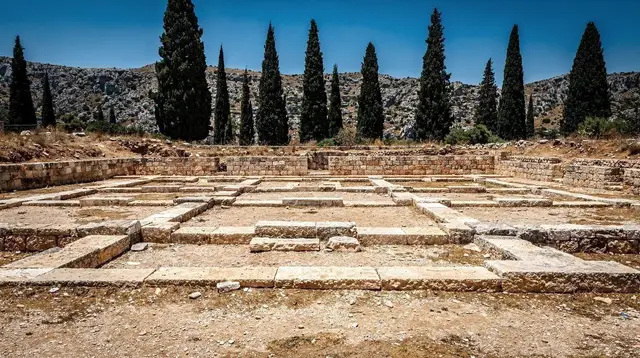
What you walk past at Knossos is largely the work of Sir Arthur Evans, the British archaeologist who excavated the site from 1900 and rebuilt parts of it in painted concrete, a technique he called reconstitution. Where fresco fragments survived, replicas were painted and set into the walls where the originals had stood, or close to it; some scenes are partly conjectural, filled in from fragments too small to tell the whole story on their own. It is a legitimate and historically important piece of early-20th-century archaeology in its own right, but it is not conservation in the modern sense, and it is not the ancient paint.
The real fragments — cleaned, stabilised, and displayed under glass — are in the Heraklion Archaeological Museum, about 5 km north of the palace. That is where the Prince of the Lilies, the Bull-Leaper, the Dolphins, and the Saffron Gatherer actually live. Skip the museum and you have seen a well-produced idea of Minoan painting. Visit both, in either order, and the two sites correct each other: the palace gives you scale and layout that no museum case can, and the museum gives you the paint that the palace only imitates.
Palace and museum, side by side
| Knossos | Heraklion Archaeological Museum | |
|---|---|---|
| What you see | Excavated and partly reconstructed palace ruins, painted-concrete fresco copies in situ | The original fresco fragments, Minoan pottery, seals, the Phaistos Disc |
| Shade | Almost none | Fully indoors, air-conditioned |
| Time needed | 1.5-2.5 hours | 1.5-2 hours |
| Best time of day | Opening time, or late afternoon in summer | Any time; a good midday shelter from the heat |
| Distance from central Heraklion | About 5 km south | Central Heraklion, near Eleftherias Square |
The two sites are close enough that a single itinerary works well: palace first thing in the morning, before the heat and the coach groups build up, then the museum once the sun is highest and shade matters most. A combined ticket, sold at either site, covers both and is typically valid over several days, so there is no penalty for splitting the visits if a single morning feels rushed.
Knossos has almost no shade — plan around it
This is worth repeating because it changes how the visit should be timed, not just how it feels. Knossos is largely open ground: low walls, gravel paths, a scatter of olive and cypress trees that shade a bench here and there but nothing like a covered route. In July and August, when the meltemi is blowing across the north coast and daytime temperatures in Heraklion regularly sit at 30-35 degrees, an 11am or midday visit to Knossos is genuinely unpleasant, and it is also when the site is busiest, as cruise-ship groups and coach tours converge on the same hour.
The fix is simple: go at opening, before the coaches arrive and while the site is still in early light, or go in the last couple of hours before closing, when both the heat and the crowds have eased. Either way, bring water, a hat, and sunscreen, and treat the visit as an outdoor walk, not a shaded museum stroll. If your schedule only allows a midday slot, do the Heraklion Archaeological Museum then instead, and save the palace for the cooler end of the day.
For travellers who would rather not work out logistics themselves, joining a guided visit removes the timing guesswork, since operators generally schedule around the heat. The Knossos, Heraklion and market guided tour combines the palace with the city’s market and centre in a single half-day, which suits a first visit to the island’s capital.
What Knossos actually was — and wasn’t
Knossos was the largest and most elaborate of the Minoan palace-complexes, inhabited from around 2000 BC and rebuilt several times after earthquakes, reaching its most famous form in the so-called New Palace period before a final destruction around 1350 BC. In its Bronze Age heyday it was almost certainly the most powerful centre on the island, the seat of a script we now call Linear A, a network of storerooms and workshops, and — if you take the later Greek myths as an echo of something real — the setting for the labyrinth and Minotaur story tied to King Minos.
What it was not, contrary to a common assumption built on its fame, is the Roman capital of Crete. That role belonged to Gortyna, a city on the Messara plain south of the island’s central mountains, which the Romans made the capital of the combined province of Crete and Cyrenaica after their conquest in 67 BC. By the Roman period, Knossos’s political importance had long since faded with the collapse of Minoan civilisation ththan a millennium earlier; its prominence today is archaeological and touristic, not a continuous thread back to Roman administration. If you’re building a Minoan-to-Roman picture of the island, Gortyna belongs on the itinerary precisely because it corrects this common mix-up.
Linear A, Linear B, and the tablets found at Knossos
Among the finds at Knossos were clay tablets inscribed in two related but distinct scripts. Linear A, the earlier of the two, was used across Minoan Crete for administrative records and remains undeciphered: we can identify individual signs and some numerals, but the underlying language has resisted every serious attempt at translation. Linear B, which appears in later strata at Knossos and at mainland sites such as Pylos and Mycenae, was cracked in 1952 by the architect and amateur linguist Michael Ventris, who showed it to be an early written form of Greek — evidence that Mycenaean Greeks controlled Knossos in its final active phase, centuries before Homer.
The practical upshot for a visitor is that the tablets in the Heraklion Archaeological Museum are not simply decorative artefacts; some can be read, in a very real sense, as the oldest written Greek in existence, while others sit as a genuinely unsolved puzzle in the same room. It’s one of relatively few places anywhere where an unbroken mystery and a solved one from the same civilisation are displayed side by side.
Knossos is not the only Minoan site worth your time
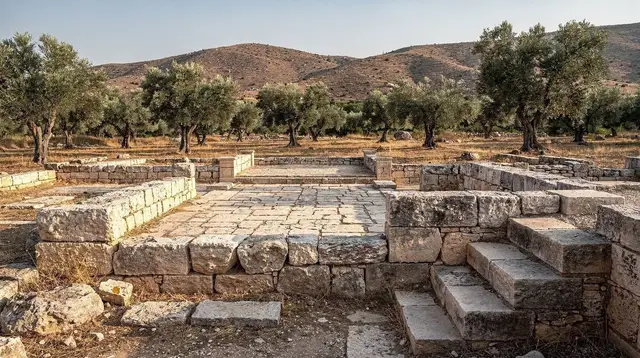
Knossos earns its fame, but it is not Crete’s only Minoan palace, and travellers who treat it as the single unmissable stop often miss sites that are, in some ways, more rewarding precisely because they carry less reconstruction and fewer crowds. Phaistos, on a hilltop above the Messara plain near Gortyna, is the second-largest palace on the island and shows its Bronze Age layout with far less concrete overlay, which some visitors find easier to read as genuine ruin rather than period reconstruction.
Malia, on the north coast east of Heraklion, adds a third palace within easy reach of the resort strip, again largely unreconstructed. Further east, Zakros pairs a smaller palace with a genuinely Minoan harbour town, reached along one of the island’s quieter roads.
A single trip to Crete does not need to choose only one of these, and a wider view of Minoan Crete actually makes Knossos make more sense: seeing an unreconstructed palace at Phaistos or Malia clarifies exactly how much of what stands at Knossos is Evans’s addition, rather than excavation alone. For a fast overview of the civilisation before or after visiting any of these sites, The Minoans in one hour lays out the chronology without the detail overload of a full academic account.
Heraklion, the city around the museum
The museum that holds the real frescoes sits inside Heraklion, Crete’s capital and by far its largest city, with roughly 180,000 residents within the city itself and more than 200,000 across the wider municipality — a scale that surprises visitors who arrive expecting a resort town rather than a genuine regional capital.
Beyond the museum, the old town holds the Venetian Koules fortress guarding the old harbour, the Venetian walls where the writer Nikos Kazantzakis is buried, and a market and food streets built for a working city rather than a tourist set piece. Basing a day here around Knossos and the museum, then, is not a compromise stop on the way to somewhere else — Heraklion carries enough on its own to fill a full two-day visit.
Travellers who want the palace, the museum and the city stitched together without self-driving can do it in one guided outing: the same Knossos, Heraklion and market guided tour mentioned above covers all three in a half-day, while those based in Chania who don’t want to drive the length of the island can join the Venetian Heraklion and Knossos palace tour from Chania, which bundles the transfer, the palace and the old town’s Venetian sites into a single long day.
Beyond the frescoes: a slower Knossos day
Not every visit needs to be palace-then-museum-then-move-on. For travellers with a full day and a rental car, Knossos sits close to the wine villages of Archanes and Dafnes, where indigenous Cretan grapes are grown within a short drive of the palace, making it easy to pair the morning’s history with an afternoon of tasting rather than another museum. The private Knossos, winery and monastery tour is built around exactly that combination, trading the market and old-town stops for a vineyard and a monastery instead.
Practical notes for visiting
Both sites are manageable on foot from central Heraklion if you’re not driving: local buses run frequently to Knossos, and the museum is a short walk from Eleftherias Square. Neither site needs a full day on its own, which is why pairing them works so well logistically as much as thematically — most visitors comfortably fit both into a single morning or a morning-and-afternoon split, leaving the rest of the day for the old town, the Historical Museum of Crete covering more recent history, or an onward drive toward Phaistos and the Messara.
| Knossos | Heraklion Archaeological Museum | |
|---|---|---|
| Typical visit length | 1.5-2.5 hours | 1.5-2 hours |
| Getting there from central Heraklion | Local bus or short drive, about 5 km | Walkable in the city centre |
| Combined ticket | Covers both sites, valid across several days | Same ticket |
| Crowd pattern | Busiest mid-morning to early afternoon with coach and cruise groups | Steadier through the day, useful as a midday shelter |
Knossos and the Heraklion Museum: your questions answered
Are the frescoes at Knossos original?
No. What stands at Knossos today is largely Sir Arthur Evans’s early-20th-century reconstruction, including painted concrete and repainted fresco copies set where the originals were found. The actual fragments, cleaned and conserved, are in the Heraklion Archaeological Museum.
How far is Knossos from the Heraklion Archaeological Museum?
About 5 km, roughly 10-15 minutes by car or bus from central Heraklion. Knossos sits just south of the city; the museum is in the centre, near Eleftherias Square.
Is there a combined ticket for Knossos and the museum?
Yes, a combined ticket covering both the palace and the museum is sold at either site and is usually valid across several days, which is useful if you want to split the two visits rather than rush them on the same morning.
Is there shade at Knossos, and when should I visit in summer?
Almost none. The site is largely open ground with low ruined walls and little tree cover, so a July or August midday visit is genuinely uncomfortable. Arrive at opening time, or go late in the afternoon, and bring water and a hat either way.
Was Knossos ever the capital of Roman Crete?
No. The Roman capital of Crete was Gortyna, in the Messara plain south of Heraklion, not Knossos. Knossos was the great Bronze Age Minoan centre; its political importance had already faded by the Roman period.
Can I read the Linear A tablets found at Knossos?
No one can, yet. Linear A, the earlier Minoan script, is still undeciphered. Linear B, found in later layers at Knossos and elsewhere, was deciphered in the 1950s and turned out to be an early form of Mycenaean Greek.
Is Knossos the only Minoan site worth visiting in Crete?
No. Phaistos and Malia are major Minoan palace sites with far fewer crowds, and Zakros in the far east adds a Minoan harbour town largely untouched by later reconstruction. Knossos is the famous one, not the only one.
Knossos Tours in Crete on GetYourGuide
Verified deep-linked GetYourGuide tours. Book through these links and we earn a small commission at no cost to you.
GetYourGuide does not provide a product photo for this activity — the image shows the meeting point, photographed by us.