The Minoans in One Hour
What do I actually need to know about the Minoans before visiting Knossos?
Knossos shows you reconstructed ruins and replica frescoes; the originals are 5 km away in the Heraklion Archaeological Museum. The Minoans' own writing, Linear A, has never been deciphered, unlike the later Linear B. The site has almost no shade, so a summer visit belongs early in the morning.
Who the Minoans Were, in Brief
Long before Crete had a Venetian harbour or an Ottoman fortress, it had a Bronze Age civilisation that modern archaeologists named after a legendary king, Minos. The Minoans built large, complex structures at several points across the island, farmed olives and vines, traded by sea across the eastern Mediterranean, and left behind a body of pottery, seals, frescoes and clay tablets that still shapes how the island tells its own story. Nobody knows what they called themselves. The name “Minoan” is a modern label, borrowed from myth by the archaeologists who excavated Knossos and gave the culture a name it never used for itself.
What survives is physical, not textual, which is part of why a short visit to a site like Knossos benefits from a little preparation. You are not walking through a building exactly as it stood. You are walking through a partly reconstructed Bronze Age complex, layered with a modern archaeologist’s interpretation, standing next to a museum that holds the genuine fragments a few kilometres away. Knowing which is which before you arrive changes what you notice.
This guide is deliberately short. It covers the handful of facts that actually prevent confusion on site, points you toward Knossos Palace Visitors Guide and Knossos and the Heraklion Museum for the fuller detail, and stops well short of pretending to settle the open academic questions. Some of the most interesting things about the Minoans are things nobody can currently answer.
Knossos: What You Are Actually Looking At
The single fact worth carrying into Knossos is this: the coloured frescoes you see on walls, pillars and reconstructed sections of the palace are replicas. The originals, or what survives of them, are on display in the Heraklion Archaeological Museum, about 5 km away in the city. Many of those originals were themselves fragmentary when excavated and were restored and reassembled, so even the museum versions carry a layer of modern interpretation. But the museum holds the real material evidence; the site holds copies, repainted onto concrete and plaster reconstructions to give visitors a sense of how the palace might once have looked.
This is not a minor curatorial detail. Knossos is unusual among Bronze Age sites in how heavily it has been reconstructed, with concrete columns, repainted walls and rebuilt staircases standing alongside genuine excavated stonework. That reconstruction is itself now historic and is part of what you are visiting, but it means the bright, famous images most people associate with Knossos, the bull-leapers, the priestess figures, the dolphins, are all reproductions of paintings that live under glass across town.
If seeing the actual frescoes matters to you, budget time for both stops. A combined ticket covering the palace and the museum exists, which makes pairing the two straightforward, and Knossos and the Heraklion Museum walks through how to sequence the two visits.
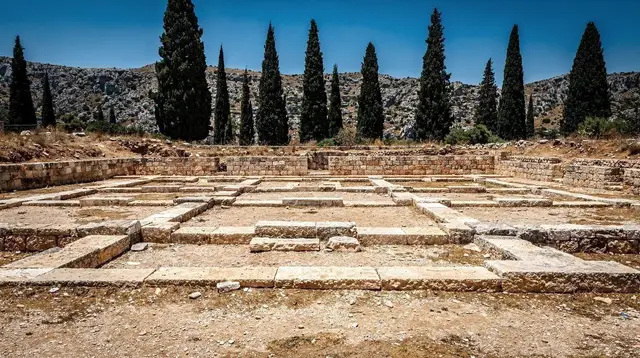
None of this makes the site itself less worth seeing. Walking the actual excavated footprint of a palatial complex this size, with its storage magazines, the throne room, and the maze of interconnected rooms that likely fed the myth of the labyrinth, is a different experience from looking at photographs. It simply helps to arrive knowing that the colour on the walls is a modern hand’s best guess, not an untouched survival from the Bronze Age.
Linear A and Linear B: Two Scripts, One Common Mix-Up
The second fact worth carrying in is about writing, and it trips up almost as many visitors as the frescoes. The Minoans used a script called Linear A for administration and religious inscriptions, scratched or pressed into clay tablets. It has never been deciphered. Scholars can describe the shapes of the signs, count how often certain sequences repeat, and compare it to later scripts, but nobody can currently read what a Linear A tablet actually says, or with total confidence even identify the underlying language.
Linear B is a different matter, and this is where the confusion usually starts. Linear B was adapted from Linear A by the Mycenaeans, the Bronze Age Greek-speaking culture centred on the mainland, and it was successfully deciphered in the twentieth century. That decipherment was a genuine landmark: it proved that Linear B tablets record an early form of the Greek language, centuries older than anyone had expected written Greek to reach. So the two scripts look related at a glance, both made of similar wedge-like signs pressed into clay, but only one of them can be read. Linear A remains Minoan and unread. Linear B is Mycenaean Greek, deciphered, and found on tablets both on Crete and on the Greek mainland.
If a guide, a plaque, or a museum label at Knossos or the Heraklion Archaeological Museum mentions either script, this distinction is worth having straight beforehand. It is also, honestly, one of the more interesting open puzzles in archaeology anywhere in the Mediterranean: an entire administrative system, recorded in writing, sitting in museum cases, that nobody alive can currently translate.
Where the Minoans Sit in Crete’s Long Timeline
It helps to place the Minoans in context rather than treat them as Crete’s only ancient story. The Minoan period belongs to the Bronze Age, long before the island’s better-documented later chapters. Venetian rule ran from 1204 to 1669, a period that left the harbour at Chania Town, the old town of Rethymno, and fortifications across the island. Ottoman rule followed, from 1669 to 1898. Both are recent by comparison with the Bronze Age palaces, and both belong to a completely different, much later phase of the island’s history, covered in Venetian Crete 1204-1669.
A more common mix-up sits earlier in the timeline: the Minoans are sometimes treated, wrongly, as the only ancient civilisation Crete has to show. They are not. Crete’s Roman-era capital was Gortyna, in the south-central plain, not Knossos, and Gortyna belongs to a later period again, well after the Minoan palaces had gone out of use.
The distinction matters if you are trying to make sense of ruins on the island generally: a Minoan palace complex like Knossos, Phaistos or the north-coast site covered in Malia Palace: Minoan North Coast is a different thing, from a different era, than the Roman remains at Gortyna, covered together with Phaistos in Phaistos and Gortyna. Treating “ancient Crete” as a single undifferentiated block flattens several centuries of very different history into one.
Visiting Knossos Without Wilting: The Shade Problem
Knossos has almost no shade. The site is largely open ground, low reconstructed walls, exposed courtyards and stone paths, with little of the tree cover you would find in a shaded ruin elsewhere. In spring this is a minor detail. In July or August it becomes the single biggest factor in how comfortable your visit actually is. Stone holds heat, the walk between the different wings of the palace complex is longer than photographs suggest, and there is limited seating out of direct sun.
The practical answer is simple: go early. Arriving close to opening time means walking the site before the day’s heat has built up in the stonework, and it also means fewer people sharing the narrower walkways and stairs, some of which are one-way for conservation reasons. Bring water, a hat, and comfortable shoes rather than sandals, since the ground is uneven in places.
If you are combining the palace with the Heraklion Archaeological Museum, the museum’s climate-controlled galleries are a natural way to spend the hotter middle of the day once you have finished at the site itself. Knossos Palace Visitors Guide has the fuller layout and timing notes for a self-guided visit.
For visitors who would rather have the context explained on the spot than piece it together from labels, a guided option removes some of the guesswork. A tour such as a guided walk through Knossos followed by Heraklion’s market and old town pairs the palace with the city in a single morning, with someone on hand to explain which walls are reconstruction and which are original excavation as you go, rather than working it out from a guidebook in the heat.
Beyond Knossos: Other Minoan Sites Worth Knowing
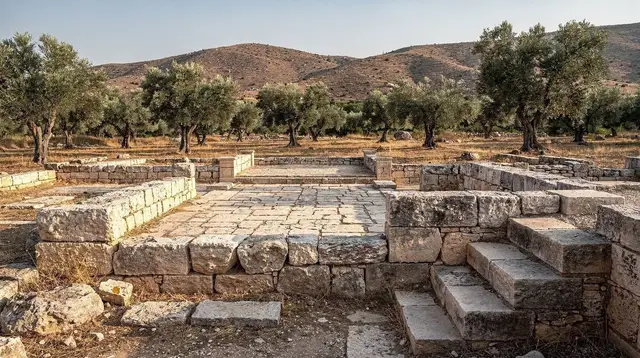
Knossos draws the crowds because of its scale and its long excavation history, but it is not the only Minoan palace on Crete, and it is not necessarily the best one for every visitor. Phaistos, on a hilltop overlooking the Messara plain in the island’s south, is considerably quieter and has one of the better views of any archaeological site on Crete, with far less reconstruction than Knossos, meaning what you see is closer to the actual excavated stonework. It shares a guide, Phaistos and Gortyna, with the nearby Roman capital, which makes it easy to see how the two very different periods sit side by side in the same stretch of countryside.
On the north coast, Malia Palace: Minoan North Coast covers a third major Minoan palatial site, smaller in scale than Knossos but a useful comparison if you want to see how consistent, or how varied, Minoan palace design actually was across the island. Further east, the Minoan presence continues at Zakros, one of the least visited of the major palace sites, which keeps a genuinely different, more remote character than the coach-tour atmosphere that can build up at Knossos in peak season.
For a single trip that tries to connect several of these sites without renting a car and self-navigating, a private tour combining the two best-known palaces removes the logistics. An option like a private day covering both Knossos and Phaistos lets you compare the heavily reconstructed north-coast palace with the quieter, less altered southern one in the same day, which is arguably the clearest way to understand what “reconstruction” at Knossos actually changed.
Making the Most of a Short Visit
If an hour or two is genuinely all the time you have for Minoan archaeology on this trip, the most efficient sequence is usually: Knossos first, for scale and the reconstructed sense of a working palace complex, then the Heraklion Archaeological Museum for the genuine frescoes, seals and the Linear A and Linear B tablets themselves, displayed with context that the open-air site cannot provide. Doing it in that order means the museum’s exhibits answer questions the site itself will have raised, rather than the reverse.
Travellers who want to fold in a wider slice of the island’s history and food culture on the same day sometimes combine the archaeology with the wine country just south of Heraklion, around Archanes and Dafnes, where working wineries sit a short drive from Knossos itself.
A combined option such as a private day linking Knossos with a nearby winery and monastery is one way to pair the Bronze Age site with a much later, still-living part of Cretan life, the vineyards and monastic tradition that grew up in the same countryside many centuries afterward. It is a useful reminder that Knossos is a stop on a much longer island timeline, not a self-contained day out.
For itinerary planning around several archaeological stops rather than a single site, Crete Archaeology 5 Days sequences Knossos, Phaistos and the museum alongside the island’s later Venetian and Ottoman layers, so the Bronze Age does not get flattened into a single rushed morning.
What This Page Deliberately Leaves Out
In the interest of staying accurate rather than tidy, this page does not give a founding or collapse date for the palace at Knossos. Archaeologists continue to debate the chronology of the site’s several building phases and its eventual decline, and no single date commands enough agreement to state here as fact.
It also does not quote a ticket price, since entrance costs change and are better checked at the time of booking than fixed in a guide meant to stay useful for years. And it deliberately avoids treating the Minoans as Crete’s only ancient builders: Gortyna, the island’s Roman-era capital, belongs to a different, later period, and conflating the two eras is one of the more common ways visitors leave the island with a flattened sense of its history.
Frequently Asked Questions About the Minoans and Knossos
Are the frescoes at Knossos original?
No. What you see painted on the walls and pillars at Knossos are replicas, some based on fragmentary originals that were heavily restored and reinterpreted. The genuine fresco fragments are displayed in the Heraklion Archaeological Museum, about 5 km from the site, and a combined ticket covering both exists.
What is Linear A, and can anyone read it?
Linear A was the script used by the Minoans for administrative records and religious inscriptions. It has never been deciphered, so scholars can describe the clay tablets that carry it but cannot read what they say. It remains one of the open problems of Aegean archaeology.
How is Linear B different from Linear A?
Linear B was adapted from Linear A by the later Mycenaeans and was deciphered in the twentieth century, revealing an early form of Greek. Linear A and Linear B look superficially similar on a clay tablet but record different, unrelated languages, and only one of them can be read today.
When is the best time to visit Knossos in summer?
As close to opening time as possible. The site has almost no tree cover, the stone paths hold heat, and by midday in July or August the walk between the palace’s open courtyards and corridors is genuinely uncomfortable. An early visit also means fewer people ahead of you on the narrower walkways.
Is Knossos the only Minoan palace worth visiting?
No. Phaistos, on a hilltop above the Messara plain, is quieter and arguably has the better view, and Malia on the north coast is a third major palatial site. Each shows a different side of the same Bronze Age culture without the crowds that gather at Knossos.
Were the Minoans the only ancient civilization on Crete?
No, and this is a common mix-up. The Minoans came first, but the island’s Roman-era capital was Gortyna, not Knossos, and it belongs to a later period entirely. Crete’s layered history continues through Byzantine, Venetian and Ottoman rule, each leaving its own mark on the same landscape.
Knossos Tours in Crete on GetYourGuide
Verified deep-linked GetYourGuide tours. Book through these links and we earn a small commission at no cost to you.
GetYourGuide does not provide a product photo for this activity — the image shows the meeting point, photographed by us.