Real Frescoes Live in the Museum, Not at the Palace
Start with the one thing every visitor should know before they buy a ticket: the vivid red, blue and ochre frescoes photographed on the walls at Knossos are not the originals. They are 20th-century replicas, repainted onto the excavated fragments by the team working for the British archaeologist Arthur Evans.
The actual pieces recovered from the site — the Bull-Leaper, the Prince of the Lilies, the Ladies in Blue — are conserved and displayed in the Heraklion Archaeological Museum, 5 km away in the city centre, alongside the gold, seals and pottery that came out of the same excavation. A combined ticket covers both the palace and the museum, and buying it before you arrive saves a second queue later in the day. Treat the museum as the second half of the visit, not an optional extra — without it you have seen the stage set and missed the props.
This is not a minor curatorial footnote. It shapes what the palace can honestly show you. Knossos today is as much a monument to early 20th-century archaeological restoration as it is to the Bronze Age civilisation it uncovered, and the two are worth telling apart, which is what the rest of this page tries to do.
Where Knossos Sits in the Heraklion Region
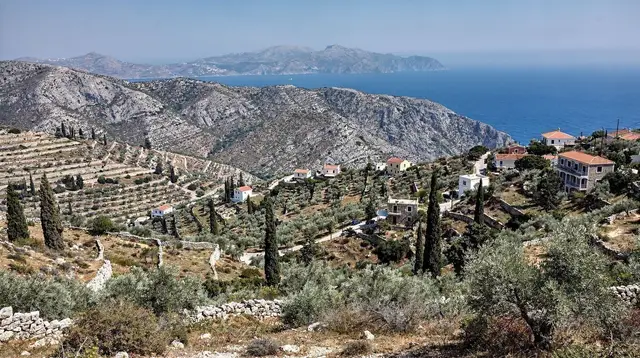
Knossos lies just south of Heraklion city, the capital of Crete and its busiest airport gateway, making it the single most visited archaeological site on the island and usually the first stop for anyone arriving by air or by cruise ship. The region around it is more than one palace: the wine villages of Archanes and Dafnes, a short drive south into the hills, grow the indigenous Vidiano, Kotsifali and Mandilari grapes and make an easy afternoon pairing with a morning at the ruins. North of the city, the beach resort of Agia Pelagia offers a coastal counterpoint if you want to end the day by the water rather than in traffic.
Heraklion itself deserves more than a drive-through — the Venetian walls, harbour and old town hold their own history, including the tomb of Nikos Kazantzakis on the fortifications. If your itinerary allows a second Minoan stop, the palace at Phaistos, on the Messara plain to the south, and the ruins of nearby Gortyna round out the picture in a way that a single site at Knossos cannot.
The Palace: the Heart of the Visit, but Never Rome’s Capital
The palace complex at Knossos was the political and ceremonial centre of Minoan civilisation, occupied and rebuilt across roughly 1900 to 1450 BCE before a final destruction that historians still argue over — earthquake, eruption on Santorini, invasion, or some combination. Its scale is what strikes most visitors first: a sprawl of storage magazines holding rows of massive pithoi jars, a throne room, light wells, and a maze of corridors that likely fed the later Greek myth of the Labyrinth and the Minotaur.
What it was not, and what a surprising number of guidebooks blur, is Rome’s seat of power on Crete. When the Romans absorbed the island in 67 BCE, the provincial capital they built up was Gortyna, in the Messara plain, not Knossos. Knossos had already been in decline for well over a thousand years by then; its moment was Bronze Age, not Roman. If a plaque, a tour script, or a fellow traveller conflates the two, the correction is simple: Minoan capital, Knossos; Roman capital, Gortyna.
Arthur Evans and the Concrete: What Is Restoration, What Is Original
The single most useful thing you can do before walking the site is adjust your expectations about authenticity. Evans excavated Knossos from 1900 and, unusually for his era, chose to rebuild rather than simply stabilise what he found. He poured concrete columns, painted in the frescoes, and reconstructed upper floors based on his own reading of the evidence — a method called anastylosis, applied here more liberally than at almost any other ancient site in Greece.
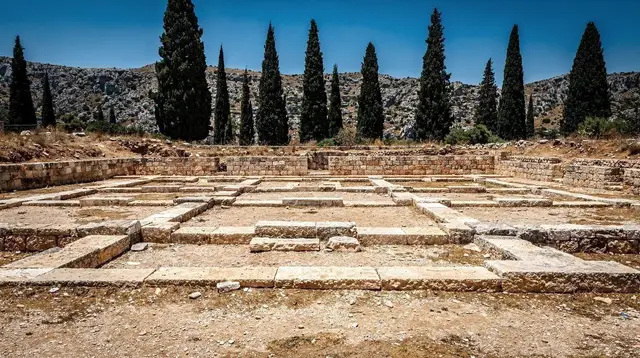
The result is a genuine hybrid. The stone foundations, the storage magazines, the drainage channels and much of the ground-floor layout are authentic Minoan fabric. The bright red and black columns rising above them, the coloured concrete floors, and a fair portion of the upper storeys are Evans’s early 20th-century interpretation, built to make the site legible to visitors rather than to preserve it exactly as excavated.
Archaeologists have debated the accuracy of his choices for a century; some reconstructions are now considered reasonably sound, others speculative. The honest way to see Knossos is as a palace ruin overlaid with one man’s best guess at what it once looked like — not as an unbroken, fully authentic Minoan structure. A visit that treats the concrete columns as ancient stone misses what actually makes the site interesting.
Beating the Heat: Why Mornings Matter
Knossos has almost no shade. The site is largely open stone, gravel paths and low vegetation, with a handful of trees that do little to cool the main courtyards. In July and August, when regional temperatures climb to 30-35 degrees Celsius and higher during a heatwave, walking the full circuit at midday is genuinely unpleasant and, for anyone sensitive to heat, a real risk. Bring water, a hat and sun cream regardless of season, and plan around it rather than fighting it.
The fix is straightforward: go at opening time, or in the hour after. Gates typically open early in high season, and arriving then buys cooler air, softer light for photographs, and a head start on the coach groups that begin arriving mid-morning from Heraklion’s port and the north-coast resorts. Outside July and August, the pressure eases — May, June, September and October bring milder days and thinner crowds, and are the better months to combine Knossos with a longer walk around the site rather than a rushed loop.
Linear A, Linear B, and a Script Nobody Has Read
Among the finds at Knossos are clay tablets inscribed with two related scripts. Linear A, used by the Minoans themselves, has never been deciphered — the symbols are catalogued, but the underlying language remains unidentified, and it stays one of the genuine unsolved puzzles of ancient writing. Linear B, which appears later at Knossos and at mainland sites such as Pylos and Mycenae, was cracked in 1952 by Michael Ventris and turned out to record an early form of Mycenaean Greek — administrative records of goods, rations and livestock, not literature.
The distinction matters for how you read the museum displays: tablets in Linear B can be translated word for word; tablets in Linear A remain, quite literally, untranslatable. For the wider Minoan story before you step onto the site, a primer such as the Minoans explained in outline is a useful ten minutes.
Getting There and Getting In
Knossos sits about 5 km south of central Heraklion, roughly a 20-minute drive or a short bus ride on the regular city line that runs from the harbour area. From Chania, allow around two hours and fifteen minutes for the 145 km drive along the north-coast highway. There is a paid car park at the site, though it fills quickly once coach traffic arrives.
Ticket prices are seasonal, with a reduced winter rate and a combined ticket covering the palace and the Archaeological Museum in Heraklion. Queues at the entrance build fast after mid-morning in high season; buying ahead and arriving early avoids most of it. For a fuller walkthrough of the ruins themselves, layout by layout, see the complete visitor’s guide to the palace, and for how to sequence the palace with the museum in one day, the Knossos and museum combination guide lays out a realistic schedule.
What to Pair Knossos With
Most visitors base themselves in or near Heraklion and treat Knossos as a morning, freeing the afternoon for the city itself or a short drive further out. A two-day stay in the region can comfortably cover the palace, the museum, the old town walls and harbour, and still leave room for a half-day in Archanes wine country — a rhythm mapped out in Heraklion in two days. Travellers building a longer, ruins-focused trip should look at five days of Crete’s archaeology, which strings Knossos together with Phaistos, Gortyna and the museum without the rushed, single-day version most people default to.
Two pieces worth reading before or after your visit correct the most common misunderstandings directly: why the frescoes you see are copies and why Gortyna, not Knossos, was the Roman capital. If the undeciphered script caught your attention, Linear A remains unread goes deeper into why, a century on, nobody has cracked it.
Booking a Guided Visit or Private Tour
A guide earns its cost at Knossos more than at most Cretan sites, because so much of what you are looking at needs context that a plaque cannot provide — which walls are Bronze Age stone and which are Evans’s concrete, what the throne room actually was, where the frescoes you are photographing were really found. A half-day guided tour of Knossos paired with Heraklion’s old market covers the palace and gives the city centre its due in the same morning.
For travellers wanting the deeper Minoan picture in one day, a private tour linking Knossos with the palace at Phaistos covers both major sites without the scheduling headache of arranging transport twice. And for a slower day that trades some ruins time for the region’s other strength, a private day combining Knossos with an Archanes winery and monastery visit is a well-matched way to spend an afternoon once the site itself starts to empty out.
Travellers who want to make the wine country the main event rather than an add-on can look instead at an Archanes tour built around tasting the region’s wine, best scheduled for the second half of the day once the Knossos heat has passed its peak.
Questions Travellers Ask About Visiting Knossos
Are the frescoes at Knossos real?
No. The frescoes you see on the palace walls are replicas, repainted over the fragments that survived. The original pieces are in the Heraklion Archaeological Museum, 5 km from the site, and a combined ticket covers both.
Was Knossos the Roman capital of Crete?
No. That role belonged to Gortyna, in the Messara plain south of the mountains, which became the capital of the Roman province of Crete and Cyrenaica. Knossos was the great Minoan centre, roughly a thousand years earlier.
How much of the palace is original Minoan work?
A minority of what stands today. The stone foundations, storage magazines and much of the layout are genuinely Bronze Age. The upright columns, the coloured concrete floors and the reconstructed upper storeys are a 20th-century restoration, mostly by Arthur Evans, and should be read as an interpretation rather than as surviving antiquity.
Is there shade at Knossos?
Almost none. The site is largely open stone and gravel with very few trees, and in July and August midday temperatures reach 30-35 degrees Celsius with no relief. An early morning visit, at or soon after opening, is the only comfortable way to see it in summer.
How long does a visit to Knossos take?
Two to three hours at a walking pace with an audio guide or a guided tour. Add the Heraklion Archaeological Museum and the visit becomes a half day, which is the way most people who come away satisfied actually plan it.
Can I visit Knossos and the museum on the same ticket?
Yes. A combined ticket covering the palace and the Heraklion Archaeological Museum is sold at both sites and is worth buying before you arrive, since it removes the need to queue twice.
What script was used at Knossos, and can it be read?
Two scripts appear at the site. Linear A, the earlier Minoan script, has never been deciphered and its underlying language remains unknown. Linear B, which followed it, was deciphered in 1952 and turned out to record an early form of Mycenaean Greek.