Phaistos and Gortyna: The Messara's Two Ruins
Should you visit Phaistos and Gortyna together, and which one actually mattered in Cretan history?
Yes — they sit about 20 minutes apart in the Messara plain south of the mountains. Phaistos was a major Minoan Bronze Age palace; Gortyna, not Knossos, became the capital of Roman Crete and stayed the island's administrative centre for centuries afterward. Both are reached by rental car, since Crete has no train and bus links into the Messara are thin.
A Roman Capital and a Minoan Palace, Twenty Minutes Apart
Most first-time visitors to Crete hear one name before any other: Knossos. Fewer hear Gortyna, and that gap in name recognition doesn’t match the historical record. Knossos was the great Minoan Bronze Age palace, and it deserves the fame — but it was not the capital of Roman Crete. That title belongs to Gortyna, a sprawling site in the Messara plain that most itineraries skip entirely.
This page exists to untangle two things that get conflated constantly: which site is which, and which one actually held power on this island, and for how long. It also answers the more practical question — is it worth driving out to see both, or should you pick one and move on.
Why Gortyna, Not Knossos, Was the Real Capital
Here is the point worth getting right, because guidebooks and casual conversation blur it constantly: Knossos was the pre-eminent palace of Minoan Crete in the Bronze Age, roughly two thousand years before the Roman era. But when Rome absorbed Crete into its empire, the administrative capital of the island was not Knossos — it was Gortyna, down in the Messara plain, south of the central mountains. Gortyna held that role for centuries, well before the much later periods of Venetian rule from 1204 to 1669 and Ottoman rule from 1669 to 1898, both of which were centred instead on Candia — the walled city known today as Heraklion.
So the timeline runs roughly: Minoan Knossos rises and falls in the Bronze Age; Gortyna becomes the Roman capital of the island in the centuries after; and only much later, in the medieval and early modern periods, does power shift north to the fortified harbour city that is now Heraklion. Three different eras, three different centres of power, on the same island. If you want the fuller Minoan backdrop before or after visiting either ruin, the guide to the Minoans in one hour lays out that earlier period, and the guide to Venetian Crete, 1204-1669 covers what came after Rome.
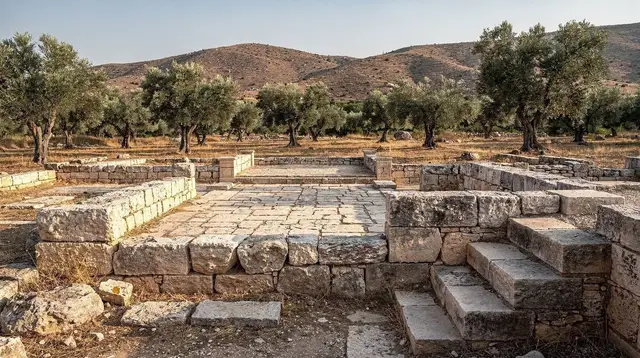
Gortyna’s Roman-era remains reflect that long administrative role: the scale of the site, sprawled across open fields rather than concentrated into one compact palace footprint, is itself a clue that this was once a working provincial capital rather than a single ceremonial complex. Walking it takes longer than the name recognition gap would suggest.
Phaistos: The Minoan Palace of the South
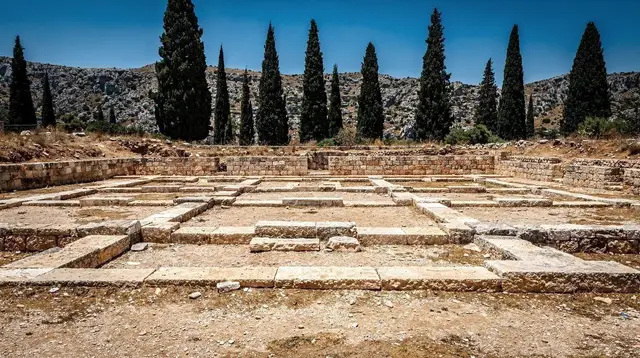
Phaistos belongs to the earlier chapter. It was one of the major Minoan palace complexes on Crete, ranked second in scale after Knossos, and it sits on a hill with a genuinely striking view across the Messara plain toward Mount Psiloritis. Where Knossos has been partly reconstructed with concrete and paint, giving it a more legible — and more debated — appearance, Phaistos has been left largely as excavated: low stone walls, the outlines of storerooms and courtyards, and far fewer crowds.
One artifact associated with the site is worth naming honestly rather than embellishing: the Phaistos Disc, a small clay disc stamped with symbols that remain the subject of scholarly debate. It is not displayed at the site itself — it’s held in the Heraklion Archaeological Museum, alongside the originals of the frescoes that most visitors associate with Knossos. Beyond that, this guide won’t speculate about the disc’s meaning or the details of its excavation; too much about it remains genuinely unsettled to state as fact.
Getting There: The Messara Sits Away from the North-Coast Flow
Both sites sit inland, south of the mountain spine that separates Crete’s busy north coast from its quieter interior. That matters for planning, because it puts them off the corridor most visitors default to. The VOAK highway that links Chania, Rethymno, Heraklion and Agios Nikolaos along the north coast doesn’t reach the Messara at all — you have to turn south and climb over or around the hills to get there.
Crete has no train anywhere on the island, and the KTEL coach network that genuinely works along that north-coast corridor thins out fast once you leave it. A handful of seasonal buses reach the Messara towns, but connections between Phaistos, Gortyna and onward to Matala are not something to plan a day around. In practice, a rental car is the realistic way to visit both sites on your own schedule — or a guided day trip, which removes the driving and routing altogether.
From Heraklion, the drive to Gortyna is roughly 45 minutes, and Phaistos sits about 20 minutes further on from there. From Rethymno the approach is longer, closer to an hour and a quarter to reach Gortyna. Neither site has a train station, obviously, and neither has more than a small café and a ticket office — plan fuel and food before you set out into the plain.
Phaistos and Gortyna Side by Side
| Gortyna | Phaistos | |
|---|---|---|
| Era of importance | Roman provincial capital of Crete | Minoan Bronze Age palace |
| Scale | Sprawling, spread across open fields | Compact hilltop palace complex |
| Setting | Messara plain, lower ground | Hilltop, wide views over the Messara |
| Shade | Minimal | Minimal |
| Facilities | Ticket booth, small café nearby | Ticket booth, small café nearby |
| Typical time needed | 60-90 minutes | 60-90 minutes |
| Distance from Heraklion | About 45 minutes by car | About 65 minutes by car |
Neither ruin should be mistaken for a shaded, comfortable midday stop. Crete’s Minoan and Roman archaeological sites are, almost without exception, open ground with little tree cover, and the Messara plain traps summer heat. If you’re visiting between June and August, treat early morning as the only realistic window for either site, and carry more water than feels necessary.
What to Actually See at Each Site
Gortyna
Gortyna’s remains are spread across a genuinely large area, and the scale itself is part of what makes the case for its former importance as a Roman capital. Give yourself time to walk between the different clusters of ruins rather than expecting one compact circuit. The site rewards a slower pace than Phaistos, precisely because it was built to run a province, not to house a single royal household.
Phaistos
Phaistos rewards the view as much as the ruins themselves. Stand at the highest point of the site and the whole Messara plain opens out toward the sea and the mountains beyond — a vista that photographs well and explains, on its own, why the Minoans chose this hill. The palace layout, even without reconstruction, is legible enough to trace courtyards and storage rooms if you take it slowly.
Neither site benefits from rushing. If your schedule allows only one, the choice comes down to what you value more: Phaistos for the Minoan palace experience and the view, or Gortyna for the historically weightier — if less visually dramatic — story of Roman Crete’s real capital.
Combine with Matala, or Go Alone?
Matala sits a short drive past Phaistos, and it’s a natural third stop for the day. Its Roman-era carved caves, set into the cliff above the beach, are a different kind of ancient site again — cut into rock rather than built up from stone — and several day trips already link all three sites together, sometimes with a stop in the wine and olive country around Zaros as well. If you’d rather see the caves and beach on their own terms, the dedicated guide to Matala’s caves and Red Beach covers that in more depth.
When to Go, and Why There’s No Shade to Promise You
The honest version of this section is short: there is little tree cover at either Phaistos or Gortyna, and no amount of good planning changes that. What you can control is timing. Early morning, before the plain heats up, is consistently the better window — especially from June through August, when temperatures in this part of Crete regularly climb well past what feels comfortable on open, unshaded ground.
Spring and early autumn are gentler, and the light across the Messara plain is arguably better for photographs in those months too. For a broader sense of what each month on Crete actually looks like, see the weather month by month guide, or the general advice on best time to visit.
Booking a Guided Day Trip
If self-driving through the Messara isn’t appealing, a guided day trip removes the routing and the parking, and usually bundles in Matala or the Zaros area as well. One option covers the pairing at the centre of this page directly: a day trip from Heraklion that combines Gortyna, Phaistos, Matala and Zaros. A similar route running from a different starting point is a Heraklion-based tour taking in Zaros, Phaistos and Matala.
Travellers who want to fold in the Bronze Age palace at the other end of the island’s Minoan story can look at a single-day tour covering Knossos alongside Gortyna, Phaistos and Zaros, which makes the Knossos-versus-Gortyna comparison this page opened with directly visible in one itinerary. And for a trip built around the beach at the end of the day, there’s a tour pairing the Gortyna site with an afternoon at Matala’s Hippie Beach.
None of these require you to drive the Messara roads yourself, and all of them solve the transport gap left by the absence of a train and the thin coach network south of the mountains. For a wider view of how to structure archaeology-focused days across the island, the five-day archaeology itinerary and the general how many days in Crete guide are useful starting points, and mistakes to avoid in Crete covers a few planning traps — underestimating driving distances chief among them — that catch out visitors heading into the interior for the first time.
Phaistos and Gortyna: your questions answered
Is Gortyna or Phaistos more historically important?
They mattered in different eras. Phaistos was one of the major Minoan palace complexes of the Bronze Age, second in scale on Crete after Knossos. Gortyna’s significance came later: it grew into the Roman provincial capital of Crete and stayed the island’s administrative centre for centuries, long before Venetian rule began in 1204. If the question is which site anchored more centuries of continuous power on Crete, it’s Gortyna.
Can you see both Phaistos and Gortyna in one day?
Yes. The two sites are roughly 20 minutes apart by road in the Messara plain, and most visitors manage both plus a stop in Matala in a single day out from Heraklion or Rethymno. Budget an hour to ninety minutes at each ruin, more if you’re driving yourself and stopping for the view over the plain.
Was Knossos or Gortyna the Roman capital of Crete?
Gortyna, not Knossos. Knossos was the pre-eminent Minoan Bronze Age palace, but by the Roman period the island’s capital had shifted south to Gortyna, in the Messara plain. That Roman-era status is a separate chapter from the later Venetian rule of 1204-1669 and Ottoman rule of 1669-1898, both centred on Candia, today’s Heraklion.
How do you get to Phaistos and Gortyna without a rental car?
It’s difficult. Crete has no train, and the KTEL coach network that works well along the north coast thins out south of the mountains, with only limited seasonal runs into the Messara. A guided day trip from Heraklion or Rethymno, or a private driver, is the realistic alternative to self-driving.
Is there shade at Phaistos and Gortyna in summer?
Not much at either site. Like most Minoan and Roman ruins on Crete, both are largely open ground with little tree cover, and summer heat in the Messara plain can be intense. Visiting early in the day and carrying water is the honest advice, rather than counting on shade.
What is the Phaistos Disc, and can you see it at the site?
The Phaistos Disc is one of the best-known finds from the site, but it isn’t on display there — it’s held in the Heraklion Archaeological Museum, the same museum that holds the Knossos frescoes. Its inscribed symbols remain debated among scholars, and this guide won’t speculate beyond that.
Should Phaistos and Gortyna be combined with Matala?
It’s a natural pairing. Matala, with its Roman-era carved caves above the beach, sits a short drive beyond Phaistos, and several guided day trips already link all three plus the Messara’s wine and olive country around Zaros.
How much time do you need at each site?
An hour is enough to walk the highlights at either Phaistos or Gortyna; ninety minutes lets you read the information boards properly and enjoy the view over the Messara plain. Add driving time between them, since neither site has facilities much beyond a ticket booth and a small café.
Knossos Tours in Crete on GetYourGuide
Verified deep-linked GetYourGuide tours. Book through these links and we earn a small commission at no cost to you.
GetYourGuide does not provide a product photo for this activity — the image shows the meeting point, photographed by us.