Toplou Monastery and Vai in One Day
Can I visit Toplou monastery and Vai beach on the same day?
Yes, they sit about 10 km apart in the far east of Crete near Sitia. Toplou is a working monastery with a dress code — covered shoulders and knees — while Vai is a fenced, protected palm forest where camping is banned, not an ordinary beach.
Why this pairing needs a plan, not just a map
Toplou monastery and Vai palm beach sit close enough together, in the far eastern corner of Crete near Sitia and Vai, that pairing them in one day is an obvious idea. The mistake is treating that day as a single, interchangeable “sightseeing plus beach” outing. It isn’t. Toplou is a working religious community that expects visitors to dress accordingly, the same way Arkadi and Preveli monastery do further west. Travellers still mapping out the shape of a first visit to the island may want to start with Crete for first-timers before narrowing in on a pairing this specific.
The distance involved is easy to underestimate on a map of an island this shape. Readers who assume every sight in Crete sits a short hop from every other should see Crete is not a small island before building a single day around this corner of Lasithi, and anyone still working out how they will reach the island in the first place can start with getting to Crete: flights and ferries.
Vai is not a stretch of sand with some palm trees for atmosphere; it is a fenced, protected natural forest, and it is managed with rules — no camping chief among them — that an ordinary beach does not carry. Get the order and the packing right and the combination works well. Treat it as one undifferentiated stop and you either arrive at the monastery gate in a swimsuit and get turned away, or you arrive at Vai expecting a free-for-all and are surprised by what is fenced off.
Toplou: a working monastery, not a museum
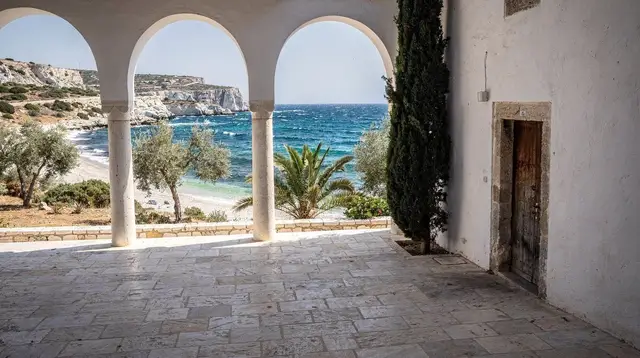
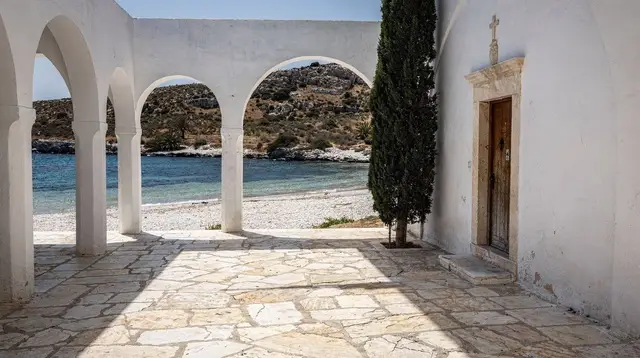
Toplou stands alone on a windswept plateau a short drive from the coast road that runs toward Vai, a fortress-like building with thick walls that speak to a long history of pirate raids and Ottoman-era sieges. That defensive architecture is not decorative: this corner of the coast absorbed real incursions over centuries, a history covered in more depth in a guide to Venetian Crete, 1204 to 1669. It functions today as it has for centuries: a working Orthodox monastery with resident monks, regular services, and a katholikon — the main church — that visitors are invited into on the same terms as any other active place of worship in Crete.
That status is the single most important thing to understand before arriving. Toplou is not run as a heritage attraction with a visitor centre and a gift-shop version of religious life bolted on. It is a functioning monastic community that happens to also welcome tourists, and the dress code follows from that fact rather than from an arbitrary rule. Shoulders and knees must be covered, for men and women alike, before entering the church and the monastery buildings.
This is the same expectation you meet at Arkadi in the Rethymno mountains and at Preveli above the Libyan coast — three monasteries, one standard, applied without exception because it reflects what the building actually is, not a tourist-facing performance of tradition.
In practice this is easy to solve and hard to improvise around at the gate. A light scarf or sarong that covers the shoulders, and trousers or a long skirt rather than shorts, will get anyone through the door. Some monasteries keep wraps on hand for visitors who arrive unprepared, but relying on that is a gamble on a busy day. The simplest fix is to keep a cover-up layer in the car for the whole trip through east Crete, since the same rule applies at Toplou and will apply again at any other monastery on the itinerary — including the Toplou-focused wine and history tours that some visitors combine with the palm beach further along the coast.
Beyond the dress code, Toplou is worth entering for its own sake: an icon collection, a long-inhabited feel that newer buildings cannot fake, and a position on the map that makes it a natural first stop before the coast road continues out to the palms. Treat the visit at a monastery’s pace — quiet, unhurried, not squeezed into ten minutes between a parking spot and a beach towel — and the contrast with Vai later in the day works in the itinerary’s favour rather than against it. The same windswept plateau supports a scrubby, wind-pruned flora that rewards a slow look while you are there, and readers curious about the island’s flowering seasons more broadly can turn to wildflowers and herbs of Crete.
That same scrubby, wind-pruned ground also supports some of the island’s more elusive wildlife, a subject covered more broadly in kri-kri and Cretan wildlife, and the herbs that colour the plateau in spring are often the same ones that turn up in local honey, the subject of honey and herbs of Crete.
Toplou’s terrain is worth flagging for anyone with mobility limitations: the monastery sits on an uneven plateau, and its courtyard and church involve worn stone flooring and low thresholds rather than a flat, step-free path throughout. Travellers planning a trip around mobility needs more broadly may find it useful to read the site’s guide to accessible travel in Crete before committing to this leg of an east-Crete day, since Toplou is not the easiest stop on the island for a wheelchair or a walker.
Families travelling with young children face a related calculation of their own, and the practical notes in Crete with kids are worth reading before committing a full day to a stop that asks for patience rather than play.
Travellers weighing the physical demands of the wider trip, not just this one stop, may find the broader overview in safety and health in Crete useful before committing to a full day on foot in the heat.
a private tour that pairs Toplou with a wine tasting nearby is one way to give the monastery visit the time it deserves before continuing to the coast.
Vai: Europe’s largest natural palm forest, not a scenic backdrop
From Toplou the road continues roughly ten kilometres to Vai, on the eastern tip of the Lasithi peninsula. What sets Vai apart from every other beach in Crete is not the sand or the water but what grows behind it: a dense natural forest of Phoenix theophrasti, a palm species endemic to Crete and found in only a handful of places on the island.
It is widely described as the largest natural palm forest in Europe, and whether or not that exact ranking holds up to the letter, the scale of it is genuinely unusual — thousands of palms growing wild, not planted for effect, forming a canopy that runs back from the beach rather than fringing it decoratively. That density of palm against open sand is part of why this stretch of coast turns up repeatedly on round-ups of photography spots in Crete.
The same species grows at Preveli, on the Libyan coast near Plakias, where a smaller palm grove lines the mouth of a gorge below another working monastery. Vai and Preveli are the two places on Crete where this endemic palm forms a real forest rather than a scattered handful of trees, and the two sites are often compared for that reason. Preveli’s grove burned in 2010 and has regrown since; Vai has kept its canopy largely intact, which is part of why its protected status is taken seriously.
That 2010 fire is covered in more detail in a short piece on how Preveli burned and grew back, which is a useful comparison for anyone assuming Vai’s own palms are somehow immune to the same risk simply because they have not burned in recent memory.
That protection is not symbolic. Vai’s forest is fenced, and access into and around it is managed rather than open to wander freely off any path that looks interesting. Camping is banned inside the site — this is not the place to pitch a tent for a free night by the beach, whatever informal habits might have existed there in past decades. The fence and the no-camping rule both exist for the same underlying reason: an endemic forest growing at the very edge of its natural range does not recover from repeated informal use the way a planted municipal park does. Readers who want the beach covered on its own terms, without the Toplou pairing built in, can turn to a dedicated Vai palm beach guide.
Visitors who come expecting an ordinary organised beach with palm trees as a photogenic extra sometimes find the managed, fenced character of the site surprising. Visitors who arrive already understanding that Vai is a protected forest with a beach attached, rather than a beach with some trees behind it, get more out of the visit and are less likely to be frustrated by rules that exist to keep the palms standing for the next generation of travellers.
The water off Vai is clear enough that some visitors bring a mask and fins, and the same stretch of coast turns up on general round-ups of snorkelling spots in Crete, though the beach itself is not marketed as a dedicated snorkelling site. Because the palm canopy shades only part of the sand, and because this corner of the island sits a long way from anywhere selling forgotten essentials, it is worth checking a general packing list for Crete before setting out rather than assuming a kiosk at the beach will cover every gap.
a direct day trip to the palm beach is worth considering for visitors based further west who want to see Vai without also covering the whole east-Crete loop by rental car.
Planning the day: order, timing, and what to pack
Most visitors who pair the two sites do Toplou first and Vai second, and there is a practical logic to that order beyond simple geography. Arriving at the monastery early in the day means cooler temperatures for standing inside a stone building with limited ventilation, and it means tackling the dress-code requirement while still in daytime clothing rather than trying to improvise a cover-up over a swimsuit later.
Vai as the second stop lets the day end at the beach, where a change into swimwear and a rinse in the sea make a natural close to the day rather than an awkward pivot back into “respectful visitor” mode. The same early-start logic holds across the shoulder months covered in best time to visit Crete, when cooler mornings make the monastery leg of the day noticeably more comfortable.
For the month-by-month detail behind that shoulder-season logic, see Crete weather month by month.
| Stop | What it requires | Rough order in the day |
|---|---|---|
| Toplou monastery | Shoulders and knees covered; a quiet, unhurried pace | First |
| Drive between the two | About 10 km on a paved road | Mid-morning |
| Vai palm beach | Beachwear, sun protection, no camping gear to set up | Second, into the afternoon |
A few practical notes worth carrying into the day. Bring a cover-up layer specifically for the monastery rather than assuming one will be available there. Bring your own water and sun protection for Vai, since the palm canopy offers patchy rather than complete shade and the site sits at the far eastern end of the island, a meaningful drive from the nearest towns of Sitia.
And treat both sites as places with their own rhythms rather than boxes to tick — a rushed fifteen minutes at each does neither one justice, and the whole point of combining them is that they offer two genuinely different kinds of experience in a single day: one contemplative and architectural, one natural and protected. Once the day itself is done, the island-wide primer on Cretan food and what to eat is a useful next stop for travellers heading back toward Sitia for dinner.
Dinner back in Sitia is also where two of the island’s more straightforward dishes are easiest to find: dakos and the Cretan mezze, and, at the end of the meal, the free pour explained in raki and tsikoudia explained.
Most visitors reach both sites by rental car, since the far east of Lasithi is not well served by scheduled buses and a self-drive day is the only way to control the order of the two stops. At Vai itself, the section of beach closest to the car park is typically run as an organised beach with sunbeds and umbrellas for hire, and it is worth knowing your rights on a Cretan organised beach before assuming the whole shoreline is either free or paid — Greek law guarantees a public strip and a clear path to the water even where operators have laid out loungers.
Travellers who would rather not drive the loop themselves have a broader option than the single Sitia-Vai-Toplou package mentioned below: private tours and drivers in Crete covers the wider range of guided and chauffeured alternatives across the island.
The mountain roads on this stretch reward a careful, unhurried style, covered in more detail in driving in Crete — including the local habit, explained in how Cretans drive, of pulling onto the hard shoulder to let a faster car pass, which is courtesy here rather than an invitation to overtake blind.
This page deliberately does not quote fixed opening hours or a specific entry price for either Toplou or Vai. Both can and do change by season and from year to year, and printing a number here that goes stale within months would do readers a disservice. Check current hours and any entry fee close to your visit date rather than relying on a figure fixed at the time this guide was last reviewed.
The same caution applies to any claim about how crowded Vai gets at a given time of year — visitor numbers shift with the season, the weather, and cruise ship schedules in ways that are not reliably captured by a single blanket statement, so this page will not offer one. Readers planning around the quieter months more broadly can check what actually shuts down in Crete in winter, since neither Toplou nor Vai is immune to the off-season thinning that affects the wider region.
Visitors arriving on a single day off a cruise ship, rather than as part of a longer island stay, face a different set of constraints, covered in one day in Crete from a cruise ship.
a private full-day trip covering Sitia, Vai and Toplou together takes care of the driving and sequencing for visitors who would rather not self-navigate the whole east-Crete loop.
What this day is not
It is worth being explicit about what this combination is not, because the two most common misreadings pull in opposite directions. It is not a simple beach day with an optional sightseeing stop tacked on — the dress code at Toplou is not negotiable and not a formality, and turning up in beachwear expecting to slip into the church anyway is the single most common way this day goes wrong.
And it is not an ordinary organised beach outing either, because Vai’s fenced palm forest and its no-camping rule mean it does not behave like the resort beaches further along the north coast at Gouves and Hersonissos or Stalida and Malia. Both halves of the day ask for a small adjustment in expectations, and both reward visitors who make it.
Whether that resort strip is worth a detour of its own, separate from this east-Crete day, is a question the site answers directly in is Hersonissos worth it.
For travellers building out a longer stay in the region, Vai and Toplou sit naturally inside a wider east-Crete loop that can take in Ierapetra and the boat crossing to Chrissi island, the Minoan site at Zakros, and the town of Sitia itself — covered in full in a dedicated Sitia town guide — with its own harbour and a slower pace than the north-coast resort strip.
Travellers still choosing a base for the wider region, rather than just for this one day, can compare options island-wide in where to stay in Crete, and those still deciding on the overall length of the trip may want to start with how many days in Crete.
The same loop also reaches naturally toward Agios Nikolaos, the gulf town most visitors use as a base for this side of the island, and on to Elounda and Spinalonga, where the former leper colony makes a very different kind of history stop from a working monastery. Inland from that same road, the hillside village of Kritsa makes a quieter detour of its own, with a Byzantine church and a weaving tradition rather than another monastery or another beach.
A dedicated guide to Spinalonga island and a practical note on which boat to take there are worth reading before adding it to the same trip. Inland, the Lasithi plateau and the Dikteon cave offer a third kind of day entirely — mountain rather than coast or monastery — and a Lasithi plateau day loop pairs about as easily with Sitia as Toplou and Vai do with each other.
Travellers whose interest in the east leans more toward the Minoan world than beaches or monasteries might prefer to frame the same region around a five-day Crete archaeology itinerary, which uses Zakros and the palace sites of the centre as its spine rather than building the days around Toplou and Vai.
An east Crete itinerary of around four days or the shorter Lasithi and the east in three days both give this corner of the island the time it needs rather than squeezing it into a single rushed loop from Heraklion.
Other monasteries and wine stops in the region make good additions to the same trip. A Sitia wine and olive oil detour pairs naturally with the monastic setting of Toplou, which has its own long history of wine production on the plateau around it, and travellers curious about Cretan wine regions and grapes more broadly will find the east a quieter, less-visited counterpart to the better-known vineyards around Peza and Archanes.
Beyond the glass, the same region’s olive presses are worth a stop in their own right, covered in Cretan olive oil mills and tastings.
For a broader sense of what to expect and avoid across the island, the guide to common mistakes to avoid in Crete and the practical notes on tipping, money and prices are useful companions before setting out. Budget-conscious travellers piecing together a longer trip may also find the cheapest week in Crete a useful companion to those same practical notes.
For travellers who would rather see this part of the island alongside other Minoan and monastic sites in one guided day, tours built around monasteries and churches across Crete, including options that combine Toplou with Arkadi and the pottery village of Margarites further west, offer a way to see several working religious sites without doing all the driving and route-planning alone. The pottery tradition itself, beyond a quick stop at the village, is covered in more depth in Margarites pottery and Cretan crafts.
a tour linking Arkadi monastery with Margarites and Melidoni gives a sense of how this same dress-code etiquette carries across the island’s other monastic stops, well beyond just Toplou and Vai.
Sitia, Vai and Toplou: questions travellers ask
Do I need to cover up to enter Toplou monastery?
Yes. Toplou is an active Orthodox monastery, not a museum, and it enforces the same dress code as Arkadi and Preveli: shoulders and knees covered for everyone. A shawl or a light long-sleeve layer in the car solves this in seconds.
Is Vai beach the same as Preveli beach?
No, but the trees are related. Both grow the same endemic species, Phoenix theophrasti, and both forests are protected. Vai, in the far east near Sitia, is the larger of the two and is fenced, with camping prohibited; Preveli, on the Libyan coast near Plakias, is the other main stand.
Can I camp overnight at Vai?
No. Vai’s palm forest is a protected natural area and camping is banned inside it. Overnight sleeping on the beach or among the palms is not tolerated, and the nearest towns with accommodation are Sitia and Palekastro.
What time do Toplou monastery and Vai beach open and close?
This page does not quote fixed hours because both can change by season and by year. Treat any hours you read online as provisional and be ready to visit either site outside a strict midday window if needed.
How much does it cost to enter Toplou monastery or Vai beach?
This page does not quote a specific entry price for either site, since fees can change. Bring some cash for a monastery donation or ticket and expect an organised-beach fee structure at Vai rather than a free-for-all stretch of sand.
Is Vai always crowded?
This page will not put a number on how busy Vai gets, because visitor counts shift by month, weather and cruise schedules and nothing here has been freshly verified. Treat any specific crowd claim you read elsewhere with the same caution.
How far is Vai from Toplou monastery?
Roughly 10 km separate them on the eastern tip of the Lasithi peninsula, a drive of well under half an hour on a paved road, which is what makes combining the two in one day straightforward.
Can I swim right after visiting the monastery, still in monastery clothes?
You can, but plan the order and pack a change. Most visitors do Toplou first while still fresh and modestly dressed, then drive to Vai and change into beachwear there rather than trying to cover up over swimwear at the monastery gate.
Is Toplou monastery accessible for visitors with mobility issues?
Not fully. The monastery sits on an uneven plateau and its courtyard and church have worn stone flooring and low thresholds rather than a flat, step-free route throughout, so travellers planning around mobility needs should treat it as a moderately challenging stop rather than assume full accessibility.
Do I need a rental car for this day, or can I get to Toplou and Vai without one?
A rental car is close to essential. The far eastern tip of Lasithi is not well served by scheduled public transport, and controlling the order of the two stops — monastery first, beach second — is much easier with your own vehicle or an organised tour than by trying to piece together buses.
Monastery Tours in Crete on GetYourGuide
Verified deep-linked GetYourGuide tours. Book through these links and we earn a small commission at no cost to you.
GetYourGuide does not provide a product photo for this activity — the image shows the meeting point, photographed by us.