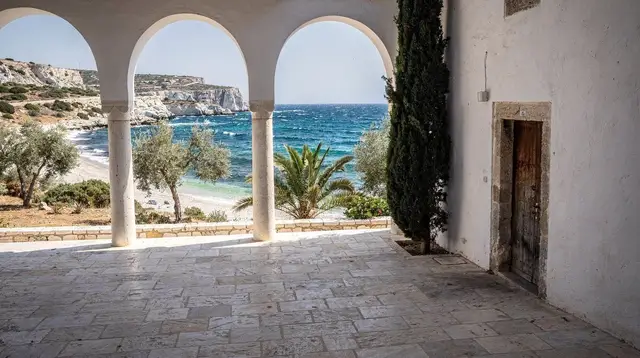
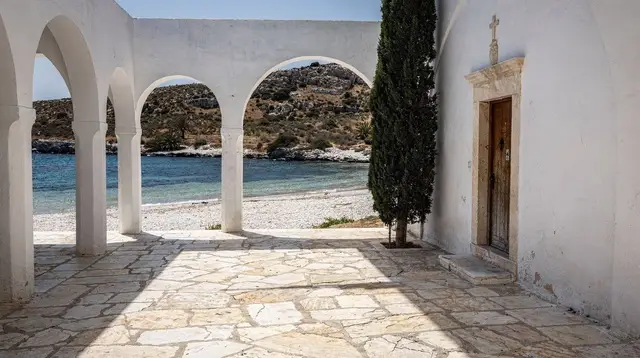
Preveli Monastery and Palm Beach
Are Preveli monastery and Preveli beach the same visit?
No. Preveli monastery sits on a headland above the Libyan Sea, and the palm-lined beach is a separate stop a short drive and a steep path below it, at the mouth of the Kourtaliotiko gorge. Most visitors treat them as two stages of one day rather than a single site.
Monastery or beach: why the question is the wrong one
Type “Preveli” into a search bar and two very different pictures come back: a whitewashed monastery on a clifftop, and a river running through a palm grove to the sea. Visitors often arrive expecting one site with two attractions folded together, and it is worth being clear from the start that this is not what you will find. Preveli is a headland on the Libyan coast of the Rethymno regional unit, and the monastery and the beach sit at different points along it, separated by a drive and then a walk. You do not stumble from the chapel courtyard onto the sand. Understanding that split early changes how you plan the day, how you dress, and how much time you actually need.
The monastery, Moni Preveli, is a working religious community with centuries of history behind it and a strict dress code. The beach, reached by descending toward the mouth of the Kourtaliotiko gorge, is a swimming stop shaded by a palm grove that is nowhere near as old or as untouched as the photographs suggest. Both are worth your time. Neither substitutes for the other, and treating them as one stop is the most common way visitors shortchange themselves here.
The palm grove is regrowth, not an untouched jungle
The single fact most visitors get wrong about Preveli is the age and character of its palm grove. It looks, in the right light and the right crop of a photograph, like a slice of tropical forest that has always been there. It has not. In 2010 a wildfire burned through the grove at the mouth of the gorge, and what stands today along the Megas Potamos river is regrowth from that fire, more than a decade of recovery rather than an ancient, undisturbed stand of palms.
The species itself is genuine and locally significant: Phoenix theophrasti, a palm endemic to Crete and found nowhere else in the wild except a handful of other Cretan river mouths and, at the far eastern end of the island, at Vai, which holds the largest natural palm forest in Europe. Preveli and Vai share the same species and little else.
Vai’s grove is larger, flatter, fenced for protection, and easier to walk through in full; Preveli’s is smaller, threaded along a river through the base of a gorge, and reached by a proper descent rather than a level stroll. If you have already built up an image of Preveli from a filtered photo of dense green fronds arching over turquoise water, it is worth resetting that expectation. What you will see is real, recovering nature on a working riverbed, not a garden maintained for visitors and not an intact tropical jungle.
Camping in the grove or on the beach is banned, a rule tied directly to the fire and the slow recovery since. Rangers do check in season, and the nearest legal beds are in Plakias or the villages above the coast, a short drive away.
A working monastery, with its own rules
Moni Preveli is not a museum piece kept open for tourism. It is an active Orthodox monastery, home to a small community, and it expects visitors to behave accordingly. The dress code is strict and enforced the same way it is at Arkadi and at Toplou in the far east: shoulders and knees covered, for men as well as women. Wraps are usually available near the entrance for anyone who turns up in beachwear, but it is far simpler to carry a light shirt or wrap in the car and change before you go in, rather than borrowing a communal cover-up on a hot day.
Inside, the courtyard is quiet, shaded by trees, and looks out over the sea from a genuinely striking clifftop position. There is a small museum with icons, manuscripts and relics, and the monastery’s own history is tied into the island’s resistance during the Second World War: Cretan monks here sheltered Allied soldiers after the Battle of Crete in 1941, at real risk to themselves, a chapter of the site’s history that is easy to miss if you only come for the view. Plan on 45 minutes to an hour to see the church, the museum and the grounds properly without rushing.
Two visits, not one day-long stop
Because the monastery and the beach are physically separate, the practical way to think about a visit is as two stages of the same outing rather than one continuous stop. Most people arrive at the monastery first, since it sits above and slightly inland from the beach access point, spend under an hour there, then drive down toward the parking areas signed for Palm Beach or Finikas, and walk down from there.
The path down is stepped, uneven in places, and takes roughly 15 to 20 minutes at an unhurried pace, more in the midday heat of July or August. Coming back up takes longer and is the part visitors underestimate, since there is no shade on most of the climb and the sun on this south-facing coast is direct. A summer shuttle boat crosses from a small jetty near the lower parking area for a modest fee, and taking it back up is a popular way to skip the return climb after a day at the beach. It runs in season only and is worth checking on arrival rather than assuming.
A half day covers the essentials — monastery, descent, an hour or two at the beach, climb or boat back up — but a full day gives you room to actually swim, eat at the small seasonal snack bar near the beach, and not feel rushed on the path.
Getting there and getting around once you arrive
Preveli sits on the south coast of the Rethymno regional unit, reached by the road that climbs and drops through the hills above Plakias and past the turning for the Kourtaliotiko gorge. From Rethymno town the drive takes roughly an hour on mountain roads that are narrow in places, with the usual local habit of pulling onto the hard shoulder to let a faster car pass — a courtesy, not an invitation to overtake blind. A rental car is the practical way to reach Preveli independently; there is no train on Crete and the coach network south of the mountains is thin and seasonal, so the KTEL buses are not a realistic option for this particular trip.
If driving and finding parking for two separate stops does not appeal, an organised excursion folds the monastery, the gorge and the beach into a single planned day. A tour along the route covering Preveli’s palm beach and monastery alongside Bali and Panormos handles the driving and the logistics of both stops in one trip, which is useful if your week also includes the north coast. For visitors staying around Chania rather than Rethymno, a private tour of the southern coast that includes Preveli beach covers the longer distance without the driving yourself.
When to go and what to expect
May through October is the workable season for both halves of this visit. The monastery is open year-round, but the beach access point, the shuttle boat and the small food stalls near the water largely run to the same season as the rest of the south coast’s tourist infrastructure, meaning they thin out or close from November through March.
Midsummer, July and August, brings the heat you would expect on a south-facing coast with almost no shade on the descent, so an early start avoids both the worst of the sun on the path and the busiest midday crowds at the water. Spring and early autumn — May, June, September, into early October — offer a gentler climb, thinner crowds and a Libyan Sea that is genuinely swimmable, often calmer than the north coast when the meltemi wind is blowing there in July and August.
Nearby: the gorge, Plakias and Spili
Preveli rarely stands alone on an itinerary, and it does not need to. The Kourtaliotiko gorge, which the Megas Potamos river runs through on its way to the palm beach, has its own short walk and waterfall worth a stop on the drive down. Plakias, the small resort town a short drive west, makes a sensible base for the night if you are not day-tripping from Rethymno or Chania, with its own beaches at Damnoni close by.
Inland, the hill village of Spili, known for its Venetian fountain with lion-head spouts, and Agia Galini further east along the coast both fit naturally into a loop that takes in Preveli without retracing the same road twice.
A tour built specifically around this stretch, the Kourtaliotiko gorge and Preveli palm beach itinerary with a mitato stop, adds a visit to a traditional shepherd’s hut, a mitato, along the way, which is a good way to see something of the pastoral side of this part of Rethymno rather than only the coast.
Preveli compared with Vai
Because the two sites share the same endemic palm, comparisons come up often, and the honest answer is that they suit different trips. Vai, at the eastern tip of the island near Sitia, is flat, fenced, and easy to walk through in full in under an hour; it is the larger of the two groves by a wide margin and the more straightforward beach day.
Preveli is smaller, involves a real descent and climb, and sits within a working gorge landscape rather than a flat coastal plain. If your trip only reaches the west and centre of Crete, Preveli is the palm beach you will actually get to. If you are covering the whole island end to end, seeing both makes the contrast between the two groves clear rather than taking either on faith.
Booking a tour instead of driving yourself
For visitors without a rental car, or who would rather not manage two separate stops and a steep path on their own schedule, several tours package Preveli with the surrounding landscape.
A half-day trip built around the Preveli beach excursion focuses on the palm grove and the swimming stop with less time on the road, while a jeep safari linking Preveli with Lake Kournas and inland gorge villages suits travellers who want the off-road, back-roads version of the day rather than a straightforward coach transfer. Both leave the driving, the parking and the timing of the monastery-then-beach sequence to someone else, which on a narrow mountain road is not nothing.
Preveli monastery and palm beach: your questions answered
Are the Preveli monastery and Preveli beach the same place?
No. The monastery, Moni Preveli, stands on a headland with sea views over the Libyan Sea. The beach, fed by the Megas Potamos river at the foot of the Kourtaliotiko gorge, is several kilometres away by road, then a steep 15 to 20 minute path down. Plan them as two stops, not one.
Is the Preveli palm grove a natural, untouched jungle?
No. It is a genuine stand of Phoenix theophrasti, a palm species endemic to Crete, but it burned in a wildfire in 2010 and has regrown since. What you walk through is recovering nature on a working river delta, not an untouched tropical forest and not a garden planted for visitors.
What is the dress code at Preveli monastery?
Covered shoulders and knees, for both men and women, as at Arkadi and Toplou. Wraps are usually available at the entrance for visitors who arrive in beachwear, but it is easier to carry a light cover-up and change before the monastery rather than after the beach.
How do you get from the monastery to the beach?
By car, following signs down toward Palm Beach or Finikas parking, then on foot down a stepped path of roughly 15 to 20 minutes each way. A summer shuttle boat also crosses from a jetty near the parking area for a small fee, cutting out part of the walk back up.
Is Preveli beach the same as Vai beach?
No, though they share the same endemic palm, Phoenix theophrasti. Vai, at the eastern tip of Crete near Sitia, is the larger natural palm forest in Europe, fenced and flat. Preveli’s grove is smaller, follows a river through a gorge mouth, and involves more walking to reach.
Can you swim at both the monastery and the beach?
Only at the beach. The monastery has no swimming access; it is a religious site on a clifftop. The beach below, where the river meets the sea, is the swimming stop, with a mix of river pools, brackish shallows and open sea.
Is camping allowed at Preveli beach?
No. The palm grove and the beach behind it are within a protected area, and camping is banned to protect the regrowth after the 2010 fire. Rangers patrol in season, and the nearest legal accommodation is in Plakias or the villages above.
How much time should I set aside for Preveli?
A half day at minimum: roughly 45 minutes to an hour at the monastery, 30 to 40 minutes on the path down and back, and however long you want at the beach. Many visitors combine it with Plakias or the Kourtaliotiko gorge to fill a full day.
Monastery Tours in Crete on GetYourGuide
Verified deep-linked GetYourGuide tours. Book through these links and we earn a small commission at no cost to you.
GetYourGuide does not provide a product photo for this activity — the image shows the meeting point, photographed by us.