A village with no road, and the harbour that serves it
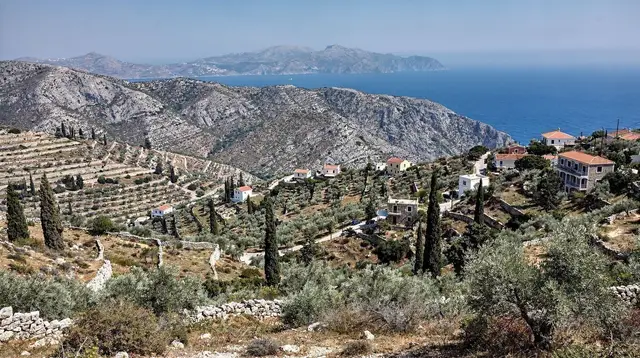
Crete is already a place where the train never arrived and the KTEL coach network thins out fast once you cross the mountains south of the VOAK highway. Sfakia takes that a step further. Loutro sits on a small bay backed by cliffs, and no road has ever reached it - not a dirt track, not a goat path wide enough for a car. The only ways in are the passenger ferry that runs the Sfakia coast, or your own two feet on the coastal path from Chora Sfakion or from Agia Roumeli. There is no workaround, no local fixer who can drive you down, and no version of this trip that ends with a rental car parked outside your room.
Chora Sfakion, twelve minutes by boat or an hour and a quarter by mountain road from Chania, is a different kind of place: a working harbour town with a car park, a bus stop and a proper road connection north. It matters for a reason that has nothing to do with its own beaches - it is one of three landings where the Samaria gorge walk actually ends.
Why Chora Sfakion is a Samaria gorge exit point
Walk the Samaria gorge and you do not walk back out. The trail runs one-way, sixteen kilometres downhill from the Omalos plateau to Agia Roumeli, a village on the Libyan Sea that also has no road. From there, hikers board a small ferry, and that ferry has three possible landings going east to west: Chora Sfakion, Sougia and Palaiochora. Whichever one your bus company or your own planning has chosen, the boat is followed by a coach ride back over the mountains to Chania, Rethymno or wherever the day started.
Chora Sfakion is usually the shortest of the three boat legs from Agia Roumeli and the one most day-tour operators from Chania build their itinerary around, but it is not automatically the fastest way home - the road out of Sfakia climbs a genuinely spectacular switchback pass, and the coach connection afterwards still takes over an hour to reach Chania. Anyone booking a Samaria day trip should check which exit port their operator uses; Sougia and Palaiochora put you further west and change the return drive accordingly.
For the walk itself, the complete Samaria gorge guide and the Chania-departure logistics guide cover timing in full, and travellers who want the short version of the walk rather than the full descent should read about the easy Samaria route from Agia Roumeli before assuming “Samaria” always means the whole gorge.
The three exit ports from Agia Roumeli
| Exit port | Typical boat time from Agia Roumeli | What follows |
|---|---|---|
| Chora Sfakion | ~1h15 | Coach over the mountains, roughly 1h-1h30 to Chania |
| Sougia | ~45min | Coach north via Chania, similar overall trip length |
| Palaiochora | ~1h30 | Coach north, usually the longest full return day |
Getting to Loutro: boat or on foot, nothing else
The regular passenger ferry along this stretch of coast links Chora Sfakion, Loutro, Agia Roumeli, Sougia and Palaiochora in season, so the simplest way into Loutro is to buy a short ferry ticket at the Chora Sfakion quay and step off less than an hour later on Loutro’s own tiny jetty. Several day-boat operators also run direct there from further afield, including trips that start in Rethymno and call at Plakias and the Glyka Nera beaches on the way, which is a good option for anyone based on the north coast who does not want to drive to Sfakia at all - see the Rethymno cruise that takes in Bali, Panormos and Loutro in one day.
Walking in is the other legitimate option, and it is a real hike, not a stroll: the coastal path from Chora Sfakion to Loutro takes a good hour and a half over exposed, rocky ground with almost no shade, and should not be attempted in the middle of a July afternoon. A more rewarding walking route drops into Loutro from above, down the Aradena gorge, which starts near the old stone bridge at Aradena village and finishes on Loutro’s waterfront - a half-day hike best done with transport arranged at both ends, which is exactly what the Aradena Gorge to Loutro hike with optional pickup is built for.
What does not exist, and never will, is a road. Do not book accommodation in Loutro expecting to drive your rental car to the door, and do not plan to leave a car parked there overnight - there is nowhere for it to be. The dedicated guide to Loutro as a car-free village goes through exactly what that means for luggage, for arriving after dark, and for anyone who needs step-free access.
Season: when the boats actually run
The ferries along this coast are a May-to-October operation. Outside that window, sailings thin drastically or stop, the Samaria gorge itself is closed for the winter, and much of what makes a stay in Loutro or a stopover in Chora Sfakion worthwhile - the tavernas, the boat trips to nearby coves, the connecting hikes - shuts down with it. If a visit here matters to your trip, build it inside the same May-October window that governs the rest of the south-west, and check current sailing times locally rather than assuming a printed summer schedule holds into the shoulder months.
July and August bring the meltemi, the strong seasonal north wind that can cancel boat trips to Balos, Gramvousa and Chrissi on the north and east coasts. The Libyan Sea side of the island, where Loutro, Chora Sfakion, Sougia and Palaiochora all sit, is sheltered from that wind by the White Mountains and routinely stays calmer when the north coast is churned up.
That is a real, useful piece of planning logic, not a marketing line - a windy week in Chania or Rethymno is a reasonable moment to look south instead. It is also why boat trips out of Chora Sfakion toward Loutro and the Glyka Nera beaches keep running through weeks when north-coast operators are cancelling, covered further in the guide to Crete in July and the meltemi.
What to actually do here
Loutro’s own beach is small and pebbly, more of a swimming spot in front of the tavernas than a destination beach, and most visitors treat it as a base for short boat hops rather than a place to lie on sand all day. The better beaches sit a short caique ride away: Glyka Nera, whose name means “sweet water” after the freshwater springs that seep through the pebbles, and Marmara, both reachable on foot along the coastal path or, more comfortably, on the Glyka Nera, Loutro and Sfakia day trip from Rethymno.
From Chania, several operators run a straightforward day out that combines the boat crossing with time in Loutro and on the beaches around it - useful for a first visit, and a way to see this coast without committing to an overnight stay. Compare the Loutro Beach Sfakia day tour from Chania against the Loutro Beach day trip departing Chania - both cover similar ground, so the choice usually comes down to boat, timing and group size.
Travellers who want to pair Loutro with a proper Byzantine-fortress beach further east can look at the tour combining Loutro and Frangokastello beach in one day, which also gives a look at Frangokastello without a separate drive.
Chora Sfakion itself is worth an hour beyond the ferry queue: a small castle above the harbour, a working fishing fleet, and tavernas that serve the lamb dishes this region is known for. It is also the practical jumping-off point for wider south-coast exploring - operators based here run trips further along the coast under names like Plakias tours discovering the wild south coast, which reach beaches and coves that have no road access at all, in keeping with everything else about this stretch of Crete.
Anyone who has already walked Samaria and wants a second, quieter gorge nearby should look at the Imbros gorge, which finishes close to the Sfakia road and is a realistic half-day add-on, or read about the Glyka Nera and Sfakia beaches as a group before deciding which cove to prioritise.
Where to stay, and how long to give it
Chora Sfakion has more rooms, more choice, and a car park - the practical base if you are combining this area with a wider south-coast loop or need to keep a rental car with you. Loutro has a handful of small family-run hotels and studios right on the waterfront, no cars, no motorbikes, and evenings that genuinely go quiet once the day-boats leave. One night in Loutro is enough to feel the difference; two lets you add the Aradena gorge walk or a slow day doing nothing but swimming off the rocks.
| Base | Access | Best for |
|---|---|---|
| Chora Sfakion | Paved road from Chania (~1h15) | A car, a Samaria exit stop, a south-coast loop |
| Loutro | Boat or foot only | A genuine car-free night, Aradena gorge finish |
Budget for a day here in the €40-90 range per person once you add a ferry ticket, a taverna lunch and any onward boat trip; accommodation in Loutro tends to sit a little above nearby resort-strip prices precisely because everything - food, linen, fuel for the generator on older properties - arrives by the same boat you did.
What this is not: a base for seeing the rest of Crete
It is worth being blunt about this, because the geography invites a mistake. Sfakia sits on the south coast, hemmed in by the White Mountains, and it is genuinely remote from the rest of the island - Chania to Sitia is roughly 270 km and takes over four hours even without a stop, and Chora Sfakion adds a further mountain crossing on top of that. Do not plan a week based here with day trips to Heraklion, Knossos or the east; those belong to a different leg of an itinerary, not this one. Sfakia rewards visitors who come for the Samaria connection, the boat-only villages and the quiet beaches, and who accept that reaching anything beyond this corner means putting real hours back on the road.
If you are driving yourself, the mountain road down to Chora Sfakion is well paved but narrow with sharp switchbacks, and the local habit of pulling onto the hard shoulder to let faster traffic pass is courtesy, not an invitation to overtake blind - see driving in Crete before tackling it for the first time, and renting a car in Crete for what a Sfakia-bound rental should and should not include. Travellers without a car can still make this work: the KTEL bus guide covers the seasonal coach service down to Chora Sfakion, though it runs far less often than the north-coast routes.
For a structured way to fit this corner into a longer trip, the White Mountains and Sfakia three-day itinerary and the broader south coast six-day itinerary both build in the drive times honestly, and the best time to visit Crete guide is worth reading alongside the May-October ferry window above.
Background on why the gorge walk ends the way it does is covered in why Samaria ends with a boat, and the wider pattern of boat-only villages along this coast is explained in the south coast boat network. If you would rather someone else navigate the pass, browse things to do around Loutro and Chora Sfakion for organised alternatives, and how Cretans drive is genuinely useful reading before the switchbacks.
Loutro and Chora Sfakion: frequently asked questions
Can you drive to Loutro?
No. Loutro has no road connection of any kind, for cars, motorbikes or any other vehicle. The village is reached only by the coastal ferry or on foot, either along the coastal path from Chora Sfakion or down the Aradena gorge.
Is Chora Sfakion the only place to get off the boat after Samaria?
No. Chora Sfakion is one of three landing points for hikers finishing the Samaria gorge at Agia Roumeli, alongside Sougia and Palaiochora. All three are followed by a coach connection north; which one you use depends on how your tour or transport was booked.
When do the ferries between Chora Sfakion and Loutro run?
The passenger ferry service along this coast operates from roughly May to October. Outside that season sailings are far less frequent or stop entirely, in step with the Samaria gorge’s own May-to-October opening window.
Is the south coast calmer than the north coast in summer?
Often, yes. The meltemi, a strong north wind that picks up in July and August, is blocked to a large degree by the White Mountains, so the Libyan Sea side around Loutro and Chora Sfakion regularly stays swimmable and the boats keep running when north-coast crossings to places like Balos are cancelled.
Can I use Chora Sfakion or Loutro as a base to see the rest of Crete?
Not comfortably. This is a remote corner of the island - Chania to Sitia is over four hours by road, and Sfakia adds a mountain crossing before you even reach the north coast highway. Treat this area as its own short stop rather than a hub for day trips across Crete.
What is there to do in Loutro besides swim?
Short caique rides to the Glyka Nera and Marmara beaches, the coastal walk to and from Chora Sfakion, and the Aradena gorge hike that finishes on Loutro’s waterfront are the main activities, alongside simply spending an evening in a village with no traffic at all.
How long should I spend here?
A single day trip from Chania or Rethymno is enough to see Loutro and swim at a nearby beach. One or two nights lets you add the Aradena gorge walk and experience the village once the day-boats have left.
Is this a good stop after hiking Samaria?
Yes, if your exit port is Chora Sfakion. Many visitors combine the two: walk the gorge to Agia Roumeli, take the boat to Chora Sfakion, and either continue straight to Chania or take a short extra ferry hop to Loutro for the night before heading north the next day.