Crete in July and the Meltemi Wind
What is Crete like in July?
July is the hottest, busiest and most expensive month, with daytime temperatures of 30-35°C and higher in a heatwave. A strong north wind called the meltemi blows through July and August, regularly cancelling boats to Balos, Gramvousa and Chrissi while leaving the south coast on the Libyan Sea much calmer.
The Short Version: Hot, Crowded, and Windier Than You’d Guess
July is peak Crete. It is the month most first-time visitors picture: long days, a sea that has finally warmed up, and tavernas full past midnight. It is also the month where the island’s two least forgiving features show up at the same time — heat that climbs past 30°C most afternoons, and a wind that can flip a planned boat trip into a cancelled one with a day’s notice. Neither is a reason to avoid July. Both are reasons to plan around them rather than be surprised by them. For a full month-by-month comparison across the year, see Crete weather month by month; this page stays on July specifically, and on the wind that defines it.
How Hot July Actually Gets
Daytime temperatures in Crete in July typically run 30-35°C, and during a heatwave they push well past that for several days in a row. Heraklion and the inland wine villages around Archanes and Dafnes tend to run a touch hotter than the coast, and the far east around Ierapetra is the warmest corner of the island. Humidity is generally low compared with a heatwave further north in Europe, which makes the heat more bearable in the shade but does nothing to help a midday walk with no shade at all — the paved courtyards of Knossos, for instance, have almost none.
The practical response every local guide gives is the same one: move the outdoor half of the day earlier. Ruins, gorges and old-town walking belong in the morning, roughly 8am to noon; the afternoon is for the beach, a shaded taverna, or an air-conditioned museum such as the Heraklion Archaeological Museum, which is also where the real Knossos frescoes live, since the ones on-site are replicas. A car left in direct sun for an afternoon is genuinely unpleasant to get back into; parking in shade, where you can find it, is worth the extra two minutes of walking.
The Meltemi: What It Is and Why It Matters
The meltemi is a strong, dry wind out of the north that builds over the Aegean through the summer and peaks in July and August. It is not a storm in the dramatic sense — the sky usually stays clear and the temperature does not drop much — but it can blow hard and steadily for two, three, sometimes several days at a stretch before easing off. On the exposed north and west coasts of Crete it whips up a real chop; it can also make an otherwise pleasant beach day windier than expected, with sand blowing across an open stretch of shore.
For a driver, the meltemi mostly shows up as a steering-wheel nuisance on exposed coastal roads and a reason to hold onto beach umbrellas. For anyone with a boat trip booked, it matters far more directly.
What the Meltemi Cancels: Balos, Gramvousa and Chrissi
Three of Crete’s best-loved boat trips sit in exactly the kind of open, exposed water the meltemi hits hardest, and all three get cancelled regularly in July and August:
| Destination | Where it sits | Why the meltemi affects it |
|---|---|---|
| Balos lagoon | Crete’s north-west tip | Fully exposed to the north wind, shallow water turns choppy fast |
| Imeri Gramvousa | Same boat route as Balos | Same open crossing from Kissamos |
| Chrissi island | Open water south of Ierapetra | Long crossing with no shelter from a strong blow |
When the wind is up, boat operators simply do not sail — this is a safety call, not a customer-service one, and it is standard for the trip to be refunded or rebooked rather than run anyway. It is worth checking the forecast and the operator’s status the evening before, especially if a boat day is the one fixed plan in an otherwise flexible week.
A rental car cannot substitute for the Balos boat: the alternative land route is an unpaved track that most rental contracts exclude from cover, which is its own reason to read Balos lagoon: boat or road before deciding. For Chrissi specifically, Chrissi island: a day trip covers what the crossing involves and how to tell in advance whether the day looks sailable.
None of this means a July trip has to be built around hoping the wind stays down. If a boat day is important, it helps to slot it early in the stay rather than on the last full day, so a cancellation still leaves room to try again.
a day trip down to Elafonissi’s pink-tinged sand, further south and less exposed to the worst of the wind, is a useful fallback for a blustery north-coast day, though it comes with its own caution: the pink is patchy rather than saturated, and removing sand or shells from this protected site is illegal.
Why the South Coast Stays Calmer
Crete’s spine of mountains — the Lefka Ori (White Mountains) in the west and the Psiloritis massif in the centre — does more than look dramatic from a rental car window. It also acts as a genuine windbreak. A meltemi blowing hard enough to cancel the Balos boat can leave the Libyan Sea coast almost untouched, which is the single most useful piece of local knowledge for deciding where to spend a windy July day.
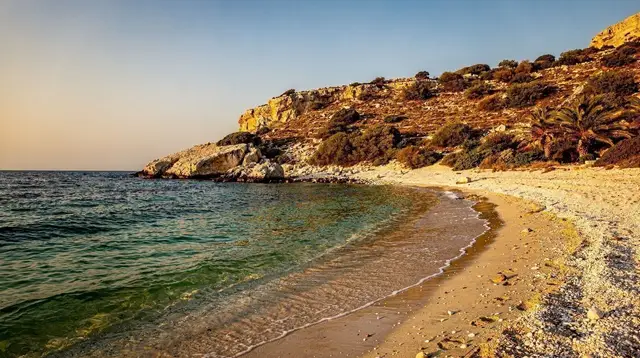
In practice that means beaches such as Plakias and Damnoni on the Rethymno coast, Agia Galini further east, and the stretch around Ierapetra tend to stay swimmable and sunbathe-able when the north coast is a flag-snapping mess. This is not a rule that holds every single day — a meltemi can occasionally reach the south too — but it is reliable enough that locals plan around it, and it is the reasoning behind the comparison in north coast versus south coast Crete.
A private day trip to a handful of south-coast beaches is a straightforward way to chase the calm side of the island without having to gamble on the forecast yourself, and it also solves the driving: some of the best south-coast approach roads are narrow and switchbacked, which is more relaxing as a passenger than behind the wheel on a hot afternoon.
The Sea Keeps Warming After July
July’s sea is already comfortable for swimming, but it is not the warmest point of the year. Water temperature in Crete peaks later, in August and September, once the sea has had the whole summer to absorb heat — which is worth knowing if a slightly warmer sea, rather than the absolute peak of crowds, is the priority. Crete in August and Crete in September cover how those two months compare on heat, wind and price against the July peak.
Samaria Gorge: Open, With Conditions
July sits comfortably inside the Samaria season, which runs roughly May to October, so the gorge is normally walkable. The park authority does close it on short notice, though, most often for wildfire risk during a hot, dry stretch or after heavy rain raises flood risk on the gorge floor — conditions that can appear with little warning in high summer. Checking the gorge’s open status the day before a planned walk is worth the two minutes it takes, rather than driving up to the Xyloskalo at Omalos to find the gate closed.
A guided hike through Samaria takes care of the logistics that make the gorge intimidating to plan solo in peak season — the early start needed to beat both the heat and the crowds, and the boat-and-coach return from Agia Roumeli, a village the gorge trail reaches with no road out.
The full route, from the 16 km descent to the narrow Iron Gates, is laid out in the complete Samaria gorge guide; for why the walk finishes on a boat rather than a bus, see why Samaria ends with a boat. Because Samaria involves a full day of heat exposure with limited shade for long stretches, an early departure matters more in July than in any other month on the schedule.
Crowds and Prices: The Peak of the Peak
July and August are, together, the busiest and most expensive weeks of the Cretan year. Popular half-day tours, rental cars and rooms in Chania, Rethymno and the resort strip between Gouves and Malia book up well ahead, and prices for all three run noticeably higher than in June or September. This is also the month when the north-coast package resorts feel busiest and the old towns’ evening streets are at their most crowded.
Anyone weighing July against the shoulder months should read the best time to visit Crete for a fuller comparison; the short version is that late June and September offer most of July’s weather with fewer crowds and lower prices, while July itself buys the most reliably hot, settled daytime weather of the year along with the fullest calendar of evening events.
For travellers set on July regardless, booking the fixed points of a trip — a rental car, any gorge or boat day, and accommodation in Chania or Rethymno’s old towns — well in advance is the difference between a smooth week and a scramble.
An evening sunset excursion is one of the better ways to use the cooler end of a hot July day, once the worst of the afternoon heat has passed and the light over the coast turns worth photographing.
One Hour Ahead, All Summer
Crete runs on Eastern European Time, which is UTC+3 in summer, including throughout July. That puts the island a full hour ahead of Paris, Berlin, Rome and most of Central Europe year-round, not just in winter. It is an easy detail to overlook on a short trip, and it matters for anything time-sensitive: a museum that closes at 3pm local time, a tour pickup, or the last KTEL coach along the north coast between Chania, Rethymno, Heraklion and Agios Nikolaos. Setting a phone to local time on arrival, rather than trusting a mental calculation, avoids the classic mistake of turning up an hour late to a Samaria gorge pickup.
A Practical July Checklist
- Move outdoor sightseeing — ruins, old towns, gorge walks — to the morning; reserve the afternoon for shade, water or an indoor museum.
- Check the meltemi forecast the evening before any boat trip to Balos, Gramvousa or Chrissi, and keep a south-coast backup plan in mind.
- Lean on the Libyan Sea coast on a windy day rather than fighting a choppy north-coast beach.
- Confirm the Samaria gorge is open the day before, especially after a dry spell.
- Book rental cars, rooms and popular tours early — July fills up faster than any month except August.
- Set your watch to local time on arrival; Crete is an hour ahead of Central Europe all summer.
- Carry more water than feels necessary for any walk longer than twenty minutes, and start early.
A trip built around these few adjustments gets the July that draws people back every year — long light, a warm sea, and an island that is genuinely at its liveliest — without the two rough surprises, a cancelled boat and an underestimated afternoon, that catch out visitors who assume Crete behaves like a smaller, tamer island than it is. If July’s crowds and wind sound like more than you want to plan around, Crete in June and September both trade a degree or two of heat for a calmer, cheaper island.
Frequently Asked Questions About Crete in July and the Meltemi
How hot does it get in Crete in July?
Expect 30-35°C on an average July day, with inland and eastern spots such as Ierapetra running a little hotter. During a heatwave, temperatures can climb well above that range for several days at a stretch, so plan outdoor walking and sightseeing for the morning.
What exactly is the meltemi?
The meltemi is a strong, dry wind from the north that builds over the Aegean in summer, peaking in July and August. It can blow for several days in a row, whipping up rough seas on Crete’s north and west coasts while the island’s mountains largely shelter the south.
Why do boat trips to Balos, Gramvousa and Chrissi get cancelled?
Balos and Gramvousa sit on Crete’s exposed north-west tip and Chrissi lies in open water off the south-east, and all three routes depend on small boats crossing water that turns rough under a strong meltemi. Captains cancel for safety rather than comfort, and refunds are standard when that happens.
Is the south coast calmer than the north in July?
Usually, yes. The Lefka Ori and the Psiloritis massif act as a windbreak, so beaches on the Libyan Sea such as Plakias, Agia Galini and the coast near Ierapetra tend to stay swimmable when the meltemi is knocking the north coast around.
Is the sea warm enough to swim in July?
Yes, and it keeps improving. July sea temperatures are already comfortable, but the water actually peaks later, in August and September, once the sea has had all summer to absorb heat.
Is the Samaria gorge open in July?
Yes, July sits inside the normal Samaria season, which runs roughly from May to October. The park authority can still close the gorge on short notice for wildfire risk or after heavy rain, so it is worth checking the day before rather than assuming.
Is July the most expensive month to visit Crete?
July is one of the two peak months, alongside August, for both crowds and prices. Accommodation, car hire and popular tours book up and cost more than in the shoulder months of May, June, September or October.
Do I need to change my watch when I arrive in Crete?
Yes. Crete runs on Eastern European Time, one hour ahead of Paris, Berlin and Rome, in both summer and winter, so a visitor from Central Europe needs to add an hour to any opening time or tour departure printed at home.
Popular Crete Tours on GetYourGuide
Verified deep-linked GetYourGuide tours. Book through these links and we earn a small commission at no cost to you.
GetYourGuide does not provide a product photo for this activity — the image shows the meeting point, photographed by us.