A Walking Guide to Heraklion's Old Town
What can you see on foot in Heraklion's old town?
Heraklion's historic centre is compact and walkable, from the Venetian harbour and Koules fortress along the sixteenth-century walls to Lions Square and the archaeological museum. The city has no train or metro, so visitors arrive by rental car, KTEL coach or Heraklion airport and then cover the old town on foot.
A City Built Around Its Walls
Heraklion is the capital of Crete and by far its largest city, with roughly 180,000 people living inside the municipal boundary and more than 200,000 across the wider municipality. It is also, for many visitors, the least understood part of the island: a working port and administrative capital that gets treated as a stopover between the airport and the beaches, when its old town rewards a proper walk on its own terms.
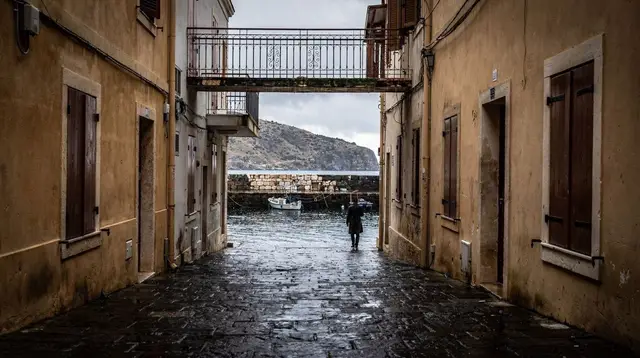
The centre of Heraklion is small enough to cover entirely on foot, and that is really the only way to see it. There is no metro, no tram and no train anywhere on Crete, so once you have arrived — by rental car, by KTEL coach along the north coast, or by air through Heraklion’s own airport — the old town itself is a walking city. Streets narrow into alleys within a couple of blocks of the harbour, and the historic core sits inside a ring of fortifications that still, in large part, defines its shape today.
This guide follows a loop that a visitor with a morning or an afternoon can realistically manage: the Venetian harbour and its fortress, a stretch of the old walls, the central squares, and the archaeological museum that holds more of Knossos than Knossos itself does.
The Venetian Harbour and Koules Fortress
Most walks through Heraklion begin at the old harbour, where the squat, sand-coloured bulk of Koules fortress guards the entrance to the water. The fortress dates to the Venetian period, when Heraklion was known as Candia and served as the administrative heart of Venice’s Cretan colony. Its thick walls and gun ports were built to withstand naval bombardment, and they did their job for a very long time — a detail worth holding onto as this walk moves toward the story of the siege that eventually broke the city’s defences.
Behind the fortress, the old Venetian arsenals — long vaulted sheds once used to build and repair galleys — line part of the harbour front, a reminder that Candia was a working naval base as much as a walled town. A dedicated look at the fortifications and how they connect to the walls above is covered in a separate guide to Koules fortress and the Venetian walls, useful if this stop is the one that interests you most.
For visitors who would rather have the harbour and the wider old town explained as they go, a guided option covers this ground directly.
a guided walk through Heraklion’s old town and harbourFor those short on time or travelling with limited mobility, an electric tuk tuk covers a similar loop of the centre without requiring a long walk on foot.
an electric tuk tuk tour around Heraklion’s historic centreOnto the Walls: Where Kazantzakis Is Buried
From the harbour, the Venetian fortifications are best appreciated by climbing onto the walls themselves, part of a fortification system built and repeatedly reinforced through the sixteenth and seventeenth centuries as Venice prepared for an Ottoman attack it knew was coming. Long stretches of rampart and several bastions survive, and walking along the top of the walls gives a clear sense of just how large a perimeter Candia’s defenders had to hold.
At the Martinengo Bastion, on the southern stretch of the walls, stands the grave of Nikos Kazantzakis, Heraklion’s best-known writer and the author of Zorba the Greek. He chose, or is said to have chosen, this high point over the city for his burial, and the site carries his own epitaph rather than a conventional religious one — a detail tied to his uneasy relationship with the Orthodox Church during his lifetime.
It is one of the more quietly affecting stops on this walk: a modern grave set directly into fortifications built four centuries earlier, with the rooftops of the old town spreading out below. A fuller picture of Kazantzakis and his place in the city’s identity, including the novel that made Heraklion’s fictional stand-in famous worldwide, is covered in a separate guide to Kazantzakis and Zorba in Heraklion.
From the Ramparts to Lions Square
Coming back down from the walls, the walk naturally funnels toward Lions Square, the civic heart of the old town, named for the Venetian fountain at its centre. The square and the streets radiating from it were shaped under Venetian rule, and much of the old town’s layout — narrow lanes opening onto small squares, buildings set close to the street — still reflects that period rather than any later one.
This is also the part of town where Heraklion feels most like a functioning Greek city rather than a historic set piece: shops, kiosks and pedestrian streets carry ordinary daily life through the same lanes that tourists are walking for the architecture. Rather than naming particular cafés or shops, which change from one season to the next, it is enough to say that this stretch between the square and the surrounding streets is where most visitors end up pausing, simply because it is where the old town concentrates its foot traffic.
The Heraklion Archaeological Museum: Where the Real Frescoes Are
A short walk from Lions Square brings you to the Heraklion Archaeological Museum, and this stop matters more than its modest footprint suggests. The museum holds the original Minoan artefacts recovered from Knossos and the other Minoan sites across Crete, including the fresco fragments that most visitors picture when they think of Knossos itself.
That distinction is worth being direct about: what is displayed at the Knossos site today, roughly five kilometres from here, is largely reconstruction and replica work carried out in the early twentieth century. The genuine painted plaster — the bull-leapers, the griffins, the processions of figures — is here, in climate-controlled museum cases, not out in the open air at the palace ruins.
A combined ticket covering both the museum and the Knossos site exists, and pairing the two in either order gives a far more complete picture than visiting only one. The museum itself is covered in more depth in a dedicated guide to the Heraklion Archaeological Museum, and the relationship between the two sites is laid out further in a guide to Knossos and the Heraklion museum together.
For visitors who want to combine the palace itself with this walk through the city, a joint option covers both in a single outing.
a combined tour of Knossos palace and Heraklion’s old townAnyone planning a Knossos visit on its own should also read the practical guide to visiting the Knossos palace site, and the wider destination page for Knossos covers its place within the region.
Candia: Twenty-One Years Under Siege
It is hard to walk this loop — the harbour fortress, the ramparts, the bastion where Kazantzakis is buried — without the story of the siege sitting somewhere in the background. Heraklion, as Candia, was the seat of Venetian power on Crete from 1204 until the island finally fell to the Ottoman Empire in 1669. The end came slowly: Ottoman forces landed on Crete in 1645, and by 1648 they had the city of Candia itself under siege. It held for twenty-one years, an extraordinary span for a single siege, sustained in part by supply and support arriving by sea from Venice and its allies, before the city was finally surrendered in 1669.
Walking the walls with that timeline in mind changes how the fortifications read. These were not decorative defences; they were tested, repeatedly, over more than two decades of active war, and they very nearly held. The wider arc of Venetian rule on Crete, from 1204 to 1669, and how it shaped towns across the island beyond Heraklion, is covered in a separate guide to Venetian Crete.
The blog piece on the Knossos frescoes being copies also touches on how much of what visitors assume about ancient Crete turns out, on closer inspection, to sit in a museum case rather than on site — a pattern that repeats with the walls themselves, much of which have been restored and reinforced over the centuries rather than surviving untouched from any single era.
Heraklion Old Town at a Glance
| Stop | What it is | Why it’s on this walk |
|---|---|---|
| Venetian harbour | Old port with Koules fortress at its mouth | Starting point, and the clearest Venetian-era structure in the city |
| Koules fortress | Fortified gate guarding the harbour entrance | Defended the port through the Ottoman siege |
| The walls / Martinengo Bastion | Sixteenth-century fortification ring | Grave of Nikos Kazantzakis, views over the old town |
| Lions Square | Central square with Venetian fountain | Civic heart of the old town, main pedestrian streets |
| Heraklion Archaeological Museum | Museum holding Minoan finds | Original Knossos frescoes; combined ticket with the site |
Market Streets and the Shape of the Old Town
Between the main landmarks, the old town rewards simply wandering rather than following a strict route. Streets running back from Lions Square toward the walls pass through mixed residential and commercial blocks where Venetian-era buildings sit alongside twentieth-century construction, much of it rebuilt after damage in the Second World War. Heraklion was bombed during the Battle of Crete and its aftermath, and the patchwork of old and newer buildings in parts of the centre reflects that history as much as it reflects any single architectural period.
Travellers who want the city’s food culture built into this walk, rather than tackled separately, have a food-focused option covering tastings alongside many of the same streets.
a food-tasting walk through Heraklion’s old townFor a wider sense of activities based in and around the city beyond this walking loop, the things to do in Heraklion hub covers tours, museums and day trips that start from the same centre. Those who prefer wine over a walking tour, and have a car or driver for the afternoon, can also reach the wine villages of Archanes and Dafnes a short drive south of the city, one of Crete’s main wine-producing areas.
Getting to Heraklion and Moving Around Without a Train
It bears repeating because visitors regularly assume otherwise: Crete has no railway. There is no train station in Heraklion and no rail link anywhere on the island, despite its size. Getting to the city is done by rental car, by the KTEL coach network — which runs a genuinely useful service along the north coast connecting Heraklion with Rethymno, Chania and Agios Nikolaos — or by air, through Heraklion’s own airport, coded HER, which sits close enough to the centre for a short taxi or bus transfer.
Once you are in the old town itself, none of that matters: the centre is compact, largely pedestrianised in its historic core, and walking is simply the only practical way to move between the harbour, the walls, the squares and the museum. Full detail on the coach network is in the guide to KTEL buses in Crete, on driving conditions and car rental in the guide to renting a car in Crete, and on the terminal itself in the Heraklion airport guide.
Visitors who would rather explore at their own pace, with commentary but no fixed group or guide, have a self-guided audio option covering the same ground as this walk.
a self-guided audio walking tour of HeraklionWhere This Walk Fits in a Wider Trip
Heraklion works well as a base for a short stay focused on the city and Knossos, or as a stopover before heading further along the island. A two-day structure covering the old town at an unhurried pace, plus Knossos and the museum, is laid out in the Heraklion in two days itinerary, useful for travellers building a longer route around it rather than treating the city as a single afternoon on the way somewhere else.
Practical Notes Before You Set Off
A few points are worth keeping in mind rather than looked up on the day. Opening hours for the museum, the Knossos site and the walls change by season and are not reliable enough to quote here — check current hours directly before planning your day around a specific stop. The same goes for entrance fees: prices are set and adjusted independently of this guide, and the only reliable figure worth repeating is that a combined ticket covering both Knossos and the archaeological museum exists, which is usually worth it if you plan to see both.
Comfortable, closed shoes matter more than anything else for this walk. The stone underfoot on the walls and in parts of the old town is uneven, and the climb up onto the ramparts involves steps rather than a ramp. Shade is limited in the middle of the day, particularly around the harbour and on the open sections of wall, so an early start or a late-afternoon walk is more comfortable than a midday one, especially outside the cooler months.
Heraklion City Walk: Common Questions
How long does it take to walk around Heraklion’s old town?
A loop covering the harbour, the walls, Lions Square and the museum quarter is easily done at a slow pace over a morning or an afternoon. Add extra time inside the archaeological museum, since it rewards a proper visit rather than a quick pass-through.
Where is Nikos Kazantzakis buried in Heraklion?
The writer is buried on top of the Venetian walls, at the Martinengo Bastion, in a spot he is said to have chosen for the view over the city and the sea. The grave carries his own epitaph rather than a religious inscription, reflecting his standing with the church at the time of his death.
Are the frescoes visible at Knossos the real ones?
No. What is on display at the Knossos site today are replicas and partial reconstructions. The original fresco fragments are held in the Heraklion Archaeological Museum, about five kilometres away, and a combined ticket covering both the site and the museum exists.
Can you get around Heraklion by train?
No. Crete has no railway anywhere on the island. Heraklion’s old town is covered on foot once you arrive, and getting to the city itself is by rental car, the KTEL coach network, or Heraklion airport, known by its code HER.
How do you get from Heraklion airport into the city centre?
Heraklion airport sits close to the city, and travellers reach the centre by taxi, local bus or a rental car picked up near the terminal. The old town itself is then explored entirely on foot, since its narrow streets are not built for driving through.
How long did Candia hold out against the Ottoman siege?
The city, then known by its Venetian name of Candia, withstood the Ottoman siege for twenty-one years, from 1648 to 1669, making it one of the longest sieges in recorded history before it finally fell.
Is Heraklion’s old town manageable with children or limited mobility?
The core loop around the harbour, the walls and Lions Square is flat and short enough for most families. The climb onto the ramparts themselves involves steps and uneven stone, so a stroller or a wheelchair is easier kept to the streets and squares below.
What is the best time of day to start this walk?
Starting in the morning avoids the strongest midday heat, particularly in summer, and gives the archaeological museum time before it gets busy. The harbour and the walls are also worth a return visit toward evening, when the light softens over the water.
City Walking Tours in Crete on GetYourGuide
Verified deep-linked GetYourGuide tours. Book through these links and we earn a small commission at no cost to you.
GetYourGuide does not provide a product photo for this activity — the image shows the meeting point, photographed by us.