Heraklion in 2 Days: Knossos and the Dafnes Wine Country Without a Car
Why Heraklion Works as a Two-Day Base
Heraklion is Crete’s capital and by far its largest city, with roughly 180,000 residents in the city itself and over 200,000 across the wider municipality. It is also the island’s least glamorous base on paper — a working port city rather than a postcard harbour — and exactly for that reason it is the easiest place to build a car-free two days around.
The city centre holds the Heraklion Archaeological Museum, the Venetian walls, and a genuinely good food and market scene, all within walking distance of most hotels. Five kilometres away sits Knossos, reachable by a frequent city bus. And beyond Knossos, Archanes and the Dafnes wine villages give you a second, quieter theme for day two, provided you accept that this stretch is better done on a tour than chased by public bus.
This plan deliberately stays within that radius. It does not detour to Phaistos, the Messara plain, or the resort strip at Hersonissos and Malia — all of them are real and worthwhile, but none of them belongs in a two-day, no-car Heraklion base. If you later add a rental car and more days, the five-day classic itinerary picks up where this one stops.
| Day | Focus | How you move |
|---|---|---|
| Day 1 | Heraklion city, the Archaeological Museum, the Venetian walls | On foot |
| Day 2 | Knossos, then Archanes and the Dafnes wine villages | City bus, then guided tour or taxi |
Day 1: Heraklion City and the Museum That Holds the Real Frescoes
Start in the old harbour, where the 16th-century Venetian fortress of Koules guards the entrance and the restored arsenali, the Venetian shipyards, line the waterfront behind it. A slow loop through the Venetian harbour sets the scale of the city before the day gets busy — Heraklion was Candia under Venetian rule, and it held out through one of the longest sieges in European history, 21 years, from 1648 to 1669, before the Ottomans finally took it.
From the harbour, walk inland through the old town on a route that takes in Lion Square (Plateia Venizelou) with its Venetian fountain, the covered market street of 1866 Street, and Agios Minas cathedral. This is the core of the Heraklion city walk, and it is short enough — under two hours at an easy pace — to leave the rest of the morning for the museum.
The Heraklion Archaeological Museum is the reason a city stop matters before Knossos, not after. This is where the original Minoan frescoes live: the Bull-Leaper, the Prince of the Lilies, the Ladies in Blue, the saffron gatherers — everything the palace ruins themselves can no longer show you, since what remains on site at Knossos is a set of concrete-set reproductions.
Seeing the originals first, in the museum, gives the following day’s walk through the palace an entirely different weight. Budget two to three hours; the collection is compact by international standards, but it rewards a slow pass over a checklist sprint, and a combined Knossos-museum ticket is sold at either site.
If you would rather have the city framed for you than piece it together on foot yourself, a short walking or selfie-focused tour covers the same harbour-to-old-town ground with a guide doing the narrating and, on a photo-oriented option, the picture-taking:
a guided selfie tour through Heraklion’s harbour and old townIn the afternoon, walk the surviving stretch of the Venetian walls, among the largest defensive fortifications the Venetians built anywhere in their empire. Near the Martinengo bastion, a plain grave under a wooden cross and a weathered epitaph marks the resting place of Nikos Kazantzakis, Heraklion’s own novelist and the author of Zorba the Greek.
The Orthodox Church of the time refused him burial in a churchyard over his writing, so the city walls became his instead — a detail worth knowing before you stand in front of the grave, and one the Kazantzakis guide unpacks in more depth. Close the day around Dermatas or the market streets near 1866 Street, where the city’s better tavernas cluster away from the harbour-front tourist rows.
Getting around day one: everything above sits within a 20-30 minute walk of central Heraklion, and the old town’s narrow streets make a car actively unhelpful — you will not need one until tomorrow’s trip out to Knossos.
Day 2: Knossos, Then Archanes and the Dafnes Wine Villages
Start early. Knossos has almost no shade, and in the warmer months the site is far more comfortable at opening time than at midday. It sits about 5 km south of central Heraklion, and city bus line 2 runs there directly from the bus terminal near the harbour roughly every 10 to 20 minutes through the summer season, a ride of about 20 minutes for a few euros — no car, and no need for one.
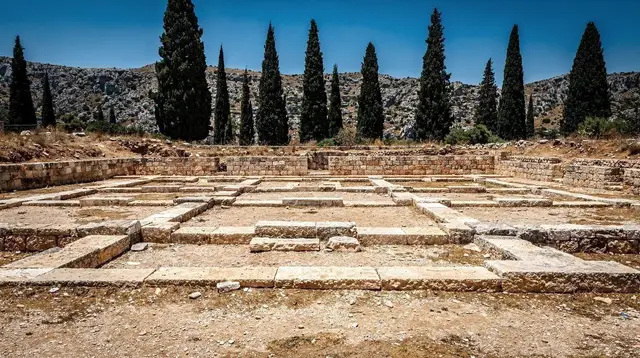
Before you walk the ruins, hold on to what you saw in the museum yesterday: the frescoes on site at Knossos — the Bull-Leaping fresco reproduction near the north entrance, the Prince of the Lilies by the south propylaeum — are reconstructions, not the originals you stood in front of the day before. Sir Arthur Evans, who excavated and partly reconstructed the palace in the early 20th century, had concrete pillars and repainted walls installed on his own interpretation of what Minoan Crete looked like; archaeologists still debate how much of that reconstruction is accurate.
Two to three hours is enough to walk the palace complex, including the Throne Room, the Grand Staircase, and the storage magazines with their giant pithoi jars. The connection between what you are standing in and what you saw in the museum is exactly what the Knossos and the Heraklion Museum guide is built to make explicit — read it before you go if you only have time for one primer.
A guided option folds the transport problem and the interpretation problem into one booking, which matters more here than at almost any other site on the island, since a site without a guide is largely silent stonework:
a guided tour combining Knossos with Heraklion’s old marketThis is where the second half of day two needs a decision. Archanes, a handsome wine village about 15 km south of Knossos, and the Dafnes wine country around it, are not reachable on a useful public bus schedule — a KTEL service to Archanes runs a few times a day, but the individual wineries scattered through Dafnes and neighbouring Peza are not on any bus route at all, and a taxi there and back with waiting time adds up quickly. For a car-free two days, the sane option is a single afternoon tour that already includes Knossos, Archanes, and a winery stop in one vehicle:
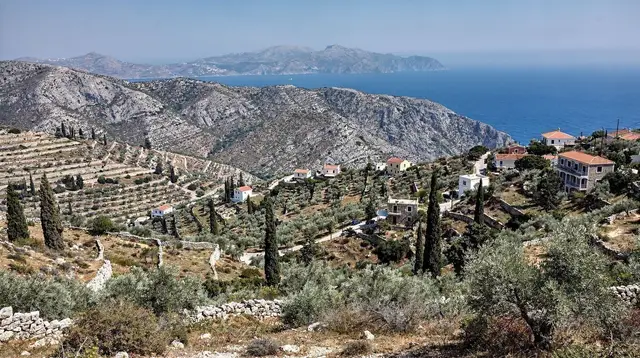
a combined Knossos, Archanes village and Dafnes winery tour from HeraklionThe wine itself is worth the detour. This corner of the Heraklion regional unit — Archanes, Dafnes and Peza — grows indigenous Cretan grapes rarely seen outside Greece: Kotsifali and Mandilari for red, Vidiano and Vilana for white. Kotsifali in particular is soft and low in tannin on its own, which is why most producers here blend it with the firmer, darker Mandilari; the resulting wines are distinctly Cretan rather than an imitation of anywhere else.
A tasting at a single mid-sized winery, with an explanation of the grapes rather than a rushed pour-and-move-on, tells you more about this than a self-driven wine-road tour would in the same afternoon — and for a visitor without a car, it is also the only version on offer. If you want more background on the grapes before you taste them, the Cretan wine regions guide covers Dafnes alongside Crete’s other main wine areas around Sitia and western Chania.
For travellers who would rather set their own pace than join a shared-group departure, a private version of the same afternoon swaps the group bus for a driver and lets you linger longer at the winery or the village square in Archanes:
a private Knossos, winery and monastery tour from HeraklionReturn to Heraklion by early evening. Two full days, planned this way, cover the capital properly, put Knossos in context rather than in isolation, and add one real taste of Crete’s wine country — without ever requiring you to rent a car.
What This Two-Day Plan Deliberately Leaves Out
Phaistos and the Messara plain, Crete’s second great Minoan palace and the site of the island’s actual Roman capital at nearby Gortyna, sit over an hour south-west of Heraklion, in the opposite direction from both Knossos and Dafnes. Fitting them into these two days without a car is not realistic: the drive alone eats a half-day, public transport there is not built for a day trip, and forcing it in turns two unhurried days into two rushed ones. If Minoan sites beyond Knossos interest you, treat Phaistos and Gortyna as a reason to extend the trip with a rental car, not as an add-on to this itinerary.
The same logic rules out the resort strip at Gouves, Hersonissos, Stalida and Malia east of Heraklion, and the south coast beaches beyond Matala — both are a different kind of Crete trip, built around beach time rather than the city-and-culture pairing this plan is for.
Practicalities for These Two Days
| Item | Detail |
|---|---|
| Heraklion to Knossos | City bus line 2, roughly every 10-20 minutes in summer, about 20 minutes, a few euros |
| Heraklion to Archanes/Dafnes | Limited KTEL service to Archanes only; wineries need a tour, taxi or car |
| Combined Knossos + museum ticket | Sold at either site, covers both in one pass |
| Best start time at Knossos | At opening, before the midday heat and the tour-bus crowds |
| Museum time needed | 2-3 hours |
| Knossos site time needed | 2-3 hours |
Getting into and out of Heraklion is straightforward from either arrival point: most international and domestic flights land at Heraklion airport, a short taxi or bus ride from the centre, and overnight ferries from Piraeus dock in the city itself. If you are weighing whether to rely on buses for more of your trip than these two days, the KTEL buses in Crete guide sets out where the network is genuinely useful — the north coast corridor this itinerary sits on is one of its strongest routes — and where it thins out fast once you leave the main road.
Frequently Asked Questions About Two Days in Heraklion
Do I need a rental car for this itinerary?
No. Heraklion’s sights are walkable, city buses reach Knossos in about 20 minutes, and a guided tour or taxi covers Archanes and Dafnes, where public transport is too thin to rely on.
How do I get from Heraklion to Knossos without a car?
City bus line 2 runs from the Heraklion bus terminal near the harbour to the Knossos site roughly every 10-20 minutes in summer, taking about 20 minutes for a fare of a few euros.
Are the frescoes at Knossos original?
No. What you see on site at Knossos are reproductions. The original frescoes are held in the Heraklion Archaeological Museum, 5 km away in the city centre, and a combined ticket covers both.
Can I visit Archanes and Dafnes by public bus?
A KTEL bus reaches Archanes village from Heraklion a few times a day, but the Dafnes wine villages and individual wineries are not served on a useful schedule, so most visitors without a car join an organised tour or book a taxi for the afternoon.
Should I add Phaistos to this two-day plan?
Not without a car. Phaistos and the Messara plain sit over an hour from Heraklion in the opposite direction from Knossos and Dafnes, and fitting them in without your own transport turns two relaxed days into a rushed one.
How much time do I need at the Heraklion Archaeological Museum?
Budget two to three hours. The museum is compact by international standards but dense, and the Minoan collection, including the original Knossos frescoes, rewards a slow pass rather than a sprint.
Is two days enough for Heraklion, Knossos and the wine country?
Yes, if you accept the trade-off: two unhurried days cover the capital, the palace and a single wine village properly, but they leave no room for Phaistos, the south coast or the resort strip east of the city.
tours.2 days
Verified deep-linked GetYourGuide tours. Book through these links and we earn a small commission at no cost to you.
GetYourGuide does not provide a product photo for this activity — the image shows the meeting point, photographed by us.