Knossos Palace: The Complete Visitor's Guide
Is Knossos worth visiting, and what should I know before I go?
Yes, but go early: the frescoes standing at the palace are reproductions, and the originals are held at the Heraklion Archaeological Museum 5 km away, where a combined ticket exists. The site has almost no shade, so a midday visit in summer is genuinely hard going. Knossos sits just outside Heraklion, Crete's capital, and it was never the island's Roman capital — that was Gortyna.
What you are actually looking at when you visit Knossos
Knossos is the largest and best known of the Minoan palace complexes, a sprawling Bronze Age site of courtyards, storerooms, staircases and reconstructed columns just south of Heraklion. It draws more visitors than almost anywhere else on the island, and most of them leave with a slightly wrong idea of what they saw. This guide exists to fix the two most common misunderstandings before you go, not after.
The short version: Knossos is worth the visit, but it rewards a visitor who knows two things going in. First, the vivid frescoes you photograph on site are not the originals. Second, the palace offers almost no shelter from the sun, which changes how you should plan the hour of your visit far more than it changes whether you should go at all.
The frescoes you see on site are reproductions, not originals
This is the fact most visitors miss, and it is worth stating plainly: every fresco image you see painted onto the walls, porticoes and reconstructed rooms at Knossos today is a reproduction. The Prince of the Lilies, the Bull-Leaper, the griffins flanking the throne room, the dolphins of the so-called queen’s megaron — all of them are modern repaintings, done during and after the early 20th-century excavation and restoration led by the British archaeologist Arthur Evans.
The original fragments, many of them small and heavily weathered before restoration, were removed from the site decades ago for conservation. They now live at the Heraklion Archaeological Museum, in the city centre, about 5 km from Knossos itself. That museum is where the actual Bronze Age pigment survives, reconstructed and displayed with the context that the palace ruins alone cannot give you.
A combined ticket covering both the palace and the museum exists, and pairing the two sites on the same day, in either order, is the single best way to understand Knossos rather than just photograph it. We cover that pairing in detail in our guide to Knossos and the Heraklion museum, and the wider habit of confusing the two is common enough that it has its own explainer in our blog.
None of this means the reconstruction is worthless. Evans’s restoration is itself now over a century old and part of how the site has been understood and presented since the 1900s — it is a historically interesting layer in its own right, even if it is not the layer most visitors think they are seeing. Just do not leave Knossos believing you photographed a 3,500-year-old painted wall. You photographed a 20th-century interpretation of one.
There is almost no shade — plan your visit around that, not around opening hours
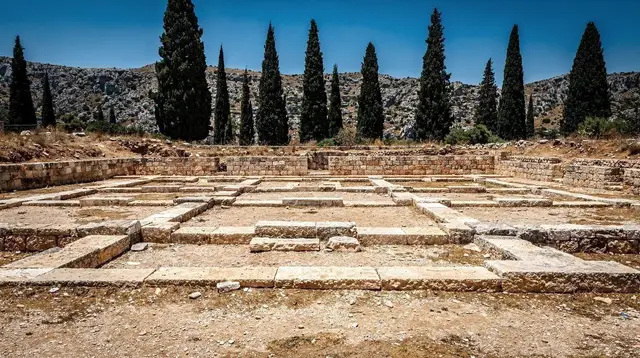
The second fact that changes how you should visit: Knossos is an open archaeological site with courtyards, stone paving and low reconstructed walls, and very little tree cover across most of the complex. A handful of shaded corners exist near the site’s edges, but the central courtyard, the grand staircase area and most of the walking route sit in full sun for the bulk of the day.
From June through September this matters more than almost anything else about planning the visit. Heraklion’s summer heat builds through the morning, the stone underfoot radiates it back, and by the middle of the day the combination of heat, glare and crowd density from arriving coach and cruise groups makes the visit far less pleasant than it needs to be. An early start — arriving as close to opening time as your schedule allows — is the practical fix. You will walk the same ruins in noticeably cooler air, with the site emptier, and you will still have most of the day left for the Heraklion Archaeological Museum or a walk through Heraklion’s old town.
Bring water, a hat and sun protection regardless of when you go, and treat this as a site with no reliable escape from the sun rather than one where you can shelter and wait out the heat. Our broader notes on seasonal planning for Crete and on what catches first-time visitors out both flag this same pattern: the biggest sites on the island are also the ones with the least shade.
Knossos sits right outside Heraklion, Crete’s capital
Knossos is not a remote ruin requiring a special expedition. It sits a short drive south of Heraklion, Crete’s capital and by far its largest city, with roughly 180,000 residents within the city itself and well over 200,000 across the wider municipality. That proximity is one of the practical strengths of visiting Knossos: it is an easy half-day trip from a Heraklion base, combinable with the museum, a walk through the old town past the Venetian walls, or a stop at the harbour, rather than a destination that needs its own overnight stay.
This also means Knossos sits inside the busiest, most infrastructure-heavy corner of the island, in the Heraklion regional unit alongside Knossos itself, Archanes and Dafnes wine country, and the resort strip running east toward Gouves and Hersonissos. If you are building an itinerary around the centre of the island, our two-day Heraklion itinerary slots Knossos in alongside the city sights rather than treating it as an isolated day trip.
Knossos was never the Roman capital — that was Gortyna
A second, smaller confusion is worth clearing up while you are planning: Knossos is a Minoan Bronze Age palace, at its height roughly 1900 to 1450 BCE, and it was not the seat of Roman power on Crete. That role belonged to Gortyna, further south near the Messara plain, which became the capital of the Roman province of Crete and Cyrenaica and still shows a Roman forum, a basilica and the famous Gortyn law code inscribed in stone.
The two sites are separated by well over a thousand years of history and by completely different civilisations, yet visitors regularly blend them into one vague impression of “ancient Crete.” Our guide to the Minoans in one hour sets out the actual timeline, and the mix-up gets its own treatment in our blog on Gortyna versus Knossos. Keeping the two straight matters if you are choosing between them, or deciding whether to see both: they answer different questions about the island’s past, not the same one twice.
Other Minoan sites, for comparison
Knossos is the largest and most visited Minoan palace, but it is not the only one, and knowing the alternatives helps you decide how much of your island time to give it. Phaistos, on the Messara plain near Gortyna, is smaller, far less crowded, and sits in open countryside with sweeping views rather than a suburban setting. Malia, on the north coast east of Heraklion, is a third major palace, again quieter than Knossos.
Further east, Zakros is the remotest of the four, reached through a genuinely dramatic gorge landscape. None of the three offer reconstructed frescoes the way Knossos does, which is precisely why Knossos remains the site most people picture when they think “Minoan palace” — reconstruction, for all its complications, is also what makes the site legible to a first-time visitor.
Getting to Knossos and what to pair it with
Most visitors reach Knossos by rental car or organised tour from Heraklion, Chania or the north-coast resorts; there is no train on Crete and the site sits close enough to Heraklion that a taxi or local bus from the city is also realistic. If you are visiting under your own steam, park early, since the car park fills with tour buses as the morning goes on.
A guided visit solves the shade and heat problem in a different way: a guide moves you through the site with context and pacing rather than leaving you to wander and overheat, and most guided itineraries are timed to beat the worst of the midday crowd. If you would rather have someone else handle the route and the history, a guided day from Chania that covers Venetian Heraklion and the Knossos palace folds the city and the ruins into one outing.
Travellers already based in Heraklion tend to prefer a guided walk through Knossos, Heraklion and the city’s market streets, which adds the food and street life of the capital to the archaeology.
For visitors who want to see Knossos alongside its Roman-era counterpart in one outing — a genuinely useful way to feel the difference between the Minoan and Roman layers of the island rather than reading about it — a private tour taking in both Knossos and Phaistos is the most direct way to do it without self-driving between the two.
Where Knossos fits in a wider island trip
Knossos works best as part of a day built around Heraklion rather than a stop bolted onto a longer drive. Pair it with a walk through Heraklion’s old town, the Koules fortress and Venetian walls, or the grave of Nikos Kazantzakis on those same walls. Travellers spending more than a day in the region often add Archanes and a wine-country afternoon nearby, or head south to Phaistos and Gortyna to see how the island’s Roman layer compares with its Minoan one.
Quick comparison: Knossos versus the museum, and Knossos versus Gortyna
| What it actually is | Common mistake | |
|---|---|---|
| Knossos palace | Minoan Bronze Age ruins with 20th-century reconstruction and reproduction frescoes | Assuming the painted frescoes on the walls are original |
| Heraklion Archaeological Museum | Home of the real fresco fragments, jewellery, seals and pottery from Knossos and beyond | Skipping it, or visiting Knossos without realising the originals are here |
| Gortyna | The Roman capital of Crete, centuries after the Minoan era | Assuming Knossos, not Gortyna, was Crete’s Roman capital |
| Phaistos | A second, quieter Minoan palace on the Messara plain, without reconstructed frescoes | Expecting the same reconstructed look as Knossos |
Knossos, Heraklion and the Minoan sites: frequently asked questions
Are the frescoes at Knossos original?
No. What stands on the walls and porticoes at Knossos today are reproductions, made during and after the early 20th-century restoration of the site. The original fragments were removed for conservation and are displayed at the Heraklion Archaeological Museum, 5 km away.
Where can I see the real Knossos frescoes?
At the Heraklion Archaeological Museum, in the city centre. The Bull-Leaper, the Prince of the Lilies and the Griffin fresco fragments all live there, reconstructed and explained, and a combined ticket covering both the museum and the palace exists for visitors who want to see both in one trip.
What time should I visit Knossos to avoid the heat?
As close to opening as you can manage, especially from June to September. The site has open courtyards, stone walkways and very little tree cover, so the heat builds quickly through the morning and the crowds arrive with the cruise and coach groups by mid-morning.
Is Knossos near Heraklion city centre?
Yes. Knossos sits a short drive south of Heraklion, Crete’s capital and largest city with roughly 180,000 residents within the city itself, which makes the palace an easy half-day add-on to time spent in the capital rather than a separate base.
Was Knossos the Roman capital of Crete?
No. Knossos is a Minoan Bronze Age palace complex. The Roman capital of Crete was Gortyna, further south near the Messara plain, a different site from a different era with its own Roman forum, basilica and law code inscription.
How much time do I need at Knossos?
Most visitors need one and a half to two and a half hours to walk the palace complex at a reasonable pace, more with a guide who explains the layout, and longer again if you add the Heraklion Archaeological Museum on the same day.
Can I combine Knossos with the Heraklion Archaeological Museum in one day?
Yes, and it is the single best way to understand what you are looking at. Seeing the reconstructed palace first and the original fresco fragments afterwards, or the other way round, turns two separate stops into one coherent story of the same civilisation.
Is Knossos suitable for visiting with children?
It can work well for children who are curious about myths and ruins, since the labyrinth and Minotaur story gives them something to hold onto, but the lack of shade and the amount of walking on uneven stone make an early start and good water and sun protection essential.
Knossos Tours in Crete on GetYourGuide
Verified deep-linked GetYourGuide tours. Book through these links and we earn a small commission at no cost to you.
GetYourGuide does not provide a product photo for this activity — the image shows the meeting point, photographed by us.