Most people who drive inland from Kissamos are heading somewhere else: down to Elafonissi for the sand, out to Falassarna for a sunset, or south toward Chania on the coast road. The route through Topolia and up into the chestnut villages around Elos is not any of those things. It is a short, narrow mountain road that most visitors never take, and the honest reason to take it is not a monument or a beach — there is neither — but the road itself, and thirty minutes of Crete that looks nothing like the coast twenty minutes behind you.
This page is written for one kind of traveller: someone with a rental car who is already moving between the far west and the interior, or who wants an hour of quiet driving away from the crowds at Elafonissi or Balos. If you are looking for a destination with a headline sight, a ticketed entrance, or a stretch of sand, this is not it, and the rest of the page says so plainly rather than dressing up a back road as more than it is.
Through the rock: the Topolia tunnel
The approach to Topolia climbs out of the coastal plain south of Kissamos through a narrowing gorge, and the road’s one genuine landmark sits right at the village: a short tunnel bored through the rock, just wide enough for a single car in places, with the village’s small chapel of Agia Sofia carved into the cliff face above the gorge entrance rather than built on open ground. There is no visitor centre and no fee. Cars slow to a crawl, headlights go on, and on the far side the road opens back into daylight and the village proper.
It is not a dramatic piece of engineering and it does not need to be sold as one — the appeal is simply that a paved road threads through solid rock rather than around it, in a stretch of Crete where most infrastructure of any age was built by hand. Drivers coming the other way, from Elos down toward the coast, meet the tunnel from the opposite direction and the same rule applies: whoever reaches the narrow point first goes through, and the other car waits.
Topolia: a hamlet built around a gorge and a chapel
Topolia itself is small, a cluster of stone houses along the road with the gorge and its chapel as the reason anyone stops at all. There is no archaeological site here and no museum. A path leads from the road up to the cave chapel, a short, uneven climb worth doing only if you are comfortable on loose stone and not in a hurry — the reward is a view down into the gorge rather than anything inside the chapel itself, which is small and plain.
Beyond that, Topolia is a place to stretch your legs, take a photograph of the tunnel mouth and the gorge walls, and move on. A taverna operates in the village on a seasonal basis, and it is worth treating any meal here as a pleasant surprise rather than a plan — see the honesty section below before you build a lunch stop around it.
Climbing to Elos: chestnut forests where citrus and olives stop
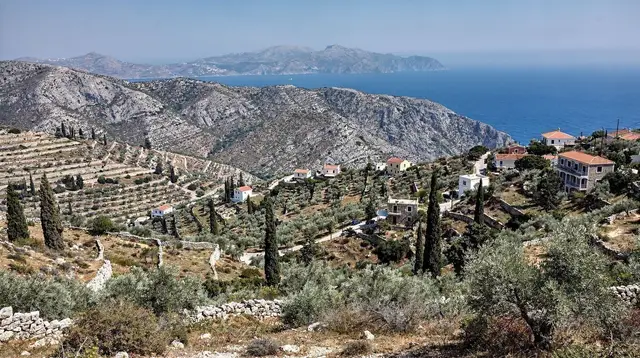
Past Topolia the road keeps climbing, and the vegetation changes with the altitude. The olive terraces and citrus groves that define most of lowland west Crete thin out and give way to plane trees, oak and, closer to Elos, chestnut forest — a genuinely unusual sight on an island whose image is almost entirely about the coast. Elos sits at around 550 metres, cool enough and wet enough in winter to support trees that simply will not grow on the plain below, and the chestnuts here have been harvested for generations, with a small local festival held in autumn around the crop rather than around any tourist calendar.
Elos is really a scatter of hamlets — Elos itself, Vlatos, Kefali and a few smaller settlements — strung along the same road rather than one compact village. None of them has a headline attraction. What they have is shaded squares, old plane trees, stone churches with no queue, and a rhythm of daily life that has very little to do with the beaches an hour’s drive away. In autumn, chestnuts genuinely litter the roadside; the rest of the year the villages are quieter still.
What this detour is not
It is worth being direct about the limits of this route before you plan around it. There is no major archaeological site here, and nothing on the scale of Knossos or Phaistos — the region’s draw is landscape and a slower pace, not ruins. There is no beach, and no version of this drive connects to one; if sand and sea are the goal, this is not the road that gets you there, and you are better served by Falassarna or Elafonissi directly. There is no substantial restaurant or hotel scene either — what exists is small, seasonal, and not something to build a booking around.
What this route offers instead is honest: a mountain road, a tunnel, chestnut forest, and villages that see far fewer visitors than anywhere on the coast twenty minutes away. If that trade is not what you are looking for on a given day, skip it and keep the time for Kolymvari, the coast, or the boats out to Balos. If it is, it rewards a traveller who already has wheels and no fixed itinerary for the afternoon.
Getting there: this is car country, not KTEL country
There is essentially one practical way to see Topolia and Elos, and it is a rental car. The KTEL bus network is genuinely useful along the north coast highway — Chania, Rethymno, Heraklion, Agios Nikolaos — but it is built around that axis, not around the villages inland from Kissamos. Any service reaching this far into the hills tends to be sparse, timed around school runs rather than visitors, and not something to plan a half-day around. If you are travelling without a car, this detour is not realistic; see the wider notes on driving in Crete and renting a car if that changes your plans for the rest of the island.
The road itself is paved for its full length between Kissamos and Elos, but it is narrow, winds through the gorge and up the hillside with a series of tight bends, and in places allows only one car at a time — the same courtesy that applies at the Topolia tunnel applies on these stretches too: pull to the wider point and let the oncoming car through rather than forcing a pass. It is not a road for speed, and treating it as a scenic, unhurried drive rather than a route to somewhere else is the right approach.
From Kissamos, allow 20-25 minutes to reach Topolia and 35-40 minutes to reach Elos. From Chania, figure on roughly an hour to Topolia and a little over that to Elos, depending on where in the city you start. None of this is a route to rush; a half-day that includes the drive, a stop in Topolia, a walk around Elos, and the return leg is a realistic plan, and it pairs naturally with a longer day that also touches Falassarna or the road down to Kissamos town.
When to drive it: avoiding the July-August heat
This is an exposed mountain road with long stretches that offer no shade, and July and August bring the kind of heat that makes a slow, winding drive with the windows down considerably less pleasant than it sounds — see the general seasonal notes on the best time to visit Crete for how that plays out across the island.
Late April through June is a strong window: the hillsides are still green from the spring rains, temperatures at altitude are noticeably milder than on the coast, and the road is quiet. September is the other good option, cooling from the summer peak with the same advantage of thinner traffic; see the month-by-month notes on September in Crete for what else lines up with that timing.
Autumn brings the chestnut harvest itself and, with it, the best reason of all to make the detour if you happen to be in the area — but it also brings the first of the season’s rain to a road that has no real drainage infrastructure to speak of, so a wet-weather check before setting out is sensible. Winter is workable for a determined driver but genuinely quiet, with village life pared back and no guarantee that even the seasonal taverna will be open.
Planning a stop here
Treat Topolia and Elos as a half-day addition to a longer west Crete itinerary based in Chania or Kissamos, not as a destination to plan a full day, let alone an overnight, around. A sensible way to use the road is as the return leg of a day that starts at Elafonissi or Falassarna: rather than retracing the coast road back to Chania, cut inland through Topolia and Elos and rejoin the north coast later, turning transit time into something worth looking at. Fill the tank before you leave Kissamos or Chania — there is nothing reliable on the mountain road itself — and carry water and a little food rather than counting on a taverna being open when you arrive.
If your priority for the day is genuinely the coast rather than the hills, the region’s better-known excursions are only a short drive away and easy to book in advance rather than improvised on the day. A private tour that already threads together Elafonissi, the chapel at Chrisoskalitissa and the village of Sfinari covers a good stretch of this same far-western landscape with a driver who knows the roads: a private day tour linking Elafonissi, Chrisoskalitissa and Sfinari.
For a simpler beach-focused option, a guided day trip to Elafonissi handles the transport and timing for you. And if the boat out to the lagoon appeals more than a mountain drive, a cruise to Balos and Gramvousa covers the same far-western corner of the island from the water instead of the road.
None of that changes the core honesty of this page: Topolia and Elos are a detour for people who already have a car, already have flexibility in their day, and want to see what the interior of the far west looks like once the citrus groves stop and the chestnut trees start. It is a modest reward for a modest amount of effort — a tunnel, a gorge chapel, a scatter of quiet villages — and it works best when nobody expects more of it than that.
FAQ: driving from Topolia to Elos
Is the Topolia to Elos road worth the detour?
Only if you already have a rental car and are travelling between the Kissamos coast and the Chania interior. There is no beach, no major site and very little to actually stop for, but the tunnel at Topolia and the chestnut forests around Elos are a genuine change of scenery from the coast road.
Can I get to Topolia and Elos by bus?
Not realistically. The KTEL network concentrates on the north coast highway between Chania, Rethymno and Heraklion; the villages inland from Kissamos see at most a sparse, school-timetabled service that is not built around visitors. A rental car is the practical way to do this route.
How long does the drive from Kissamos to Elos take?
Kissamos to Topolia is about 20-25 minutes and Kissamos to Elos is roughly 35-40 minutes on a narrow but paved mountain road. Add time for the tunnel, for slow-moving farm traffic, and for pulling over where the road is single-lane.
Is there anywhere to eat in Topolia or Elos?
A handful of tavernas operate in both villages, mostly seasonally, and none of them should be counted on for a set menu or long opening hours outside the warmer months. This is not a place to plan a meal around; it is a place to eat if a taverna happens to be open.
Is there anywhere to stay overnight?
A few rooms and small guesthouses exist in the wider area, but accommodation is thin and often closed outside the main season. Most travellers see Topolia and Elos as a half-day stop on a longer west Crete route based in Chania, Kissamos or Elafonissi, not as a base.
What is grown in the chestnut villages around Elos?
Elos and its neighbouring hamlets sit in one of Crete’s few chestnut-growing pockets, cool and wet enough at altitude to support trees that will not grow on the coastal plain below. A small local chestnut festival is held in autumn, timed to the harvest rather than to tourist demand.
When is the best time to drive this road?
Late April through June, and September, give the most comfortable conditions: cooler air at altitude, green hillsides earlier in the year, and chestnuts underfoot in autumn. July and August bring real heat with little shade on the open stretches, and winter can bring rain, mist and occasional closures on the higher sections. A glass of wine at day’s end back on the coast is a fitting way to close the loop — see a sunset wine and food pairing at Falassarna for one option after a day inland.
Is the tunnel at Topolia safe to drive through?
Yes, but it is narrow, unlit in the way a modern road tunnel would be, and single-lane in places, so drivers slow down and take turns rather than pass side by side. It is a short, low-speed crossing, not an engineering landmark, and most visitors are through it in under a minute. For general guidance on Cretan mountain-road etiquette, see the notes on driving in Crete and on itineraries covering the west that can build a day like this one around it, and on mistakes to avoid elsewhere on the island.