Quad and Buggy Tours Around Gouves and Hersonissos
What is a quad or buggy tour around Gouves and Hersonissos actually like?
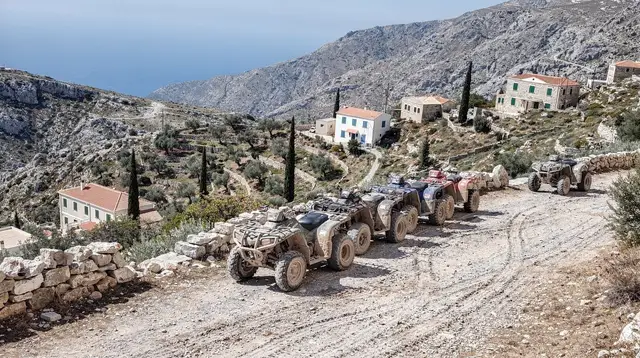
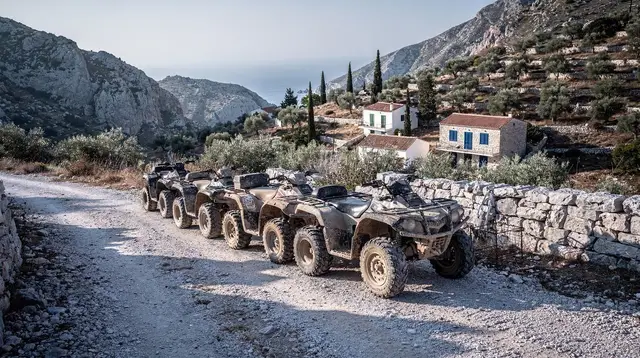
Expect a mix of paved back lanes, gravel farm tracks and a short dirt stretch through olive groves and low hills above the resort strip, not a wilderness expedition. The coast here is a narrow, built-up band, and the ride stays close to it rather than crossing the island.
What the Terrain Behind Hersonissos Actually Looks Like
Every summer, a steady stream of quads and buggies pulls out of rental yards along the coast between Gouves and Hersonissos and heads inland. The marketing photos show dust, hills and open track, and the feeling of freedom is real enough. What is worth setting straight before you book is what kind of ground you are actually crossing, and what happens to your insurance the moment the road stops being paved.
This stretch of the north coast is the busiest and most built-up piece of Crete: a run of hotels, tavernas, car rental offices and nightlife roughly twenty kilometres long, from Hersonissos through Stalida and on to Malia. It is an easy strip to picture as “Crete”, because it is where most package holidays land. It is worth remembering that Crete itself runs close to two hundred and sixty kilometres from Chania in the west to Sitia in the east. The resort coast you are riding out of is a genuinely small fraction of a genuinely large island, and a quad tour here samples the hills directly behind the hotels, not the island as a whole.
A sense of scale
| Distance | Length |
|---|---|
| Hersonissos to Malia (the developed strip) | about 20 km |
| Chania to Sitia (the island, west to east) | about 260 km |
| Typical quad or buggy tour loop | a few hours, inland from the coast road |
| Hersonissos to Balos lagoon (west coast) | well over 150 km |
The Ground Under the Wheels
Inland from the coast road, the land behind Gouves and Hersonissos rises quickly into low, dry hills covered in olive groves, vineyards and scrub. A typical route strings together three kinds of surface: quiet asphalt lanes between villages, compacted gravel farm tracks that see tractor traffic more than tourist traffic, and shorter stretches of looser dirt where the track narrows between terraces or drops into a streambed. None of it resembles the deep-desert imagery some operators use in their advertising. It is working agricultural land, dusty in summer, sometimes rutted after rain, and shared with the people who actually farm it.
That mixed surface is exactly why this page will not hand you a fixed route. Operators adjust their loops for the season, for recent weather, for group size and for which tracks are passable that week — the same track can be smooth gravel in June and washed out after an autumn downpour. Anyone promising an identical, guaranteed off-road circuit every day of the year is describing a route on paper, not the ground you will actually ride.
What Surprises First-Timers
The pace is the most common surprise. A guided convoy rides at the speed of its slowest or least experienced member, with regular stops to regroup, so a route that looks fast and continuous in an operator’s highlight video is, in practice, a fair amount of idling behind the quad in front while the group closes up. Riders expecting a racetrack feel are usually disappointed; riders expecting a scenic, unhurried ride through farmland tend to get exactly what they came for.
The other surprise is how audible the coast stays. Much of the route runs close enough to the resort strip and the main road that traffic noise, and sometimes music from a beach bar, carries up into the hills, breaking the sense of being somewhere remote. Phone signal is generally fine for the same reason — this is not a dead zone — but it also means the “wilderness” feeling promoted in marketing photos is more a matter of framing than of actual distance from the coast.
Season, Time of Day and Who Can Ride
Timing changes the experience more than most people expect. Trips that run in the shoulder months of May, June and September ride firmer ground and cooler air than the height of summer, when the same dirt sections turn to fine, choking dust and the midday sun on an open quad or buggy is genuinely hard going without full coverage. Morning departures, typically the first slot of the day, avoid both the worst heat and the midday convoy traffic when several operators are running loops through the same stretch of hills at once. An afternoon booking in July or August still runs, but expect more dust in the air from earlier groups and a noticeably warmer ride back.
Not everyone can or should ride. Most operators set a minimum age for solo quad riding, commonly mid-teens with a valid car or motorcycle licence depending on the vehicle’s engine size, and a separate, usually lower, minimum for riding as a passenger on a buggy or behind a guide. Pregnancy, recent back or neck surgery, and uncontrolled heart conditions are standard exclusions across the industry, given the vibration and jolting of gravel and dirt. None of this is unique to Gouves and Hersonissos, but it is worth checking against the specific operator’s own written policy rather than assuming general fitness is enough, since the terrain described above really is uneven enough to matter for anyone with an existing injury.
The Insurance Gap Nobody Mentions at the Rental Desk
This is the part worth reading twice. In Crete, the same insurance gap that trips up drivers on the dirt road to Balos applies just as directly here. Two separate policies matter, and both tend to have quiet exclusions for unpaved or off-road use.
First, your car rental agreement, if you have one for the rest of your trip, almost certainly does not extend to a quad or buggy at all — that is a separate vehicle with its own separate contract, and reading one does not tell you anything about the other. Second, and more easily missed, many travel insurance policies list quad biking, ATV riding or off-road driving as an excluded or “hazardous activity” requiring an add-on, buried in the policy wording rather than flagged at checkout. A rider who assumes their annual travel policy simply covers “anything on holiday” can find out otherwise only after an accident, which is the worst possible moment to discover a gap.
The practical takeaway is the same one that applies on the unpaved approach to Balos and Gramvousa: leaving a paved, signposted road in a vehicle not built or insured for it can leave you personally exposed if something goes wrong, whatever reassurances are given verbally on the day.
Before booking any quad or buggy activity, it is worth doing three things: reading the operator’s own insurance terms rather than assuming they mirror a car rental, checking your travel policy for an explicit mention of quad biking or ATVs, and asking direct questions about what happens if the vehicle is damaged on track rather than on tarmac. None of that removes the fun of the day; it just means you know what you are actually covered for before you are twenty minutes into an olive grove.
Quad, Buggy or Jeep — What the Difference Actually Means
The three activities get lumped together in resort brochures, but they put you in a different amount of control.
| Format | Who drives | Typical group size | Feel |
|---|---|---|---|
| Quad | You, solo | 1 rider per quad | Most direct control, most exposed to dust and sun |
| Buggy | You, usually with a passenger | 2 per buggy | Enclosed roll cage, seatbelts, still self-driven |
| Jeep safari | A hired driver | 4-6 per jeep | You are a passenger; see our guide on what a jeep safari really involves |
A quad puts the accelerator, brake and balance entirely in your hands, riding in convoy behind a guide who sets the pace. A buggy does the same but with a roll cage, seatbelts and usually a passenger seat, which suits people who want the open-air feeling without solo balance on gravel. A jeep safari, by contrast, is a different product altogether: several people in one closed vehicle with someone else driving, which removes both the physical effort and the personal insurance question above, since you are not the one operating the vehicle.
If the appeal is genuinely the terrain rather than the driving, it is worth being honest with yourself about which of the three you actually want. A day spent gripping handlebars through unfamiliar gravel is a different holiday from a day spent looking at the same hills from a jeep’s back seat.
If you are travelling with a partner or an older child and only have a few free hours, the buggy is usually the easier call: one booking covers two people, the roll cage and seatbelt lower the anxiety for a nervous rider, and nobody has to be left out because they are not confident balancing a quad solo on gravel. A quad suits a traveller who wants to ride alone, or two adults who would each rather have their own machine and do not mind paying for two bookings instead of one. Neither format is objectively better; the honest way to decide is by how much solo control matters to you against how much simpler a shared vehicle is to organise, not by which one looks better in the operator’s photos.
What a Typical Day Actually Involves
Half-day and full-day formats both exist along this stretch of coast, and both tend to follow the same shape: a safety briefing and short practice loop near the meeting point, then a guided convoy inland through the terrain described above, usually with one or two stops — a viewpoint over the coast, a village square, sometimes a monastery or a cave along the way. Some itineraries fold in a swim or a snorkel stop back near the water, others end with lunch. None of that changes the underlying point: this is a half-day activity on the hills directly behind a resort strip, not a crossing of the island.
a quad safari that pairs the inland tracks with a monastery stop and lunch is one way to see both the terrain and a piece of local life in the same outing, while a half-day buggy route that adds a cave visit and a snorkelling stop suits travellers who want the ride broken up with something to do on foot and in the water. For a shorter window, a three-hour quad adventure out of Heraklion fits into an otherwise full day without taking it over.
What the Rest of Your Day, or Trip, Might Look Like
Because the coast here is so compact, most visitors pair a quad or buggy morning with something else nearby rather than treating it as the whole day. A short crossing out to Dia Island, visible from the coast at Gouves, is a common add-on, whether as a catamaran sail out to Dia for a swim in the afternoon or a longer full-day sailing trip with lunch on board. Others use the afternoon for a taste of the region’s wine country with a wine tasting session based in Hersonissos, an easy contrast to a morning spent on gravel.
For anyone wanting more distance and more genuine off-road country in a single outing, an organised trip east to the Sarakinas gorge in the island’s east covers ground a half-day quad loop near Hersonissos simply cannot reach. And for something lighter and family-friendly rather than off-road, a Camel Trophy style driving experience is worth knowing about as an alternative format on the same stretch of coast.
Why a Rental Car Still Matters Even If You Ride a Quad
Crete has no train anywhere on the island, and no light rail either — the KTEL coach network covers the north coast well but thins out fast once you leave it, especially south of the mountains. A quad or buggy tour is a few hours of guided riding on a small loop of land; it is not transport, and it does not replace the need to get from Hersonissos to Heraklion, to Knossos, or further afield to the west or south coast over the following days.
For most visitors staying anywhere along this coast, a rental car remains the practical complement to everything else on the itinerary: reaching Knossos and the Heraklion Archaeological Museum in a morning, driving south to Matala and Phaistos, or heading west toward Rethymno and Chania on the E75.
See our guides to renting a car in Crete and driving in Crete for what that actually involves, and the comparison of rental car versus organised tours if you are still deciding how to structure the trip. The quad or buggy morning and the rental car for the rest of the week are not competing choices — most people who do both consider them entirely separate parts of the same holiday.
Practical Notes Before You Book
A few things are worth confirming directly with whichever operator you choose, since none of them are standard across the island: minimum age and whether a driving licence is required to ride solo on a quad, whether a second rider on a buggy needs their own licence, what happens to your deposit if the vehicle is returned with damage, and what the operator’s own policy says about unpaved sections specifically. None of these questions are unusual to ask, and a reputable operator will answer them plainly before you sign anything.
Dust is a bigger factor than most first-timers expect, even on a short loop — sunglasses or riding goggles and something to cover your nose and mouth make a real difference, particularly if you are riding behind other quads rather than at the front of the convoy. Closed shoes are worth wearing regardless of how hot the day is; gravel and loose stone throw up more debris than sand does. If your afternoon plan includes a swim, bring a change of clothes, since a morning of dust does not rinse off in seawater alone.
A Fair Way to Think About It
A quad or buggy tour around Gouves and Hersonissos is a genuinely enjoyable few hours: real hills, real dust, a break from the beach and the pool. It is not a wilderness crossing, it does not cover meaningful distance on the scale of the island, and it comes with an insurance question worth answering before you book rather than after something goes wrong. Treated as what it actually is — a half-day activity on the coastal hills, paired with a rental car for everything the tour does not reach — it earns its place on a Crete itinerary without needing to be oversold as more than that.
Quad & Buggy Tours in Crete on GetYourGuide
Verified deep-linked GetYourGuide tours. Book through these links and we earn a small commission at no cost to you.
GetYourGuide does not provide a product photo for this activity — the image shows the meeting point, photographed by us.