What a Jeep Safari in Crete Really Covers
Is a jeep safari in Crete covered by a standard rental car insurance policy?
No. Most Crete rental agreements explicitly exclude unpaved and off-road driving, so an accident or breakdown on a dirt track such as the Balos road, roughly 8 km long, is typically not covered. An organised jeep safari uses vehicles insured separately by the tour operator for that terrain, which is the practical reason travellers book one instead of self-driving the same tracks.
The question nobody asks before booking
Every rental counter in Crete hands over a compact car with a full tank and a laminated map, and every one of those contracts contains a line about where that car is allowed to go. Almost nobody reads it. The short version: standard rental cover in Crete applies to sealed, signposted roads, and it typically excludes unpaved tracks, off-road driving and, in many contracts, gravel forest roads even when they connect two paved sections. That single clause is the real reason organised jeep and 4x4 safaris exist here, not as a novelty add-on to a beach holiday but as the only realistic way for most visitors to reach parts of the island a standard rental car legally should not go.
This page is not a pitch for any one operator. It is the plain mechanics of what changes, insurance-wise, between driving your own rental car and sitting in a vehicle run by a company that has arranged cover for the terrain. Crete rewards the traveller who understands that distinction before a wheel touches a dirt track, not after.
Where the exclusion actually bites
The best-known example on the island is the road to Balos and Imeri Gramvousa, in the far north-west of the Chania region. The paved road ends and a dirt track of roughly 8 km continues to a car park, from which it is a 20 to 30 minute walk down to the lagoon and back up again at the end of the day. That track is exactly the kind of unpaved surface most rental agreements name as excluded.
A stone through a sump, a torn tyre wall on the rutted sections, or a low-speed slide on loose gravel on the way down all fall outside standard cover, and the driver is generally liable for the full repair or excess regardless of fault. Our guide to reaching Balos by boat or by road sets out both options side by side, and for most travellers the boat from Kissamos removes the insurance question entirely rather than answering it.
Balos is the clearest case because it is the most photographed, but the same clause applies anywhere the tarmac stops: forest tracks above Anogia and around Psiloritis, the unpaved approaches to some inland villages near Archanes, stretches of the Lasithi plateau loop that wander off the sealed ring road, and quieter tracks around Sitia in the east. None of these carry a warning sign. The surface simply changes from asphalt to compacted stone and dust, and the insurance status of the trip changes with it, silently.
What standard rental cover actually includes
| Coverage element | Typical standard rental cover | Typical exclusion |
|---|---|---|
| Sealed public roads | Included | — |
| Collision damage waiver | Included, with an excess | Void off sealed roads in most contracts |
| Theft protection | Included | Often void if vehicle left unlocked on a track |
| Windscreen and tyre cover | Sometimes included as an add-on | Frequently excluded on unpaved surfaces even with the add-on |
| Unpaved or off-road driving | Not covered | Explicit exclusion clause in most Crete rental agreements |
| Breakdown recovery off-road | Not guaranteed | Recovery cost passed to the driver |
This table is a generalisation, not a substitute for reading your own agreement. Some larger international chains sell an upgraded policy that narrows the gap; smaller local agencies, which offer some of the cheapest rates on the island, are usually the strictest about the unpaved exclusion. Our guide to renting a car in Crete walks through what to check at the counter, and driving in Crete covers the road conditions themselves, tarmac and otherwise.
How an organised safari changes the picture
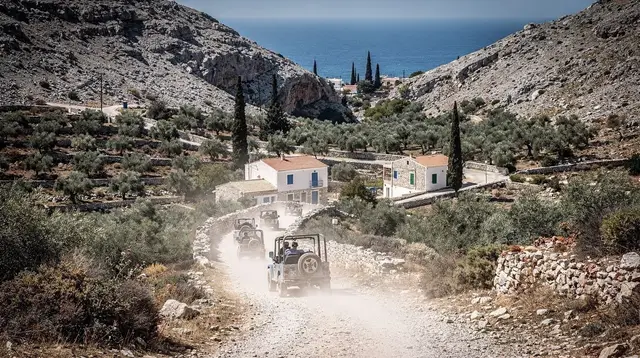
A jeep, quad or buggy safari does not remove the physical risk of driving on a mountain track. What it changes is who carries the insurance exposure for the vehicle. On a guided tour, the vehicles belong to the operator, who insures them for the terrain the tour actually covers, and a driver-guide who knows the specific track leads the way. On a self-drive convoy format, sometimes offered as an alternative to a fully guided jeep tour, the operator’s own fleet and its off-road cover still apply, which is a fundamentally different arrangement from taking your own rental car onto the same track.
That distinction is why a trip like the one described in a full-day jeep route into a remote gorge at the island’s edge exists as a separate product from simply hiring a car for the day. It is also why routes that climb onto the island’s high plateaus, such as a Land Rover route through Crete’s mountain plateaus, are built around vehicles suited to and insured for that ground, rather than a compact hatchback. None of this is a guarantee against a rough ride, a hot dusty afternoon, or a late return — it is specifically about who is financially exposed if the vehicle is damaged.
Travellers weighing the two options in general, not just for a safari, will find a broader comparison in rental car vs organised tours in Crete.
Mountain road etiquette, and what it does not mean
Crete’s inland and mountain roads are mostly single-carriageway, twisting along contour lines with no hard barrier and a drop on one side more often than not. Local drivers, who know these roads well, have a standing habit: when a faster car catches up behind, the car in front pulls partway onto the hard shoulder or the unpaved verge to let it pass. It happens constantly on the roads above Rethymno, around the approaches to the Lasithi plateau, and on the switchbacks into the White Mountains.
Visiting drivers sometimes misread this courtesy as an invitation to overtake more aggressively than they normally would, reasoning that if locals pull over so readily, the road must tolerate a quick pass on a blind bend. It does not. The driver ahead is creating space on a straight or a wide enough curve, not signalling that the next corner is clear.
Treat every blind bend on a Cretan mountain road as if something is coming the other way, because on a narrow road shared with delivery vans, farm trucks and the occasional flock of sheep, something regularly is. Our mistakes to avoid in Crete and safety and health in Crete guides cover this alongside the island’s other everyday driving habits.
The same narrow-road discipline applies whether you are in a rental saloon, a guided jeep, or a quad. Organised safaris brief participants on convoy spacing and overtaking rules before setting off precisely because the terrain does not forgive improvisation.
Why organised 4x4 transport fills a real gap here
Crete has no train, anywhere, on an island 260 km long. The KTEL coach network is a genuinely workable way to travel the north coast corridor linking Chania, Rethymno, Heraklion and Agios Nikolaos, running along the VOAK highway with reasonable frequency. South of the mountain spine, and into most inland villages, that network thins to a handful of seasonal, once- or twice-daily runs, timed around school and market days rather than tourism. Our KTEL buses in Crete guide sets out exactly where the coverage holds and where it does not.
That gap is the practical origin of organised jeep, quad and buggy tourism on the island. A visitor based in Rethymno or Heraklion who wants to see the Lasithi plateau, a remote village on the southern coast, or the track above Loutro, a village that famously has no road at all, has three realistic options: drive a standard rental car and stay strictly on paved roads, join an organised 4x4 tour built for the terrain, or rely on the sparse seasonal bus and boat links that serve the same places.
A route like a full-day Land Rover circuit through Crete’s inland villages and viewpoints exists specifically to cover ground that a rented saloon car, insurance aside, is simply not built or licensed for.
Quad and buggy safaris: the same rule, smaller vehicle
Quad and buggy tours run on the same insurance logic as jeep safaris, with one added layer: many countries’ standard travel insurance policies treat quad biking as a listed exclusion or an activity requiring an upgrade, independent of the vehicle rental question entirely.
Before booking something like a full-day quad route into Crete’s backcountry, it is worth checking both the vehicle operator’s own liability cover, which is standard practice for licensed operators, and your personal travel insurance policy for an off-road or quad biking exclusion clause. The two are separate questions that both need a yes. Our guide to quad and buggy tours in Crete goes into the practical side of what a typical route involves, helmets, briefings and all.
What a typical jeep safari day actually looks like
Setting insurance aside, the appeal is straightforward: a jeep safari reaches terrain a standard itinerary skips. Routes commonly combine a section of dirt track through pine forest or olive terraces, a stop at a working olive mill or a small mountain taverna, a swim at a beach with no road access for ordinary traffic, and a viewpoint over a gorge or a plateau that a paved road never quite reaches. Timing matters: a a late-afternoon route timed to reach a high viewpoint for sunset trades the midday heat, which regularly hits 30 to 35 degrees Celsius in July and August, for softer light and a cooler ride back.
None of that changes the underlying fact that this page keeps returning to: the moment wheels leave the paved surface, a standard rental car’s insurance and an organised safari’s insurance are two different things, and only one of them was designed with that dirt track in mind.
Practical checklist before you book anything off-road
- Read the exclusions section of your rental agreement specifically for the words “unpaved,” “off-road” or “unmarked roads” before assuming any cover extends past the tarmac.
- Ask a jeep, quad or buggy operator directly whether the vehicle and route are covered by their own liability insurance, and keep the confirmation email.
- Check your personal travel insurance policy for an off-road or adventure activity exclusion, separate from the vehicle question.
- Treat every hard-shoulder pull-over on a mountain road as a courtesy, not a green light to overtake on the next bend.
- Plan reliance on organised transport for places the KTEL network does not reach south of the mountains, rather than assuming a bus will be there.
- For Balos specifically, default to the boat from Kissamos unless you have separately confirmed off-road cover for the dirt track.
For the wider planning picture, how many days in Crete helps place a jeep safari day within a longer itinerary, and driving in Crete covers the island’s roads more broadly, sealed and unsealed alike.
Jeep safaris and rental insurance in Crete: the questions people ask
Does my rental car insurance cover unpaved roads in Crete?
Almost never. Standard collision damage waivers and theft protection sold with a Crete rental car apply to sealed, public roads. The rental agreement usually lists unpaved, unmarked or off-road driving as an exclusion, which voids cover for that trip regardless of how carefully you drive.
What happens if I break down on the Balos dirt road in my rental car?
You are likely liable for the full cost of recovery and repair, because that stretch is unpaved and excluded from most policies. This is the main reason most visitors reach Balos and Imeri Gramvousa by the boat from Kissamos instead of driving the roughly 8 km track and walking down.
Is a jeep safari itself a risky activity?
It carries the ordinary risks of any off-road activity, but the vehicles are operated and insured by the company running the tour, under a different framework from a self-drive rental. That does not remove risk, it changes who is responsible for the vehicle if something goes wrong.
Why do people pull onto the hard shoulder on Cretan mountain roads?
It is local courtesy on narrow single-lane mountain roads, letting a faster car pass safely rather than forcing an overtake on a blind bend. It is not a signal that overtaking is safe or invited at that exact moment, and it should never be read as one.
Can I take a KTEL bus to inland or south coast villages instead of a jeep tour?
Along the north coast, yes, the KTEL network connecting Chania, Rethymno, Heraklion and Agios Nikolaos is genuinely usable. South of the mountains and into inland villages it thins to a handful of seasonal, once-a-day runs, which is a real gap that organised 4x4 transport fills.
Should I buy separate travel insurance for a jeep or quad safari?
It is worth checking your travel insurance policy for adventure or off-road activity exclusions before booking, since some standard policies treat quad biking or off-road driving as an excluded activity requiring an upgrade or rider.
Is there a difference between a jeep safari and a self-drive off-road tour?
Yes. In a guided safari, a company vehicle and driver, or a company-owned self-drive convoy with briefed routes and support, absorbs the off-road risk. Taking your own standard rental car onto the same tracks is a different, uninsured situation even if the road looks identical.
Jeep Safaris in Crete on GetYourGuide
Verified deep-linked GetYourGuide tours. Book through these links and we earn a small commission at no cost to you.
GetYourGuide does not provide a product photo for this activity — the image shows the meeting point, photographed by us.