A different coast, a different pace
Most visitors picture Crete’s package resorts when they think of a beach town, and that picture is built around the north coast: Gouves, Hersonissos and Malia, a strip of hotels, bars and organised nightlife running along the VOAK highway. Matala is not that. It sits on the south side of the island, on the Messara plain below the Asterousia mountains, facing the open Libyan Sea rather than the Aegean.
The village grew up around a small bay, a scatter of Neolithic and Roman-era sea caves cut into the sandstone cliff at its northern end, and, briefly in the late 1960s, a community of travellers who slept in those caves — a chapter that still shows up on a handful of faded photographs in the village bars, more than in anything you can actually visit today.
What makes Matala worth building a page around is not the caves alone. It is the combination: a beach on a coast that behaves differently from the north in high summer, and a location inland from which two of Crete’s most important ancient sites, Phaistos and Roman Gortyna, are each under half an hour away. That combination — sea, caves, and two short cultural excursions — is the actual case for basing here, not a promise of resort infrastructure or nightlife that the village was never built for.
The Libyan Sea and the meltemi
Crete’s north coast, from Chania through Rethymno and Heraklion to Agios Nikolaos, faces the Aegean and takes the full force of the meltemi, the strong north wind that blows through July and August. On bad meltemi days, boats to Balos and Gramvousa and to Chrissi off Ierapetra are cancelled, and swimming on the north shore can turn choppy and uncomfortable for hours at a stretch.
Matala faces south, onto the Libyan Sea, and the Asterousia range behind the village blocks much of that wind. The practical result is a beach that generally stays calmer and more swimmable than the north coast on exactly the days the meltemi is strongest — not immune to wind entirely, since a southerly blow can still stir the bay, but a genuinely different and usually gentler pattern than Hersonissos or Agia Pelagia see in midsummer.
This is also why the south coast in general, including Agia Galini further west and Plakias beyond that, draws travellers who have had a windy week on the north shore and want a change. It is worth being clear that “calmer than the north in the meltemi” is a real and useful distinction, not a claim that the sea here is flat and predictable every single day of the summer.
Getting there: an inland drive, and a thin bus service
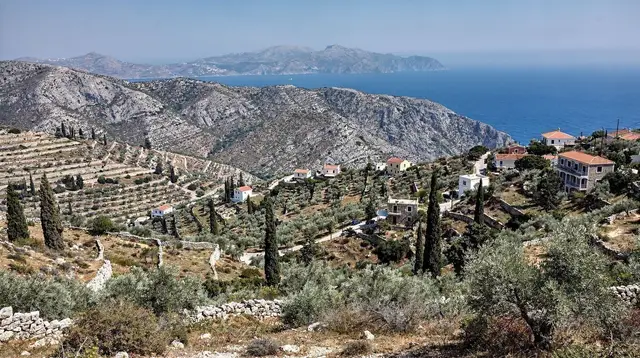
Matala sits about 65 km south-west of Heraklion and roughly 75 km from Rethymno, but the route is not a coastal run — it climbs inland across the Messara plain, through olive groves and past the turn-offs for Phaistos and Gortyna, before dropping down to the south coast. Allow around 1 hour 15 minutes from Heraklion and closer to 2 hours from Rethymno or Chania. Renting a car is the practical way to reach Matala and to combine it with Phaistos and Gortyna on your own schedule; see the general notes on driving in Crete for road conditions and mountain-road etiquette.
The KTEL coach network, which runs a genuinely useful service along the north coast between Chania, Rethymno, Heraklion and Agios Nikolaos, thins out considerably south of the mountains. There are direct or connecting KTEL buses from Heraklion to Matala, but services are limited to a handful of departures a day, more in high season and fewer or none at all in winter, and connections from Rethymno or Chania typically mean changing at Heraklion or Mires. If you are travelling without a car, check current timetables before building a day around them, and expect the return journey to shape your schedule more than it would on the north coast.
For a day trip rather than a self-drive, an organised excursion is a straightforward alternative from Heraklion: the Heraklion: Zaros, Phaistos and Matala day trip covers the Messara’s mountain village, palace site and coast in one outing, and the Gortyna, Phaistos, Matala and Zaros day trip from Heraklion adds the Roman capital to the same loop.
The caves, the beach, and the village’s real scale
Matala’s sea caves are cut into the sandstone headland on the north side of the bay, a short walk from the village along the beach. Entry is through a small ticketed area, generally open in daylight hours through the season; inside, a stepped path connects a dozen or so chambers with sweeping views back over the bay. The site is manageable in well under an hour, which is part of why it pairs so naturally with a beach day rather than needing a day of its own.
Beyond the headland to the south, the coastal path leads to Red Beach, a smaller, partly nudist cove reached on foot or by a short boat hop in season — a quieter alternative when the main beach fills up. A guided look at both is covered in the Matala: Hippie Beach tour.
It is worth being direct about scale. Matala is a village, not a resort town: a single curved bay, a short row of tavernas and rooms along the seafront, and a fraction of the bed count you would find in Hersonissos, Malia or Agia Pelagia. That is part of its appeal for travellers who want a low-key south-coast base, but it also means fewer hotel choices, a shorter high-season window in which everything is open, and an atmosphere that stays closer to a fishing village than a holiday resort even in August. Book accommodation early for July and August, and expect a noticeably quieter, more limited village in April, October or the shoulder months either side.
Phaistos and Gortyna: two short excursions, not a detour
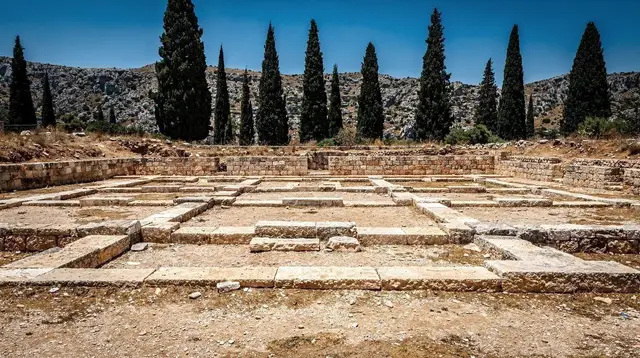
The main reason Matala works as more than a beach stop is what sits inland from it, on the same Messara plain. Phaistos, the second-largest Minoan palace after Knossos, is about 20 minutes from Matala by car — a hilltop site with sweeping views over the plain to Psiloritis, generally far less crowded than Knossos and with none of the reconstruction controversy that surrounds it; there is nothing here to mistake for a replica. A joined-up look at both the palace and its context is in the Phaistos and Gortyna guide.
Gortyna, roughly 25 minutes from Matala, is a different kind of site: the Roman and later Byzantine capital of the island, not Knossos, as is sometimes assumed. Its Odeon houses the famous Law Code inscription, one of the oldest and most complete legal texts to survive from the ancient world, and the ruins of the basilica of Agios Titos spread across an olive grove that visitors can walk through largely at their own pace.
Combining Phaistos and Gortyna with Matala in a single day, by car or on an organised trip, is one of the more efficient half-days of ancient-site visiting on the island, since all three sit within a 20-30 minute radius of each other on the plain. The Matala village, winery and lunch day trip folds a Messara winery stop into a similar loop, for travellers who want the region’s wine alongside its archaeology.
For a longer look at the wild country south of the plain, the Agiofarago gorge, a short walk down to a beach near a chapel cut into the rock, is covered by the Matala: Agiofarago Gorge outing, a half-day option for travellers who want hiking alongside the beach and ruins.
When to swim
The swimming season on the Libyan Sea broadly follows the rest of the island: May to October. Early in the season, from late May into June, the sea is still cool, generally in the low-to-mid 20s Celsius, warming through July and peaking in late August and September, when the water is at its warmest and the worst of the meltemi’s effect on the north coast makes the calmer south shore an even more obvious choice. By late October, days are still pleasant for a walk along the bay and a visit to the caves, but swimming becomes a matter of personal tolerance rather than a given.
There is no reason to visit Matala specifically in November through March: village businesses thin out or close, and the site is better handled as a stop on a spring or autumn Messara itinerary. See Crete in June and Crete in September for month-by-month detail, or the wider north coast versus south coast comparison for how Matala’s season stacks up against Hersonissos or Agia Pelagia.
What Matala is not
Two expectations are worth correcting before you build a trip around this village. First, Matala is not a nightlife destination. There is no strip of clubs or late bars comparable to Hersonissos or Malia; evenings here mean a taverna table by the water and an early night, and travellers chasing the kind of nightlife those resorts sell should look elsewhere — the Hersonissos worth it piece lays out what that comparison actually involves. Second, Matala is not a base for touring the whole of Crete.
The island has no single town from which Chania and Sitia are both a short drive — Chania to Sitia alone runs over four hours — and the Messara’s position on the south-central coast, while excellent for Phaistos, Gortyna and this stretch of coastline, is not a sensible staging point for the Samaria gorge, Elounda or the far west. Treat Matala as one stop within a wider south-coast or full-island itinerary — see Crete south coast in 6 days or Crete archaeology in 5 days — rather than a single hub for the trip.
Planning at a glance
| What | Detail |
|---|---|
| Distance from Heraklion | About 65 km, 1 hour 15 minutes by car |
| Distance from Rethymno / Chania | 75-140 km, roughly 2-2.5 hours |
| Phaistos | About 20 minutes from Matala |
| Gortyna | About 25 minutes from Matala |
| Public transport | KTEL from Heraklion, limited daily departures |
| Swimming season | May to October, warmest late August-September |
| Typical stay | 1-2 nights, or a half-day / day trip from Heraklion |
Matala: frequently asked questions
Is Matala worth visiting if I’m based in Heraklion or Chania?
As a day trip from Heraklion, yes — it is about 1 hour 15 minutes each way and pairs naturally with Phaistos and Gortyna. From Chania, at over 2 hours each way, it works better as an overnight stop within a longer south-coast or Messara itinerary rather than a single day out.
How do I get to Matala without a rental car?
KTEL buses run from Heraklion to Matala, with limited daily departures that thin out further from Rethymno or Chania, usually requiring a change. An organised day trip from Heraklion, such as a combined Zaros, Phaistos and Matala tour, is a more predictable option if you are not driving.
When is the best time to swim at Matala?
The season runs May to October. The sea is coolest in late May and June, and warmest in late August and September, which is also when the calmer south-coast water contrasts most with a windy north coast during the meltemi.
Are the Matala caves free to visit?
No, the sea caves on the headland above the beach have a small entrance fee and set opening hours through the season. The visit itself takes well under an hour.
Can I visit Phaistos and Gortyna in the same day as Matala?
Yes. Both sites sit within a 20-30 minute drive of Matala and of each other on the Messara plain, which makes a beach morning plus an archaeology afternoon a realistic single-day plan, whether self-driven or on an organised tour.
Does Matala have nightlife?
No, not in the sense that Hersonissos or Malia do. Evenings are tavernas and a quiet waterfront rather than clubs or late bars, and travellers looking for resort-style nightlife should plan for the north coast instead.
Is Matala a good base for exploring all of Crete?
No single town covers the whole island — Chania to Sitia is over four hours apart. Matala works well as a base for the Messara plain, Phaistos, Gortyna and this stretch of south coast, but a full-island trip needs multiple bases.
How many days should I spend in Matala?
One to two nights covers the village, its caves and beach, and a half-day for Phaistos and Gortyna. Many visitors instead treat it as a half-day or full-day stop within a longer south-coast itinerary rather than a multi-night stay.