Samaria Gorge from Chania: The Complete One-Way Hike
Can you hike Samaria gorge as an out-and-back from Chania?
No. Samaria is walked in one direction only, 16 km downhill from the Xyloskalo at Omalos to Agia Roumeli, which has no road in or out. Everyone leaves by boat, usually to Chora Sfakion, Sougia or Palaiochora, then by coach back to Chania.
The one fact that decides your whole day
Before anything else about pace, footwear or where to stop for lunch, one fact shapes every other decision about the Samaria gorge: you walk it in a single direction. The path runs 16 km downhill from the Xyloskalo, the entrance gate above Omalos at 1,227 m, to Agia Roumeli, a village on the Libyan Sea with no road connecting it to the rest of Crete.
There is no loop, no car park at the far end, and no walking back up. Once you reach Agia Roumeli, the only way onward is a boat, and that boat runs on a schedule you do not control. Planning a Samaria day from Chania is really planning three separate legs — getting to the Xyloskalo, the walk itself, and the boat-plus-coach return — and it is the third leg that catches people out, not the second.
This guide sets out that full chain, from the drive up to Omalos to the coach ride back into Chania town, and draws a hard line between this hike and the much shorter walk sold in resorts under the same name.
The route: Xyloskalo to Agia Roumeli
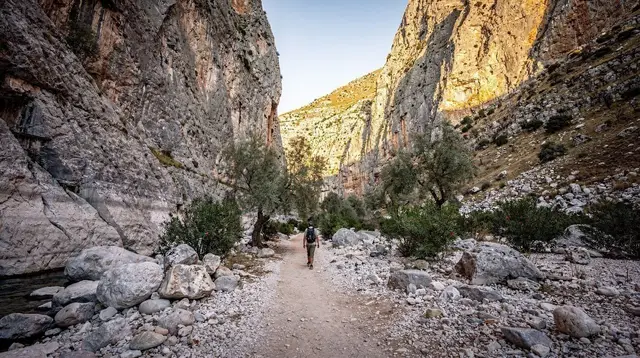
The Xyloskalo — the name means “wooden staircase” — is a steep zigzag of stone steps dropping from the Omalos plateau into the gorge proper. It is the toughest stretch on the knees, over in the first 2 km, and after it the gradient eases into a long, gradual descent that makes up most of the remaining distance. Around the 6 km mark the abandoned village of Samaria gives the gorge its name; a small church and a handful of stone houses, left when the area became a national park in 1962, sit among plane trees where most hikers take their first proper break.
The walking surface is uneven limestone and river stone for almost the entire 16 km, not graded trail, which is the main reason the hike takes five to seven hours rather than the three or four the distance alone might suggest. There is shade for long stretches under plane and cypress trees, though the final approach to Agia Roumeli opens out and gets hot in summer. A full guide to the route, with distances between each landmark, is in the complete Samaria gorge guide.
The Iron Gates
The single most photographed point on the walk comes late, in the last few kilometres before the gorge widens toward the coast: the Sideroportes, or Iron Gates. Here the walls close to roughly 3 to 4 m apart while rising more than 300 m overhead, a corridor of rock narrow enough to touch both sides at once in places. It is a short section, walked in a few minutes, but it is the point that makes the whole descent feel like a single, continuous canyon rather than a country path. After the Iron Gates the gorge relaxes, the walls pull back, and the final stretch into Agia Roumeli is flat and open.
When the park is open, and when the gates actually close
Samaria operates roughly from early May to mid-October, and that window moves with the weather rather than the calendar: spring snowmelt or a wet spring can delay opening, and the park closes without warning whenever flood or fire risk rises, sometimes for a single day, sometimes for longer. Outside that season the gorge is closed outright — there is no winter access, guided or otherwise.
Within the season, the entrance gates at the Xyloskalo shut in the early afternoon, typically around 3pm, because everyone on the path needs to clear the gorge and reach Agia Roumeli before the last boats of the day. Arriving at Omalos in the late morning without knowing this is the single most common way visitors get turned away at the entrance. If you are driving yourself, plan to be walking well before midday; if you book a guided hike with pickup from Chania, the pickup time is built around this deadline for you.
| Detail | What to expect |
|---|---|
| Season | Roughly early May to mid-October |
| Entrance gate closes | Early afternoon, around 3pm |
| Distance | 16 km, one way, Xyloskalo to Agia Roumeli |
| Descent | About 1,200 m, mostly gradual after the Xyloskalo steps |
| Typical walking time | 5 to 7 hours |
| Closures | Flood or fire risk, announced with little notice |
Getting from Chania to the Xyloskalo
Omalos sits about 40 km and just under an hour’s drive south of Chania, climbing steadily into the Lefka Ori, the White Mountains. Three ways to make that first leg:
Self-drive. The road from Chania to Omalos is sealed and well signed, and there is a car park at the Xyloskalo. The catch is the return: your car stays at Omalos, and you finish the hike at sea level in Agia Roumeli, 16 km away as the crow flies but with no road between the two. Some hikers solve this with a taxi back to Omalos from Chora Sfakion, which is slow and not cheap; most simply treat the drive up as one-way and arrange transport home from the coast instead. If you are weighing this against renting a car for the rest of the trip, the car rental guide covers what a Cretan rental does and does not cover on mountain roads.
KTEL coach. A direct bus runs from Chania’s bus station to Omalos in season, timed for hikers, and is the simplest way to reach the Xyloskalo if you are not driving. Details on frequency and timing are in the KTEL buses guide.
A booked hike with transport included. This is the option most first-time visitors end up choosing, because it removes every logistics decision at once: pickup from a Chania hotel, a seat on the drive up, entry to the park, and — depending on the option — the boat and coach back are already arranged. A gorge hike with pickup from Chania covers the drive up and the walk; for the return leg handled as well, a private hike that includes the ferry back folds the whole day, gate to gate, into one booking.
Agia Roumeli and the return by boat
Agia Roumeli is the reward and the bottleneck at once: a small village of tavernas and rooms built entirely around hikers finishing the gorge, with a beach to cool off on and no road connecting it to anywhere. Every visitor leaves the same way — by boat — and the only questions are which boat and where it goes.
| Destination | Typical crossing | Onward connection |
|---|---|---|
| Chora Sfakion | About 45 minutes | KTEL coach to Chania, the standard return route |
| Sougia | About 45 minutes | Coach or onward transfer toward Chania |
| Palaiochora | Around 1 hour 15 | Coach to Chania, a longer but scenic alternative |
Chora Sfakion is the route most day hikers take, because the coach connection back to Chania is the most direct. Sougia and Palaiochora work as alternatives, and either is worth considering if you plan to spend a night on the south coast rather than push straight back to Chania the same evening — both towns have their own case for a stopover, covered in the Palaiochora and Sougia destination guides. If you are self- organising, buying the ferry ticket at the Agia Roumeli quay is normal practice in season, and queues build as the afternoon groups finish the walk together; a pre-booked hike removes this step, which is the main practical reason people choose one over a fully independent day.
South of Chora Sfakion, the coastline continues into a stretch of villages that share the same no-road character as Agia Roumeli — most notably Loutro, reachable only by boat or on foot, and a natural add-on for anyone who has already committed to a boat-and-coast day. A separate day trip to Loutro from Chania is worth knowing about even if you keep it for a different day, since it runs the same south-coast logistics without the 16 km walk attached. The Loutro guide explains why the village has stayed car-free.
Samaria versus the “easy Samaria”
Travel desks in Chania’s resorts, and in Rethymno and Heraklion further along the coast, sell a day trip billed simply as “Samaria” that is not the hike described above. That trip drops visitors at Agia Roumeli by boat first, then walks a short section of the gorge — typically 3 to 4 km up from the village and back the same way — before returning by the same boat used to arrive. It never reaches the Xyloskalo, never descends the full 1,200 m, and never passes the Iron Gates, which sit well beyond the turnaround point of this shorter walk.
There is nothing dishonest about that trip on its own terms: for a traveller based on the south coast, or anyone unable to manage a 16 km descent, it is a genuine way to see part of the gorge with far less effort. The problem is only the shared name. If your plan is built around walking the whole gorge, from Omalos down, confirm exactly which itinerary you are booking — the easy Samaria guide sets out that shorter walk in full, so you can tell at a glance which one a given listing describes.
Planning the rest of the day
Because the hike, the boat and the coach together fill a full day — most people are back in Chania by early evening at the earliest — treat this as its own day rather than one stop on a busier itinerary. A few things worth arranging in advance:
- Footwear. The path is loose stone for almost its entire length; trainers survive it, but worn soles and river crossings near the bottom make broken-in hiking shoes the better choice.
- Water and food. There are refill points inside the gorge, but no shops until Agia Roumeli. Carry at least 1.5 litres per person and something to eat on the way, since lunch realistically happens at the taverna after you finish.
- What to pack more broadly for a hiking day in Crete’s heat and terrain is covered in the packing guide, and the common planning errors that catch out first-time Samaria hikers specifically are collected in the mistakes to avoid guide.
- A base for the night. If a full day of hiking, boating and busing sounds like enough for one stay rather than a rushed evening back in Chania, some visitors build it into a short three-day west Crete itinerary instead of a single long day trip.
For those who would rather not manage the drive up, the entrance timing, the ferry ticket and the coach connection themselves, a guided Samaria hike handles the whole chain as a single booking, which is the main appeal for a first visit to the gorge.
The Samaria gorge, from Chania: questions people actually ask
Can I hike Samaria gorge in both directions?
No. Park rules require a one-way descent from the Xyloskalo at Omalos to Agia Roumeli. Walking back up is not permitted, and there is no reason to attempt it: Agia Roumeli has no road, so the only way out is the boat regardless of which direction you walked.
What is the difference between Samaria and the easy Samaria?
The real Samaria gorge is the full 16 km descent from Omalos, taking most hikers five to seven hours and passing the Iron Gates near the end. The easy Samaria, sold by resort travel desks under a similar name, is a shorter and separate walk of 3 to 4 km up into the gorge from Agia Roumeli and back the same way, reaching neither the Xyloskalo nor the Iron Gates.
How do I get back from Agia Roumeli after the hike?
By boat only. Ferries run from Agia Roumeli to Chora Sfakion, Sougia or Palaiochora, timed to meet hikers as they finish in the afternoon. From any of those three villages, a KTEL coach connects back to Chania, so the return is a boat leg followed by a road leg, not a single journey.
When is Samaria gorge open?
Roughly early May to mid-October, and only within that window: there is no winter access. The park also closes without much notice for flood or fire risk, and the Xyloskalo entrance gate shuts in the early afternoon, so a late arrival can mean being refused entry even in season.
How hard is the 16 km hike?
It is a long day on foot rather than a technical climb: mostly downhill, on an uneven stone surface, with about 1,200 m of descent overall. Most hikers finish in five to seven hours. Sturdy, broken-in footwear matters more here than general fitness.
What are the Iron Gates?
The narrowest section of the gorge, where the walls close to roughly 3 to 4 m apart while rising more than 300 m overhead. It comes late in the walk, shortly before the gorge widens out on the approach to Agia Roumeli.
Do I need to book the return ferry in advance?
Not strictly, if you are organising the day yourself — buying a ticket at the Agia Roumeli quay on arrival is standard practice in season, though queues build as groups finish the walk together in the afternoon. Booking a guided or private hike that includes the ferry removes that step entirely.
What should I pack for the hike?
Broken-in walking shoes, at least 1.5 litres of water per person, sun protection and a hat, and some food for the walk, since the first reliable meal stop is the taverna at Agia Roumeli once you finish. Shade covers much of the route but thins out near the end.
Gorge Hikes in Crete on GetYourGuide
Verified deep-linked GetYourGuide tours. Book through these links and we earn a small commission at no cost to you.
GetYourGuide does not provide a product photo for this activity — the image shows the meeting point, photographed by us.