Loutro: The Village With No Road to It
How do you get to Loutro if there's no road?
Loutro is reached only by small boat or on foot. Ferries along the south-west coast connect Chora Sfakion, Loutro, Agia Roumeli, Sougia and Palaiochora, and the same boats also carry hikers out of the Samaria gorge. There is no coastal road, no car access and no regular bus into the village itself.
There is no road sign pointing to Loutro, because no road goes there. Ask about driving in and the honest answer is that you can’t: the only ways into this whitewashed cove on Crete’s Libyan Sea coast are a small ferry or your own two feet along the coastal path. That single fact shapes everything else about a visit here, from how you plan a day trip to why the village stays so quiet even in August.
Why Loutro Has No Coastal Road
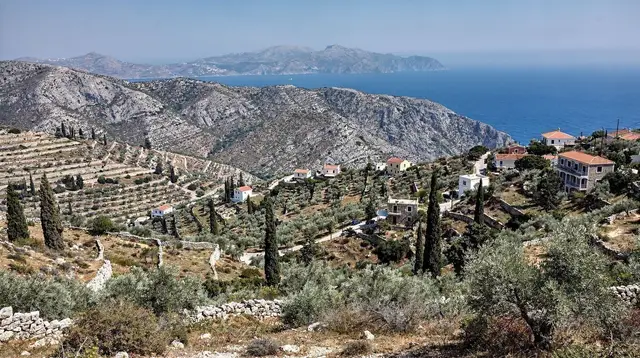
Loutro sits inside the region of Sfakia, where the Lefka Ori, the White Mountains, drop almost vertically into the sea. Between Chora Sfakion and Agia Roumeli at the foot of the Samaria gorge, the cliffs never relented enough for a road to be cut through, and nobody has tried in earnest since. Loutro is the one settlement in that gap, built around a natural harbour so sheltered that it served as a Venetian and later a small naval anchorage. The absence of a road is not neglect; it is geography, and locals will tell you they would not trade it for asphalt.
That isolation is also why Loutro looks the way it does: low white houses stepping down to a curved bay, a handful of tavernas with tables at the water’s edge, no cars, no motorbikes, no scooters for hire. Everything that reaches the village — food, building supplies, luggage — arrives the same way visitors do, by boat.
Getting to Loutro by Boat
The practical route from Chania is to drive or take a KTEL coach south over the mountains to Chora Sfakion, a journey of roughly ninety minutes that ends at sea level after a long descent through switchbacks. From the small port there, a passenger ferry covers the twenty minutes to Loutro several times a day in season, dropping and less frequently in the shoulder months.
The same boats continue west along the coast, calling at Agia Roumeli and often on to Sougia, with some runs extending to Palaiochora. A rough one-way schedule in high season looks like this:
| Route | Approximate crossing time | Frequency (May-Oct) |
|---|---|---|
| Chora Sfakion - Loutro | 20 minutes | Several times daily |
| Loutro - Agia Roumeli | 30-40 minutes | Several times daily |
| Agia Roumeli - Sougia | 45-60 minutes | 1-2 times daily |
| Sougia - Palaiochora | 45 minutes | 1 time daily, seasonal |
Times shift by season and by weather, and the timetable posted at the Chora Sfakion ticket kiosk on the day is more reliable than anything printed in advance. If you are day-tripping, buy your return leg before you board, since the last boat back is earlier than most visitors expect.
Several boat operators run the same stretch as a standalone excursion rather than pure transport, and a boat trip from Chania to Loutro along the car-free south coast is a straightforward way to see the village without driving yourself over the mountains and coordinating ferry times solo.
The Same Boats That Empty the Samaria Gorge
Loutro’s ferry network is not a tourist add-on invented for day trips; it is the same infrastructure that makes the Samaria gorge walkable in the first place. The gorge runs one-way, sixteen kilometres down from the Xyloskalo above Omalos to Agia Roumeli, a village with no road of its own either. Hikers who reach the shore at the end of the walk have exactly one way out: the same south-west boat line that stops at Loutro.
That means a hiker finishing Samaria in the afternoon and a visitor spending the day in Loutro can end up on the same deck, heading in opposite directions along the coast — the hiker toward Chora Sfakion and a coach back to Chania, the day-tripper further along toward Agia Roumeli or Sougia.
It is worth knowing this if you are trying to time a visit to Loutro around the gorge season: services genuinely thin out once the Samaria gorge from Chania closes for the winter, because a meaningful share of the boats’ passengers are gorge walkers rather than beach-goers. Anyone weighing the two experiences together may also want the fuller picture in the complete Samaria gorge guide before building an itinerary around both.
Sfakia’s Libyan Sea Climate
Loutro faces south onto the Libyan Sea, and that orientation matters more here than almost anywhere else on the island. In July and August, the meltemi, a strong north wind, regularly disrupts sailings on Crete’s north coast and can cancel boat trips to Balos or Chrissi outright. The south coast, sheltered by the width of the island and the wall of the White Mountains, stays calmer through the same weeks, which is a large part of why Loutro’s boat schedule holds up reliably even at the height of summer.
Sea temperatures follow the same pattern as the rest of the island: around 21-25 degrees Celsius by June, and a genuinely comfortable 24-27 degrees Celsius in September, which is arguably the best month to be here — warm water, a still-full boat timetable, and noticeably fewer people than August. Winter is a different story. From November to March the coast stays mild by northern European standards, but many rooms and tavernas in Loutro close for the season, and boat frequency drops to a fraction of the summer schedule. Anyone weighing when to come should also read how north coast conditions compare to the south coast more broadly across the island.
What Loutro Is Like Once You’re There
The village itself is small enough to see in twenty minutes and rewarding enough to stay for a full day. A single unpaved path traces the curve of the bay, lined with tavernas serving fresh fish and simple Sfakian cooking, their tables set close enough to the water that you can watch the boats come and go while you eat. There is a small pebble beach directly in the village and better swimming a short walk in either direction along the coastal path.
Above the village, the ruins of a small fort and a scatter of Byzantine chapel remains hint at Loutro’s longer history as a sheltered anchorage predating tourism by centuries. There is little in the way of formal sightseeing, and that is rather the point: Loutro rewards sitting still, swimming, and watching a working fishing harbour go about its business rather than ticking off attractions.
Operators who run trips here often frame it plainly, and a day trip from Chania to Loutro, sometimes marketed as the Cretan Santorini for its whitewashed cluster of houses, gives a sense of how the village is pitched to first-time visitors, even if the comparison undersells how quiet and unhurried Loutro actually is compared with anywhere on Santorini.
Aradena Gorge, Marmara Beach and Hikes Reached From Loutro
Loutro’s lack of a road does not mean it is cut off from walking country; if anything, the opposite is true. The coastal path east toward Chora Sfakion and west toward Agia Roumeli is part of the long-distance E4 trail across Crete, and several shorter hikes start or finish here.
The Aradena gorge descends from the abandoned village of Aradena down to the sea near Marmara beach, a walk of a few hours that many visitors combine with a boat pickup from Loutro rather than retracing their steps uphill. A guided hike through Aradena gorge down to Loutro, with an optional boat pickup at the bottom removes the logistics of getting back to a car left at the gorge’s head.
For a shorter outing, the walk to Marmara beach and its cold freshwater spring just offshore is popular precisely because it can be done as a there-and-back on foot or combined with transfer options, and a visit to Marmara beach’s sweet-water spring near Loutro, with or without transfer included covers both ways of doing it.
Further along the coast, the beaches around Glyka Nera share the same car-free logic as Loutro itself — reachable only by boat or on foot — and are frequently paired with a Loutro stop on boat-based day trips out of Chania, Sfakia or even Rethymno, such as a day trip from Rethymno taking in Glyka Nera and Loutro along the Sfakia coast.
Reaching Loutro From Elsewhere on the Island
Most visitors come from Chania, but Loutro also appears on boat-based itineraries departing from other bases. From Sfakia’s port town itself, shorter excursions run along the coast rather than the full mountain crossing, and a boat tour to Loutro beach departing from within Sfakia suits anyone already staying on that stretch of coast. Day trips also run directly from Chania without requiring a self-drive over the mountains, among them a day trip from Chania to Loutro beach that bundles the coach transfer and the boat leg into one booking.
From the Rethymno side, the longer sailing options combine several stops along the coast in a single day, including a cruise from Rethymno taking in Bali, Panormo and Loutro, which trades a shorter time in Loutro itself for a wider look at the coastline. None of these routes reach Loutro any other way than by sea; the village genuinely has no landward option.
What Loutro Is Not
Loutro is not a base for people who want a rental car parked outside their door, and it is not a place to expect nightlife, shops beyond the essentials, or an ATM you can rely on outside peak season. It is not connected to the KTEL bus network directly — the coaches stop at Chora Sfakion, Sougia and Palaiochora, and Loutro picks up from there by boat only.
And unlike much of the island’s north coast, it is not somewhere with a dependable winter service: treat any plan to visit between November and March as provisional until you have confirmed that season’s boat and accommodation situation locally, since what actually stays open through a Cretan winter varies from year to year on this stretch of coast.
If a car-free village with strong walking connections and a calm sea is the appeal, it is worth comparing Loutro against the similarly boat-only villages further along this coast, and against the busier but road-connected towns of Chora Sfakion, Frangokastello and Palaiochora, each of which offers a different balance of access and quiet.
A wider view of how west and east Crete differ is covered in east versus west Crete, and travellers building a longer route through this corner of the island may also want the white mountains and Sfakia three-day itinerary or the broader Crete south coast six-day itinerary for how Loutro fits alongside Samaria, Sougia and the rest of this coastline.
For the mechanics of the ferry network itself, the south coast boat network explainer and why Samaria ends with a boat both go into more detail on timetables and connections. A short stay that mixes village time with the water is easiest with a guided base, and a relaxed day tour centred on Loutro village itself is built for exactly that pace.
Loutro Boat Access: Frequently Asked Questions
Why doesn’t Loutro have a road?
The White Mountains drop almost straight into the Libyan Sea along this stretch of the Sfakia coast, and no road has ever been cut through the cliffs between Chora Sfakion and Agia Roumeli. Loutro sits in the middle of that gap, reachable only by boat or on foot along the coastal path.
How do I get to Loutro from Chania?
Drive or take a coach on the KTEL line south over the mountains to Chora Sfakion, then board one of the small ferries that run along the coast to Loutro. The drive from Chania takes around ninety minutes; the boat crossing is roughly twenty minutes more.
Can I drive to Loutro myself?
No. There is no road into Loutro for any vehicle. Drivers leave their car in Chora Sfakion, Sougia or Palaiochora and finish the journey by boat, which also means nobody in Loutro is dealing with through-traffic or parking.
Do the boats to Loutro also serve Samaria gorge hikers?
Yes. Hikers who walk the sixteen kilometres down the Samaria gorge to Agia Roumeli leave that village by the same south-west ferry network, often on the very boat that stops at Loutro on its way to Chora Sfakion or Sougia.
Is Loutro open all year?
No. Many rooms, tavernas and the ferry timetable itself scale back sharply from November to March, and some businesses close completely. Spring and early autumn keep a full service with far fewer visitors than July and August.
What’s the best time to visit Loutro?
Late April to June and September into early October give warm, swimmable sea, a full boat schedule and a calmer village than midsummer. July and August are busiest and hottest, though the Libyan Sea side stays notably steadier than Crete’s north coast when the meltemi blows.
Where do the boats to Loutro actually stop?
The core south-west line runs Chora Sfakion - Loutro - Agia Roumeli - Agia Roumeli old village - Sougia, with some services continuing to Palaiochora. Not every departure calls at every port, so the printed timetable in Chora Sfakion or Sougia is worth checking on the day.
Is there a KTEL bus to Loutro?
No bus reaches Loutro itself. KTEL coaches run to Chora Sfakion, Sougia and Palaiochora, the three ports that connect onward to Loutro by boat; south of the mountains the regular network thins to a handful of seasonal runs rather than a dense timetable.
Village Tours in Crete on GetYourGuide
Verified deep-linked GetYourGuide tours. Book through these links and we earn a small commission at no cost to you.
GetYourGuide does not provide a product photo for this activity — the image shows the meeting point, photographed by us.