The Samaria Gorge: A Complete Guide
Can you hike the Samaria Gorge in one day, and how do you get back?
Yes, but it is one-way: a 16 km descent from the Xyloskalo above Omalos to Agia Roumeli, a village with no road. You leave by boat to Chora Sfakion, Sougia or Palaiochora, then a coach — the gorge is open roughly May to October only.
Samaria is the gorge most visitors to Crete have heard of before they arrive, and it is also the one most often misunderstood. It is not a loop, not an out-and-back, and not a hike you can start whenever the mood strikes. It is a one-way descent of 16 km through the White Mountains, and the way you finish it is by boat.
What a day in Samaria actually looks like
The walk begins at the Xyloskalo, a stepped path cut into the mountainside above Omalos, at 1,227 m. From there the trail drops steadily through pine and cypress forest, past the abandoned village of Samaria itself, and down through progressively narrower rock until it reaches the sea at Agia Roumeli. There is no vehicle access at either end that would let you turn back partway and simply drive home — the Xyloskalo sits at the top of a mountain road with no through route, and Agia Roumeli has no road at all. Once you commit to the descent, the only ways out are to keep walking to the end or to be evacuated by park staff.
Most hikers take five to seven hours to cover the 16 km, not counting the additional walk from the official gorge exit into the village of Agia Roumeli for food, water and the boat ticket office. Start times matter here: the gate opens early, and hikers who begin at first light generally finish with time to spare for a swim and a late lunch before the afternoon boat; those who start at midday are often still on the trail as the light softens, with a longer wait for a later departure.
The narrowest point: the Iron Gates
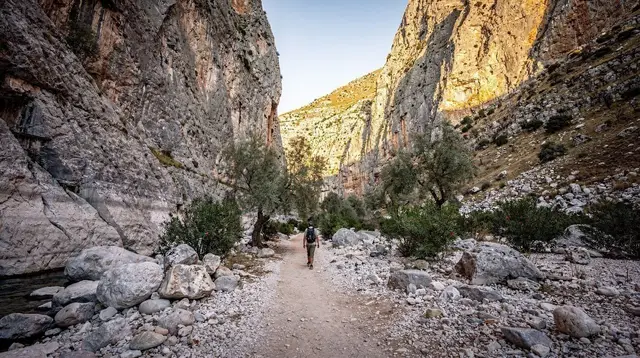
Roughly two-thirds of the way down, the gorge narrows to its most dramatic point, known as the Sideroportes, or Iron Gates. Here the walls close to about 3 to 4 metres apart while rising more than 300 metres overhead — a corridor of rock rather than a valley. It is the single image most people picture when they hear the word Samaria, and it comes late enough in the walk that reaching it is itself a small landmark: past the Iron Gates, the trail widens again and the gorge begins its final descent toward the coastal plain and Agia Roumeli.
| Section | Distance | Character |
|---|---|---|
| Xyloskalo to Samaria village | about 6 km | steep stone steps, pine forest, the steepest drop of the day |
| Samaria village to the Iron Gates | about 7 km | riverbed trail, gradual descent, the gorge narrowing |
| Iron Gates to Agia Roumeli | about 3 km | the narrowest walls, then the trail opens to the coast |
When the park is genuinely open
The Samaria Gorge national park runs on a season, not a calendar guarantee. It typically opens in early May and closes in mid-October, and within that window it can still shut for a day at a time — after heavy rain raises flood risk in the riverbed, or during hot, windy spells that raise fire risk in the pine forest.
On any normal day, the entrance gates also stop admitting new hikers in the early afternoon, regardless of season, because everyone on the trail needs enough daylight to reach Agia Roumeli and catch a boat before evening. None of this is published as a fixed closing hour that travellers can plan a full itinerary against — the honest approach is to check conditions the morning of, and to build in a buffer day if the visit matters to the trip.
Outside that window, from November to April, the gorge is closed outright. The path is unsupervised, unmaintained for the season, and often affected by the same rain and rockfall risk that closes it in shoulder months — this is not a hike to attempt independently in winter regardless of fitness.
The trap: “easy Samaria” is not the same hike
Resorts along the south and north coasts often sell a walk billed as easy Samaria or the Samaria shortcut, and it is worth being precise about what that actually is, because it is not a lighter version of the full descent. Easy Samaria starts from the other end: hikers take a boat to Agia Roumeli first, then walk up into the lower gorge for 3 to 4 km before turning around and walking back down to the village the same way.
It never reaches the Xyloskalo, never crosses the upper two-thirds of the trail, and never passes through the Iron Gates from the Omalos side — though it can reach a viewpoint near them from below, weather and crowding permitting. Anyone who wants to say they have walked Samaria, rather than the last stretch of it, should book the full one-way descent, not the coastal add-on.
Getting out: the boat, then the coach
This is the detail that decides whether a Samaria day works or falls apart: Agia Roumeli has no road, so the only way out is by sea. Ferries run along the south coast to Chora Sfakion, to Sougia, and to Palaiochora, and from each of those a KTEL coach connects back toward Chania and the north coast. Which boat makes sense depends on where the day started — hikers who drove to Omalos and left a car near Chania usually route back via Chora Sfakion or Sougia, since the coach connections from there are more direct, while those staying on the south-west coast may simply stay in Palaiochora that night instead of rushing back.
a guided hike through Samaria from the south entrance, timed around the boat schedule takes the planning out of hikers’ hands entirely, which is the main reason organised trips remain popular even among travellers who would rather walk independently: the operator times the bus to Omalos, the entry, and the return boat as one package, so a missed connection becomes someone else’s problem rather than a stranded evening in Agia Roumeli.
| Exit port | Typical crossing | Onward transport |
|---|---|---|
| Chora Sfakion | about 1 hour from Agia Roumeli | KTEL coach to Chania, roughly 1.5-2 hours |
| Sougia | about 1 hour from Agia Roumeli | KTEL coach toward Chania via the south-west coast |
| Palaiochora | about 1.5-2 hours from Agia Roumeli | KTEL coach toward Chania, or an overnight stay locally |
If you don’t want the full descent
Not every visit to this stretch of Crete needs to be the full 16 km. Travellers based in Chania who want the White Mountains without the logistics of a one-way hike have other options nearby: the Imbros gorge is a shorter, gentler descent that ends at a village with a road, which removes the boat-and-coach chain entirely, and the coastal village of Loutro — reachable only on foot or by sea — offers a similar taste of the roadless south coast without the climb.
A day trip by boat to Loutro along this same coastline is a common pairing for a second day in the area, and hikers who enjoyed the riverbed and cliff scenery of Samaria sometimes add a guided walk to the ancient site of Lissos near Sougia, a shorter trail through similar terrain with Byzantine and classical ruins at the end of it.
Further east along the same coast, a tour out of Plakias exploring the wilder stretches of the south coast covers ground that shares the same roadless, boat-dependent character as Agia Roumeli, for travellers who want more of that landscape without repeating the gorge itself.
For hikers building a longer trip around Samaria, the wider network of trails through this end of the island is covered in the guide to the E4 trail across Crete, which the Samaria path forms one section of, and a full three-day itinerary through the White Mountains and Sfakia sets the gorge inside a longer loop through Loutro, Frangokastello and the coast east of Chora Sfakion. Travellers stitching Samaria into a broader hiking-focused trip can also look at the Crete hiking week itinerary for how it sits alongside other gorges on the island.
What to bring, and what to plan around
A day like this rewards preparation more than fitness. Sturdy shoes with real grip matter more than trail experience, since the upper section is loose stone rather than packed earth. Water is not reliably available along the whole route, so carrying enough for several hours in the heat is standard advice, not caution for its own sake. A hat and sun protection matter even under the forest canopy of the upper gorge, and more so on the open lower stretch near Agia Roumeli. Most hikers carry cash for the boat ticket and for food in Agia Roumeli, since the village is small and not every business takes cards reliably.
The single planning point worth repeating: because the gorge only opens roughly May to October and closes on short notice for weather, and because the only way out is a boat that runs on its own schedule, a Samaria day should never be the only plan for that day of a trip. Building in a spare day, or treating the hike as one option among a shortlist that includes Sougia or Palaiochora as a base, keeps a closed gate or a cancelled boat from derailing the rest of the itinerary.
Frequently asked questions about hiking the Samaria Gorge
Is the Samaria Gorge hike one-way or a round trip?
One-way only for the full hike. You start at the Xyloskalo above Omalos, at 1,227 m, and descend 16 km to Agia Roumeli, which has no road in or out. There is no path back up through the gorge — you leave by boat.
How long is the Samaria Gorge hike and how hard is it?
The full descent is 16 km and takes most walkers 5 to 7 hours, plus the walk from the gorge exit into Agia Roumeli itself. It is steep and rocky underfoot, especially in the upper third, and demands sturdy shoes and a full water bottle rather than technical climbing skill.
What are the Iron Gates?
The Iron Gates, or Sideroportes, are the narrowest point of the gorge, about 3 to 4 metres wide between limestone walls that rise over 300 metres on either side. They sit in the lower section, not far before the trail opens out towards Agia Roumeli.
When is the Samaria Gorge open?
Roughly May to October, weather and conditions permitting. The park closes for flood risk after heavy rain and for fire risk in dry, windy spells, and the entrance gates stop admitting new hikers in the early afternoon even on a normal day, so there is no fixed closing time to plan against.
What is the difference between the full Samaria hike and easy Samaria?
Easy Samaria, often sold in resorts as a lighter option, is a different walk: an out-and-back of 3 to 4 km from Agia Roumeli up into the lower gorge and back the same way. It does not reach the Xyloskalo, the upper gorge, or the Iron Gates from that direction, and it is not a shortcut through the full descent.
How do you get back from Agia Roumeli after the hike?
By ferry, since Agia Roumeli has no road. Boats run to Chora Sfakion, Sougia or Palaiochora, where a KTEL coach connects onward to Chania or the north coast. Which boat to take depends on where you parked or where you are staying, and it is worth checking a timetable before you set off, not after you reach the coast.
What happens if the gorge closes early or a boat is cancelled?
The gorge can close for a day on short notice for flood or fire risk, and boats along the south coast can be cancelled or delayed by strong wind. Neither is common in the main season, but both are real enough that a same-day return to a north-coast hotel should never be booked as a certainty.
Gorge Hikes in Crete on GetYourGuide
Verified deep-linked GetYourGuide tours. Book through these links and we earn a small commission at no cost to you.
GetYourGuide does not provide a product photo for this activity — the image shows the meeting point, photographed by us.