Sea Kayaking to Spinalonga: Is It Better Than the Boat?
Can you sea kayak to Spinalonga instead of taking the boat?
Yes, on a guided trip from Elounda, Agios Nikolaos or Plaka, and it is a genuinely good way to approach the island slowly. It does not replace the boat entirely: landing is restricted to the authorised jetty, and a strong meltemi in July and August can make the open crossing too rough to run.
Why Paddle Out to a Former Leper Colony
Before any talk of paddling technique or launch points, Spinalonga deserves to be understood for what it is. The island in the gulf of Mirabello carries a Venetian fortress completed in 1579, built to guard the approach to Elounda and the salt pans below it. That fortress later became something far heavier: from 1903 to 1957, Spinalonga was Greece’s leprosy colony, and the last one in Europe still in use. People were sent there, lived there, married there, and in some cases are remembered there by name.
Victoria Hislop’s novel The Island, set partly on the island, brought that history to a wide readership, but the events themselves are not fiction — they sit within living memory for families in this part of Crete. A kayak trip that treats Spinalonga as a scenic backdrop for a paddle misses the point of the place. The approach by water is worth doing because it is quiet and slow, not because the island is a stage set.
For the full record of the fortress, the colony and what there is to see once you land, see the complete guide to Spinalonga. This page focuses on one narrower question: whether reaching the island by sea kayak, rather than on the regular boat, is a good way to do it, and what that choice actually involves.
Elounda, Agios Nikolaos and Plaka: Where Kayak Trips Start
Spinalonga sits in the gulf of Mirabello, in the Lasithi region of eastern Crete, and every route to it starts from one of three points on the mainland shore. Elounda is the largest and best known, a resort town with its own causeway and salt pans, roughly 2 km from the island by water. Agios Nikolaos, the regional capital, sits further around the gulf and gives a longer, more open crossing. Plaka, a small fishing village a little north of Elounda, faces Spinalonga directly and offers by far the shortest paddle of the three, around 750 metres of water at its narrowest.
| Starting point | Distance to Spinalonga | Character of the crossing |
|---|---|---|
| Plaka | About 750 m | Shortest, most sheltered, most commonly used for kayaking |
| Elounda | About 2 km | Longer open-water paddle, often combined with a coastal route |
| Agios Nikolaos | About 8 km by sea | Too far for most kayak trips; usually done by boat, kayak as an add-on |
Because of that geography, most guided sea kayak trips either launch from Plaka for a short, approachable crossing, or from Elounda for a longer paddle along the coastline before the final stretch to the island. Trips billed from Agios Nikolaos typically transfer clients to Elounda or Plaka by road before the kayaks go in the water, since paddling the open gulf from the town itself is a different undertaking altogether. For the practicalities of each base — accommodation, distances, what else is nearby — see the destination guide to Elounda and Spinalonga and the separate guide to Agios Nikolaos and Lake Voulismeni.
What the Fortress Island Actually Allows
One thing a kayak does not change: where you are allowed to set foot on Spinalonga. The island is a protected archaeological and historical site, managed with a single authorised jetty and a signed route through the fortress and the settlement above it. That applies identically to visitors who arrive on the scheduled boats from Elounda and Plaka, and to visitors who arrive under their own paddle power.
There is no free landing on a quiet cove around the back of the island, however calm the water looks from a kayak seat. A guided kayak trip lands where every other boat lands, ties up or beaches at the same point, and follows the same walking route before returning to the water. Anyone hoping a kayak offers a private, off-the-record way onto the island should drop that idea before booking — it is not on offer, and it is not meant to be.
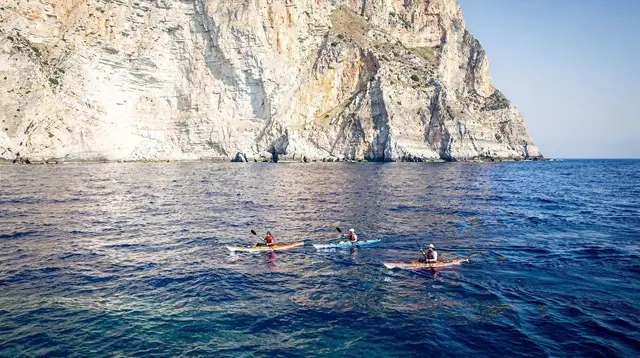
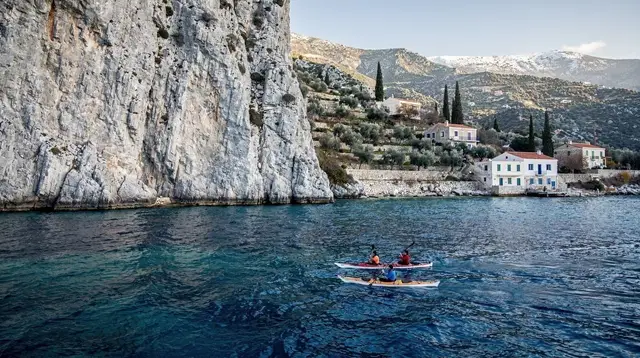
What the kayak genuinely changes is the approach: the last stretch of open water, the fortress walls rising ahead at eye level rather than seen from a boat deck, and the option to pause on the water rather than simply pull in. That is a real difference in how the place lands emotionally, even though the visit itself, once ashore, is the same for everyone.
The Meltemi and the North Coast: When the Sea Says No
The gulf of Mirabello faces broadly north-east, and that matters because Crete’s dominant summer wind, the meltemi, blows from the north and is strongest in July and August. A meltemi day can turn a flat, glassy gulf into a chop that a small open kayak has no business being out in, even where a larger motorised boat would still run its scheduled crossing without much trouble. This is the single biggest practical difference between kayaking to Spinalonga and taking the boat: kayak operators cancel or reroute at a lower wind threshold than boat operators do, because the risk profile of a low, unpowered craft in open water is simply higher.
In practice this means a booked kayak trip in peak summer carries a real chance of being shortened, moved to a more sheltered stretch of coastline, or cancelled outright on a windy morning, with the alternative usually being the standard boat crossing instead. Shoulder-season months — May, June, September and into October — see far less of this wind and generally calmer water in the gulf, which makes them the more reliable window for a paddling trip specifically.
For what the meltemi does more broadly across the island’s coasts, see Crete in July and the meltemi and the wider piece on what the meltemi does to your holiday. None of this should be read as a reason to avoid Elounda in summer — it is a reason to book a kayak trip with realistic expectations and a plan B, which any established local operator already builds into the day.
Kayak or Boat: Two Honest Ways to Reach Spinalonga
Neither approach is objectively better; they suit different visitors and different days.
| Sea kayak | Scheduled or private boat | |
|---|---|---|
| Pace | Slow, self-powered, close to the water | Fast, fixed schedule |
| Best starting point | Plaka (shortest crossing) | Elounda or Plaka, both easy |
| Weather sensitivity | High — cancels earlier in wind | Lower — runs in more conditions |
| Physical effort | Real, though guided and short | None |
| Feel on arrival | Quieter, more physically earned | Convenient, group-friendly |
| Suits | Confident swimmers, active travellers | Families, limited mobility, hot days |
A kayak trip typically also includes a stop to swim or snorkel along the coastline near Plaka or Elounda, which the standard boat crossing does not offer in the same way. If the goal is simply to see the fortress and the former colony with the least fuss, the ordinary boat does the job well and is the more dependable option in any wind. If the goal includes the approach itself — the physical act of closing the distance to the island under your own effort — the kayak is the better fit, weather allowing.
a private guided kayak crossing to Spinalonga from Plaka or Agios Nikolaos covers the paddling route described above with an instructor setting the pace and choosing the sheltered line across the gulf.
a boat trip to Spinalonga from Elounda with a barbecue lunch on board is the straightforward alternative on days when the wind rules out paddling, or for travellers who would rather not paddle at all.
What a Guided Sea Kayaking Day Around Elounda and Spinalonga Involves
A typical trip starts with a short briefing on shore, fitting of a buoyancy aid, and time in stable double sit-on-top kayaks near the launch point before the open crossing begins. Groups paddle together at a pace set by the guide, who reads the water and the wind rather than following a fixed line regardless of conditions. Once at Spinalonga, kayaks are secured at the approved landing point and the group continues on foot through the fortress and the settlement, following the same route as every other visitor before paddling or being transferred back.
Many itineraries add a swim or snorkel stop along the coastline near Elounda or Plaka on the return leg, since that stretch of water is sheltered and clear. None of this requires previous kayaking experience, though a reasonable level of swimming confidence and general fitness makes the day considerably more comfortable, particularly on the longer Elounda route.
a scheduled boat crossing to Spinalonga from Elounda port also works well as the return leg for travellers who paddle out but would rather not paddle back against an afternoon breeze — some operators allow this kind of mixed arrangement, so it is worth asking directly when booking.
Other Ways to Be on the Water Near Elounda
Spinalonga is the obvious draw, but it is not the only reason to get on the water around Elounda and the Lasithi coast. The same sheltered stretch supports snorkelling along rocky coves, and a slower boat day for anyone who would rather stay dry.
a snorkelling boat trip from Elounda covers a different stretch of coastline at a gentler pace, and pairs naturally with a separate day trip to Spinalonga rather than combining both into one long outing.
For a broader look at where to snorkel and dive around the island, see snorkelling spots in Crete and diving in Crete.
Travellers building a full stay in the east should also look at Lasithi and the east in three days for how Spinalonga, Elounda and Agios Nikolaos fit together, and at the category page for kayaking and paddling activities and for things to do around Spinalonga more generally. General safety notes for open-water activity on Crete’s coast, including what to do in stronger wind, are covered in safety and health in Crete.
Deciding Whether to Book the Kayak
The honest answer to the question this page opened with is: it depends on the wind forecast and on what you want the visit to feel like, not on which option is objectively superior. Book the kayak if the forecast for your dates is calm, if you are comfortable on open water, and if the idea of arriving at a Venetian fortress under your own effort appeals more than arriving by engine.
Book the boat, or keep it as your fallback, if your dates fall in a windy stretch of July or August, if mobility or time is limited, or if the history of the place matters to you more than the manner of the crossing — either way, you reach the same jetty, walk the same route, and stand in front of the same walls that sheltered a community for more than half a century. For the island’s own story in more depth, the piece on Spinalonga within living memory is worth reading before you go, kayak or not.
Spinalonga by Kayak: Questions Travellers Ask
Can you kayak all the way from Elounda to Spinalonga?
Yes, guided sea kayak trips run from the Elounda waterfront across to Spinalonga, though the crossing is longer than from Plaka. Most operators pair the paddle with a shorter transfer leg on the outward or return journey so the whole day stays manageable for non-experts.
Is kayaking a better way to see Spinalonga than the regular boat trip?
It is a different experience rather than a strictly better one. A kayak gets you closer to the fortress walls at sea level and lets you set your own pace on the water, but the standard boat trip from Elounda or Plaka is faster, drier and runs in conditions a kayak cannot handle.
Where do sea kayak trips to Spinalonga actually start?
The three regular starting points are Elounda, Agios Nikolaos and the small harbour at Plaka, which sits directly across from the island and offers the shortest crossing of the three, around 750 metres of open water.
Can you land anywhere on Spinalonga by kayak?
No. Spinalonga is a protected historical site and free landing is not permitted. Guided kayak trips land only at the authorised jetty used by the scheduled boats, then continue on foot with the same access rules as every other visitor.
Does the meltemi wind affect a Spinalonga kayak trip?
Yes, more than it affects the boats. The meltemi blows hardest in July and August from the north, and the crossing to Spinalonga faces that direction. Operators cancel or shorten kayak trips on windy days well before they would cancel a motorised boat.
Do you need kayaking experience to do this trip?
No. Guided trips use stable sit-on-top double kayaks, cover a short and sheltered route when conditions allow, and include instruction beforehand. Reasonable fitness and comfort on open water matter more than prior kayaking experience.
How long does a guided kayak trip to Spinalonga take?
Budget half a day for the paddling and the island visit together, longer if the trip starts from Elounda rather than Plaka and includes a swim stop or snorkelling along the coastline.
Is Spinalonga worth visiting if you already know the history?
Knowing the history changes what the visit means. The island held Crete’s last working leper colony until 1957, inside a Venetian fortress finished in 1579, and Victoria Hislop’s novel The Island drew wide attention to real, recent lives lived there rather than to ruins alone.
Kayaking Tours in Crete on GetYourGuide
Verified deep-linked GetYourGuide tours. Book through these links and we earn a small commission at no cost to you.
GetYourGuide does not provide a product photo for this activity — the image shows the meeting point, photographed by us.