Lasithi and the East in 3 Days
Three days is enough to see the Lasithi plateau, Agios Nikolaos and Spinalonga properly, but only if you resist the pull to add just one more town. Sitia and Ierapetra both sit close on a map of Crete and both add more than an hour of driving each way, which turns a relaxed three days into three long ones. This itinerary keeps a single base in Agios Nikolaos, moves inland to the plateau on day one, stays local on day two, and finishes on the water at Spinalonga on day three.
A three-day loop, one base, no extra hour of road
The logic here is simple: everything in this itinerary sits within about 45 minutes of Agios Nikolaos, so there is no reason to pack a bag twice. Check in on arrival, keep the same room for three nights, and let the car — or the bus and boat network, if you are travelling without one — do the moving instead of you. That single decision is what keeps this trip from feeling rushed.
| Day | Focus | Base |
|---|---|---|
| 1 | Lasithi plateau, Psychro and the Dikteon cave | Agios Nikolaos |
| 2 | Agios Nikolaos town and Kritsa | Agios Nikolaos |
| 3 | Elounda and Spinalonga by boat | Agios Nikolaos |
Day 1: The Lasithi plateau and the cave of Zeus
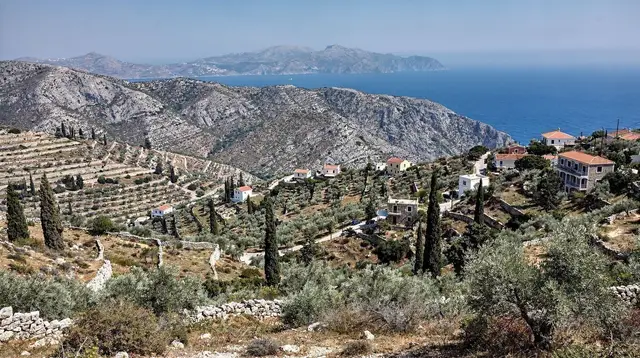
The drive from Agios Nikolaos up to the Lasithi plateau takes around 45 minutes to an hour, climbing through switchbacks until the road opens onto a wide, flat basin at roughly 850 metres. This is farmland ringed by mountains, still worked in strips the way it has been for generations, and it looks nothing like the coast you left behind.
Set expectations before you go: the plateau’s famous white-sailed windmills, thousands of them once pumping irrigation water across the fields, are mostly gone. What remains is rusted metal skeletons dotted across the basin, with a small cluster restored near the villages purely for visitors to photograph. It is worth seeing for what it is now, not for the postcard version.
Stop in one of the plateau villages for a coffee or an early lunch before continuing to Psychro, on the plateau’s southern edge, for the Dikteon cave, the cave the ancient Greeks believed was the birthplace of Zeus. The path down is steep and can be slippery, especially near the entrance and on the descent into the main chamber, so wear flat closed shoes and take the stairs slowly rather than treat it as a casual stroll. A local guide or a mule ride partway up is available for anyone who would rather not manage the return climb unassisted.
If you would rather not drive the mountain road yourself, a guided option covering the plateau and its surroundings in one day works well here — a full-day tour through the highlights of east Crete takes the driving off your hands and still leaves the afternoon free once you are back on the coast.
For a slower version of this same day, the Lasithi plateau day loop walks through village stops and viewpoints beyond the cave itself, useful if you want to build in an extra hour before heading back down to Agios Nikolaos for the evening.
Day 2: Agios Nikolaos and Kritsa
With no driving to plan, day two can move at a walking pace. Start in Agios Nikolaos itself: the town wraps around Lake Voulismeni, a small, deep, round lake connected to the harbour by a short channel, and the walk around it takes barely twenty minutes but sets the tone for the rest of the morning. Follow it with a wander through the harbour and the streets just behind it — see the guide to Agios Nikolaos and Lake Voulismeni for a fuller route through town.
Mid-morning, head inland roughly 20 minutes to Kritsa, one of the larger traditional villages in this part of Crete, known for its weaving and embroidery workshops as much as for its narrow lanes climbing the hillside. It is an easy add to the same day without eating into your Lasithi or Spinalonga time, which is exactly why it pairs with Agios Nikolaos rather than with either of the other two days.
Travellers without a car can still cover this pairing comfortably: a day trip from a nearby base with hotel pickup included handles the Agios Nikolaos side of things, and a short local taxi or organised walk covers Kritsa on top. For those who want Kritsa itself as the focus, with more structure than a free wander through the lanes, a guided walking route through Kritsa and its gorge turns the village visit into a proper half-day outing rather than a quick stop.
Spend the rest of the afternoon back in Agios Nikolaos itself — the town has enough tavernas and waterfront benches to fill out the day without needing a third stop. This is deliberately the lightest day of the three, and it should stay that way.
Day 3: Elounda and Spinalonga
The last day is built entirely around one destination: Spinalonga, the fortress island in the gulf of Mirabello. Start with the short drive or bus ride to Elounda, around 20 minutes from Agios Nikolaos, and choose your crossing from there. Boats to the island run from three points — Plaka, just across the narrow strait and the shortest ride; Elounda itself, usually combined with more time on the water; and Agios Nikolaos, for those who would rather skip the drive to Elounda altogether and sail the whole way.
Spinalonga carries a 1579 Venetian fortress on its walls, but the island’s more recent history is what visitors remember: from 1903 to 1957 it operated as a leper colony, the last one in Europe, and the people who lived and died there are recent history rather than scenery. Victoria Hislop’s novel The Island brought the site wider attention, but the ruins of the settlement speak for themselves — walk the main street of the old colony rather than treat the island as a quick photo stop. Full detail on the island’s layout and history is in the Spinalonga island guide, and a comparison of the three departure points is in which boat to take to Spinalonga.
For a boat day with more time on the water around the bay before or after the island itself, a boat trip out of Elounda that takes in the coastline around the fortress is a pleasant way to close out the trip, especially if you would rather not manage timed ferry tickets yourself. Either way, plan to be back in Agios Nikolaos by the evening for a final dinner on the harbour before moving on.
What this itinerary leaves out, and why
Sitia and Ierapetra are both real destinations in their own right, and neither is a bad trip — they are simply not this trip. Sitia sits roughly an hour beyond Agios Nikolaos along the north coast, and Ierapetra is over an hour in the opposite direction, past Kritsa and across the island’s narrowest point to the Libyan Sea. Adding either one to a single day here means sacrificing time at the plateau, in Kritsa, or on the water at Spinalonga, which is the trade this itinerary is built to avoid. If you have a fourth or fifth day to spare, both towns make a sensible extension — the Sitia town guide is worth reading before you decide.
Planning notes
Agios Nikolaos works as a single base because nothing on this loop sits more than about 45 minutes away, so there is no packing and unpacking to plan around. If you are choosing where to stay for the first time, the guide to where to stay in Crete covers the trade-offs of basing yourself here against Elounda or further along the coast. A rental car makes day one considerably easier, since the plateau sits away from the coastal bus corridor — see renting a car in Crete if you have not booked one yet — though days two and three can both be managed without one, using local buses, taxis and the boats to Spinalonga.
Before you go, it is worth reading through the common mistakes to avoid in Crete, several of which apply directly here: rushing the Dikteon cave descent, underestimating how far Sitia and Ierapetra actually are, and skipping Kritsa because it looks like a minor stop on the map when it is really a short, easy add to day two.
Lasithi and Agios Nikolaos: your questions answered
Can I fit Sitia or Ierapetra into this same 3-day loop?
Not without cutting something else short. Sitia is roughly an hour beyond Agios Nikolaos and Ierapetra over an hour the other way, past Kritsa. Either one turns a relaxed day into a long driving day, and this itinerary is built to avoid that.
Do the Lasithi plateau windmills still turn?
Almost none of them. The thousands of white-sailed windmills that once pumped irrigation water are mostly rusted frames now; a handful have been restored near the villages for visitors to photograph, but the working windmill landscape of old postcards is gone.
Is the Dikteon cave hard to visit?
It is a steep, slippery descent on worn stone steps, doable in flat closed shoes but not easy for anyone unsteady on their feet. Guides and a mule ride partway up are available at Psychro for those who prefer not to walk the full climb back.
Which boat should I take to Spinalonga?
Plaka, just across the water, has the shortest crossing. Elounda and Agios Nikolaos both run boats too, usually combined with time cruising the bay, so the choice comes down to how much boat time you want alongside the island visit itself.
Do I need a car for this itinerary?
A rental car makes the Lasithi plateau day much easier, since the plateau sits away from the coastal bus routes. Agios Nikolaos and Kritsa, and the boats to Spinalonga, can all be done without one if you would rather not drive.
Is one base in Agios Nikolaos really enough for three days?
Yes. Agios Nikolaos sits within about 45 minutes of the Lasithi plateau, a few minutes of Kritsa, and a short drive or boat ride of Elounda, so nothing on this loop justifies changing hotels.
tours.3 days
Verified deep-linked GetYourGuide tours. Book through these links and we earn a small commission at no cost to you.
GetYourGuide does not provide a product photo for this activity — the image shows the meeting point, photographed by us.