Spinalonga: The Fortress That Was Never a Film Set
What is Spinalonga and how do you visit it?
Spinalonga is a Venetian fortress island in the gulf of Mirabello that became Greece's last leper colony, inhabited from 1903 to 1957. Boats leave from Plaka, the shortest crossing, and also from Elounda and Agios Nikolaos, and a visit typically takes half a day once you count the crossing and the walk around the site.
A fortress that outlived three different uses
Most islands people visit in Crete are visited for a beach, a view or a boat ride. Spinalonga is visited for what happened there, and that changes how it should be approached. The islet sits just off Plaka in the gulf of Mirabello, close enough to Agios Nikolaos that it appears on almost every east Crete itinerary, and small enough to walk end to end in under an hour.
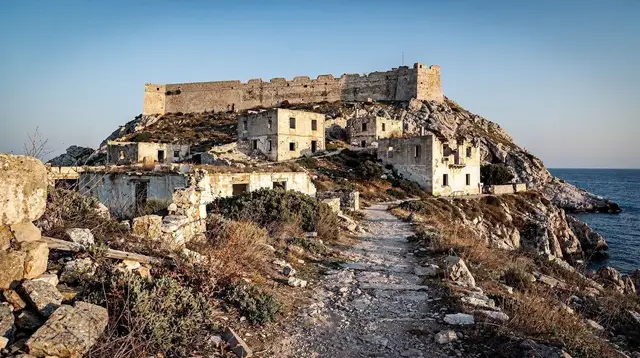
None of that makes it a quick photo stop. Spinalonga has been a Venetian fortress, an Ottoman garrison town, and, for more than fifty years of the twentieth century, Greece’s last leper colony. The people who built its walls, the families who once traded inside them, and the patients who made a life there are three different layers of the same small piece of rock, and a good visit tries to see all three rather than skipping straight to the most cinematic one.
This guide covers the history in enough depth to make the walk mean something, is honest about where the popular novel version of the story simplifies things, and lays out the three real departure points for the crossing without pretending one of them is the only sensible choice.
The Venetian walls of 1579
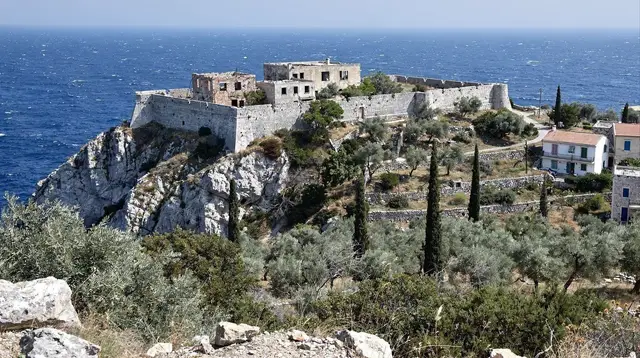
The fortifications visitors walk today date to 1579, built by the Venetians who then controlled Crete to guard the entrance to the gulf of Mirabello and the salt pans nearby. Spinalonga was one of the last Venetian strongholds to fall when the Ottomans took the rest of the island: Crete’s main cities capitulated through the seventeenth century, but the fortress held out until 1715, decades after Venetian rule elsewhere on Crete had ended.
Under Ottoman control it became a small fortified town, with a Muslim community that lived inside the walls and traded across the channel. That civilian settlement is the one that later gave the island its houses, its narrow lanes and its small square — the built fabric that the leper colony would eventually inherit rather than construct from nothing.
It is worth holding onto that sequence, because it explains why Spinalonga looks the way it does. The fortress is not a folly built for effect; the walls are working eighteenth-century Venetian military architecture, and the streets inside them were laid out for an Ottoman-era trading community long before disease had anything to do with the place.
1903 to 1957: the last leper colony in Europe
In 1903 the Greek administration of Crete designated Spinalonga as a colony for people with leprosy, known clinically as Hansen’s disease. It was not the first such colony in Greece, but it became the longest-running and, by the time it closed, the last one operating anywhere in Europe. Patients were sent there from across Crete and beyond, often separated from their families for years or decades, at a time when leprosy carried both a severe physical toll and a heavy social stigma that isolation did nothing to soften.
What developed on the island over the following decades was, in its own constrained way, a functioning town. Records and survivors’ accounts describe shops, a church, a small cinema, a café and eventually a rudimentary hospital, run largely by the residents themselves rather than imposed from outside. Conditions improved gradually through the twentieth century as medical understanding of the disease advanced, though the underlying reality — people confined to a small island because of an illness, often for the rest of their lives — never stopped being harsh.
The colony closed in 1957, not because leprosy had been eradicated, but because the introduction of effective antibiotic treatment made the whole premise of permanent isolation unnecessary. The last residents, several of whom had lived on Spinalonga since childhood, were finally free to leave a place that had been the only home many of them had known for years.
This is recent history, not distant history. People who were born on Spinalonga, or who had parents and grandparents interned there, are alive today, and their families still live in the towns around the gulf of Mirabello. A visit to the island sits closer, in human terms, to living memory than to the myth-sized story it sometimes gets flattened into.
Beyond The Island: what the novel got right, and what it simplifies
Victoria Hislop’s 2005 novel The Island did more than any single source to put Spinalonga on international travellers’ itineraries, and it deserves credit for that: before the book, the island was a footnote in most guidebooks rather than a headline stop. The novel traces a fictional Cretan family across several generations, weaving in the real history of the colony, the Battle of Crete and postwar island life.
It is fiction, though, built around real events rather than a documentary account of them. Character arcs, individual relationships and some of the finer historical detail are invented or compressed for the sake of the story, and the book’s warmth and narrative pull can leave readers with a softened, occasionally romanticised sense of what confinement on the island actually meant for the people who lived it.
Treating the novel as background reading rather than as the definitive record of Spinalonga is the fairer way in — read it for atmosphere and for the way it opened the story to a wide audience, and let the island’s own documented history, told through its museum panels, its restored buildings and the accounts of former residents’ families, carry the actual facts.
That distinction matters for how a visit should feel. Spinalonga is not a stage set built to evoke a beloved book; the book was built to evoke a place that already existed and that real families still carry memories of. A walk around the island works best when it is treated the second way round.
Choosing where to sail from: Plaka, Elounda or Agios Nikolaos
There is no single correct departure point for Spinalonga, and any guide that tells you otherwise is simplifying for convenience rather than describing the real choice.
Plaka sits directly across the narrow channel from the island and offers the shortest crossing of the three, typically only a few minutes on the water. It suits travellers who are already staying in or near Elounda and want the most direct route with the least time spent on the boat itself.
Elounda, a short distance round the bay from Plaka, is the departure point built into most half-day boat trips, often combined with time on the water around the gulf or a stop at a nearby beach. It works well as a base because Elounda has the widest range of accommodation and dining options along this stretch of coast.
Agios Nikolaos, the regional town on the far side of the gulf, offers a longer crossing that takes in more of the gulf of Mirabello along the way. It suits visitors staying in the town itself, or those who would rather build a Spinalonga trip into a wider day out that also covers Agios Nikolaos and Lake Voulismeni.
None of the three is objectively better; the right one depends on where you are staying and whether you want the crossing itself to be a short hop or part of the day’s sightseeing. For a closer look at how the different boat options actually compare, the dedicated guide on choosing a boat to Spinalonga goes further into timing and what each route includes.
A short boat trip from Elounda covers the crossing directly, and pairing it with a stop at Kolokytha beach turns the outing into a fuller half-day rather than a there-and-back shuttle.
a boat trip to Spinalonga with time on the water and a barbecue lunch includedTravellers who want the island paired with a swim stop on the same outing tend to prefer the combined route from Elounda that adds Kolokytha beach to the crossing.
a day trip that combines the island with Kolokytha beachWhat a visit actually involves
Once ashore, visitors pass through the Dardanelles gate, the main fortified entrance built into the Venetian walls, and follow a marked path that climbs gently up through the old settlement before circling back down. The route takes in the surviving houses of the leper colony era, the church, the remains of the hospital building, and the upper fortifications with views back across the channel to Plaka and the mainland coast. Information panels along the way set out the history in more detail than a guidebook can, and it is worth reading them rather than walking past.
A full visit, crossing included, generally takes around half a day. The walk itself is not strenuous — the paths are well maintained and the climb is gradual — but there is very little shade on the island, so a hat, water and sun protection matter here as much as they do at any exposed archaeological site in Crete, Knossos included. Good, closed shoes help on the uneven stone paths through the old streets.
There is no accommodation on Spinalonga and no way to stay overnight; every visit is a day trip governed by the boat schedules from Plaka, Elounda or Agios Nikolaos. Facilities on the island itself are limited, so it is worth arranging food and water before boarding rather than expecting much once ashore.
Walking the village: what to look for, and what to leave alone
The most affecting part of a Spinalonga visit is usually not the fortress walls but the ordinary domestic details of the old settlement: the outlines of small houses, a surviving shopfront, the church where residents worshipped, the layout of streets that were, for decades, simply where people lived their daily lives. Approaching these with the same restraint you would bring to any site connected to real hardship — quiet voices in the areas nearest the hospital ruins, no treating doorways or thresholds as backdrops for staged photos — goes some way toward keeping the visit honest to what the place actually was.
Nothing should be removed from the site, and the marked paths exist to protect both visitors and the fragile older structures, not as a suggestion. Guided options, including the more detailed tours from Elounda, add context that the on-site panels alone don’t always cover, particularly around individual residents’ stories and the day-to-day workings of the colony.
a professionally guided boat tour that adds context to the walk around the islandNearby: the gulf of Mirabello beyond the island
Spinalonga sits inside a wider stretch of coastline that rewards a bit more time than a single crossing allows. Kolokytha beach, reached on several of the boat routes, offers a swim stop with clear water and none of the crowding of the resort beaches further along the coast. Elounda itself has a relaxed waterfront worth an evening, and the hill town of Kritsa, a short drive inland, is one of the more genuinely lived-in villages in this part of Crete.
Travellers building a longer stay around this base often combine Spinalonga with a trip up to the Lasithi plateau, roughly an hour’s drive south, home to the Dikteon cave and the last of the region’s old irrigation windmills. A day loop around the Lasithi plateau pairs naturally with a morning at Spinalonga on either side of a short stay in Elounda or Agios Nikolaos, and the broader east Crete four-day itinerary works as a template for slotting both in.
For visitors who want the crossing itself to be more of an experience, a private boat charter around the bay covers Spinalonga alongside quieter coves that the larger group trips don’t reach.
a private boat trip around the bay that takes in Spinalonga and quieter coves nearbyDeciding how many days to give this corner of Crete, and where to base yourself for it, is covered in more general terms in the guide on how many days to spend in Crete and the wider where to stay in Crete guide, both useful before fixing an itinerary around Elounda and the east. For the boat trip itself, a look at common mistakes to avoid in Crete covers a few habits, like skipping sun protection on exposed sites, that catch out visitors on Spinalonga specifically. Evening light on the crossing back is also one of the better settings in the region for a sunset cruise if timing allows.
Things to do in and around the island, beyond the boat crossing itself, are gathered on the Spinalonga activities page, and the wider write-up on the island’s place in living memory is worth reading alongside this guide.
Spinalonga’s history, answered directly
When was Spinalonga used as a leper colony?
From 1903 to 1957. It operated as the last leper colony in Europe, closing only once antibiotic treatment made lifelong isolation medically unnecessary rather than because the disease itself had disappeared.
Is Victoria Hislop’s novel The Island historically accurate?
It is a work of fiction built around real events, not a documentary account. It compresses timelines and invents individual characters for narrative effect, and it deserves credit for drawing wide attention to Spinalonga’s history, but the island’s documented history and residents’ own accounts remain the more reliable source.
Where do boats to Spinalonga depart from?
Three places work equally well: Plaka, directly across the narrow channel and the shortest crossing; Elounda, a short distance round the bay and the most common base for half-day trips; and Agios Nikolaos, a longer crossing that takes in more of the gulf of Mirabello.
How long does a visit to Spinalonga take?
Plan on roughly half a day once the crossing, the walk around the fortress and village, and the return trip are all counted. Combined trips that add a beach stop or extra time on the water run longer.
Did anyone actually live on Spinalonga, or is it a film set?
People lived there for over five decades as part of a real, self-organised community with shops, a church and a small cinema. Descendants of former residents still live in the towns around the gulf of Mirabello today, so this is living memory rather than a set built for tourism.
What should visitors keep in mind when walking around the island?
Spinalonga was a real home for the people confined there, often under difficult conditions, so a measure of quiet respect around the old houses and hospital ruins fits the place better than treating it purely as a photo backdrop. Sturdy shoes, sun protection and water matter too, since shade on the island is minimal.
Spinalonga Tours in Crete on GetYourGuide
Verified deep-linked GetYourGuide tours. Book through these links and we earn a small commission at no cost to you.
GetYourGuide does not provide a product photo for this activity — the image shows the meeting point, photographed by us.