Diving in Crete: Where, When and What the Water Is Really Like
When is the best time to dive in Crete, and does the coast you choose matter?
The diving season runs roughly May to October, with sea temperatures rising from around 16-18°C in spring to 24-27°C by August and September. In July and August the meltemi, a strong north wind, regularly disrupts the north coast, so the calmer, warmer south coast on the Libyan Sea is often the better choice in those two months.
Two Seas, One Season: How Crete’s Coastline Works for Divers
Crete sits between two different bodies of water, and that split matters more to a diver than almost anything else on this island. The north coast faces the open Aegean and takes the brunt of the summer’s dominant wind; the south coast, on the Libyan Sea, is sheltered by the island’s own mountain spine and tends to stay calmer and warmer through the same weeks. Choosing a dive site here is really choosing a coast, and choosing a coast means paying attention to the season, not just the map.
This page sets out when the water is diveable, how warm it actually gets month by month, why the north and south coasts behave so differently in summer, and what kind of seabed and marine life you should genuinely expect. It does not list dive centres, instructors or baptism prices — those change too often and too locally to belong on an island-wide guide — and it does not promise encounters this destination cannot deliver.
Sea Temperature Through the Year
Water temperature around Crete follows a slow, predictable curve rather than sharp swings, but the range across the season is wide enough to change how a dive feels.
| Period | Approximate sea temperature | What it means in the water |
|---|---|---|
| April - May | 16-18°C | A wetsuit (5-7 mm) is genuinely needed; comfortable for short dives only |
| June | 21-23°C | Noticeably milder; a 3-5 mm wetsuit is typical |
| July - early August | 23-25°C | Warm, though the meltemi affects conditions more than temperature does |
| Late August - September | 24-27°C | The warmest window of the year, and often the calmest on the north coast |
| October | Cooling from the September peak | Still swimmable, water holds warmth longer than the air suggests |
| November - March | Cold, largely outside the dive season | Most boat-based diving stops; a handful of shore dives may continue for the committed |
The lag behind the calendar is worth noting: the sea is at its warmest not in the hottest month but toward its end, in August and September, because open water heats and cools more slowly than land or air. A traveller planning a trip around the best time to visit Crete who assumes July automatically means the warmest sea will be pleasantly surprised in September instead.
The Meltemi: Why July and August Are Not Simple
The meltemi is a strong, dry wind that blows from the north through July and August, and it is the single biggest variable for anyone planning to dive or snorkel in Crete during high summer. It does not affect the whole island evenly. The north coast — the stretch that runs through Souda Bay and Akrotiri, past Rethymno and Heraklion to Agios Nikolaos and the Gulf of Mirabello — takes the wind directly, and it can turn a flat morning sea choppy by afternoon. Some boat-based snorkelling and dive-boat trips get cancelled or rerouted on the windiest days, and visibility can drop as surface chop stirs sediment near the shore.
The south coast, facing the open Libyan Sea and shielded by the island’s mountains, generally rides out the meltemi far better. Around Plakias and Damnoni and further east near Matala, the water often stays calmer and, being open to the south, slightly warmer than the north coast at the same point in the calendar. If a trip falls in late July or August and diving or snorkelling matters to it, building in a day or two on the south coast is a reasonable hedge against a windy week up north — see how the wind pattern plays out day to day.
Outside July and August, the meltemi mostly loosens its grip, which is one reason the shoulder months handle diving conditions more predictably than high summer does.
What Is Actually Under the Water
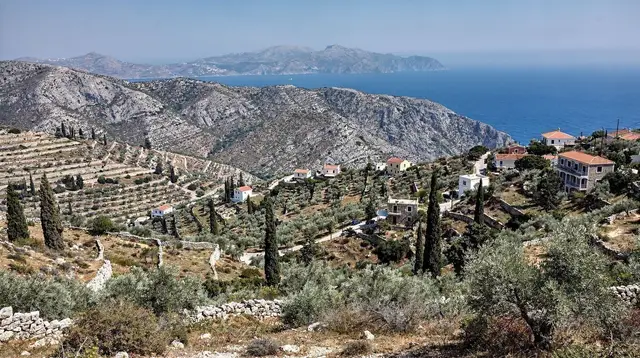
It helps to be clear about what kind of seabed this island offers, because Crete’s geology gets misread. Crete is not a volcanic island. There is no caldera here, no fumarole venting warm gas, no crater lake, no field of solidified lava the way there is on Santorini or Nisyros. The rock beneath Crete’s coastline is overwhelmingly limestone and folded sedimentary rock, built up over millions of years and pushed into the ridges, gorges and cliffs that define the island above the waterline too. Underwater this translates into rocky reef, submerged boulders, small caverns and swim-throughs cut into limestone, rather than the black sand, pillow lava and volcanic vents divers find on Greece’s volcanic islands.
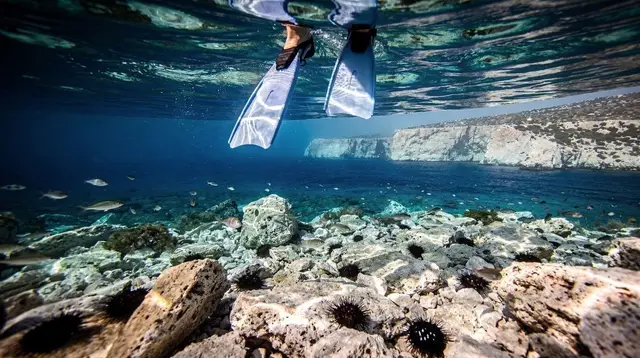
The clarity of the water is one of the coast’s real strengths: visibility is frequently strong, particularly away from harbour mouths and river outflows, which is part of why snorkelling here can be worthwhile even for visitors who never put on a tank. See shore-accessible spots that reward a mask and fins alone.
That limestone base also explains features divers notice without necessarily connecting to the geology: the sudden drop-offs a short swim from shore, the small underwater arches and short tunnels worked into the rock by centuries of wave action, and the occasional freshwater seep where rain that fell on the mountains resurfaces through cracks in the seabed.
None of this is volcanic in origin — it is the same folding and faulting that raised Psiloritis and the White Mountains above sea level, continuing below the waterline. A diver who has read about Santorini’s submerged caldera wall or Nisyros’s underwater fumaroles should not expect anything comparable here; Crete’s underwater landscape is quieter and slower-formed, built by water wearing at stone rather than by eruption.
Marine Life: What to Expect, and What Not To
Crete’s sea supports a normal Mediterranean mix of life — grouper, bream, damselfish, octopus, moray eels tucked into rock crevices, sea urchins and starfish on the sandy patches between reef. Schools of smaller fish gather around the rocky ledges in the warmer months, and a careful look into a crevice on almost any dive will turn up an eel or a resting octopus that would otherwise go unnoticed from the surface. It is a pleasant, varied Mediterranean dive, and that is the honest pitch for it — attentive rather than spectacular, rewarding patience more than luck.
What this page will not do is oversell it. Crete is not a whale- or dolphin-watching destination. There is no resident population set up for reliable sightings, no operator network built around megafauna encounters the way there is in parts of the Atlantic or the Pacific. A boat trip booked here should be understood as a trip to a place — an island like Dia, a stretch of protected coast, a sheltered bay for snorkelling — not as a wildlife-encounter tour with a guaranteed animal at the end of it. Anyone travelling specifically hoping to see a whale or a dolphin pod should look elsewhere in the Mediterranean or beyond; setting that expectation on a Cretan boat trip will most likely end in disappointment.
The Coasts, Region by Region
West — Chania and Souda Bay. The Akrotiri peninsula and the coves around Souda Bay offer sheltered water close to Chania, with rocky shoreline that suits both shore dives and short boat trips. It is the most convenient base if the rest of the trip is centred on Chania town and the west.
North-centre — Rethymno and Heraklion. Both cities sit on the exposed north coast, so conditions here are the ones most directly shaped by the meltemi in July and August. Outside those months, the coast is generally reliable and well served by operators working from the towns themselves.
East — Agios Nikolaos and the Gulf of Mirabello. The gulf is more enclosed than the open north coast further west, which gives it some shelter from wind-driven chop. A snorkel cruise around the bay works well here, and the presence of Spinalonga just offshore makes this stretch a natural combination of a boat day and a snorkel stop, without pretending the fortress island itself is a dive site.
South — Plakias, Matala and the Libyan Sea. This is the fallback for anyone whose trip lands during a windy stretch up north. Calmer, warmer, and less developed for organised diving than the north coast, it rewards travellers willing to base further from the main towns for a day or two. Ierapetra and Chrissi islet sit further east along this same southern exposure and follow the same pattern of calmer water when the meltemi is up.
Booking a Dive or a Snorkel Day
For a first taste of the water with no certification required, an introductory dive under direct supervision is the standard entry point — the beginner scuba dive out of Chania runs exactly this kind of session for people who have never dived before. Around Rethymno, a similar discover-scuba experience covers the same ground on the north-centre coast, useful for anyone based closer to that town than to Chania.
Snorkelling is the lower-commitment option, and it pairs naturally with a boat day rather than a dedicated dive trip. The boat cruise around Mirabello Bay with snorkel gear included covers the sheltered east-coast water near Agios Nikolaos and Elounda described above, and includes transfer, which removes the logistics of driving to a departure point on an unfamiliar coast. It is a practical option on a windy day too, since a sheltered gulf keeps working as a snorkel destination even when an open-water boat trip further along the coast has been called off.
This guide deliberately does not quote baptism-dive prices, name specific dive schools or instructors, or rank operators against each other — those details shift by season and by business, and the honest version of this page is the one that tells you where and when the water works, and lets you choose an operator on the day.
Practical Notes
A wetsuit thickness that suits April may be uncomfortable by August, so check what is included before a booking rather than assuming. Certified divers should carry their logbook and certification card regardless of how recently they last dived. On boat-based trips, expect the operator to make the wind call on the day — a morning departure can still be cancelled or moved to a sheltered bay if the meltemi builds through the afternoon, which is normal practice rather than poor planning.
If diving is one part of a broader trip rather than the whole focus of it, a beaches-focused week or a look at the weather month by month helps place a dive day against the rest of the calendar, especially for a visit that also wants gorge walks, old-town time in Chania or Rethymno, or the sites around Knossos that have nothing to do with the coast at all.
Frequently Asked Questions About Diving in Crete
What is the water temperature for diving in Crete?
It starts around 16-18°C in spring, warms through the low-to-mid 20s by June, and peaks at roughly 24-27°C in August and September, which is the warmest window of the year.
Does the meltemi affect diving in Crete?
Yes. The meltemi is a strong north wind that blows mainly in July and August, roughening the north coast and cancelling some boat-based trips, while the south coast on the Libyan Sea usually stays calmer.
Is Crete a good place to see whales or dolphins while diving?
No. Crete is not set up as a whale- or dolphin-watching destination, and a diving or snorkelling trip here should not be booked on the promise of encountering large marine mammals.
Is there volcanic diving in Crete, like a caldera or lava reef?
No. Crete has no volcanic caldera, fumarole or lava formations. The seabed around the island is built from limestone and folded rock, shaped by faulting and erosion rather than by volcanic activity.
Which coast of Crete is better for diving, north or south?
The north coast, from Souda Bay to the Gulf of Mirabello, has the greater concentration of dive centres and is easy to reach from Chania, Rethymno, Heraklion and Agios Nikolaos. The south coast, facing the Libyan Sea near Plakias and Matala, is a calmer, warmer alternative especially when the meltemi is blowing.
Do I need a certification to dive in Crete?
Certified divers can join guided dives with their existing qualification and logbook, while beginners can take an introductory or discovery dive that requires no prior experience and is run under direct supervision.
Is snorkelling a good alternative to diving in Crete?
Yes, particularly along the rocky coves of Akrotiri and the sheltered bays of the east, where clear water and visible reef structure make snorkelling worthwhile even without diving equipment.
When is the sea too rough to dive in Crete?
Rough conditions cluster around the meltemi period on the north coast in July and August, and more generally through the winter months when boat-based diving largely stops island-wide.
Diving & Snorkeling in Crete on GetYourGuide
Verified deep-linked GetYourGuide tours. Book through these links and we earn a small commission at no cost to you.
GetYourGuide does not provide a product photo for this activity — the image shows the meeting point, photographed by us.