Agios Nikolaos and Lake Voulismeni: A Walking Base for Spinalonga
Is Agios Nikolaos worth visiting, and is it a good base for Spinalonga?
Agios Nikolaos is a small, easy-to-like port town built around Lake Voulismeni, with a short lakeside and harbour walk that takes under an hour. It works well as a base for Spinalonga, since boats to the fortress islet leave from the town's own harbour as well as from nearby Plaka and Elounda, with Plaka offering the shortest crossing.
A small town built around a lake
Most visitors reach Agios Nikolaos already knowing one thing about it: there is a lake in the middle of town, and it is supposedly bottomless. It is not — depth soundings have put the floor at around 64 metres, still striking for a body of water barely 137 metres across, but not literally without a bottom. What matters for a visit is simpler. Lake Voulismeni sits a short walk from the harbour, connected to the sea by a narrow canal cut in the 1860s, ringed by cafés, tavernas and a low limestone cliff on its western side. The loop around it takes well under an hour, which is exactly why it works as the spine of a longer town walk rather than a destination in itself.
Agios Nikolaos is the main town of the Lasithi regional unit, the easternmost of Crete’s four, and it carries a different rhythm from Chania or Rethymno. There is no walled old town or Venetian core to speak of — the medieval town here was smaller and less fortified than its western counterparts — so the appeal is more about setting than architecture: the lake, the harbour lined with fishing boats and yachts, and the short Kitroplatia beach a few minutes’ walk south, tucked between headlands right against the town centre.
It is a place to arrive, settle for a day or two, and use as a launch point rather than a place with a long list of sights to check off. Most travellers reach this side of the island by landing at Heraklion first rather than flying in from further east; the practicalities of the flight itself are set out in a Heraklion airport guide, and the broader question of getting here at all — flights against the overnight ferries from Piraeus — is covered in a guide to getting to Crete by flight or ferry.
For travellers deciding which Cretan town to spend the most time in, it helps to know where this one sits relative to the others. A guide weighing Chania, Rethymno and Heraklion against each other lays out the character differences directly, which matters when dividing a west-to-east itinerary. Timing is worth checking too, since Agios Nikolaos empties out faster than the west-coast resorts once the season turns — a general guide to the best time to visit Crete is worth reading before booking dates.
Walking the lake and the harbour
The natural route starts at the canal bridge, where the lake meets the sea, then follows the eastern quay past the fishing boats to the wider harbour and marina. From there, the coastal path continues around the small headland to Kitroplatia beach, a sheltered strip of sand within easy walking distance of any hotel in town.
Doubling back along the lake’s western side brings you past most of the town’s restaurants, many with tables set right at the water’s edge. Kitroplatia itself is a public beach, and like every organised beach in Greece it must leave a free strip of sand and a clear corridor to the sea even where sunbed rows are set up — the specifics are covered in a guide to sunbeds and your rights on Cretan beaches.
None of this is strenuous or long — the whole circuit, lake plus harbour plus a stop at Kitroplatia, is comfortably done in 90 minutes without hurrying, and the town itself is compact enough that a car is not needed once you are there. Early morning or evening light is worth timing for: the cliff above the lake and the boats reflected in it photograph best when the sun is low, and the midday heat in July and August makes a slow lakeside walk considerably less pleasant.
A fuller version of this same walk, extended with quieter backstreets, is covered separately for anyone who wants more than the short loop described here. Anyone chasing that early light across the island more broadly can find the best vantage points and timing advice in a dedicated guide to photography spots in Crete.
The flat, paved lake-and-harbour circuit is also one of the more manageable short walks on the island for anyone travelling with young children or with mobility concerns, a point picked up separately in guides to Crete with kids and to accessible Crete.
Why Agios Nikolaos works as a Spinalonga base
The reason most itineraries route through Agios Nikolaos at all is Spinalonga, the fortress islet visible from parts of the Gulf of Mirabello coastline. Boats to it leave from three points, and the differences between them are worth knowing before you book anything.
| Departure point | Typical crossing | What it suits |
|---|---|---|
| Plaka | Shortest crossing, around 10 minutes | Travellers already staying near Elounda or Plaka; least time on the water |
| Elounda | Short crossing, more frequent departures | Larger tour boats, easy pairing with a stop in Elounda itself |
| Agios Nikolaos | Longest crossing of the three | Convenient if town is your base; often bundled with a wider bay cruise |
None of these figures should be read as a fixed schedule or a guaranteed daily service. Departures are run by private operators, they thin out well below their summer frequency once the season turns, and strong wind on the gulf can cancel a crossing outright with little notice. The sensible approach is to treat Spinalonga as a plan for the day you are in the area, confirmed the day before or that morning, rather than something booked and forgotten weeks in advance.
The wind most often responsible for a cancelled crossing is the meltemi, the strong north wind that peaks in July and August and is explained in a guide to Crete in July and the meltemi and, in more general terms, in Crete weather month by month. Treating a Spinalonga boat as guaranteed is one of a handful of recurring assumptions covered in a wider guide to mistakes to avoid in Crete.
Ticket prices and what is included differ more between operators than the crossing time alone suggests — some boats bundle the island entry fee into the ticket, others leave you to pay it separately at Spinalonga’s own kiosk on arrival. A guide on which Spinalonga boat to take sets out these differences by departure point, which is worth reading before comparing prices online, since the cheapest-looking ticket does not always include everything the next one does.
For visitors staying in Agios Nikolaos itself, the practical convenience of a boat leaving from the town’s own harbour usually outweighs the extra minutes at sea. If a Spinalonga boat trip departing straight from the Agios Nikolaos harbour fits your day, it removes the need to arrange transport to Elounda or Plaka first.
Travellers who want the island paired with lunch and a swim stop can look at a Spinalonga crossing that adds a barbecue lunch on the boat, which turns the outing into most of a day rather than a half-day errand. A broader comparison of the three departure points, including how each operator structures the visit once you land, is covered in a dedicated guide.
Spinalonga: more than a boat-trip backdrop
It is easy to let Spinalonga become scenery — a fortress silhouette for a photo, ticked off between the boat ride out and the boat ride back. The island deserves more attention than that. The Venetians fortified it in 1579 to control the entrance to the Gulf of Mirabello, part of the same defensive network that shaped Imeri Gramvousa in the far west, and it held out under Ottoman control long after most of Crete had fallen, becoming one of the last Venetian and then Ottoman strongholds on the island. A dedicated Spinalonga island guide covers the layout of the fortress and the paths inside it in more depth than a single background section here can manage.
Its more consequential history is later and far more sobering. From 1903 to 1957, Spinalonga served as Crete’s leprosy hospital — the last such institution to operate anywhere in Europe. People diagnosed with Hansen’s disease were sent there, in many cases for the rest of their lives, and a small self-sufficient community grew inside the fortress walls with its own shops, church and administration. The hospital closed in 1957, once effective treatment for leprosy had become available, and the last residents left the island then.
Victoria Hislop’s 2005 novel The Island, set partly on Spinalonga, brought this history to a much wider readership than it had before, but it is worth remembering while walking the island’s paths that this is recent history, within living memory for some Cretan families, rather than a picturesque ruin invented for tourism. The town of Elounda opposite, along with the nearby villages, still carries that memory in a way that is easy to miss on a quick visit.
The fortress itself predates the hospital by more than three centuries, and its earlier role fits into a much longer pattern of defensive building across the island’s coastline, covered in a guide to Venetian Crete between 1204 and 1669. For readers who want the leprosy-hospital period explored further than a single section here can manage, a longer piece on Spinalonga within living memory draws on accounts from families in Elounda and Plaka who remember the colony directly, rather than only through the novel.
A boat trip that combines Spinalonga with time on the water is a reasonable way to see more of the bay in one outing — a boat trip around the gulf with stops for snorkelling works well for travellers who want the fortress and a swim in the same afternoon.
Getting to Agios Nikolaos and around the Lasithi coast
Agios Nikolaos sits on the VOAK, the highway that runs the length of Crete’s north coast from Chania through Rethymno and Heraklion. That makes it the most straightforward part of east Crete to reach without a car: KTEL coaches run from Heraklion in roughly an hour and a half, and connections from Chania and Rethymno involve a change but remain workable. Beyond Agios Nikolaos itself, the coach network drops off quickly — Elounda has some service, but villages like Kritsa or a route up to the Lasithi plateau are realistically a rental-car trip, not a bus one.
For anyone relying on the coach rather than a rental car, a dedicated guide to KTEL buses in Crete explains how tickets are bought, why timetables printed online can lag the ones posted at the station, and which routes run daily rather than a few times a week outside summer.
For anyone planning to explore beyond the town — Elounda, Kritsa’s old quarter, or a day loop up to the Lasithi plateau — a rental car remains the practical default for the region, in keeping with how travel works across most of Crete outside the north coast corridor. Details on documents, insurance exclusions and where hire terms get restrictive are covered in a separate guide on renting a car in Crete, and the driving conventions specific to Cretan mountain roads — including the local habit of pulling onto the hard shoulder to let faster traffic pass — are worth reading before a first drive here.
Travellers who would rather not drive at all can look at private tours and drivers in Crete as an alternative for the Lasithi loop, or arrange an airport transfer straight to Agios Nikolaos from Heraklion instead of picking up a rental car at the terminal.
Beyond the lake: Elounda, Kritsa and the Lasithi plateau
Agios Nikolaos makes most sense as a base for a wider loop through eastern Lasithi rather than as a single-stop destination. Elounda, a short drive north along the coast, has its own resort strip and the closest Spinalonga departures at Plaka just beyond it. Inland, the hill village of Kritsa holds one of the better-preserved old quarters in the region and a Byzantine church worth the detour.
Further inland and uphill again, the Lasithi plateau spreads out at around 850 metres, ringed by mountains and dotted with the rusted frames of what were once thousands of white-sailed irrigation windmills — a handful restored for visitors, the rest left as they are. The plateau is also the access point for the Dikteon cave at Psychro, the cave associated in myth with the birth of Zeus, reached by a steep and occasionally slippery path from the car park.
Each of these places carries more detail than a single paragraph here can hold. The Elounda destination page covers its beaches and the sunken Roman-era ruins visible in shallow water near the shore, worth a look for anyone treating the village as more than a ferry stop.
The Kritsa destination page goes into the Panagia Kera church’s frescoes, and the Lasithi plateau destination page sets out the villages and windmill viewpoints in more depth than the day-loop framing above allows. For the cave specifically, a dedicated guide to the Dikteon cave covers the lighting inside, the slippery sections after rain, and why an early arrival matters before tour buses fill the small car park at Psychro.
None of these places are walkable from Agios Nikolaos, and the plateau loop in particular is a half-day or full-day outing on its own. A dedicated day-loop guide lays out a sensible order for visiting the plateau and the cave together, and the itinerary guide for Lasithi and the east groups these places into a workable three-day plan for travellers based in this part of the island.
Other things to do around town
Agios Nikolaos has a modest but genuine range of activities beyond the lake walk and the Spinalonga crossing. The town has a small ceramics tradition worth a couple of hours if you enjoy a hands-on souvenir — a pottery workshop where you shape your own ceramic cup is a low-key way to spend a slow afternoon between boat trips. Cretan ceramics has a longer history than one workshop can show, and the inland village of Margarites, the island’s best-known pottery centre, is covered in a guide to Margarites pottery and Cretan crafts for anyone who wants to see the tradition at its source.
Anglers and anyone curious about the bay from the water rather than from the fortress deck have options too, from short trips within the gulf to longer outings further out — a guide to fishing trips in Crete covers what these outings typically include and how they differ from a standard boat tour. Snorkellers who would rather explore the bay independently than book an organised boat can check a guide to snorkelling spots in Crete for the more sheltered spots near town.
Hikers with a full day free and decent fitness can head inland to Mount Karfi above Kritsa, an ascent with wide views back over the Lasithi coast and the Gulf of Mirabello, best attempted with a guide given the exposed summit ridge and the navigation involved on unmarked sections. Anyone staying long enough to want an evening out beyond a lakeside taverna will find a modest but real scene set out in a guide to nightlife in Crete.
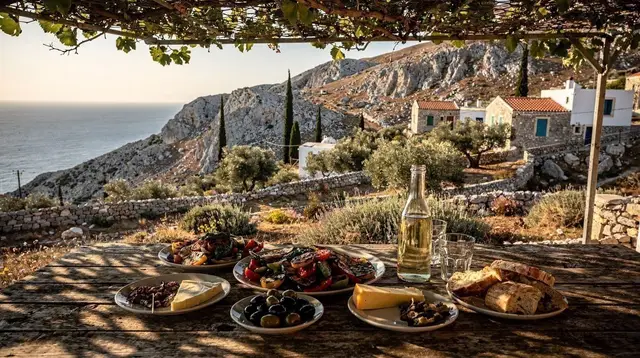
The tavernas ringing the lake lean toward the standard Greek and Cretan repertoire rather than a dish unique to the town, so anyone curious about what to actually order — dakos, a slow-cooked antikristo, or the everyday mezze plates that fill most menus here — is better served by a guide to dakos and the wider Cretan mezze spread than by the photos taped outside each restaurant.
Where this fits in an east Crete trip
For most travellers, Agios Nikolaos is one stop in a wider east Crete loop rather than a standalone weekend destination. It pairs naturally with Elounda and Spinalonga on one side and with Ierapetra, Sitia and the Lasithi plateau on the other, and it sits close enough to the VOAK to be a sensible overnight stop for anyone driving the island west to east.
The town’s genuine strengths — the lake, the harbour, easy access to Spinalonga, and a workable coach connection back to Heraklion — make it a reasonable one- or two-night base rather than a place that needs a week. Anyone weighing whether to split time between Agios Nikolaos and its neighbours will find the comparison of east and west Crete useful for deciding how much of a full itinerary to spend on this side of the island.
Travellers extending east past Elounda reach Ierapetra, the southernmost town in Crete and gateway to the protected islet of Chrissi, covered in its own Ierapetra town guide with detail on the waterfront and the Chrissi boat departures. Further along the coast, Sitia offers a quieter, more local alternative for a final night before flying out of its small airport, set out in a separate Sitia town guide.
Travellers with an extra day can push further still to Vai, Europe’s largest natural palm forest and a beach unlike anything else on the north coast, detailed in a guide to Vai palm beach. A dedicated four-day itinerary for east Crete strings these towns together with Agios Nikolaos as the natural first stop, useful for anyone who wants a full plan rather than assembling one place at a time. For travellers building a longer route across the whole island rather than staying only in the east, Crete in 7 days, west to east shows where a stop in Agios Nikolaos fits into a full west-to-east itinerary.
Agios Nikolaos and Spinalonga: planning questions
How long does the walk around Lake Voulismeni take?
The loop itself is short, well under a kilometre, and takes 20 to 30 minutes at an easy pace. Most visitors stretch it into an hour or two by continuing along the harbour and the Kitroplatia beach promenade and stopping for coffee along the way.
Where do boats to Spinalonga actually leave from?
From three points on the Gulf of Mirabello: Plaka, Elounda, and Agios Nikolaos itself. Plaka is the closest village to the islet and has the shortest crossing, Elounda has more departures and larger boats, and Agios Nikolaos is the most convenient if you are already based in town, at the cost of a longer sea journey.
Is the boat to Spinalonga guaranteed to run every day?
No. Boats are a private, seasonal service that can be cancelled or shortened in strong wind, particularly outside the core summer months, and the schedule thins noticeably in low season. Treat any online timetable as indicative and confirm at the harbour or with your accommodation before planning the rest of the day around it.
What was Spinalonga used for, and is it really about the leprosy hospital?
The islet carries a Venetian fortress built in 1579 to guard the entrance to the gulf, but its defining chapter is later: from 1903 to 1957 it held Crete’s leprosy hospital, the last one to operate in Europe. Victoria Hislop’s novel The Island brought that history to a wide readership, but the people who lived and died there are recent history, not a film set.
Can I reach Agios Nikolaos by public transport?
Yes, more easily than most of east Crete. The KTEL coach network runs along the north coast highway and calls at Agios Nikolaos from both Heraklion and, with a change, from Chania and Rethymno. From Agios Nikolaos onward to Elounda, Kritsa or the Lasithi plateau, services are thinner and a rental car becomes the practical option.
How many days does Agios Nikolaos and the surrounding area need?
One full day covers the lake, the harbour and a Spinalonga boat trip with room to spare. Two or three days let you add Elounda, Kritsa’s old town and church, and a loop up to the Lasithi plateau or the Dikteon cave without feeling rushed.
Is Agios Nikolaos a good base for exploring the rest of Crete?
For east Crete and the Lasithi region, yes. For the island as a whole, no single base works well, since Agios Nikolaos sits roughly two and a half to three hours from Chania by road. It suits an east-Crete stay or the last leg of a west-to-east itinerary rather than a single fixed base for the whole trip.
Do I need cash in Agios Nikolaos, or are cards accepted everywhere?
Cards are accepted in most restaurants, shops and boat-ticket offices around the lake and harbour, but small kiosks, some KTEL ticket windows and the odd rural taverna outside town still work cash-only. Carrying a modest amount of cash — enough for a coffee, a bus ticket or a small ceramics purchase — avoids awkward moments; a broader guide to tipping, money and prices in Crete covers rounding conventions and typical costs across the island in more detail.
What should I eat while I’m in Agios Nikolaos?
The lakeside and harbour tavernas serve the same core Cretan repertoire found across the island rather than a dish unique to the town: dakos, the barley rusk topped with tomato and mizithra cheese, appears on nearly every menu, alongside grilled fish priced by the kilo along the harbour. A guide to dakos and the wider Cretan mezze spread is useful for knowing what a fair plate should actually contain before ordering.
City Walking Tours in Crete on GetYourGuide
Verified deep-linked GetYourGuide tours. Book through these links and we earn a small commission at no cost to you.
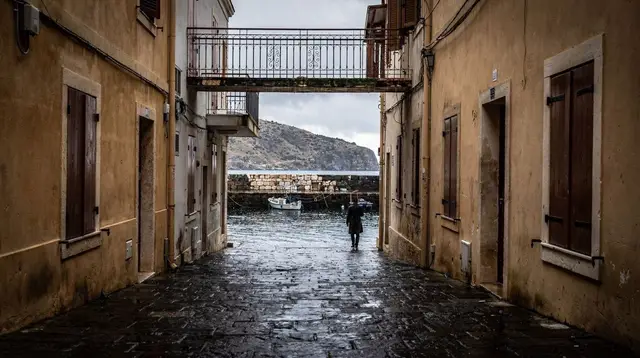
GetYourGuide does not provide a product photo for this activity — the image shows the meeting point, photographed by us.