Crete’s Far Eastern Corner, Explained
Sitia, Vai and Zakros sit at the end of the island, past the point where most itineraries run out of days. This is not the Crete of resort strips and cruise-ship coaches. It is a quieter, drier, more agricultural landscape, and it holds two things nothing else on the island can offer: a genuine palm forest and one of the four great Minoan palaces. Neither needs to be dressed up to be worth the drive.
The honest starting point is distance. From Heraklion it is close to three hours on the road; from Chania closer to five. This corner rewards a base in Sitia or Agios Nikolaos for a night or two, not a rushed there-and-back from the north-central coast, even though that day trip is what most visitors actually do.
Vai: A Palm Forest That Belongs to Crete
Vai looks, in photographs, like it has been shipped in from somewhere tropical. It has not. The palm is Phoenix theophrasti, a species endemic to Crete and a handful of sites in Turkey and on Gavdos — it grows here and almost nowhere else on earth. The same species lines the gorge at Preveli on the island’s south coast, a much smaller grove that burned in 2010 and has since regrown; Vai is the larger of the two by a wide margin, and the biggest natural stand of this palm anywhere in Europe.
That status is exactly why the grove is fenced. Wardens control entry to the forest itself, paths are marked, and camping and open fires are banned outright — this is a protected natural monument, not a free beach with palm trees for shade. The beach in front of the grove is sandy and genuinely beautiful, with sunbeds and a taverna in season, but there is no accommodation on the beach itself and nowhere to sleep rough legally. Anyone picturing a castaway night under the palms should look elsewhere; Vai is a day visit, protected as carefully as it is because it very nearly wasn’t.
Entry to the grove itself is controlled at a ticket booth: a small per-person fee applies in season, plus a separate charge for the car park just above the beach, both usually payable in cash on the spot. A wooden boardwalk winds through part of the forest, keeping foot traffic off the tree roots, though it does not cover the whole grove and the sandy paths beyond it are uneven going for a pushchair or a wheelchair. The car park itself sits a short, shadeless walk from the ticket gate, worth knowing for a midday arrival in August. Opening hours follow the season, roughly sunrise to early evening from May to October, and there is no facility of any kind on site once the gates close for the night.
Because Vai sits roughly 25 km northeast of Sitia, most visitors see it as a half-day trip combined with something else — the monastery at Toplou, a walk around Sitia town, or the drive down to Zakros. The full write-up on the grove itself covers parking, entry fees and the quietest hours in more detail than fits here.
a direct day trip to Vai palm beach from Heraklion is the simplest way to see the grove without renting a car, though it is a long day on a coach for a beach visit — worth weighing against a self-drive itinerary that also takes in Sitia and Zakros at a slower pace.
Sitia: The Island’s Third Airport
Crete has three airports, and Sitia’s is the one most travellers have never heard of. Heraklion (HER) and Chania (CHQ) handle the overwhelming majority of arrivals; Sitia’s small airport, code JSH, runs a much thinner schedule, mostly domestic connections and a handful of seasonal charters. For most visitors it is not a realistic entry point to the island — it matters here mainly as a marker of how far east this region sits, and as a convenience for the small number of travellers already routed through it.
Sitia town itself is worth the stop regardless of how travellers arrive: a working harbour, a low-key waterfront, and none of the package-tourism weight of the north-central coast. It functions as the practical base for this whole corner — fuel, supermarkets, tavernas, a choice of rooms — and as the last proper town before the roads to Vai and Zakros thin out further. The kastro above the harbour and the archaeological museum, which holds finds from Zakros among other eastern sites, are worth an hour before heading out.
Zakros and the Minoan East
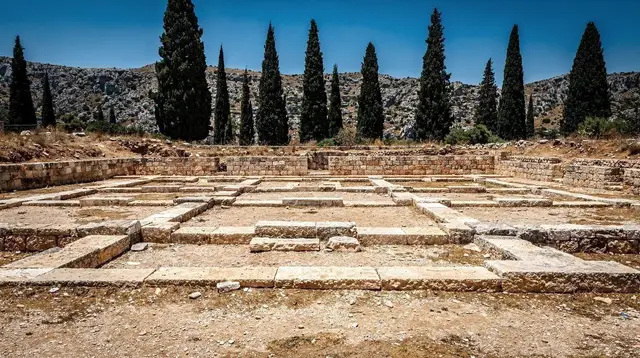
Zakros is the fourth of Crete’s great Minoan palaces, after Knossos, Phaistos and Malia, and by far the least visited — which is precisely its appeal. The palace sits near the village of Kato Zakros, at the end of a gorge locally nicknamed the Valley of the Dead for the Minoan burial caves cut into its cliffs. There is no reconstruction here in the style of Knossos, no repainted frescoes standing in for the originals: what survives is foundations, storerooms and the layout of a working palace complex, excavated later and less thoroughly disturbed than the others.
Zakros owes some of its appeal to an accident of geography. Because the site was destroyed and abandoned around 1450 BC and never resettled, later builders never dug through it the way they did at Knossos and Phaistos, and Nikolaos Platon’s 1960s excavation found workshops with their tools still in place, storage jars still standing, and objects that would have been looted or carried off elsewhere. Among them was a rock crystal rhyton, a ceremonial vase carved from a single block of quartz, now one of the standout pieces in the Heraklion Archaeological Museum rather than at the site itself — one more reason the museum earns a stop even for visitors who make it all the way out here.
a guided day covering the region’s Minoan and historic sites suits travellers who want the archaeological context filled in rather than reading site boards alone. For a self-guided visit, the dedicated Zakros guide lays out the palace layout, the gorge walk down from Ano Zakros, and how to combine the site with lunch on the small beach below.
Getting Around Without a KTEL Safety Net
The KTEL coach network that makes the north coast between Chania and Agios Nikolaos genuinely usable thins out sharply east of there. Services to Sitia itself run along the main road, but Vai and Zakros are served, at best, by a limited seasonal bus or two a day, timed for tour groups rather than independent travellers. Outside peak summer, expect no practical public transport option at all for reaching either site.
A rental car is close to essential for this region, not a convenience. The roads themselves are straightforward by Cretan standards — mostly paved, well signed, with none of the unpaved stretches that catch out drivers heading for Balos in the west — but distances are real and fuel stations become sparser past Sitia, so filling up before heading to Vai or Zakros is sensible. General notes on driving conditions across the island apply here as anywhere, including the local habit of pulling onto the hard shoulder to let faster traffic pass.
| From Sitia to | Distance | Drive time |
|---|---|---|
| Vai beach | ~25 km | 30-35 minutes |
| Toplou monastery | ~18 km | 20-25 minutes |
| Kato Zakros (palace) | ~45 km | 50-60 minutes |
| Ierapetra | ~72 km | 1h10-1h20 |
| Heraklion | ~135 km | 2h20-2h40 |
Choosing What to Skip
Few visitors to this corner have time for everything, and the honest advice is to rank sites rather than force all three into one day. Vai comes first for most people — it is the one thing here with no equivalent anywhere else on the island, and the earlier it is seen, the better the light and the thinner the coach crowd. Toplou monastery adds perhaps forty-five minutes and sits directly on the way back toward Sitia, making it the easiest addition to keep.
Zakros is the one worth sacrificing on a single rushed day trip from Heraklion or Chania: the palace rewards unhurried time on-site, and reaching it adds a further drive past Sitia that turns an already long day into a very long one. Travellers who can spare a second day should give it to Zakros on its own terms, ideally combined with lunch on the small beach below the site.
When to Go
The useful season here runs May to October, the same window as the rest of the island, and for the same reasons: the roads and facilities in this far-flung corner rely on a fixed summer season, and many small tavernas and rooms around Sitia and Vai simply close over winter. Outside those months, expect a working fishing town in Sitia and closed shutters almost everywhere else.
Within the season, July and August bring the heaviest coach traffic to Vai, arriving in waves timed with day-trip departures from Heraklion and Agios Nikolaos — the beach can feel genuinely busy by late morning despite being an hour’s drive past the last major resort. The meltemi, the strong north wind of high summer, is less disruptive here than on the boats to Balos or Chrissi, but it can still whip sand across the beach on a bad afternoon. Late May, June, September and early October give the same warm sea with noticeably fewer coaches and easier parking.
A Realistic Day (or Two) in the East
The single most common way to see this region is a long day trip out of Heraklion or Agios Nikolaos: Vai in the morning before the coaches arrive in force, Toplou monastery on the way back, and Sitia town for a late lunch. That works, but it is a lot of driving for one day, and it leaves no real time for Zakros.
A better-paced version treats the east as its own two- or three-day loop, sleeping in Sitia or Agios Nikolaos and folding in Elounda and Spinalonga or a run down to Ierapetra and Chrissi island on the south coast. The three-day itinerary for Lasithi and the east and the fuller four-day east Crete plan both build this kind of loop rather than a single rushed out-and-back.
a day covering the region’s history and coastline is one option for travellers based further south who want the east folded into a single organised outing rather than a self-drive loop.
What Not to Expect
It is worth being direct about what this corner is not. Vai is not a tropical island scene transplanted to the Aegean — it is a Cretan botanical curiosity, real and protected, but modest in scale next to an actual rainforest, and best appreciated for what it genuinely is rather than for the postcard version. There is no accommodation on the beach itself, no legal camping in or near the grove, and no late-night infrastructure to speak of; visitors staying nearby sleep in Sitia or one of the small villages inland.
The region is also not, for the most part, KTEL territory once you step off the coastal spine through Sitia. And despite the distance from the island’s main airports, Vai in August is not an undiscovered secret — it draws real coach traffic, and arriving early or late in the day makes a bigger difference here than almost anywhere else on the island’s beach circuit.
Sitia, Vai and Zakros: Questions Travellers Ask
Is Vai a real tropical forest?
No. It is a forest of Phoenix theophrasti, a palm species endemic to Crete, not a tropical import. It is the largest natural stand of this palm in Europe, and the same species grows in the smaller grove at Preveli on the south coast.
Can I camp or sleep overnight at Vai beach?
No. The palm grove is a fenced, protected natural monument, and camping and open fires are banned. There is no accommodation directly on the beach; the nearest rooms are in Sitia or nearby villages.
How do I get to Vai from Heraklion or Chania?
By rental car it is roughly 2h30-3h from Heraklion and around 5 hours from Chania. Organised day trips run from Heraklion and Agios Nikolaos in season; there is no realistic KTEL route for independent travellers most of the year.
Is Sitia airport useful for reaching this region?
Only for a small number of travellers. Sitia (JSH) runs a limited, mostly seasonal schedule and cannot be relied on as a main entry point the way Heraklion or Chania can — most visitors still fly into one of those two and drive east.
Can Vai and Zakros be combined in one day?
Yes, comfortably, if starting from Sitia — the two sites are under an hour apart. Combining them with a long drive from Heraklion or Chania on the same day is possible but leaves little time to linger at either.
Is Vai crowded in summer?
Yes, in July and August especially, once the day-trip coaches from Heraklion and Agios Nikolaos arrive mid-morning. Visiting at opening time or in the last two hours before closing avoids most of the crowd.
Do I need a car to see Sitia, Vai and Zakros properly?
Essentially yes. KTEL coverage east of the main coastal towns is thin and seasonal, and a rental car is the only reliable way to link Sitia, Vai, Zakros and Toplou monastery on one’s own schedule.
What’s the best time of year to visit this region?
May through October, matching the rest of the island’s season. Late May, June, September and early October offer the same warm sea with noticeably lighter crowds at Vai than the peak of July and August.
Is there an entrance fee for Vai beach?
Yes. A small per-person fee covers access to the fenced palm grove, and the car park above the beach charges separately in season. Both are typically cash only, so it is worth carrying coins or small notes before arriving.
Is Vai accessible for wheelchairs or strollers?
Only partly. A boardwalk crosses part of the grove, but it does not reach every corner, and the sandy paths beyond it are hard going for wheels of any kind. The car park to the beach involves a short, shadeless walk with no dedicated accessible route.