Sitia: Crete's Quiet Eastern Gateway
Is Sitia worth visiting on a trip to Crete?
Yes, but only if you plan for it: Sitia has its own small airport and its own overnight ferry link to Piraeus, so it works as an entry or exit point for the east of the island rather than a side trip from Chania or Heraklion. It also sits inside one of Crete's recognised wine regions, alongside Peza, Archanes and Dafnes, so a visit can combine a relaxed harbour town with vineyards, Vai beach and the Minoan site of Zakros.
A town most itineraries skip — should yours?
Most first-time visitors to Crete never see Sitia. Their trip runs Chania, Rethymno, Heraklion, maybe Agios Nikolaos, and stops there, because that line follows the island’s one real highway and its two big airports. Sitia sits another hour or more past Agios Nikolaos, at the point where the north coast road starts to feel like the edge of something rather than a through-route. That is not a flaw in the town. It is the reason it looks and feels different from the rest of the north coast — and the reason it needs a deliberate decision, not an afternoon detour, to include.
This page is built around that decision. It sets out what Sitia actually offers, what getting there and away really costs in time, and where it fits — or does not — in a wider Crete itinerary.
Getting to Sitia: its own airport, its own port
Sitia is one of only three places on the island with a working airport, alongside Heraklion and Chania. Its airport, coded JSH, is small, with a limited and seasonal schedule — nothing like the volume of flights into Heraklion or Chania, and not a hub to plan an entire trip around. What it does give Sitia is a genuine identity as an entry or exit point for the east of the island, separate from the two larger gateways.
The port works the same way. Sitia has an overnight ferry connection to Piraeus, in addition to the country’s tourists and freight passing mainly through Heraklion and Chania’s Souda port. Frequency and season vary from year to year, so treat any specific schedule as something to check at the time of booking rather than a fixed fact — this page deliberately does not quote sailing times or name a ferry operator, because both change. The ferries from Piraeus to Crete guide covers how these routes generally work.
Both of these links are seasonal in practice rather than year-round. Flights into JSH thin out or stop entirely outside the main travel season, and the airport itself operates on a reduced footing over winter, so travellers planning a shoulder-season or winter trip should not assume a Sitia flight will be available and should check directly with an airline before building an itinerary around it. The ferry runs on a lighter timetable outside summer as well. None of this makes Sitia unreachable outside July and August — the drive from Heraklion or Agios Nikolaos works year-round — but it does mean the airport and port should be treated as a summer convenience rather than a dependable backbone for a trip at any time of year.
Most visitors, in practice, still arrive by road. A rental car from Heraklion or Agios Nikolaos along the north coast is the default, and the drive is straightforward on Crete’s main highway before narrowing past Agios Nikolaos. See renting a car in Crete and driving in Crete for what to expect on Cretan roads more generally.
Chania to Sitia: the real distance
It is worth stating this plainly, because it is the single most common planning mistake made about Sitia: this is not a side trip from a Chania base. Crete is roughly 260 km long, and Chania to Sitia covers close to the full length of it.
| From | Approx. distance | Approx. drive time |
|---|---|---|
| Chania | ~270 km | 4+ hours |
| Rethymno | ~200 km | 3-3.5 hours |
| Heraklion | ~130 km | 2-2.5 hours |
| Agios Nikolaos | ~70 km | 1-1.5 hours |
These are road-trip figures, not straight-line distances, and they do not allow for stops — realistic driving on Crete means slower average speeds than a map suggests, especially past Agios Nikolaos where the road narrows. The practical conclusion: if Sitia and its surroundings are on your list, treat the east of the island as its own leg of the trip, built around Agios Nikolaos or Sitia itself as a base, rather than an add-on to time spent around Chania or Rethymno.
The east Crete four-day itinerary and the shorter Lasithi and the east three-day route are both built around exactly this logic, and the general how many days in Crete guide covers how to divide time across the island’s four regions properly.
The town itself
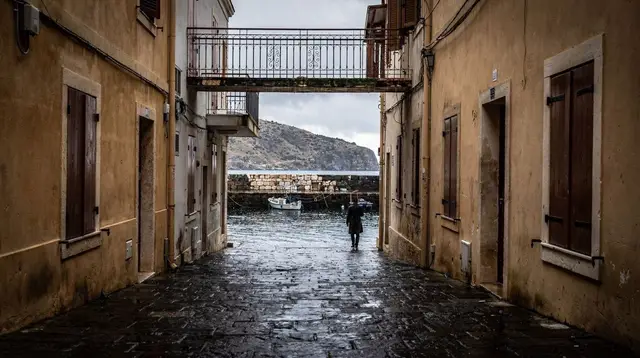
Sitia’s centre sits around a curved harbour lined with cafés and tavernas, backed by a compact old town climbing the hill behind it. A Venetian-Ottoman fortress, the Kazarma, overlooks the harbour and hosts open-air events in summer; below it, narrow streets hold a market and a small archaeological museum with finds from the surrounding region, including Zakros.
None of this competes in scale with Chania’s old town or Rethymno’s Venetian quarter — Sitia is a working port town first, and a tourist destination second, which is exactly what gives it a different, quieter texture than the resort strip further west around Hersonissos, Stalida and Malia.
A long promenade runs along the bay toward a sand-and-pebble town beach, walkable from the centre, useful for an evening swim without a car. Sitia is not a base built around a single headline sight; it is a base built around access to several very different ones within a reasonable radius.
The harbour promenade and the seafront street are flat and easy walking, including for visitors with limited mobility or a pushchair, and several harbourside tavernas have step-free terraces. The old town behind it is a different matter: narrow lanes climb steeply toward the Kazarma fortress, with uneven paving and steps in places, so a visit up there means a genuine walk uphill rather than a stroll. The town beach along the promenade shelves gently and is easy to reach on foot from most harbourfront accommodation, which matters here since Sitia has fewer of the organised, sunbed-lined beaches found further west — this is a swim-and-walk-back beach, not a beach club.
What Sitia doesn’t give you
Sitia does not try to be a nightlife town, and visitors expecting the bar streets of Malia or even the livelier evenings of Agios Nikolaos will be disappointed. The harbour front has tavernas that fill for dinner and empty out by midnight; a handful of cafés stay open later, but there is no strip of clubs or late bars. Restaurant choice is real but narrower than in Heraklion or Chania — mostly Cretan tavernas doing grilled meat, mezze and the local wine, with few options outside that register.
Shopping is limited in the same way: a small number of independent shops around the market street, no chain retail beyond the essentials. None of this is a flaw so much as a mismatch of expectations — Sitia suits travellers who came for the harbour, the wine and the drive to Vai, not for an evening out. Anyone who wants livelier nights within reach of the east should base in Agios Nikolaos instead, or plan Sitia as one stop on a longer loop rather than the whole stay.
A wine region you might not expect
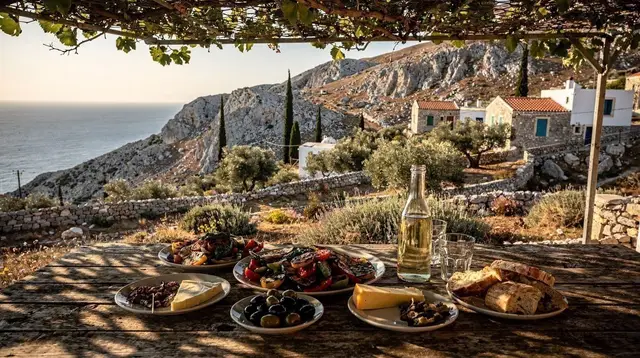
Crete’s best-known wine country sits inland from Heraklion, around Peza, Archanes and Dafnes, where the bulk of the island’s production and its oldest cooperatives are based. Sitia is less often mentioned in the same breath, but it belongs in it: the area around the town is one of Crete’s recognised wine-growing zones, working with the same indigenous grapes found further west — white Vidiano, prized for its texture and aromatics, and red Liatiko, one of the oldest cultivated grapes on the island, alongside other local varieties.
A handful of producers around Sitia are open to visitors for tastings, generally by appointment rather than as drop-in operations, so it is worth planning ahead if wine is part of the reason to come this far east. The Cretan wine regions and grapes guide sets Sitia in context against Peza and Archanes, and the dedicated Sitia wine and olive oil page goes into the producers and the olive oil side of the same agricultural belt in more detail.
One option for a guided introduction to a related monastery estate is a private wine tasting and tour at Moni Toplou, which pairs a working monastery with its own vineyards.
Note that Sitia is not associated with a reduced VAT rate or any special tax status — Crete has never had the reduced island VAT given to some other Aegean islands, and prices here follow the same national rules as the rest of the country.
Day trips from Sitia: Vai, Toplou and Zakros
This is where Sitia earns its keep as a base rather than a curiosity. Three of the east’s strongest sights sit within an easy half-day of the town, closer than they are to any base further west.
Vai, at the island’s far eastern tip, holds the largest natural palm forest in Europe — a stand of the endemic species Phoenix theophrasti, fenced and protected, with camping banned. It shares that palm species with Preveli on the Libyan coast, far to the west. The Vai palm beach guide has the practical detail; Toplou monastery and Vai covers the fortified monastery en route, which keeps the same dress code — covered shoulders and knees — as Arkadi and Preveli further west.
Zakros, past Sitia on the island’s eastern edge, is one of the four great Minoan palace sites, smaller and far less visited than Knossos or Phaistos, reached down a scenic gorge road. The Zakros and the Minoan east guide covers the site and the approach.
A guided way to cover Sitia, Vai and Toplou together in one outing is a private day trip taking in Sitia, Vai and Toplou monastery. For hiking further south toward the coast near Ierapetra, there is also a private trek through Sarakina gorge combined with Myrtos beach, which sits closer to Ierapetra than to Sitia itself but works well as a second base-swap day for travellers splitting time across the east.
With only half a day based in Sitia, the choice is usually between staying in town or heading straight for Vai. The honest answer depends on what the rest of the trip already covers: if the itinerary already includes other old towns and harbours, Vai’s palm beach is the more distinctive use of a short window, since nothing else on the island looks quite like it.
If the trip is short on relaxed harbour time, or arrives in Sitia late and leaves early, the town itself — the Kazarma, the market streets, a harbourside lunch — is enough to justify the stop without adding a further hour of driving each way to Vai and back. Trying to force both into a single half-day usually means rushing one of them, particularly in summer when parking at Vai fills early and the road back can be slow.
Where Sitia fits in an east Crete trip
Treat Sitia as one of two realistic anchors for the eastern third of the island, the other being Agios Nikolaos. Agios Nikolaos sits closer to Elounda and Spinalonga and to the Lasithi plateau; Sitia sits closer to Vai, Toplou and Zakros, and adds its own airport and ferry link that Agios Nikolaos does not have. Which one to base in depends on whether the far-east sights or the Lasithi-Elounda side of the region matter more to your trip — some visitors, with enough time, base in both, one after the other, rather than commuting between them daily.
Either way, the wider point stands: this is a decision made at the itinerary-planning stage, not something to bolt onto a week spent around Chania or Rethymno. If your plan is still taking shape, best time to visit Crete and crete weather month by month are useful starting points before you fix how many legs the trip has, and crete is not a small island makes the same distance argument from a different angle.
Questions about visiting Sitia
Is Sitia worth a detour from Chania or Heraklion?
It depends on how your trip is structured. Sitia is roughly 270 km and over four hours’ drive from Chania, so it is not a realistic day trip from the west. It makes far more sense as a base for the last stretch of an island-wide itinerary, or as an entry or exit point if you fly or sail directly into the east.
How do you get to Sitia?
Sitia has its own small airport, coded JSH, with a limited seasonal schedule, and a port with an overnight ferry connection to Piraeus. Most visitors, though, arrive by rental car from Heraklion or Agios Nikolaos along the north coast road, since Sitia’s own transport links are thinner than Heraklion’s or Chania’s.
How far is Sitia from Chania?
About 270 km and more than four hours of driving, even without stops, because the route runs the length of the island’s north coast. This is the clearest reason Sitia does not fit into a Chania-based week — it belongs to a different, eastern leg of a Crete trip.
Is Sitia touristy?
Less so than Agios Nikolaos, Elounda or the resort strip around Hersonissos and Malia. Sitia’s harbour and old town serve a working port and a farming and wine-growing hinterland first, with tourism as a secondary layer rather than the whole economy.
Can you fly directly into Sitia?
There is a small airport, JSH, but its schedule is limited and seasonal compared with Heraklion or Chania, so most itineraries still route through one of the two larger airports and add Sitia by road.
What wine is Sitia known for?
Sitia is one of Crete’s established wine areas, growing indigenous grapes such as Vidiano and Liatiko alongside the better-known zones of Peza, Archanes and Dafnes further west. Several producers around the town are open for tastings.
Is Sitia a good base for visiting Vai and Zakros?
Yes — this is its strongest practical argument. Vai’s palm beach and the Minoan site at Zakros both sit within an easy half-day of Sitia, closer than they are to any town on the north-central coast, which makes Sitia a genuinely useful base for the far east rather than a scenic stop along the way.
Do ferries run from Piraeus to Sitia?
Sitia’s port does have an overnight ferry connection to Piraeus, alongside the more frequent routes into Heraklion and Chania. Schedules and frequency vary by season, so check current sailings directly with a ferry operator rather than assuming a fixed timetable.
Does Sitia get crowded in summer?
Less than the north-coast resorts, but it is not empty. July and August bring more visitors passing through on the way to Vai, and harbour tavernas and the town beach fill up accordingly, though nothing like the crowds around Hersonissos or Malia. Outside those two months, and especially outside May to October entirely, Sitia is genuinely quiet.
Is Sitia walkable without a car?
The harbour, old town and town beach are all walkable from most central accommodation, so a short stay based purely on the town works fine on foot. Reaching Vai, Toplou or Zakros without a car is harder, since public transport to the far east is thin — a rental car, a taxi, or an organised day trip are the realistic options for those sights.
City Walking Tours in Crete on GetYourGuide
Verified deep-linked GetYourGuide tours. Book through these links and we earn a small commission at no cost to you.
GetYourGuide does not provide a product photo for this activity — the image shows the meeting point, photographed by us.