Vai Palm Beach: Europe's Largest Natural Palm Forest
Is Vai a tropical palm beach?
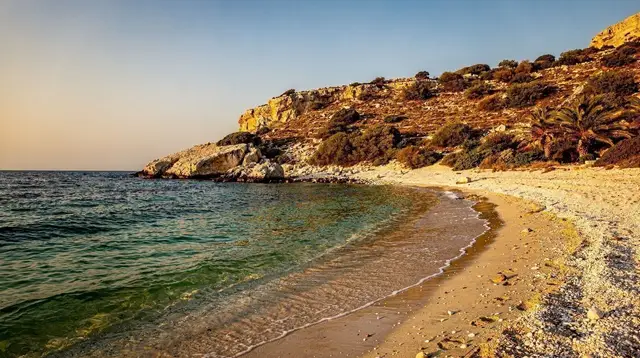
No. Vai is a fenced, protected beach in far east Crete backed by Europe's largest natural stand of Phoenix theophrasti, a palm species endemic to Crete and nearby Turkey. It looks striking against the sand, but the setting is Aegean scrubland and limestone, not a Caribbean island, and camping in the grove is banned.
A palm forest, not a postcard from the Caribbean
Photographs of Vai travel well, and they travel with a suggestion attached: turquoise water, leaning palms, something closer to the Caribbean than to Greece. It’s worth correcting that before you go, because Vai’s real story is more interesting than the postcard. What grows here is not an imported ornamental palm but Phoenix theophrasti, a species that exists almost nowhere else on earth, and the sand and scrub around it are unmistakably Aegean — dry hills, limestone, the flat glare of an east Cretan afternoon. Vai rewards you for knowing what you’re actually looking at.
This guide sits inside our broader things to do around Sitia, Vai and Zakros and pairs with the destination page for Sitia and Vai if you want the wider area at a glance.
Where Vai actually sits — and why that matters
Vai is about as far east as Crete goes, north of Palekastro and not far from the Minoan site at Zakros. That geography matters more than most visitors expect. Crete is not a small island: it runs roughly 260 km from west to east, and a one-way drive from Chania to this corner of the island covers well over 270 km and more than four hours on the road. Vai is not a beach you fold into a west-coast itinerary built around Chania, Balos or Elafonissi.
It belongs to the eastern end of the island, alongside Sitia, Ierapetra and the Lasithi region, and the practical way to see it is from a base in that part of Crete — read our Sitia town guide or the comparison of east and west Crete before you build a route that tries to do both coasts in one loop.
If you’re arriving through Heraklion, the drive out to Vai is still a long one; through Chania, longer still. Check our Heraklion airport guide or Chania airport guide for arrival logistics, and see driving in Crete and renting a car in Crete for what the roads are actually like once you’re past the north-coast highway.
Phoenix theophrasti: the tree that makes this beach unusual
The palm at Vai is endemic to Crete, with a small additional population in southwest Turkey — it grows wild almost nowhere else. That single fact is the reason Vai exists as a protected site rather than just a beach with some trees on it. The forest here is the largest natural stand of Phoenix theophrasti in Europe: several thousand palms, self-seeded and growing in dense, low clusters rather than the tall, spaced-out plantings you’d see in a resort car park. It is a wild population, not a garden.
That also means the grove behaves like any wild, slow-growing ecosystem: it needs protection from trampling, fire and removal, which is exactly why access is managed the way it is (more on that below). If you want to see the species again elsewhere on the island, the other place it grows naturally is the palm gorge above Preveli on the south coast — and the comparison between the two sites tells you something useful about how fragile this palm actually is.
Preveli’s fire, and what it says about Vai
In 2010, the palm gorge at Preveli burned. It has since regrown, and today the gorge is once again a shaded, green corridor down to a beach on the Libyan Sea — read the full story in our Preveli monastery and palm beach guide. The fire and its aftermath are a useful reference point for Vai, because it’s the same species, subject to the same risks. A forest fire, careless camping, or years of uncontrolled foot traffic can put a decades-old grove of this palm back to zero. Preveli happened to recover within about a decade; that isn’t guaranteed, and it isn’t a reason to treat protection measures at Vai as bureaucratic caution rather than a real necessity.
Preveli and Vai are often mentioned in the same breath as “Crete’s palm beaches,” and it’s a fair pairing — but they sit on opposite coasts, roughly across the island from each other, so seeing both in one trip means planning around the same west-to-east distances discussed above, not a casual detour.
The fence, the ban on camping, and why both exist
Vai’s palm forest is fenced, and paths keep visitors on defined routes through it rather than free to wander among the trees. Camping on the beach and in the grove is prohibited. Neither rule is there to sell you a paid alternative — they exist because this is a Natura 2000 protected habitat and an endemic, slow-regenerating species, and unrestricted access and open fires are precisely what damaged Preveli’s equivalent forest. If you’ve read anything about sunbed rights and beach access law in Crete, the same underlying principle applies here in a stricter form: organised access, protected habitat, rules that are enforced rather than suggested.
Don’t expect this guide to hand you exact opening times, entry fees, or a facilities list — those details change and are exactly the kind of thing worth confirming locally or with whoever runs your transfer or tour on the day, rather than trusting a number fixed in a guidebook months earlier.
Getting to Vai
Realistically, there are three ways to approach Vai:
| Approach | Best for |
|---|---|
| Self-drive from Sitia or Ierapetra | Flexibility, combining with Zakros or Toplou |
| Organised day tour from Heraklion | Visitors based in central Crete without a rental car |
| Combined day trip covering Sitia, Vai and Toplou | Visitors who want the east’s main sites in one outing |
If you’re staying in central Crete and don’t want to drive the distance yourself, a direct outing such as a day trip from Heraklion straight to Vai’s palm beach covers the long drive for you.
For a broader look at the eastern tip of the island in a single day, a private day trip linking Sitia, Vai and Toplou monastery adds the monastery and the town to the beach itself. And if you’d rather build a full day around the region’s other landmark, a private tour combining Toplou monastery with a wine tasting gives you a different anchor point nearby.
Whichever way you arrive, budget the drive time honestly. This is the far edge of the island, and the roads east of Sitia are not the fast highway you’ll have used along the north coast.
What the beach itself is like
Strip away the palm forest and Vai is a sandy beach on a bay, backed by low hills and, inland, the protected grove. The water is Aegean, not the flat, warm shallows you might expect from tropical comparisons — expect the same seasonal temperature range as the rest of Crete’s coast, cooler early and late in the season, warmest toward the end of summer. The setting is what sets it apart: palms at the edge of the sand, in a landscape that is otherwise dry Cretan hillside, not jungle. It is genuinely unusual for the Mediterranean, but it’s worth going with the right expectation rather than one shaped by Caribbean travel photography.
Accessibility and what to expect on foot
Vai is not a walk-up beach from a roadside car park. Visitors arrive at a parking area set back from the shore and cover the final stretch on foot, through or alongside the fenced grove, before the sand opens out. The path is flat and short, but there’s no getting around the walk itself, and midday sun in high summer makes it more of an effort than the short distance suggests. Anyone with mobility limitations should plan for uneven ground near the grove and no guarantee of shade along the way in from parking — the palms shelter the interior of the forest more than the approach path or the open beach itself.
The heat matters more here than the distance. Vai sits in one of the sunniest, driest corners of Crete, and the exposed sand offers little relief once you’re off the palm-lined fringe. Late morning through mid-afternoon in July and August is the hardest stretch to be out on open sand; arriving earlier or later in the day, when the light is softer and the heat has eased, makes the walk in and the time on the beach considerably more comfortable, even without a fixed schedule to plan around.
When to go
Vai sits on the same broad seasonal calendar as the rest of the island: busiest and hottest in July, when the meltemi wind picks up across much of Crete, through August, and quieter either side of that peak. The east of the island can run slightly different weather patterns from the west and south coasts, so treat month-by-month advice for Chania or the Libyan Sea coast as a rough guide only, not a match for conditions at this specific corner of Crete.
Nearby: Toplou, Zakros, and Sitia
Vai is rarely a destination on its own, and the east of Crete rewards combining it with what’s close by. Toplou monastery sits inland on the same stretch of coastline, with its own architecture and history — see our guide to Toplou and Vai together. Further south, the Minoan palace site at Zakros is one of the four major palace excavations on Crete, covered in Zakros and the Minoan east. And Sitia itself, the nearest sizeable town, makes a natural base for exploring this whole corner — start with the Sitia town guide.
For a trip built specifically around this end of the island rather than treating Vai as a single stop, our east Crete four-day itinerary puts these places in a practical order.
If you only have half a day here
Not every visitor to east Crete has room for Vai, Toplou and Zakros in one outing, and it’s worth being honest about what to drop rather than rushing all three. If the palm forest itself is the draw, give the beach and grove the bulk of your time and treat Toplou as a brief stop on the way in or out — the monastery rewards maybe forty minutes to an hour, not a full visit in its own right.
If Minoan archaeology matters more to you than a second monastery, skip Toplou and pair Vai with Zakros instead, since both sit within a reasonably short drive of each other at the island’s eastern tip. Trying to fit the beach, the monastery and the palace site into a single half-day from a base further west usually means shortchanging all three; the east Crete four-day itinerary exists precisely because this corner of the island deserves more than an afternoon carved out of a west-coast trip.
What surprises first-time visitors
The most common surprise is scale. Photographs crop tightly on the palms, and the beach itself is smaller than its reputation suggests — a compact bay, not the sprawling stretch of coastline the image implies. In peak season the sand fills quickly, and because access funnels everyone through the same fenced path, the crowd is concentrated rather than spread out the way it might be on a longer, open beach elsewhere in Crete.
Visitors expecting to wander the palm grove itself are sometimes surprised, too — the fencing means you view the forest from defined paths and viewpoints rather than walking freely among the trees, which is a deliberate trade-off for keeping an endemic, slow-growing species alive rather than a shortfall in what’s on offer.
What doesn’t disappoint is the contrast itself: stepping off dry, scrubby hillside into a stand of wild palms above the sand is genuinely unusual for this part of the Mediterranean, and no amount of crowding changes that first impression. Go in with the expectation of a striking, protected curiosity rather than a private tropical cove, and Vai tends to deliver on its own terms.
Practical notes
A few points worth carrying into your visit, rather than assuming:
- The palm forest is fenced and paths are marked — stay on them, both because it’s the rule and because it’s how the grove survives.
- Camping is not permitted on the beach or in the forest.
- This is a Natura 2000 protected site; treat it with the same respect for removing nothing that applies at Elafonissi’s protected sand or at Crete’s other ecologically sensitive coastal sites.
- Distances in east Crete are real distances. Don’t plan Vai as a quick add-on to a west-coast day.
- We haven’t quoted opening hours, entry prices or exact visitor numbers here deliberately — these details shift and are worth confirming with a local source or your tour operator on the day rather than trusting a fixed figure.
Vai palm beach: your questions answered
Is Vai a real palm forest or a few trees for photos?
It is a genuine forest of several thousand Phoenix theophrasti palms, the largest natural stand of this species in Europe. It is not an ornamental planting; the grove is fenced off and protected as a Natura 2000 site.
Can you camp at Vai?
No. Camping inside the palm forest and on the beach is prohibited, and the grove itself is fenced to keep visitors on marked paths. The protection exists because the species is endemic and slow to regenerate.
Is Vai the same kind of palm as at Preveli?
Yes. Both Vai and Preveli’s palm gorge on the south coast grow Phoenix theophrasti, Crete’s endemic palm. Preveli’s grove burned in 2010 and has regrown since; Vai is the larger and better-known of the two stands.
How far is Vai from Chania or Rethymno?
Far. Vai sits at the eastern tip of Crete, beyond Sitia, while Chania and Rethymno are in the west. A one-way drive from Chania to this corner of the island covers well over 270 km and more than four hours, which is why Vai is realistically visited from Sitia, Ierapetra or Agios Nikolaos, not as a day trip from the west.
What else is near Vai worth combining with a visit?
Toplou monastery sits a short drive inland, and the Minoan palace site at Zakros lies further south along the coast. Sitia town, with its own beach and harbour, makes a practical base for the area.
Is Vai busy or quiet?
The beach is well known and organised, with the protected grove behind it drawing steady interest through the travel season. Exact visitor numbers and current facilities are not something to rely on secondhand; check locally or with a tour operator for up-to-date conditions before planning your day.
What time of day is best to visit Vai?
Early morning or late afternoon, especially in July and August. The walk in from the car park and the open beach itself offer little shade, and midday heat in this exposed, dry corner of Crete is more noticeable than the short distance suggests. No fixed opening hours are quoted here deliberately — check locally for current arrangements.
Can you walk freely through the palm grove itself?
No. The forest is fenced, and visitors stick to marked paths and viewpoints rather than wandering among the palms. That is a protection measure for an endemic, slow-regenerating species, not a sign of poor access — you still see the grove clearly, just not from inside it.
Beach Tours in Crete on GetYourGuide
Verified deep-linked GetYourGuide tours. Book through these links and we earn a small commission at no cost to you.
GetYourGuide does not provide a product photo for this activity — the image shows the meeting point, photographed by us.