Zakros and the Minoan East
How far is Zakros from Knossos and Heraklion?
Zakros lies at the far eastern tip of Crete, well beyond Sitia and Vai. Chania to Sitia alone is about 270 km and over four hours by road, and Zakros sits further east again, so it cannot be paired with Knossos or Heraklion as a single day out.
Crete Is Not a Compact Island
Most travellers arrive in Crete having already decided what “Minoan” means, because they have seen a photograph of red columns and blue dolphins at Knossos. Zakros asks a different question: what does the same civilisation look like at the opposite end of the island, four regional units and the better part of a day’s driving away? Before anything else, that distance needs to be taken seriously.
The single measure that matters is scale: the crossing from Chania to Sitia alone runs about 270 km and over four hours by road, and Zakros sits further east again, beyond Sitia and beyond Vai. Crete is not the compact island a short holiday brochure implies, and nowhere makes that clearer than the drive out to its far eastern corner.
That matters for planning, not just for geography. A guide to Zakros that pretended it could be tacked onto a morning at Knossos, or squeezed into a Heraklion city break, would be setting travellers up to fail. This page treats Zakros as what it is: a destination for people already based in or heading toward the east — around Sitia, Agios Nikolaos or Elounda — rather than a side trip from the centre.
Where Zakros Fits in the Minoan Picture
To place Zakros, it helps to step back to the wider Minoan story first, because a few persistent misconceptions travel with almost every visitor. The frescoes most people picture when they think of Minoan Crete — the ones reproduced on postcards, tote bags and hotel murals — are the reconstructed paintings associated with Knossos.
Those images at the site itself are modern recreations; the surviving original fragments are held and displayed at the Heraklion Archaeological Museum, five kilometres away from the palace ruins. Anyone who wants to see genuine Minoan painting rather than a modern impression of it needs to go to the museum, not just the site — and that holds true whether the site in question is Knossos or, later, Zakros.
The second correction is chronological rather than artistic. Knossos is often assumed to have remained Crete’s “capital” in every era that followed the Bronze Age, but that is not how the island’s later history ran. When Rome absorbed Crete, it was Gortyna, in the south-centre of the island near Phaistos, that became the Roman capital — not Knossos. The Minoan palatial centres and the later administrative capitals of Crete are two different maps, layered on the same ground centuries apart, and it is worth holding both in mind before trying to place Zakros within either one.
With that background set, Zakros belongs to a specific, well-established group: Crete’s Minoan palatial sites, usually counted as four — Knossos near Heraklion, Phaistos in the south, Malia on the north coast east of Heraklion, and Zakros, on its own, at the eastern tip of the island. Each palace served a population and a territory around it; together they describe a Crete organised around several centres of power rather than one.
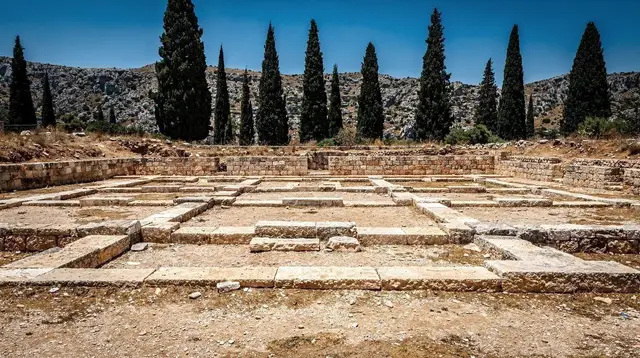
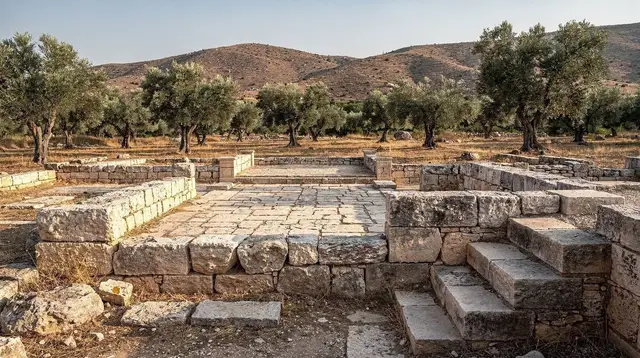
Zakros is the smallest and remotest of the four, and the one least altered by twentieth-century reconstruction work — there are no poured-concrete columns standing in for lost wooden ones here, unlike parts of Knossos. What survives is a ground plan: the outline of a palace complex, courtyards and storerooms, set close to the shore at the eastern edge of Crete, facing out toward the wider eastern Mediterranean rather than back toward the island’s own centre.
Reaching the Far East on Its Own Terms
Zakros sits beyond Sitia, on the coast near the village of Kato Zakros, reached along minor roads that see far less traffic than the main VOAK highway running along the north coast from Chania through Rethymno and Heraklion to Agios Nikolaos. There is no train anywhere on Crete, and coach coverage thins out considerably once you are past Sitia — this corner of the island runs on rental cars and organised excursions far more than the north-coast towns do.
| From | To | Distance / time |
|---|---|---|
| Chania | Sitia | about 270 km, over 4 hours by road |
| Heraklion (HER) | Knossos | a short hop, minutes from the city centre |
| Piraeus | Heraklion (ferry) | overnight, roughly 9 hours |
The table is deliberately about scale rather than about Zakros itself: it is there to show why the far east reads as a separate leg of a Crete trip, not an afternoon extension of a Heraklion or Chania base. A traveller staying in the west who wants to see Zakros is better served by rethinking their itinerary around a night or two in Sitia or Ierapetra than by trying to drive there and back from Chania in a day.
The small Sitia airport exists precisely because the east is its own travel zone; for most visitors, though, the practical route in is still by road from Heraklion or from a base already established around Agios Nikolaos or Elounda.
What a Visit to Zakros Actually Offers
Because Zakros has not been rebuilt for visitors the way Knossos has, a walk through it asks more of the imagination and gives back less in obvious spectacle. What it offers instead is context: a genuine sense of a Minoan settlement built for trade with the wider eastern Mediterranean, facing away from the island’s centre rather than toward it, and a level of quiet that the more visited palatial sites simply cannot match. Where Knossos absorbs coach parties and cruise-ship day-trippers by the thousand, Zakros sees a fraction of that traffic, precisely because reaching it takes real effort.
That contrast is worth experiencing deliberately, not by accident. Visitors who go to Knossos first and assume every Minoan site will feel similar — reconstructed walls, crowds, a gift shop at the exit — are likely to be surprised, in a good way, by how different Zakros is on the ground. It rewards travellers who have already accepted that a single day cannot cover “Minoan Crete” as one experience, and who are willing to treat the east as a distinct chapter of the trip.
Building an East Crete Day Around Zakros
Because Zakros sits well outside any efficient day-trip radius from the centre, the sensible approach is to fold it into time already being spent in the east. A few natural pairings recur:
- Sitia and Vai. Sitia town makes a comfortable base, with the palm beach at Vai — the largest natural palm forest in Europe — within easy reach along the same stretch of coast.
- Toplou monastery. Toplou, a working monastery with its own dress code, sits on the road between Sitia and Vai and slots naturally into the same outing as Zakros.
- A longer east Crete loop. Travellers with several days to give the region can build a proper loop rather than a single excursion — see the dedicated east Crete four-day itinerary for how Sitia, Vai, Zakros and the surrounding villages fit together without doubling back.
For anyone who does not want to self-drive the minor roads out to Kato Zakros, an organised day out covering the area removes the logistics: a private day trip through Sitia, Vai and Toplou strings the region’s main stops together in one outing, which is the most efficient way to see this corner of the island without committing to an overnight stay.
Not a Substitute for Knossos, and Not the Other Way Round
It is worth saying plainly: nothing here argues that Zakros should replace a visit to Knossos, or that Knossos is somehow the lesser experience because parts of it have been reconstructed. They answer different questions. Knossos, alongside the Heraklion Archaeological Museum that holds its actual frescoes, gives the clearest single introduction to Minoan Crete that the island offers, and remains the right first stop for most visitors. Zakros is what comes after that introduction, for travellers who have the time and inclination to see how the same civilisation looked at its farthest edge, once the reconstructed columns and the tour buses are left behind.
Travellers building a longer trip around the archaeology of the island, rather than a single site, sometimes prefer to compare the layout and setting of several palaces in one stretch of days — pairing a look at the south with the ruins at Phaistos, near Gortyna: a tour taking in ancient Phaistos and the Roman-era ruins at Gortyn makes the “Gortyna, not Knossos, was the Roman capital” point tangible on the ground rather than as a line in a guidebook.
Others prefer to stay closer to Heraklion and combine the palace with the villages and crafts of the surrounding hills: a day combining Knossos palace with the Lasithi villages and their pottery workshops does exactly that, and works well as the counterpoint trip for anyone who has already made the journey out to Zakros and wants to see the more visited, more restored end of the same story.
A Mistake Worth Avoiding
The most common planning mistake with Zakros is treating it as an add-on rather than a destination in its own right — assuming that because Knossos, Phaistos and Malia can all be reached from a central base in a single day each, Zakros must work the same way. It does not. Building a trip that visits Heraklion and Knossos one day and expects to also reach the far east the next, without a change of base, usually ends with Zakros dropped from the plan altogether. The better approach is to decide early whether the east is part of the trip at all, and if it is, to give it the days and the change of base it needs — treating Sitia and Vai as a region to stay in, not a stop to pass through.
Zakros and the Minoan East: Common Questions
Can I visit Zakros and Knossos on the same day?
Not realistically. Knossos sits just outside Heraklion, in the centre of the island, while Zakros is at the far eastern edge beyond Sitia. The two belong to different legs of a trip, not the same afternoon.
Are the frescoes at Zakros original Minoan paintings?
Crete’s most famous frescoes, the ones associated with Knossos, are modern reconstructions; the originals are kept in the Heraklion Archaeological Museum. Zakros is a different kind of site again, valued for its layout and setting rather than painted walls.
Was Zakros the capital of Minoan Crete?
No single site held that role in the way later capitals did. Knossos is the best known and largest of the palatial centres, but Phaistos, Malia and Zakros were built and used alongside it, and centuries later it was Gortyna, not Knossos, that became the Roman capital of the island.
How do I get to Zakros without a rental car?
It is difficult. The area is served by the small Sitia airport and by road from Heraklion or Agios Nikolaos, but public transport thins out east of Sitia, and Zakros itself sits down a minor road beyond the last coach stops. Most visitors arrive by car or on an organised day trip from further west.
What else can I combine with a visit to Zakros?
The east is its own mini-region: Sitia town, the palm beach at Vai, and Toplou monastery all sit within a manageable radius, so a day built around Zakros usually folds in one or two of these rather than trying to reach the centre of the island.
Is Zakros as busy as Knossos?
No. Its distance from Heraklion and the cruise-ship crowds keeps numbers far lower than at Knossos, which is part of its appeal, but it also means fewer facilities and less infrastructure built around the site.
Is it worth flying into Sitia instead of Heraklion for this part of the trip?
If the east is a substantial part of the itinerary, basing time around Sitia rather than treating it as a long day trip from Heraklion makes the whole region, Zakros included, far easier to reach and enjoy without rushing.
Does visiting Vai make more sense paired with Zakros or on its own?
Vai and Zakros sit close enough together, near Sitia, that most visitors combine them in the same outing rather than making two separate trips out to the far east; a single day covering both, sometimes alongside Toplou, is the efficient way to see the region: a direct Heraklion-to-Vai palm beach day out is one way to reach that same corner for travellers based in the centre who only have one day to spare for the east.
Knossos Tours in Crete on GetYourGuide
Verified deep-linked GetYourGuide tours. Book through these links and we earn a small commission at no cost to you.
GetYourGuide does not provide a product photo for this activity — the image shows the meeting point, photographed by us.