Chania Wine Tasting: What the West of Crete Actually Offers
Is there a real wine route near Chania, Platanias or Agia Marina?
Not really. Crete's indigenous grape varieties — Vidiano, Vilana, Dafni and Thrapsathiri in white, Kotsifali, Mandilari and Liatiko in red — concentrate around Peza, Archanes, Dafnes and Sitia, near Heraklion, roughly three hours east of Chania. Western Crete has one bookable winery tasting near Chania, plus olive oil, honey and cheese tastings closer to Platanias and Agia Marina.
What “Wine Road” Means When You’re Staying in Platanias or Agia Marina
Search for a Chania wine road and you will find the phrase repeated on a dozen sites, usually next to a map that implies a string of vineyards a short drive from your hotel. If you are staying along the beach strip of Platanias or Agia Marina, on the north coast a few kilometres west of Chania, it is worth saying plainly what that phrase does and does not mean here.
Crete does have a real, old, serious wine tradition, built on grape varieties that grow nowhere else. But that tradition lives mainly at the other end of the island, in the hills south of Heraklion. West of Chania, past Kolymvari and toward Kissamos, the terrain runs to olive groves, not vineyard rows. This page is written for anyone weighing up whether to spend a day chasing a “wine tour” from a base in Platanias or Agia Marina, or whether to set that plan aside and do something else with the day instead. The honest answer sits somewhere in between, and it depends on how much you actually want a flight of Cretan grape varieties versus a pleasant afternoon of local food and drink with a splash of wine in the mix.
Where Crete’s Vineyards Actually Are
Crete’s indigenous varieties are one of the more interesting, least exported parts of Greek wine. In white, the island grows Vidiano, Vilana, Dafni and Thrapsathiri; in red, Kotsifali, Mandilari and Liatiko. None of these are Chania grapes. They concentrate in the regional unit of Heraklion, above all around three villages: Peza, Archanes and Dafnes, a short run south of Heraklion city into low hills that have been planted with vines since antiquity. A second, smaller pocket of serious wine and olive oil production sits around Sitia, far in the east of the island, past Agios Nikolaos and Ierapetra.
If you want to read about those regions properly before deciding whether they belong in your itinerary, the guide to Cretan wine regions and grapes lays out the varieties and the geography in more depth, and the Peza and Archanes winery day guide covers what a day trip out of Heraklion actually looks like. Both are written for a traveller based in or near Heraklion city or Archanes and Dafnes themselves, not for someone staying in Chania — the distances make a same-day round trip from the west coast a long undertaking, not a relaxed wine afternoon.
That is the geography this page has to respect. It would be easy, and dishonest, to describe a “west Crete wine road” with named estates and a tasting itinerary as if the region matched what exists around Peza and Archanes. It does not, and stretching the comparison would send you looking for something that is not there.
The One Winery Tasting Actually Bookable Near Chania
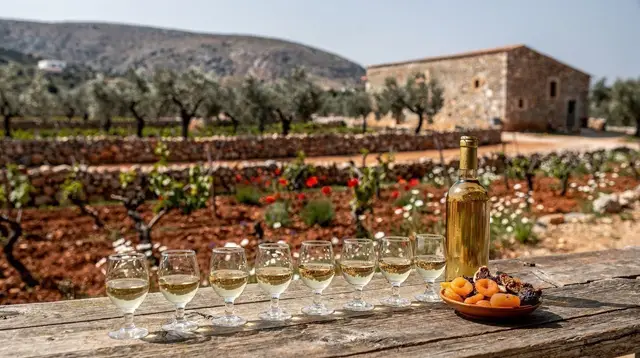
There is a genuine exception worth knowing about: a single winery tour with tasting operating out of the Chania area, bookable as a half-day trip. a Chania winery tour with a guided wine tasting is the one option in this guide that puts a flight of Cretan wine in your hand without a three-hour drive first. It will not replicate the breadth of Peza or Archanes — one winery is one winery, not a region — but for a traveller staying in Platanias or Agia Marina who wants an afternoon built around wine specifically, rather than food with wine as a footnote, this is the realistic option, and it is worth treating as exactly that: one stop, not a route.
Beyond it, most of what gets marketed locally as a “wine experience” near Chania is really a food-and-drink afternoon where wine is one course among several, alongside olive oil, cheese and honey. That is not a downgrade — it is simply a different, and arguably more representative, Cretan afternoon than a vineyard crawl would be, because food culture here runs deeper and wider than wine tourism does.
What Platanias and Agia Marina Offer Instead
Where the west of the island genuinely delivers is olive oil, honey, cheese and cooked food, and several tours based around Chania and Platanias build a tasting afternoon on exactly that foundation. a Chania bakery and small winery tour combining bread, olive oil and wine tastings pairs a working bakery with a small winery stop, which is a more honest framing for the west of the island: bread and olive oil are the backbone of Cretan food culture, and the wine pour sits alongside them rather than pretending to be the main event.
A broader version of the same idea is a Chania tasting tour covering olive oil, wine, cheese and honey together, which is closer in spirit to what most visitors mean when they picture a relaxed Cretan tasting afternoon: a table with several small producers’ work on it, not a single varietal explained in depth. For a food-first version of the same idea with a cultural framing, a Chania cultural tasting tour built around a full plate of local food leans further into cooked dishes than into wine specifically, and is worth booking on those terms rather than as a wine substitute.
If honey is more your interest than wine, the weekly market circuit around Platanias runs its own tasting stop through a Platanias farmer’s market honey tasting, which is a lighter, shorter commitment than any of the winery or multi-producer options above, and a reasonable way to spend an hour without committing a full afternoon.
For background on the food itself, the Cretan food guide, the olive oil mills and tastings guide and the honey and herbs of Crete guide are worth reading before any of these tours — they explain what you are actually tasting, rather than leaving you to guess from a tour description. For the cheese side specifically, the mizithra, graviera and staka guide covers the three cheeses most likely to turn up on a tasting plate near Chania.
Raki, Not Ouzo, Not Rakı
Whichever tasting you book, a small glass of clear spirit at the end of the meal is close to guaranteed, and it deserves an honest introduction because visitors reliably get it wrong.
Raki, also called tsikoudia in Crete, is distilled from the grape marc — the skins, seeds and stems left over once the grapes have been pressed for wine — and it has no anise in it. It is offered, traditionally free of charge, at the close of a taverna meal across the island, poured into small glasses and drunk neat, usually alongside a plate of fruit or a sweet.
It is not the same drink as ouzo, which is anise-flavoured and a different spirit entirely, and it is not the same as Turkish rakı, which despite the near-identical name is also anise-flavoured. The confusion is understandable — three words that sound alike, all clear spirits, all served in small glasses — but the taste gives it away immediately: raki is dry, grape-forward and has none of ouzo’s aniseed sweetness.
| Drink | Base | Flavour | Where |
|---|---|---|---|
| Raki / tsikoudia | Grape marc | No anise, dry | Crete |
| Ouzo | Grape or grain spirit, anise added | Aniseed | Mainland Greece and islands |
| Rakı | Grape marc or grain, anise added | Aniseed | Turkey |
For more on the tradition around it, including why it is poured at the end of a meal rather than the start, see the raki and tsikoudia guide.
Prices, Tax and What to Expect to Pay
Every tasting price quoted in this guide, and every price you will see on a menu or a tour listing anywhere in Crete, already has Greek VAT built in. The standard rate is 24 percent, and it applies in full here — Crete has never carried the reduced rate that some other Aegean islands were granted. There is no separate tax line to budget for on top of a quoted tasting or tour price.
Tipping runs on a different, lighter logic than many visitors expect. A round-up of the bill, or roughly five to ten percent, is the norm at a taverna or a small tasting, well short of the fifteen to twenty percent common in North America. At a producer’s own table — a small winery, a family-run bakery — a tip is welcome but rarely itemised or expected in the way a service charge is elsewhere. The tipping, money and prices guide covers this in more detail if you are budgeting a whole trip rather than one afternoon.
If You Actually Want the Real Wine Region
Nothing in this guide is written to talk you out of a serious Cretan wine trip — only to be straightforward about where it happens. If tasting Vidiano, Kotsifali and Liatiko properly is a priority rather than a nice-to-have, the honest plan is to build part of your trip around Heraklion rather than trying to squeeze it into a day from Chania.
| Base | Realistic for a serious wine day? | Distance from Chania |
|---|---|---|
| Platanias / Agia Marina | One winery, bookable half-day | — |
| Heraklion city | Yes, Peza and Archanes are a short drive | ~140 km, under 2 hours |
| Archanes / Dafnes | Yes, you are already there | ~150 km, under 2.5 hours |
| Sitia | Yes, smaller producer base | ~330 km, over 4 hours |
A same-day round trip from Chania to Peza or Archanes and back means roughly six hours of driving on the VOAK highway before any stop at a winery, which turns a tasting afternoon into a driving day. The more workable options are to split a longer Crete trip so that part of it is based near Heraklion, or to accept that Chania’s role in your trip is the harbour, the mountains and the west coast, and to leave the wine region for a future visit or a different base.
The four-day Cretan food and wine itinerary is built with exactly that geography in mind, and the seven-day west-to-east itinerary is the more realistic frame if you want to see Chania and reach Peza or Archanes inside the same trip without a punishing single-day drive.
For a wider sense of what west Crete does well instead of wine, the wine tasting category page lists every bookable tasting on the island by region, so you can see at a glance how thin the western options are next to the Heraklion cluster. And if olive oil is closer to what draws you here than wine is, the buying real Cretan olive oil guide is a useful companion piece — the west of the island earns its reputation on oil far more than on wine.
Getting There and Practicalities
Chania itself, and the beach towns of Platanias and Agia Marina just west of it, sit on the north coast highway that links the island’s main towns. The Chania market and food streets guide is worth reading before any tasting tour, since several of the producers behind these experiences also sell through the covered market in the old town, and tasting something there first is a low-cost way to decide whether a fuller tour is worth booking.
A rental car makes reaching any of the west-Chania tasting stops straightforward, since they sit inland from the coast road rather than in the town centre itself; most tours listed here include transfer from Chania-area hotels, which is worth confirming at booking if you are not driving yourself. None of the destinations in this guide require the unpaved roads or the insurance complications that come up elsewhere in western Crete — this is ordinary, paved, secondary-road driving.
A Realistic Half-Day, Not a Wine Road
The plainest way to put it: there is no wine road near Platanias or Agia Marina in the sense the phrase implies further east. There is one winery worth booking, a handful of broader tastings that put wine alongside olive oil, cheese and honey, and a proper wine region three hours away that rewards a dedicated day or an overnight stay. Treat a Chania “wine tasting” afternoon as a sampler of west-Cretan food culture with wine in the mix, book the Heraklion side of the island separately if the grapes themselves are the point, and neither plan will leave you disappointed by a mismatch between what was promised and what actually turned up.
Wine Tasting Tours in Crete on GetYourGuide
Verified deep-linked GetYourGuide tours. Book through these links and we earn a small commission at no cost to you.
GetYourGuide does not provide a product photo for this activity — the image shows the meeting point, photographed by us.