Peza and Archanes: A Day With Crete's Own Wine Grapes
Where do you actually taste Crete's own wine, and what should you expect?
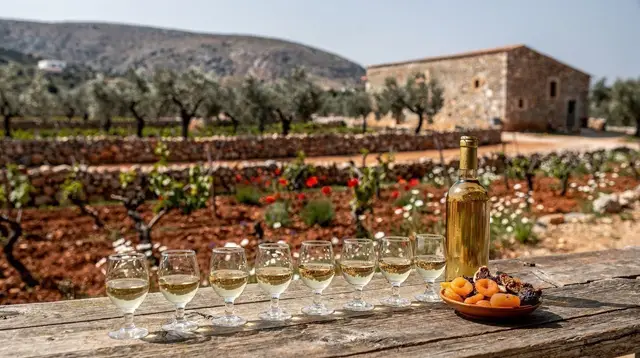
In the villages of Peza, Archanes and Dafnes in the Heraklion hills, where native grapes such as Vidiano and Kotsifali are grown and made into wine still sold mostly by name of grape rather than by a marketed label. There is no organised wine route with guaranteed stops here — it is a scattered rural landscape best visited with a guided tour or a rental car and a loose plan, not a checklist of addresses.
What Crete actually drinks
Ask what Crete drinks and most visitors guess ouzo, or assume ouzo and raki are the same thing poured under two names. Neither is close to the truth. The island has its own wine tradition, built on grape varieties that grow almost nowhere else on earth, concentrated in a handful of inland villages south of Heraklion and in the far east around Sitia. It also has raki, a completely different drink made from what is left over once the wine grapes have been pressed. Understanding the difference, and knowing where the wine actually comes from, turns a vague sense of “local drinks” into something you can see and taste on a single day inland from Heraklion.
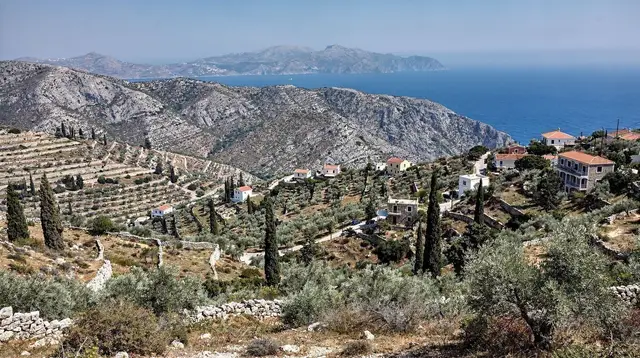
That day centres on three villages: Peza, Archanes and Dafnes, all within a short drive of each other in the hill country south of Heraklion, before the land climbs toward Psiloritis. This is not a resort landscape. There is no boardwalk, no organised “wine road” with numbered stops and a map handed out at a visitor centre. It is farmland — vines on terraced slopes, olive groves between them, villages built for people who work the land rather than for people passing through it. That is also exactly why it rewards a slow visit rather than a box-ticking one.
The grapes that make this place different
Crete’s wine identity rests on grapes that are, for the most part, indigenous to the island. They are not international varieties grown here as an experiment; they are what has grown in this soil for a very long time, and in several cases they grow almost nowhere else.
On the white side, the grape to know first is Vidiano. It has become the variety most associated with quality Cretan white wine in the last generation, prized for producing wines with body and stone-fruit character rather than the thin, neutral whites the island’s grapes were once reduced to. Alongside it sits Vilana, the traditional workhorse white grape of the Peza area specifically, historically the base of everyday Cretan white wine long before Vidiano’s rise. Two rarer names worth recognising are Dafni, aromatic and herbal, and Thrapsathiri, another native white grown in smaller quantities.
On the red side, the defining grape is Kotsifali, often blended with Mandilari for colour and tannin, since Kotsifali alone tends to make a pale, soft wine that benefits from Mandilari’s structure. The third red name to learn is Liatiko, one of the oldest cultivated grapes on Crete, used for both dry reds and, traditionally, sweet wines, and closely tied to the Sitia region in the island’s east as well as to the Heraklion hill villages.
None of this is trivia for its own sake. It matters on the day itself, because a bottle or a glass labelled “Vidiano” or “Kotsifali” is telling you something specific about where you are and what has grown on that hillside for generations, in a way that a generic “white” or “red” on a taverna list does not.
Where the wine actually comes from
Two areas carry the recognised production behind these grapes: the Heraklion hill country around Peza, Archanes and Dafnes, and the region around Sitia in the far east of the island. This guide stays with the first, because it sits close enough to Heraklion for a single day, while Sitia is its own trip in the east of Crete.
Peza gives its name to one of Crete’s established wine zones, historically built on Vilana whites and Kotsifali-Mandilari reds. It is a working agricultural village rather than a tourist stop, and that is the point: the wine here grew out of farming, not out of a marketing plan.
Archanes is the most visitable of the three villages in its own right. It is a well-kept settlement with Venetian and Ottoman-era houses along narrow lanes, a small archaeological museum reflecting the Minoan-era finds from the surrounding area, and a genuinely pleasant place to walk slowly with no particular destination. Wine and olive oil are both central to its economy, and several organised visits in the area treat the two together rather than isolating wine as the only subject worth a stop.
Dafnes sits nearby and lends its name to the Dafnes appellation, another recognised zone for the same core grapes. Together, Peza, Archanes and Dafnes cover a stretch of hill country roughly 15 to 20 kilometres south of central Heraklion, close enough that the drive itself is short even though the villages are spread out rather than clustered along one road.
Sitia’s own wine and olive oil economy, in the far east of the island, is worth reading about on its own terms rather than assuming it works the same way as this day does: see Sitia wine and olive oil for that region separately. The two areas share several of the same grapes, but they sit far enough apart, roughly across the whole length of Crete, that no single day realistically covers both.
No wine route, and no invented address
It would be easy to write this page as if Peza, Archanes and Dafnes had a signposted wine route with a dozen cellar doors you could tick off between breakfast and dinner. That is not how it works here, and claiming otherwise would set up a disappointing day. This is a dispersed rural wine landscape: producers of very different sizes, spread across several villages and the farmland between them, not a compact route built for drop-in visitors.
That has two practical consequences. First, this guide will not name a specific winery, cellar or tasting fee, because doing so without a verified, current source risks sending you to a address that has changed hours, changed ownership or stopped welcoming walk-ins altogether — a real risk in small family operations. Second, the two realistic ways to spend the day are a booked tour that already has relationships with specific producers and handles the driving, or a self-driven day where you treat any winery stop as a possibility to confirm on arrival rather than a certainty to plan around.
Neither approach is worse than the other. A guided visit removes the uncertainty and the driving, and typically builds in food pairing or an olive oil stop alongside the wine. Self-driving gives you the freedom to linger in Archanes itself, walk its lanes without a schedule, and treat any tasting you do find as a bonus rather than the entire point of the day.
What a guided day actually offers here
a half-day out to Archanes built specifically around tasting the local wine is the most direct way to spend a few hours in this landscape without needing your own transport or prior knowledge of which villages produce what. For a slower pace with food alongside the glass, a small-group wine experience in Archanes that pairs tastings with local food keeps the group size down, which tends to suit a subject like this better than a full coach.
Travellers based further west can still reach this area in a day: a day trip from Rethymno that combines Archanes with an olive oil and wine theme covers the distance for you and treats the two local products, wine and oil, as the connected story they actually are in this economy.
And because Knossos sits on the same road south of Heraklion before it climbs toward Archanes, a tour from Heraklion that pairs Knossos palace with an Archanes village and winery visit is a practical way to combine a Minoan site with this wine country in one outing, provided you go into it understanding they are two different kinds of stop, not one continuous theme.
A day that also isn’t only about wine
Archanes and its surrounding villages are as much about olive oil, quiet walking and unhurried village life as they are about wine specifically, and it is worth planning the day with that in mind rather than treating every stop as a tasting glass. A morning spent walking Archanes and the Dafnes wine country on foot, without a fixed schedule, tells you more about how this landscape actually works than a rushed sequence of stops ever could.
For visitors who want the olive side of the local economy given its own attention rather than folded into a wine day, Archanes olive woodturning demonstration and the related craft of working with olive wood in Archanes show a different, quieter side of the same villages — old olive wood shaped by hand, a tradition as rooted in this ground as the vines are, and worth a half-day on its own or as a change of pace within a longer stay in the area.
Those who prefer a private pace over a scheduled group tour, or a longer day that folds this wine country into a wider circuit through the Minoan sites of the region, will find that option covered in private tours and drivers in Crete and in the wider Knossos and the Heraklion museum guide, both useful companions to the villages covered here.
Getting there and getting around
Archanes sits roughly 15 kilometres south of central Heraklion, close enough that the drive itself rarely takes more than 25 to 30 minutes outside peak traffic. Peza and Dafnes lie nearby in the same hill country rather than along a single connecting road, so moving between the three villages means several short drives rather than one continuous route. Public transport reaches Archanes, but service into the smaller surrounding wine villages is thin, and this is one part of the island where renting a car genuinely opens up the day compared with relying on buses.
If self-driving, treat the villages as a loose loop rather than a fixed itinerary: start in Archanes itself for the walking and the museum, then head out toward Peza or Dafnes with no fixed expectation of what you will find open, and build in time to simply stop where something looks interesting. That approach suits this landscape far better than a printed list of addresses that may or may not still be accurate by the time you arrive.
Half a day here, or a full one
A half-day from Heraklion covers Archanes itself comfortably: the walk through its lanes, the small museum, lunch, and one tasting if a producer happens to be open and willing. It does not leave enough time to also reach Peza and Dafnes and treat either village properly, since the connecting drives, short as each one is, add up once you factor in stopping to ask whether a place is open. Anyone trying to fit all three villages into an afternoon usually ends up rushing Archanes to make Peza, which defeats the point of a landscape meant to be walked slowly rather than ticked off.
A full day changes that calculus: it allows the loose loop described above, with room to be turned away from one closed gate and simply move on to the next village rather than treating a single stop as the whole trip. Travellers who want more than one day given over to this subject, rather than folding it into a single outing from Heraklion, can look at a dedicated four-day food and wine itinerary across Crete, which gives wine country room alongside other regions instead of compressing it into a single afternoon.
Raki: the drink this is not
No page about Cretan wine is complete without separating it clearly from raki, also called tsikoudia. Raki is not wine, and it is not ouzo either, despite the frequent confusion among first-time visitors. It is a clear spirit distilled from the pomace — the skins, stems and seeds — left over after grapes have been pressed for wine. Because it comes from the marc rather than from anise-flavoured distillation, it has no anise character at all, which is exactly what separates it from ouzo, an anise-based spirit that is culturally and legally a different drink with a different origin.
In practice, raki shows up at the end of a meal across Crete, usually poured free by the taverna as a gesture rather than sold as a specialty item. It is strong, clear and meant to be drunk quickly rather than sipped and analysed the way a glass of Vidiano might be. If a winery visit in Peza or Archanes offers you a small glass of something unlabelled after a wine tasting, it is very likely raki, made from the same grapes you have just been tasting as wine, at the opposite end of what those grapes can become.
For a fuller account of this distinction and how it fits into the wider picture of what Crete actually drinks, see raki and tsikoudia explained and the broader overview of Cretan wine regions and grapes.
A realistic day plan
| Time | Activity |
|---|---|
| Morning | Drive from Heraklion to Archanes (roughly 25-30 minutes); walk the village lanes and visit the small archaeological museum |
| Late morning | Continue toward Peza or Dafnes, treating any winery stop as a possibility to confirm on arrival, not a guaranteed appointment |
| Midday | Lunch in or near Archanes, ideally somewhere serving Cretan mezze alongside a local glass of Vilana or Kotsifali |
| Afternoon | Either a booked tasting tour, or unhurried wandering between villages with no fixed stop-list |
| Early evening | Return to Heraklion, or continue on to Knossos if combining the two in one longer day |
The mezze suggested for that midday stop is not incidental. Cretan food: what to eat sets out the wider dishes worth ordering alongside a glass of Vilana or Kotsifali, and dakos and the Cretan mezze covers the small-plates style of eating that a wine lunch in this area usually follows, rather than a single main course eaten alone.
Comparing the grapes at a glance
| Grape | Colour | What to expect |
|---|---|---|
| Vidiano | White | Full-bodied, stone-fruit character; the variety driving Crete’s modern white wine reputation |
| Vilana | White | The traditional, lighter everyday white of the Peza area, historically the region’s backbone grape |
| Dafni | White | Aromatic and herbal, grown in smaller quantities |
| Thrapsathiri | White | A rarer native white, less widely planted than Vidiano or Vilana |
| Kotsifali | Red | Soft and pale on its own, usually blended with Mandilari for structure |
| Mandilari | Red | Deep colour and tannin, typically a blending partner rather than a standalone bottling |
| Liatiko | Red | One of Crete’s oldest cultivated grapes, used for both dry reds and traditional sweet wines, closely tied to Sitia as well as the Heraklion hills |
Understanding Peza, Archanes and Dafnes
Is there an official wine route through Peza and Archanes?
Not in the sense of a signposted trail with fixed stops. Peza, Archanes and Dafnes form a wine-producing area, but the vineyards and small producers are spread across the hillsides and village lanes rather than lined up along one road, so a visit depends on a plan you build yourself or a guide who already knows the ground.
What grapes should I actually look for here?
The whites to know are Vidiano, Vilana, Dafni and Thrapsathiri. The reds are Kotsifali, Mandilari and Liatiko. These are grapes native to Crete, grown almost nowhere else, and Peza in particular is closely associated with Vilana and Kotsifali blends going back generations.
Is raki the same as this wine, or as ouzo?
No to both. Raki, also called tsikoudia, is a clear spirit distilled from the grape marc left over after wine pressing. It has no anise, unlike ouzo, and it is usually poured free at the end of a meal rather than sold as the region’s showcase drink.
Can I just show up at a winery without booking?
Some producers welcome walk-ins during working hours and some do not open to visitors at all outside an arranged tasting. Because this guide does not point you to a specific named cellar or a set tasting fee, treat any winery stop as something to confirm on the day, by phone or through a booked tour, rather than something to count on finding open.
How far is this from Heraklion, and can I do it without a car?
Archanes is roughly 15 kilometres south of Heraklion, with Peza and Dafnes close by in the same hill country. It is a short drive, but public transport into these specific villages is limited, which is why most visitors either self-drive or join a small-group tour that already includes transport between stops.
Is this the same trip as visiting Knossos?
It can be combined, and several tours pair the two because Knossos sits on the same road south of Heraklion before it climbs into the Archanes hills. They are separate stops with separate purposes, though — one is a Minoan palace, the other is farming and wine country.
What else is there to do in Archanes besides wine?
Archanes is a working village worth a slow walk on its own, with a small archaeological museum, quiet squares and lanes of Venetian and Ottoman-era houses. Olive oil is as central to the local economy as wine, and several visits in the area combine an olive press or grove stop with a winery stop rather than treating wine as the only subject.
When is the best time to visit for wine?
Harvest, roughly late August into October depending on the grape, is when the villages are most active and pressing is visible, but it is also the busiest working season for growers, so a visit outside harvest, from spring through early summer, is often the calmer choice for anyone who wants unhurried conversation over a rushed glimpse of a working harvest.
Do I need to time my visit around opening hours?
Yes, more than in a resort town. Small agricultural producers here keep working hours built around farm life rather than tourist footfall, which often means a pause in the early afternoon and closed doors on Sundays. Late morning on a weekday is the most reliable window for finding anyone at all, and a booked tour sidesteps the guesswork entirely by confirming access in advance.
Will I find this wine easily once I’m back home?
Probably not. Very little Cretan wine is exported in meaningful volume, and what does leave the island rarely reaches ordinary supermarket shelves abroad. That is part of why tasting Vidiano, Vilana or Kotsifali here matters more than it would with a wine you could simply buy at home afterwards — for most visitors, this day is the only realistic chance to drink it.
Wine Tasting Tours in Crete on GetYourGuide
Verified deep-linked GetYourGuide tours. Book through these links and we earn a small commission at no cost to you.
GetYourGuide does not provide a product photo for this activity — the image shows the meeting point, photographed by us.