Cretan Wine Grapes: What Is Actually in the Glass
What grapes make Cretan wine different from generic Greek wine?
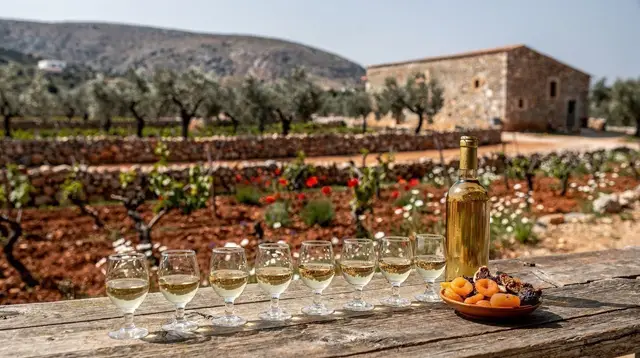
Crete grows its own indigenous varieties rather than the grapes most people associate with Greece. The whites to look for are Vidiano, Vilana, Dafni and Thrapsathiri; the reds are Kotsifali, Mandilari and Liatiko. Most of it is grown around Peza, Archanes and Dafnes in the hills south of Heraklion, with a second, drier pocket around Sitia in the east.
Beyond the label that just says Greek wine
Order a glass in a taverna in Heraklion or in a village square near Archanes and Dafnes, and the label rarely says anything as generic as “Greek white” or “Greek red.” It says Vidiano, or Vilana, or Kotsifali-Mandilari, or Liatiko. Those names are not marketing flourishes.
They are grapes that grow almost nowhere outside Crete, carried through the Venetian and Ottoman centuries by families who kept replanting the same vines in the same red hillside soil south of Heraklion, and in the drier, higher country around Sitia at the island’s eastern tip. This page is about what those names mean in the glass, and where they come from, rather than about which winery to book or what a tasting costs — those depend on the season, the operator and the day, and are better left to the tour description than to a guide.
Crete’s wine geography is straightforward once the two poles are clear. The first, and by far the larger, is the arc of hills directly south and east of Heraklion: Peza, Archanes and Dafnes, three villages close enough together that locals and growers treat them as one zone.
This is where most of the island’s bottled wine originates, and where most visitor tastings happen, because it sits twenty to thirty minutes from Heraklion city and from Knossos. The second, smaller and less visited, is around Sitia in the far east, a drier, more inland-feeling landscape where a different balance of the same grapes, and a distinct sweet-wine tradition, has survived.
The white grapes: Vidiano, Vilana, Dafni, Thrapsathiri
Vidiano is the grape Cretan producers reach for when they want to prove the island belongs on a serious wine list rather than a holiday one. It ripens late, builds real weight and alcohol, and typically shows stone fruit — apricot, peach — alongside honey and a faint almond note, sometimes softened further by a period in oak. It is closer in body to a Rhône white than to the crisp, mineral whites most people associate with Greek islands, and it is the variety most worth asking for by name on a wine list around Peza or Archanes.
Vilana is the older, more everyday white of the same hills, and the one most likely to turn up as the house pour in a village taverna. It is light, dry, citrus-driven, low in tannin because it is a white, and was for decades the grape that filled the bulk-wine trade before the current generation of small producers began bottling Vidiano and blends under their own labels. Ordering a glass of each side by side is the fastest way to feel the difference: Vilana refreshes, Vidiano fills the mouth.
Dafni takes its name from the Greek word for laurel, and the association is not accidental — the wine carries a genuine herbal, bay-leaf-adjacent note on top of citrus fruit, unlike anything in the standard Sauvignon-or-Chardonnay vocabulary. It is grown in small pockets around Rethymno and in scattered plots in the Heraklion hills, in far smaller volumes than Vidiano or Vilana, which makes it something closer to a curiosity than a house wine — worth trying if a grower or a taverna happens to pour it.
Thrapsathiri is the fourth white worth knowing, an old, high-acid variety often blended with Vidiano to add freshness and cut the richer grape’s weight, or bottled on its own in smaller runs. It rarely gets billing on its own on a list, but it is frequently present, quietly, in a Peza or Archanes white blend.
The red grapes: Kotsifali, Mandilari, Liatiko
Kotsifali is soft-textured, aromatic, and naturally low in both acid and tannin, which makes it pleasant on its own but structurally thin — most producers around Peza and Archanes do not bottle it alone. Instead it is blended with Mandilari, a deeply coloured, high-tannin, high-acid grape that supplies exactly the backbone Kotsifali lacks. The resulting Kotsifali-Mandilari blend is the everyday red of the region, the one most likely to be the house wine in a village near Archanes or Peza, and a reasonable default order if nothing else on the list is named.
Liatiko is the grape with the longest history on the island and, for a visitor, the most surprising one. Historically Crete’s most widely planted red, it is a pale-skinned variety that producers can take in two directions: fermented briefly on the skins for a light, orange-red wine with almost no tannin that reads, at a glance, closer to a rosé than a red — or given longer skin contact for a darker, more structured, still relatively delicate wine.
Both are correctly labelled red Liatiko; the pale version is a style choice, not a flaw or a blending error. Liatiko is also the grape behind Crete’s naturally sweet, sun-dried wine tradition, most associated with the Sitia area in the east, where growers have historically dried the grapes before pressing to concentrate sugar, a style with roots going back to wines exported from Crete in the medieval period.
Where the vines actually are: Peza, Archanes, Dafnes and Sitia
The Peza-Archanes-Dafnes zone sits in the red-soil hills immediately south of Heraklion, close enough to the city and to Knossos that a winery stop fits naturally into a half-day that also covers the palace. Peza, the largest of the three villages, gave its name to Crete’s oldest appellation zone and is still where much of the island’s Vilana and Kotsifali-Mandilari blend is grown at scale.
Archanes, a few kilometres on, is the prettier stop for most visitors — a tight, flower-draped village centre with its own small archaeological history — and increasingly where the newer, Vidiano-focused producers have their tasting rooms. Dafnes, smaller again, lends its name to a wine zone historically associated with sweeter Liatiko styles alongside dry reds. Together the three villages form a compact loop that most half-day and full-day tours from Heraklion, and some from further afield, are built around.
Sitia, by contrast, is a destination in its own right rather than a side trip — well over two hours by road from Heraklion, in the drier, more continental-feeling east of the island near the palm beach at Vai. Its vineyards sit higher and further from the coast than those around Peza, and the wine economy there is historically tied to Liatiko and to the island’s other major agricultural export, olive oil, which the same visitor stops often cover together. A Sitia wine and oil visit is realistically a separate day from an Archanes one, not an add-on to it.
Reading a Cretan wine list without a translator
A short table is more useful here than a paragraph. This is not a price list — prices vary by grower, vintage and season, and the honest way to check one is the wine list itself, not a guide written months in advance — but it is a way to know roughly what to expect from a name before the glass arrives.
| Grape | Colour | What it tastes like | Where it is centred |
|---|---|---|---|
| Vidiano | White | Full-bodied, stone fruit, honey, sometimes oaked | Peza, Archanes |
| Vilana | White | Light, dry, citrus, everyday pour | Peza, wider Heraklion hills |
| Dafni | White | Herbal, bay-leaf note, citrus | Rethymno, pockets near Heraklion |
| Thrapsathiri | White | High acid, often blended with Vidiano | Peza, Archanes |
| Kotsifali | Red | Soft, aromatic, low tannin, usually blended | Peza, Archanes |
| Mandilari | Red | Deep colour, high tannin and acid, blending grape | Peza, Archanes, Sitia |
| Liatiko | Red (pale style possible) | Light and rosé-like, or darker and structured; base of the sweet, sun-dried style | Dafnes, Sitia |
One repair worth making to expectations before the trip: none of this is a taste of “Greek wine” in the sense most visitors arrive expecting, built around grapes like Assyrtiko that belong to Santorini and the Cyclades. Crete’s indigenous varieties are a different, older, less exported family, and a Cretan producer will say so directly if asked — it is a point of local pride rather than a technicality.
What a price on a Cretan wine list already includes
One number worth carrying into any tasting room or restaurant on the island: prices in Greece, wine included, are quoted VAT-inclusive, and the standard rate is 24 percent. Crete has never carried the reduced rate that some smaller Aegean islands were granted for a period, so there is no local discount to expect or to ask a grower about — the number on the list, or on a bottle at a village shop, is the number paid. It is a useful fact mainly because it removes a question that visitors sometimes bring from other Greek islands where a lower island rate did apply; on Crete, standard-rate VAT is simply built into every price already shown.
Tasting in the hills without turning it into a shopping trip
The honest way to compare these grapes side by side, without committing to a single producer or a fixed price you cannot check in advance, is an organised half-day or full-day visit into the Archanes-Peza country that stops at more than one grower, and often pairs the tasting with food or with the region’s other signature product, olive oil. A half-day wine walk through the Archanes hills covers the basics — Vidiano against Vilana, a Kotsifali-Mandilari blend, usually a Liatiko — without asking for a full day.
For a longer, more structured visit, a small-group Archanes tasting paired with local food sets the wines against dishes built to match them, which does more to explain a grape’s weight and acidity than a tasting note ever will.
Travellers based further west can join a day trip from Rethymno combining Archanes wine and olive oil producers rather than relocating for a single afternoon. Either way, a driver who already knows the villages solves the one real practical problem of this trip: none of Peza, Archanes or Dafnes sits directly on a coach route, and a rental car in unfamiliar hill lanes after a tasting is not the ideal way to end the day.
Reading the wine, not just the label
The point of naming Vidiano, Vilana, Dafni and Thrapsathiri, and Kotsifali, Mandilari and Liatiko, is not to turn a holiday glass into an exam. It is that a Cretan producer pouring one of these grapes is showing something specific to the island — a variety that, in most cases, is barely grown anywhere else in Greece, let alone abroad — and a visitor who can tell a Vidiano from a Vilana, or ask whether a Liatiko is the pale or the darker style, gets a materially more interesting afternoon than one who orders “the local white” and leaves it there.
The food culture around these wines follows the same logic: dishes built around olive oil, dakos and local cheese are not a random pairing but the same hillside economy that grows the grapes. And at the end of most meals, a small glass of raki appears unasked — a different drink entirely from wine, and worth reading about separately before assuming it is a stronger cousin of the same thing.
FAQ: Cretan wine grapes and where to taste them
What is the most distinctive white grape on Crete?
Vidiano is the grape most growers point to. It ripens into a full, slightly oily white with stone-fruit and honey notes, closer in weight to a white Rhône blend than to a light island white, and it has become the grape Cretan producers use to argue their wine belongs on a serious list.
Is Vilana the same as Vidiano?
No, and mixing the two is the single most common mistake. Vilana is the old workhorse white of the Peza zone, planted for volume for decades: light, dry, citrusy, and usually the cheapest white on a Cretan wine list. Vidiano is the newer, richer, more ambitious variety grown in smaller quantities.
What is Liatiko, and why do some bottles taste almost like rosé?
Liatiko is an old, pale-skinned red grape, historically Crete’s most planted, that can be vinified two ways: as a light, orange-red, low-tannin wine that reads almost like a rosé, or fermented on the skins longer for something darker and more structured. Both are correctly called red; the pale style is not a mistake.
What does Kotsifali bring to a Cretan red blend?
Kotsifali is soft, aromatic and low in acid and tannin on its own, so it is almost always blended rather than bottled alone. It is most often paired with Mandilari, a deeply coloured, tannic, high-acid grape that supplies the structure Kotsifali lacks. The Kotsifali-Mandilari blend is the house red of the Peza and Archanes zone.
Is Dafni related to bay leaf?
Only in aroma, not botanically. Dafni is a rare indigenous white grape that takes its name from the Greek word for laurel because the wine carries a genuine herbal, bay-leaf-like note alongside citrus. It is grown in small quantities, mostly around Rethymno and pockets of the Heraklion hills, and rarely appears outside Crete.
Why does Sitia wine taste different from Peza or Archanes wine?
Sitia, at the eastern end of the island, is drier and more continental than the Peza-Archanes country, with vineyards running higher and further from the coast. Liatiko is the grape most identified with Sitia, traditionally used for a naturally sweet, sun-dried style as well as dry reds, alongside the region’s own olive oil economy.
Do Cretan wine prices already include tax?
Yes. Greek retail and restaurant prices, wine included, are quoted VAT-inclusive at the standard 24 percent rate. Crete has never qualified for the reduced rate some Aegean islands were granted, so a price on a Cretan wine list is the full price, with no local rate to expect or ask about.
Can I taste these grapes without booking a specific winery?
Yes. Organised half-day and full-day trips into the Archanes and Peza hills typically stop at more than one grower and pair the tasting with food or an olive oil call, which is a practical way to compare Vidiano against Vilana, or a Kotsifali-Mandilari blend against a pale Liatiko, in a single afternoon. A combined day covering Knossos, Archanes village and a winery stop is a practical way to fit a tasting around a Heraklion-based itinerary without giving up a whole day to wine alone.
Wine Tasting Tours in Crete on GetYourGuide
Verified deep-linked GetYourGuide tours. Book through these links and we earn a small commission at no cost to you.
GetYourGuide does not provide a product photo for this activity — the image shows the meeting point, photographed by us.