What to Eat and Drink in Crete
What should I know before eating and drinking in Crete?
Cretan cooking centres on olive oil, wild greens, pulses, cheese and grilled meat, not on any single signature dish. Raki, also called tsikoudia, is a grape-marc spirit with no anise and is not ouzo. Menus already include Greece's standard 24 percent VAT, and a tip is a small round-up rather than a fixed percentage.
Understanding the Cretan table
Ask what Crete’s national dish is and you will get a shrug rather than an answer, because the island’s food is not built around one showpiece plate. It is built around a pantry: olive oil pressed from the island’s own groves, wild greens gathered from the hillsides, pulses, snails, goat and lamb, and a handful of firm and soft cheeses made on-site by small producers.
The so-called Cretan diet that nutritionists study is really this pattern repeated across thousands of households and small kitchens — vegetables and legumes as the base, meat as an occasional addition, and very little that is fried or heavily processed. Understanding that pattern, more than memorising a list of dish names, is the most useful thing a visitor can do before ordering.
This guide sets out what actually appears on a Cretan table, from the mezze plates that start most meals to the cheese, oil, honey and herbs behind them, then moves on to wine and to the single most misunderstood drink on the island: raki. It also covers the two practical questions every visitor eventually asks — how tax and tipping actually work here — without pretending to hand you exact figures that change from one kitchen to the next. For the ingredients themselves in more depth, see the dedicated pages on dakos and the mezze table and on Cretan cheese.
Dakos and the mezze table
Mezze in Crete is less a category of small plates than the normal way a meal unfolds: a spread of shared dishes rather than one main course per person. The dish that shows up most often is dakos, a dried barley rusk soaked briefly, then piled with chopped tomato, crumbled soft cheese, olive oil and oregano — closer to a rural staple than a delicacy, and honest enough that its quality depends almost entirely on the tomato and the oil rather than on technique.
Around it sit dishes built from the same rural economy: wild greens known collectively as horta, dressed simply in oil and lemon; snails, often cooked with rosemary and vinegar in a preparation called chochlioi boubouristi; fried courgette or aubergine slices; and small plates of pulses such as fava, a split-pea purée that has nothing to do with fava beans despite the name.
Meat, when it appears, tends to be grilled rather than sauced — lamb or goat, often slow-cooked in the antikristo style over an open fire, a method with roots in the shepherding culture of the White Mountains and still used for celebrations. A full account of how that dish is made, and where it fits into Cretan cooking traditions, sits on the antikristo and Sfakian lamb page. None of this depends on a particular restaurant or region: the same core dishes turn up in Chania, Rethymno, Heraklion and Lasithi, adjusted by whatever the local hillside and coast happen to provide.
Cheese, olive oil, honey and mountain herbs
Crete’s dairy tradition runs on sheep and goats rather than cows, and it produces three cheeses worth knowing apart from each other. Graviera is a firm, aged cheese, usually the one grated over pasta or grilled and served warm with a squeeze of lemon. Mizithra is its opposite: a soft, mild whey cheese eaten fresh, frequently the crumbled topping on dakos. Staka sits apart from both — a rich, slow-cooked preparation of the fat skimmed from goat or sheep milk, served warm as a savoury spread or stirred into eggs and pasta, and not really a table cheese at all. The distinctions matter mainly because visitors often assume “Cretan cheese” is one thing, when in practice a household will use all three for different purposes in the same week.
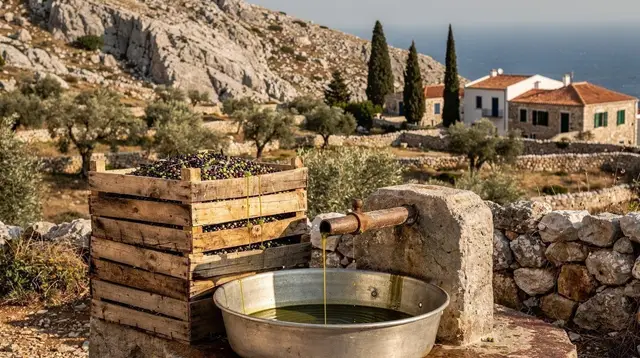
Olive oil is less an ingredient than the backbone of the whole cuisine, poured generously rather than measured, and small mills across the island — particularly around Sitia, Kissamos and the Heraklion hinterland — still press it in ways that have barely changed. The olive oil mills and tastings guide covers how to visit one responsibly, and a separate piece looks specifically at what actually distinguishes oil that is genuinely Cretan from oil merely bottled on the island.
Honey, usually thyme or wildflower honey gathered from the same mountain slopes that produce the herbs used in cooking and folk remedies, rounds out the pantry; the page on honey and herbs of Crete goes into where and how it is produced.
Cretan wine: the grapes and the regions
Cretan wine has spent the last two decades rebuilding a reputation it briefly lost to bulk production, and it has done so by leaning into grape varieties that exist almost nowhere else. On the white side, Vidiano makes rounder, more aromatic wines and has become something of a flagship grape for quality producers, alongside the lighter, more everyday Vilana, the rare and distinctive Dafni, and Thrapsathiri, often blended for acidity. Reds run on Kotsifali, soft and fruit-forward, usually blended with the darker, more tannic Mandilari to give it structure, and Liatiko, an old grape capable of both dry reds and sweeter, sun-dried styles.
Geographically, the historic centre of Cretan wine sits inland from Heraklion, around Peza, Archanes and Dafnes, an area that holds most of the island’s protected-designation vineyards and has been producing wine since antiquity — Minoan wine presses have been found in the same hills. The wine regions and grapes guide maps this area in detail, and a dedicated Peza and Archanes winery day page lays out how to spend a day there.
Sitia, in the far east, has its own smaller PDO zone with a long viticultural history of its own, covered on the Sitia wine and olive oil page, while a newer generation of small producers has taken root in the west around Chania, working the same indigenous grapes on markedly different soil — see Chania’s wineries for that side of the island.
| Grape | Colour | Character | Main area |
|---|---|---|---|
| Vidiano | White | Round, aromatic, often the flagship white | Peza / Rethymno |
| Vilana | White | Light, everyday drinking | Island-wide |
| Dafni | White | Rare, herbal, distinctive | Central Crete |
| Thrapsathiri | White | Used mainly for acidity in blends | Island-wide |
| Kotsifali | Red | Soft, fruit-forward | Peza / Archanes |
| Mandilari | Red | Dark, tannic, used to add structure | Island-wide |
| Liatiko | Red | Old variety, dry or sweet styles | Sitia / Dafnes |
Raki, or tsikoudia: what it actually is
Here is the single most useful correction this page can offer: raki, which locals more precisely call tsikoudia, is not an anise-flavoured drink. It is a pomace brandy, distilled from the skins, stems and pulp left over once the grapes have been pressed for wine — the same raw material Italy uses for grappa. Nothing about the process involves anise, star anise or any of the spices that give ouzo its licorice character, and a raki poured in a Cretan household tastes closer to a clear, warming grape spirit than to anything anise-flavoured.
This is where the confusion usually starts. Ouzo, made across mainland Greece from a neutral spirit redistilled with anise and other botanicals, is the drink most visitors already know by name, and its sweetish, milky-when-diluted character is what many people expect raki to taste like. It does not. A second, separate mix-up comes from the name itself: Turkish rakı is also anise-flavoured, distilled differently again, and entirely unrelated to Cretan tsikoudia beyond sharing a similar-sounding word. Three drinks, three different production methods, only one of them free of anise — and it is the Cretan one.
Tsikoudia’s place at the table is as much about custom as taste. It is traditionally poured, unasked, at the very end of a meal — a small glass alongside fruit or a sweet, offered as a gesture of hospitality rather than sold as an aperitif. It also turns up earlier in some households as an accompaniment to mezze, but the closing pour is the version almost every visitor encounters first. For more on how it is made, and on the household stills still used in autumn across Cretan villages, see raki and tsikoudia explained.
Tipping, VAT and how prices actually work
Two practical points come up often enough to spell out clearly, and neither involves quoting a specific euro figure, which varies too much by establishment and season to be useful here. First, Greece applies a standard VAT rate of 24 percent, and Crete has never received the reduced rate that some smaller Aegean islands were granted in past years — so whatever a menu shows already includes tax, with nothing added at the table.
Second, tipping is not obligatory and follows a modest local pattern: rounding the bill up by roughly five to ten percent for good service is the norm, a fraction of the fifteen to twenty percent routinely expected in North America. Staff will not chase a larger tip, and leaving none at all for a quick coffee or a casual lunch is unremarkable.
These two facts together explain a common visitor complaint that turns out to be a misunderstanding rather than a genuine overcharge: a bill that looks higher than expected is very rarely a hidden tax, since the tax was already folded into the price shown, and a modest round-up rather than a large percentage is all that local service expects in return.
Tasting Crete hands-on
Reading about dakos, staka and Vidiano only goes so far, and several ways exist to taste the island’s food and drink with someone who actually makes it. A guided walk through Heraklion’s food streets is one option worth booking ahead — the Heraklion food sightseeing walking tour moves between markets and small producers over roughly half a day. For a more hands-on introduction, the traditional Cretan cooking class covers the basics of the mezze dishes described above, from dough to dakos toppings.
On the wine side, a half-day trip that pairs tastings with food is the most efficient way to compare the indigenous grapes side by side — the vineyard tour and wine tasting with food pairing does exactly that at working wineries.
Visitors curious about the herbs and greens behind so much Cretan cooking can join the herbalist foraging outing, which walks the same hillsides that supply village kitchens with wild greens and honey. Full planning context for the region around these visits is on the where to stay in Crete and how many days in Crete pages, and the broader activity list sits under food and gastronomy.
Questions about Cretan food, wine and raki
Is raki the same as ouzo?
No. Raki, also called tsikoudia in Crete, is distilled from the grape skins and stems left over after winemaking and has no anise flavouring. Ouzo is a separate, anise-flavoured spirit made across mainland Greece, and Turkish raki, spelled rakı, is yet another anise drink. The confusion is common among first-time visitors, but the three are not interchangeable.
Why is raki often served for free at the end of a meal?
It is a long-standing gesture of hospitality rather than a sales item, usually poured unbidden as a small glass alongside a plate of fruit or a sweet once the main courses are cleared. Declining it is fine, and asking for it earlier in the meal is unusual since it is understood as a closing ritual, not an aperitif.
What grapes go into Cretan wine?
The island relies on indigenous varieties rather than the grapes most visitors already know. Vidiano, Vilana, Dafni and Thrapsathiri are the main whites, while Kotsifali, Mandilari and Liatiko dominate the reds, often blended together. These grapes are largely specific to Crete and rarely appear on wine lists outside Greece.
Where are Crete’s wine-producing areas?
The historic core sits inland from Heraklion around Peza, Archanes and Dafnes, where most of the island’s PDO wine is made. Sitia in the far east has its own smaller appellation, and western Crete around Chania has a newer cluster of small producers working with the same indigenous grapes on a different soil and climate.
What is dakos?
Dakos is a barley rusk soaked and softened, then topped with chopped tomato, crumbled soft cheese, olive oil and oregano. It is closer to a rural staple than a delicacy, and it appears on the vast majority of mezze spreads across the island as one of the standard opening dishes.
What is staka, and how is it different from graviera or mizithra?
Staka is a rich, slow-cooked mixture of the fat and residue skimmed from goat or sheep milk, usually served warm as a savoury spread or over eggs and pasta. Graviera is a firm, aged cheese used for grilling or grating, and mizithra is a soft, mild whey cheese eaten fresh, often inside dakos or pastries. All three come from the same sheep and goat dairy tradition but are used for different purposes at the table.
Do I need to tip in Crete?
Tipping is not obligatory but rounding up the bill by roughly five to ten percent is normal practice for good service. This is well below the fifteen to twenty percent expected in North America, and staff neither expect nor request more than a modest round figure.
Does Crete have a lower VAT rate like some other Greek islands?
No. Certain Aegean islands were granted a reduced VAT rate in the past, but Crete has never been included in that scheme and has always applied mainland Greece’s standard rate of 24 percent. Menu prices already include this tax, so there is no separate charge added at the table.
Food Tours in Crete on GetYourGuide
Verified deep-linked GetYourGuide tours. Book through these links and we earn a small commission at no cost to you.
GetYourGuide does not provide a product photo for this activity — the image shows the meeting point, photographed by us.