Cretan Cheese Around Anogia and Mount Psiloritis
What should I know about Cretan cheese before visiting Anogia?
Anogia sits on the flank of Psiloritis, Crete's highest mountain at 2,456 m, where snow lingers into May or June and shepherding still shapes daily life. Mizithra, graviera and staka are names you will meet on menus and in shops there, but exact recipes, ageing methods and village-level origins vary by household and producer, so this guide sticks to the geography and pastoral context rather than claiming details it cannot confirm.
Anogia is a village people usually arrive at for one of two reasons: the Sfendoni cave nearby, worth its own dedicated guide to the cave and neighbouring Zoniana if the underground side of the visit is the real draw, or the promise of Cretan cheese. Both are reasonable, and both sit inside the same geography, on the northern flank of Psiloritis, the mountain also known as Mount Ida, which at 2,456 m is the highest point on Crete. Before looking at what is on the plate, it is worth understanding what is under the village, because the terrain explains a great deal about why this particular pocket of the island still has working shepherds and roadside dairy shops rather than resorts.
This page is deliberately narrow. It will tell you where Anogia sits, why the mountain above it has shaped a pastoral way of life, how raki fits into the picture without being confused with cheese, and how to see some of this in person on an organised visit. It will not hand you a recipe for mizithra, a maturation period for graviera, or the name of a village said to have invented staka. Cretan dairy is genuinely local and genuinely varied, household to household and flock to flock, and a general-interest travel guide has no reliable basis for pinning specific techniques or origins to specific places. What follows sticks to what can be said with confidence: geography, altitude, season, and the practical business of visiting.
A Village Under Crete’s Highest Peak
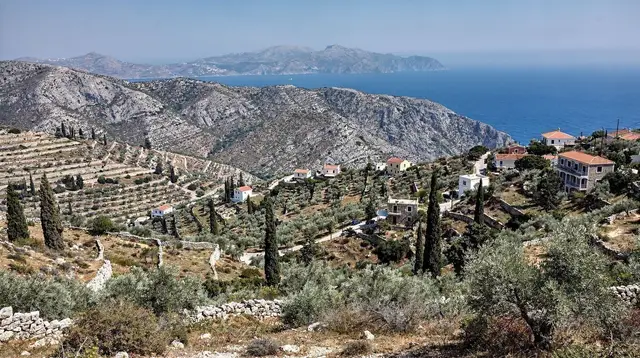
Anogia sits at roughly 740 m on the slopes below Psiloritis, in the Rethymno regional unit, with the mountain rising directly behind it toward the Nida plateau and the summit beyond. Psiloritis is the island’s high point at 2,456 m, taller than Pachnes in the Lefka Ori (White Mountains) to the west at 2,453 m, and its snow cover typically lasts into May or June in an ordinary year. That is a long snow season for a Mediterranean island, and it is the reason the ground here behaves differently from the coastal strip most visitors picture when they think of Crete.
Psiloritis is not the only Cretan summit that holds snow long into spring. Pachnes, the highest point of the Lefka Ori in the west, sits only three metres lower and keeps its own snow cover on a broadly similar schedule. Anyone curious how the two ranges actually compare, in scale, access and the kind of pastoral life each one supports, will find that laid out directly in a separate guide to Pachnes and the White Mountains, which is useful context before assuming Psiloritis is a one-off rather than part of a wider pattern across the island’s interior.
A mountain that holds snow for half the year does not lend itself to the citrus groves and vineyards of the lowlands below Archanes or Peza. It lends itself to grazing: sheep and goats moved up toward higher pasture as the snow retreats and the grass follows the melt line, then brought back down as autumn closes in. That seasonal rhythm, transhumance in the general sense of the word, is the backdrop against which Anogia’s dairy tradition exists. It is not a claim about any one farm’s practice today, simply a description of why this part of the island, more than the resort coast, has kept a visible pastoral economy running alongside tourism.
That lowland contrast is worth seeing rather than only reading about. Archanes and the villages around Dafnes sit in a completely different microclimate from the Psiloritis foothills, close enough to Heraklion for a half-day out and built around vines rather than flocks, and a separate destination guide to Archanes and Dafnes covers what that lowland area has to offer beyond its role as a counterpoint here. For a full day built specifically around that wine landscape rather than a single stop, a guide to spending a day at the Peza and Archanes wineries lays out how to combine several of them in one visit.
Anogia itself has a harder history than the pretty-village description suggests. The village was destroyed during the Second World War in reprisal for resistance activity, and it was rebuilt after. That history sits alongside its reputation today as a centre of Cretan music, particularly the lyra, and it is worth knowing before you arrive expecting only a cheese stop on a day trip. For the island’s wartime history more broadly, including the cemeteries at Maleme and Souda Bay, a separate guide to the Battle of Crete in 1941 covers this in more depth than belongs here.
Anogia’s reputation for lyra music is not a side note dropped in for colour; it is one of the reasons people build an entire evening around the village rather than treating it as a cheese-and-cave stop on the way to somewhere else. Travellers who want to understand that side of Anogia before arriving, including how mantinades, the improvised sung couplets, fit into a night of live lyra, will get more out of a dedicated guide to Cretan music, lyra and mantinades than from anything a food-focused page like this one can responsibly cover.
The road up from Rethymno climbs steadily, and the approach itself is part of the experience: olive terraces give way to scrubbier slopes, then to the open grazing land that ring the village. If a hike up Psiloritis itself is on your list, Anogia and the Nida plateau above it are the usual starting point, and the practicalities of that route, including how late into the season snow can block the higher paths, are covered on its own page about the Psiloritis summit hike.
Mountain Pastoralism Below Psiloritis
The word most often reached for to describe this area is pastoral, and it earns the label. Flocks of sheep and goats are a normal sight on the roads around Anogia and on the approach to the Nida plateau, and roadside stops selling dairy products are common enough that they barely register as a tourist attraction to people who live here. What this guide will not do is describe a specific cheese-making process as though it were uniform across the region. Recipes, salting methods, and ageing times for cheeses like mizithra and graviera vary from household to household and from one small producer to another, and claiming a single fixed method would be inventing detail this brief cannot verify.
What can be said in general terms: mizithra across Crete tends to be a soft, fresh cheese, often eaten within days of production, sometimes sweetened, sometimes left plain. Graviera tends to be a firmer, aged cheese, the kind more likely to turn up sliced on a meze plate or grated over a dish than eaten by the spoonful. Staka is a dairy preparation more associated with cooking than with the cheeseboard, often appearing warm at breakfast or worked into a dish rather than served as a discrete cheese. Beyond those broad strokes, this page stops rather than guessing at a specific village’s claim to a specific method, a producer’s name, or an official designation, none of which sits on a solid enough footing here to print.
If the food side of a Crete trip interests you more broadly, a general overview of what is actually eaten across the island, as opposed to the taverna staples aimed at visitors, sits in a separate guide to Cretan food, and the specific case of the mixed small-plates spread built around dry rusks and produce like this is covered on its own page about Cretan mezze.
Raki, a Different Tradition at the Same Table
Ask about Cretan cheese in a village like Anogia and raki tends to come up in the same breath, which is understandable but worth separating out clearly. Raki, also known as tsikoudia, is a spirit distilled from grape marc, the leftover skins and stems from winemaking. It has no anise in it, which distinguishes it sharply from ouzo, and it is not the same drink as Turkish rakı despite the similar name. It is very commonly offered free, unbidden, at the end of a meal in a taverna, as a gesture rather than a menu item, and that habit holds as true in the mountain villages as anywhere else on the island.
The reason raki and cheese end up mentioned together so often is simply that both belong to the same table and the same rural economy: a household or small producer that keeps animals for milk may well also have a vineyard, or access to grape marc after the harvest, and both traditions get folded into hospitality without much ceremony. But they are separate products with separate histories, and conflating them risks making both sound vaguer than either deserves.
For the fuller picture of raki specifically, a dedicated guide to raki and tsikoudia covers what it is and is not in more depth, and the island’s wine side, built on indigenous grapes grown mainly around Peza, Archanes and Dafnes, has its own guide to Cretan wine regions and grapes as well.
What This Page Will Not Claim
It is worth being explicit about the limits here, because Cretan food writing online is full of confident detail that does not always hold up. This guide will not tell you that a particular cheese is protected under a specific designation of origin tied to Anogia, will not name a cooperative or a family producer as though we had visited and verified their methods, and will not describe an ageing period in weeks or months as though it were fixed across the region.
None of that is because such things do not exist somewhere in Crete’s dairy world; some almost certainly do. It is because a travel page assembled without a site visit or a verified source has no business asserting them, and getting them wrong would do readers more harm than leaving them out.
What the page can responsibly do is set the geographic and seasonal scene, point out that this is real working pastoral country rather than a themed stop on a tour route, and be honest that the specifics of any one product are best learned on the ground, from whoever is actually selling or serving it that day.
Seeing This Without Guessing
The honest way to learn more than a general-interest page can responsibly tell you is to see some of it in person, ideally with someone who works in the area rather than through printed claims. A handful of organised excursions run from Rethymno into the Anogia and Psiloritis area and combine a cave visit with a stop connected to cheese, which is a reasonable way to get beyond a roadside shop window.
The Sfendoni Cave Anogia and Cheese Making Tour by minivan pairs a visit to the Sfendoni cave with a stop in Anogia connected to local cheese, run as a small-group trip from Rethymno; treat the cheese-making element as whatever the operator’s current itinerary describes on the day, rather than assuming a fixed script. For a private alternative that puts the mountain itself, rather than only the village, at the centre of the day, the private jeep tour to Anogia and a Psiloritis mountain chalet covers similar ground at a slower, more flexible pace.
Cheese is only one thread of Cretan gastronomy, and if a broader food-focused day matters more than the mountain setting specifically, the Eleftherna experience combining cheesemaking, cooking and tasting and the traditional Cretan food tour through Rethymno’s old town both sit closer to a general culinary introduction than to the specific geography of Anogia.
If what you actually want is Psiloritis itself rather than the village at its foot, the guided hike up Psiloritis mountain is the more direct route to the terrain that shapes everything described above, weather and season permitting.
For travellers who would rather not tackle the mountain roads themselves but also do not want a fixed-departure group excursion, hiring a private driver for the day sits between the two, and the trade-offs of that option specifically are covered in a separate guide to private tours and drivers in Crete. It costs more than a self-drive rental or a seat on a shared minivan, but it removes both the mountain-driving nerves and the group’s fixed schedule, which for a day built around Anogia and Psiloritis is often the deciding factor for anyone still undecided.
If a proper ascent of Psiloritis is the real goal and Anogia is simply the last village before the trailhead, it is worth planning around more than a single day. A guide to spending a full week in Crete built around hiking lays out how a Psiloritis climb fits alongside the island’s other gorges and mountain routes, rather than treating the summit as an isolated add-on tacked onto a coastal holiday.
Whichever option you choose, book with the season in mind. A trip that depends on a mountain road being clear, or on grazing being visible on the higher slopes, plays out very differently in April, when snow can still sit on the upper mountain, than in August, when the Nida plateau is fully open and the flocks are at their highest pasture.
General notes on how the island’s weather shifts month to month, including how late snow lingers, are covered in a separate seasonal guide to Crete’s weather month by month, and the practical case for renting a car to reach villages like this one at your own pace, rather than relying on the thinner inland bus network, is covered in a dedicated guide to driving in Crete.
Getting There and Practical Notes
Anogia is reached by road from Rethymno or from Heraklion, with the drive from Rethymno the shorter and more commonly used approach for day visits. There is no rail network anywhere on Crete and no realistic way to reach Anogia by coach on a tight schedule, so a rental car or an organised tour are the two practical options, in keeping with how much of inland Crete works outside the KTEL routes along the north coast highway.
If you are driving yourself, treat the road up toward Anogia and further on toward the Nida plateau as a mountain road in the plain sense of the phrase: narrower than the coastal highway, with the usual local habit of pulling onto the hard shoulder to let a faster car pass, which is courtesy rather than an invitation to overtake blindly. Outside the summer months, check conditions before pushing on toward the higher plateau or the mountain refuge, since snow can close the upper road well after the coast has turned warm. A general rundown of avoidable mistakes on Cretan roads and elsewhere on the island is collected in a separate guide to mistakes to avoid in Crete worth reading before you set out.
One detail worth knowing before locking in a departure time from the coast: Crete runs on Eastern European Time, an hour ahead of Paris, Berlin or Rome, which matters less for Anogia’s informal village hours than for coordinating an early start with a cave tour slot or a rental car pickup booked against mainland assumptions. For visitors weighing whether to rent a car specifically for a detour like this one, rather than relying on organised transport for the whole trip, the practical side of that decision, insurance and mountain roads included, is set out in a dedicated guide to renting a car in Crete.
Anogia village itself sits low enough on the mountain’s flank to stay open and reachable across most of the year, unlike the seasonal south-coast villages and boat-only settlements described elsewhere on this site. That makes it a realistic stop even outside the high season, when the shepherding and dairy side of the local economy, driven by the mountain above rather than by the tourist calendar, is arguably closer to its ordinary working rhythm than it is in the middle of August.
Frequently Asked Questions About Cretan Cheese Near Anogia
What cheeses is the Anogia and Psiloritis area associated with?
Anogia and the surrounding Psiloritis foothills are known in general terms for sheep’s and goat’s milk cheeses, including soft fresh mizithra and firmer aged styles such as graviera. This guide does not attribute a specific recipe or protected origin to any single village, since that level of detail is not something we can confirm.
Is mizithra the same thing as graviera?
No. Mizithra is typically a soft, fresh whey cheese eaten young, often within days of being made, while graviera is a firmer, aged cheese. Both appear across Crete under local variation, and this page avoids stating a fixed recipe or ageing period for either.
What is staka?
Staka is a dairy preparation associated with Cretan mountain cooking, usually served warm as part of a breakfast or meze rather than eaten as a table cheese on its own. Beyond that general description, this guide does not claim specific ingredients or a fixed method, since sources vary.
Is raki the same product family as these cheeses?
No. Raki, also called tsikoudia, is a grape marc spirit with no anise, distinct from ouzo or Turkish raki. It is a separate tradition from dairy, though the two often appear at the same table, commonly with raki offered free at the end of a meal.
Why does mountain pastoralism persist around Psiloritis?
Psiloritis, at 2,456 m, is Crete’s highest peak, and its slopes and the Nida plateau beneath it hold snow into May or June in a typical year. That terrain has long supported seasonal grazing of sheep and goats rather than large-scale arable farming, which is the geographic backdrop for dairy traditions in villages like Anogia rather than a claim about any specific farm.
Can a visitor watch cheese being made near Anogia?
Some organised excursions in the area combine a visit to the nearby Sfendoni cave with a stop connected to cheese making, typically run as small-group or private tours from Rethymno. Details of any individual stop are set by the tour operator on the day, so check the current itinerary when booking rather than relying on a fixed description.
When is Psiloritis snow-covered, and does that affect a visit to Anogia?
Snow typically holds on Psiloritis’s upper slopes into May or June, well after the coast has warmed up. Anogia itself, at a lower elevation on the mountain’s flank, is usually accessible by road outside the depths of winter, but the high plateau and summit routes above it are a different matter and depend on the season.
Is Anogia reachable without a rental car?
A rental car is the practical way to reach Anogia and explore the Psiloritis foothills at your own pace, since the KTEL coach network thins out away from the north coast highway. Organised tours from Rethymno or elsewhere are the other realistic option if you are not driving yourself.
Does the snow on Psiloritis mean there is skiing near Anogia?
No. Despite snow holding on Psiloritis’s upper slopes into May or June in a typical year, Crete has no ski lift anywhere on the island. What the mountain supports is grazing and a working pastoral economy rather than winter sports infrastructure, which surprises some visitors who assume that deep, long-lasting snow must come with some kind of resort behind it.
Food Tours in Crete on GetYourGuide
Verified deep-linked GetYourGuide tours. Book through these links and we earn a small commission at no cost to you.
GetYourGuide does not provide a product photo for this activity — the image shows the meeting point, photographed by us.