Crete in September: Warm Sea, Thinner Crowds
Is September a good time to visit Crete?
September is one of the best-balanced months: the sea holds at 24-27°C, among the warmest readings of the year alongside August, the Samaria gorge is normally still open, and crowds are noticeably thinner than in July or August. The meltemi wind is generally weaker than in high summer, though it is not absent, and some seasonal businesses begin closing toward the end of the month.”
The compromise month, tested against the numbers
Every guide to Crete eventually gets asked the same question in different words: when do you get the warm sea without the July crowds, and the open gorges without the wind cancelling half your plans. September gets proposed as the answer more often than any other month, and it largely earns that reputation, but it earns it with real trade-offs rather than a clean win on every count. Boat days hold up well this late, and an guided Elafonissi excursion is easier to fill in September than in the August crush.
This page goes through what actually changes in September, using the same figures anyone planning around Best Time to Visit Crete: Why July and August Aren’t the Whole Story or Crete Weather Month by Month would want checked, rather than the vague “shoulder season” language that gets recycled across travel sites without a single number attached.
The short version: the sea is at its warmest, the island’s gorges are generally still running, the meltemi has usually eased off from its July-August peak, and the crowds that define Crete in July and the Meltemi Wind and Visiting Crete in August have thinned out. None of that is a guarantee. A windy week can still happen, a gorge can still close on short notice, and the island’s slide toward low season starts showing by late September in a way it never does in early August.
Sea temperature: September’s strongest argument
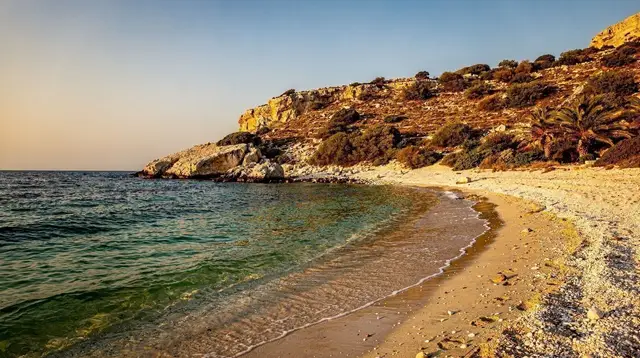
Crete’s sea runs 16-18°C in spring and climbs through the summer, but it does not peak in August the way most people assume. It peaks in August and September together, holding at 24-27°C through September before beginning its slower autumn decline. That means a swimmer arriving on 5 September and one arriving on 25 August are getting essentially the same water.
This is the single clearest number-based reason September gets recommended over June, when the sea is still working its way up from 21-25°C, and it holds regardless of which coast a visitor picks — the beaches around Platanias and Agia Marina: Chania’s Nearest Beach Strip in the west and those near ierapetra-chrissi in the east are drawing on the same seasonal warmth.
Air temperature tells a slightly different story. July and August routinely hit 30-35°C, sometimes more in a heatwave, and September backs off from that peak — days are still warm, often comfortably into the high 20s early in the month, but the harshest heat has generally passed. For a visitor who wants to combine beach time with walking around Knossos or a coastal town without the midday heat of high summer, that gap between air and sea temperature is the actual mechanism behind September’s reputation, not a vague sense that it’s “less busy.”
What the meltemi does, and doesn’t do, in September
The meltemi is a strong wind from the north that defines July and August far more than any other month. It is the reason boat trips to balos-gramvousa, to Imeri Gramvousa’s Venetian fortress, and to the protected islet at ierapetra-chrissi get cancelled with some regularity in high summer, while the Libyan Sea coast in the south stays comparatively calm through the same stretch.
By September, the meltemi has generally eased. It blows less often and less forcefully than at its July-August peak, and that alone is a real reason to prefer September for anyone whose plans depend on a specific boat trip. But “generally weaker” is not the same as “gone.” A windy day can still show up in September, and when it does, the same boats to Balos, Gramvousa or Chrissi can still be cancelled with little notice — operators call it on the morning, not the week before.
Anyone booking a boat-dependent day in September should build in a backup day or a flexible itinerary rather than assuming the wind has finished for the year, and the same caution applies to sunset cruises and other coastal excursions. A sunset boat trip along the west coast is a good September pairing with calmer evening conditions precisely because it isn’t staked on one single weather-dependent crossing.
Crowds: the other half of the trade-off
European school holidays are the real driver of Crete’s crowd curve, and they end in late August across most of the continent. That single calendar fact is why September reads as noticeably quieter than the two months before it — not because fewer people are interested in visiting, but because the family travel window that packs Hersonissos, Malia and the beaches around gouves-hersonissos through July and August has closed.
Restaurants in chania-town and rethymno-town that needed a reservation in August become walk-in friendly again, and sites like Knossos, which has almost no shade and gets uncomfortable in a July crowd, are easier to visit at a normal pace.
This is the crowd argument behind grouping September with late April through June as the island’s best-balanced period, alongside genuinely open gorges and a milder version of the summer heat. It is a real effect, but it is gradual rather than a switch that flips on 1 September.
The first week or two of the month can still carry a late-summer feel in the most popular resort strips, and pricing tends to follow the same slow curve — noticeably cheaper than August on average, but not at low-season rates until later in the autumn. Anyone weighing Chania vs Rethymno vs Heraklion for a September base will find all three towns easier to navigate than in high summer, though none of them empties out entirely.
The Samaria gorge, and what “open” means in September
The Samaria gorge runs on a season that stretches roughly from May to October, which puts September comfortably inside its normal operating window in most years. That makes September one of the more reliable months for the full 16 km descent from Xyloskalo down to Agia Roumeli, a walk that ends with a boat rather than a road, as covered in the The Samaria Gorge: A Complete Guide.
Reliable is not the same as guaranteed. The park authority can close the gorge on short notice for fire or flood risk, and unlike the meltemi’s rough seasonal pattern, that kind of closure can happen at any point within the operating window, September included.
Anyone building a trip around the Samaria hike, whether through a guided Samaria Gorge hike or independently, should check the gorge’s current status close to the date rather than assuming a September booking is automatically safe. The gentler alternative, described in The ‘Easy Samaria’ Walk from Agia Roumeli, Explained, follows the same open-or-closed status as the full descent, since it uses the same access points.
What starts closing, and what stays open
This is the part of the September pitch that gets softened too often. The island does not run on a single switch between “high season” and “low season” — it fades in stages, and September sits at the start of that fade rather than fully inside peak conditions. The three old towns, the major museums, Knossos, the monasteries and the core tavernas of Chania, Rethymno and Heraklion operate year-round and are unaffected.
But smaller, seasonal operations — a beach bar on a quieter stretch of coast, a family-run boat trip, some of the more marginal south-coast tavernas — begin scaling back or closing as September moves into its final third, ahead of the fuller shutdown that defines Crete in October: Is the Season Still On? and the genuine low season covered in the crete-in-winter material.
There is no fixed date for this. It varies by business, by weather, and by how the season has gone. The practical takeaway is not to treat every day of September as identical: the first half of the month behaves closer to a quieter August, and the back half starts leaning toward October. A visitor planning specifically around a beach bar, a small boat operator or a remote taverna in late September should confirm it’s still running before building a day around it, something covered in more general terms in Common Mistakes to Avoid in Crete.
A September week, roughly sketched
| Days | Focus | Notes |
|---|---|---|
| 1-2 | Chania old town and the west coast | Warm sea, thinner crowds than August |
| 3-4 | Samaria gorge or Imbros gorge | Confirm gorge status close to the date |
| 5 | Balos or Gramvousa by boat | Check for wind before committing to a boat day |
| 6 | Rethymno or a wine village day | Wine tasting in the Peza-Archanes area pairs well here |
| 7 | Heraklion, Knossos and the Archaeological Museum | Easier pace than a July visit |
This mirrors the pattern in Crete in 7 Days: West to East with the Samaria Gorge, adjusted for what September specifically offers: warm swimming every day, a real shot at the full Samaria descent, and boat trips that need a weather check rather than a guarantee.
How September compares to the months around it
| Month | Sea temp | Meltemi | Crowds | Samaria gorge |
|---|---|---|---|---|
| July-August | 24-27°C | Strongest, frequent cancellations | Peak | Open, very busy |
| September | 24-27°C | Generally weaker, not absent | Noticeably thinner | Normally open |
| October | Cooling | Rare | Thin | Closes during the month |
| June | 21-25°C | Building | Moderate | Open |
The table makes the actual trade-off visible: September matches August on sea temperature while backing off from its wind and crowd levels, but it does not fully match June or October on price or quiet, and its gorge access, boat reliability and business hours all carry the same caveats as the rest of high season, just eased rather than removed.
Getting the most from a September trip
A rental car remains the practical way to cover ground in September, as in any month — see Renting a Car in Crete: Is It Really Necessary? for what to expect from local contracts, including the standard exclusion of unpaved roads that matters for anyone tempted by the Balos dirt track. For a day that swaps the driving for someone else’s local knowledge, a Land Rover day out through the west reaches beaches and villages that are harder to string together independently in a single day, and a private tour of the south coast beaches works well once the meltemi has eased enough to make the drive over the mountains worthwhile.
What to pack changes modestly from August: see What to Pack for Crete for the seasonal detail, but the short version is summer clothing plus a layer for cooler evenings, since September nights, especially inland, are noticeably cooler than the daytime warmth suggests. First-time visitors weighing September against other months can cross-check the general planning advice in Crete for First-Timers: Getting Your Bearings, which covers the island’s size and the case against trying to base in one town for a full week.
Crete in September, questions travellers actually ask
Is the sea warm enough to swim in Crete in September?
Yes. September sea temperatures run 24-27°C, among the warmest of the year alongside August, so swimming is comfortable at any beach on the island, north or south coast.
Does the meltemi wind still blow in September?
It can, but it is generally weaker and less frequent than in July and August, when the meltemi is at its strongest. A windy day can still cancel a boat to Balos, Gramvousa or Chrissi in September, so it is never safe to assume calm seas for the whole month.
Is the Samaria gorge open in September?
Usually, yes. The gorge runs on a roughly May-to-October season, and September normally falls within it, but the park can close on short notice for fire or flood risk, and the exact closing date for the year is never fixed months in advance.
Are hotels and restaurants still open in Crete in September?
Most are, especially in the first three weeks. Toward the end of the month, some seasonal beach bars, boat operators and smaller family-run tavernas in quieter areas begin winding down as the low season approaches, so late-September plans benefit from checking ahead.
Is September cheaper than August in Crete?
Generally, yes, because demand drops once the August peak passes, though prices do not fall to low-season levels until well into October or November. Early September in particular can still carry late-summer pricing in the most popular resorts.
Is September less crowded than July and August in Crete?
Yes. Crowds thin out visibly once European school holidays end in late August, which is one of the main reasons September is grouped with late spring as the island’s best-balanced period.
What should I pack for Crete in September?
Summer clothing and swimwear cover most of the month, but evenings can cool noticeably, especially inland or in the mountains, so a light layer is worth packing alongside sun protection.
Popular Crete Tours on GetYourGuide
Verified deep-linked GetYourGuide tours. Book through these links and we earn a small commission at no cost to you.
GetYourGuide does not provide a product photo for this activity — the image shows the meeting point, photographed by us.