Crete in October: Is the Season Still On?
Is October a good time to visit Crete?
Yes, especially the first half. Late September's warmth carries into early-to-mid October, with sea temperatures still around 24-27°C and far smaller crowds than summer, but the Samaria gorge normally closes for the season around this month and some south-coast businesses begin shutting down by late October.
Is October Still Crete’s Season, or Already Over?
Ask this question in July and the answer is obvious. Ask it in October and it depends which half of the month you mean. October in Crete is not one season, it is the hinge between two. The first two or three weeks generally carry the character of late September: warm days, a sea that has spent all summer heating up, gorges still open, and a noticeably thinner crowd than the July-August peak. The last week or two of the month leans the other way, toward the genuine off-season that runs from November to March, when the south coast quiets down, some businesses shutter for the year and rain becomes a real possibility rather than a rounding error.
That split matters more in October than in almost any other month, because it is the one stretch of the calendar where “the season” and “not the season” overlap on the same island in the same week. A traveller who arrives on the 3rd and one who arrives on the 28th can have genuinely different trips, even though both technically visited “Crete in October.” This guide treats the month honestly, as a transition rather than a single fixed condition, and it will not promise you an exact closing date for any single attraction — those shift from year to year with weather and demand, and the only responsible advice is to check status close to your actual travel dates.
For orientation, it helps to read this page alongside Crete in September, since the two months share most of their character, and Crete in winter, which describes what October is edging toward. The general seasonal overview at best time to visit Crete and the month-by-month breakdown in Crete weather month by month fill in the wider context this page assumes.
The Weather Genuinely Carries Over From September
The headline fact about October in Crete is that it does not reset the moment the calendar flips. The island’s climate has enormous thermal inertia, mostly stored in the sea, and that heat does not vanish overnight. Air temperatures in early October typically still sit in a comfortable range for sightseeing and beach days, closer to a mellow September than to a genuine autumn. By the back half of the month, daytime highs have usually eased further, mornings and evenings carry a noticeable chill, especially inland and at altitude, and the odd day of real rain becomes plausible rather than freakish.
The wind pattern shifts too, and this is one of the most practical differences between October and high summer. The meltemi, the strong north wind that defines July and August and regularly cancels the small boats to Balos and Imeri Gramvousa and to Chrissi off Ierapetra, has generally spent itself by autumn.
That does not mean boats never get cancelled in October — any operator can call off a crossing for a specific day’s sea state — but the structural, week-defining wind problem of midsummer is largely gone. If a Balos or Chrissi boat trip was on your list and the meltemi worried you, October is a genuinely better window than August, and the Balos lagoon guide and the Chrissi island day trip guide are worth reading before you book.
The Samaria Gorge Question
If there is one attraction that defines whether “October in Crete” still means summer or already means shoulder season, it is the Samaria gorge. The gorge operates on a season, not a calendar guarantee, roughly running from May into October depending on the year, and it closes when conditions or management decide it should — sometimes for flood risk, sometimes for fire risk, sometimes simply because the season has run its course. October is the month this closure typically falls within, but the exact date moves from year to year, and no page, including this one, can responsibly promise the gorge will be open on a specific day you have not yet checked.
What this means practically: if a walk through Samaria is a priority for your trip, book your dates toward the earlier part of October rather than the later part, and confirm current operating status as close to arrival as you reasonably can, rather than relying on last year’s dates.
A guided option removes some of the uncertainty around logistics — the one-way, 16-kilometre descent from the Xyloskalo at Omalos to Agia Roumeli, a village reachable only by boat, is unforgiving of a wasted morning — and a guided hike through the gorge handles the transport and timing questions that trip up independent visitors. The full Samaria gorge guide covers the walk itself in detail, including the difference between the full traverse and the shorter “easy Samaria” walk from Agia Roumeli.
If the gorge has already closed by the time you travel, it is worth knowing that Crete’s other gorges are not on the same tight seasonal switch, and several remain walkable later into the autumn — a reasonable fallback worth researching once your travel dates are fixed rather than assumed.
What Else Starts Closing, and What Doesn’t
October’s closures are gradual and uneven, not a single island-wide shutter falling on the 31st. The pattern that actually holds: smaller, seasonal operations on the south coast and in the more resort-dependent parts of the north — certain beach tavernas, some family-run hotels, a portion of water-sports operators — begin shortening hours or closing for the year as October progresses, a process that continues through November rather than completing in a single week. Larger towns and permanent businesses are far less affected.
What stays open regardless of the date: the old towns of Chania, Rethymno and Heraklion, the museums, the Minoan site of Knossos, and the working monasteries of the island. These are year-round destinations, and October — with smaller crowds than summer — is arguably a better month to see them than August is.
The Knossos guide is a useful companion if the palace is on your list; it is worth knowing before you go that the frescoes displayed at the site itself are replicas, with the originals held at the Heraklion Archaeological Museum five kilometres away.
For a fuller sense of exactly what October’s closures look like on the ground, the companion piece on what closes in Crete in winter describes the endpoint of the process this month begins.
The Sea, the Beaches, and the Boats
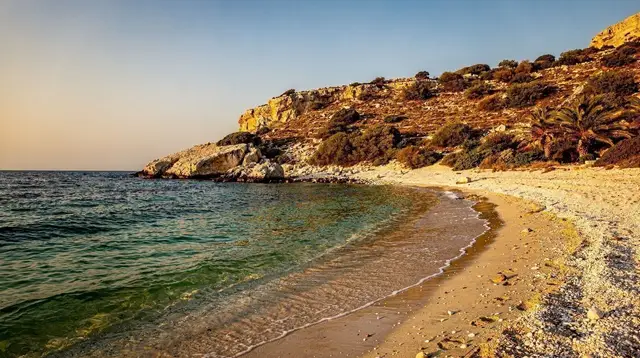
Sea temperature is the clearest thread connecting October back to summer. Crete’s coastal water warms slowly through spring and early summer and holds its heat into autumn, typically peaking around August and September before a gradual cool-down. Early October generally still delivers swimmable, comfortable sea temperatures inherited from that September peak, and the south coast — facing the Libyan Sea — tends to run a touch warmer and calmer than the north, particularly useful if the north coast picks up any late-season wind.
This is also a reasonable month to combine a beach day with a boat trip that summer crowds and summer wind both complicate. A day trip to Elafonissi’s pink-tinged sand avoids the worst of the July-August crush, and the drive or boat out to Elafonissi is considerably more pleasant without a mountain-road traffic jam. As with every seasonal claim on this page, treat “the sea is warm in October” as a strong general pattern rather than a guarantee for your specific week — a cold front can arrive in any given year, and the difference between the 3rd of October and the 30th is real.
Best Things to Do in Crete in October
| Activity | Why October works | Where to read more |
|---|---|---|
| Samaria gorge hike | Cooler than summer, if the season hasn’t closed yet | Samaria gorge guide |
| Balos and Gramvousa boat trip | Meltemi season is over, calmer crossings | Balos lagoon guide |
| Chrissi island day trip | Fewer crowds than August, boats still running | Chrissi island guide |
| Wine tasting around Peza and Archanes | Post-harvest, a genuinely seasonal moment | Cretan wine regions guide |
| Old town walking, Chania and Rethymno | Comfortable temperatures, thinner streets | Chania old town walk |
Beyond the gorge and the boats, October lines up well with two other things Crete does well. It is a genuine harvest month for wine, and a wine and olive oil tasting in the vineyards around Peza fits the season rather than being scheduled around it. The Cretan wine regions and grapes guide covers the indigenous varieties — Vidiano and Vilana in white, Kotsifali and Mandilari in red — grown in the wine villages of Archanes and Dafnes.
For a slower, scenic day that does not depend on a gorge being open or a boat running, a sunset safari across the island’s back roads is a reasonable way to close out a shorter October evening, since daylight is noticeably shorter than in midsummer.
Early October or Late October: Which Half to Pick
If your travel dates are still flexible, the two halves of the month genuinely differ enough to plan around.
| Early-to-mid October | Late October | |
|---|---|---|
| Sea temperature | Warm, close to September levels | Cooling, still swimmable on calm days |
| Samaria gorge | Often still operating, check current status | Frequently closed for the season |
| Crowds | Noticeably thinner than summer | Thin, approaching low-season quiet |
| South-coast businesses | Mostly still open | Some closing for the year |
| Rain risk | Low | Increasing |
Nothing in that table is a promise for a specific year — October’s exact turning point moves with the weather, sometimes by two or three weeks either way. What it reflects is the general direction of travel: earlier is more like summer’s tail, later is more like winter’s approach. If a Samaria hike or a pink-sand beach day at Elafonissi is the centrepiece of your trip, book earlier in the month rather than later.
Where to Base Yourself in October
With smaller crowds and cooling evenings, a base in one of the old towns tends to work better in October than a resort strip built for a July beach holiday. Chania and Rethymno both stay lively through October, with restaurants, museums and the harbour walks operating on their normal year-round schedule rather than a seasonal one. If your plan leans toward the south coast and its boats, a base near Ierapetra keeps the Chrissi crossing and the quieter Libyan Sea beaches within easy reach, while acknowledging that some smaller south-coast operations may already be scaling back by the later weeks of the month.
Packing for a Month of Two Seasons
October rewards layering more than any other month on this island. Days can still feel like late summer, particularly in the first half and away from altitude, while evenings — especially inland, in the mountains, or in the back half of the month — turn genuinely cool. A light jacket or fleece is worth packing regardless of how warm the forecast looks on the day you book, along with a swimsuit that may or may not get used depending on exactly when you travel and how the water feels that week.
Sturdy shoes matter if a gorge walk is still on the table, and it is worth checking current opening status for anything weather-dependent — a gorge, a boat crossing, a specific beach operator — close to your actual dates rather than relying on general seasonal patterns like the ones described on this page.
Questions About Visiting Crete in October
Is October too late to visit Crete?
No, not for most of the month. Early and mid-October usually still feel like a mild, quiet extension of September, with warm sea temperatures and open gorges. It is the back half of the month, moving toward November, where the island genuinely starts to wind down.
Is the Samaria gorge open in October?
It depends on the year and on conditions. The gorge normally operates from around May into October and closes for the season somewhere in that month, sometimes earlier if there is heavy rain or fire risk. Never plan a trip around a specific October date without checking current status close to arrival.
How warm is the sea in Crete in October?
Still warm by most standards, generally in the low-to-mid twenties Celsius, a carryover from the 24-27°C typical of September. It cools as the month goes on, and the south coast, facing the Libyan Sea, tends to stay milder than the north.
Are the boats to Balos, Gramvousa and Chrissi running in October?
Usually yes, especially earlier in the month, because the meltemi wind that cancels these crossings is mainly a July-August phenomenon. Autumn weather is calmer, though any boat trip can still be called off for a specific day’s conditions.
What closes in Crete in October?
Nothing closes all at once. Some south-coast tavernas, smaller hotels and seasonal beach operations begin shortening their hours or shutting for the year as October progresses, a trend that continues through November. The old towns, museums, Knossos and the monasteries stay open year-round.
Is October a cheaper time to visit Crete?
Generally yes. Accommodation and car hire tend to ease down from the August peak, and flights are usually less contested than in high summer, though exact pricing depends on airline and demand in a given year.
Should I visit early October or late October?
Early-to-mid October keeps more of the summer feeling: warmer sea, more open businesses, a still-functioning Samaria gorge in most years. Late October leans toward the low season, with a real chance of rain, cooler evenings and reduced services in smaller coastal villages.
Popular Crete Tours on GetYourGuide
Verified deep-linked GetYourGuide tours. Book through these links and we earn a small commission at no cost to you.
GetYourGuide does not provide a product photo for this activity — the image shows the meeting point, photographed by us.