Matala: Caves, Red Beach and the Messara Coast
What are the Matala caves and is the beach worth visiting?
The Matala caves are man-made hollows cut into the sandstone cliff above a small sandy bay on Crete's south coast, in the Messara plain. The beach is compact and organised, with a free access corridor guaranteed by Greek law, and a quieter cove called Red Beach lies a short cliff path away.
A cove at the edge of the Messara plain
Matala sits where the flat farmland of the Messara plain meets the sea, on the south coast of Crete, facing the Libyan Sea. It is one of the few points on this stretch of coast where a sandy bay, a small village and a short cliff walk to a second cove all sit within a few hundred metres of each other, which is why it draws day-trippers from Heraklion, Phaistos and the resorts of the north coast in roughly equal numbers.
The village itself is small: a single beach road lined with tavernas, rooms and a handful of shops, backed by the low sandstone cliffs that give Matala its most photographed feature. This is not a resort strip in the way the Hersonissos to Malia stretch on the north coast is — it is closer in scale to the other south-coast villages of Plakias and Damnoni or Agia Galini, a short drive along the coast road.
Matala is best understood as one stop within a wider day out around the Messara. The Minoan palace at Phaistos and the Roman remains of Gortyna sit a short drive inland, and most visitors who base themselves in Heraklion or Rethymno see Matala as part of a loop rather than a destination on its own for a full day.
The caves cut into the cliff
The feature that gives Matala its identity is the row of man-made caves hollowed into the sandstone cliff at the southern end of the beach. They are shallow chambers, cut by hand rather than formed by natural erosion, and their exact original purpose is not settled with certainty — this page will not repeat any single dramatic story about their age or use as fact, because the record does not support one confirmed version.
What can be said reliably is that they have been used and reused across long stretches of the island’s history, and that in the late 1960s and early 1970s they became known internationally as a gathering point for travellers drawn to the coast, which is where Matala picked up the “hippie beach” nickname still used for some of the boat trips and day tours that visit today.
The caves now sit inside a small fenced and ticketed archaeological area at the end of the beach, reachable on foot along the sand or from the village. There is very little shade inside the enclosure, so a visit is easier in the morning or the later afternoon than at midday in July or August. The climb up into the caves is short but uneven, over worn rock steps, and is not well suited to anyone unsteady on their feet.
It is worth being clear about what Matala is not, since the caves and the dramatic cliff line lead some visitors to expect more than the site offers. This is not a volcanic coastline — Crete has no calderas, no fumaroles and no thermal pools anywhere on the island, and the caves are cut into ordinary sedimentary rock, not lava. Nor is a Matala boat trip a dolphin-watching excursion; boats along this coast run to quiet coves and to villages with no road rather than out to open water in search of marine mammals. The caves and the coastline are the attraction here, not either of those things.
Matala beach and the rule every organised beach in Crete follows
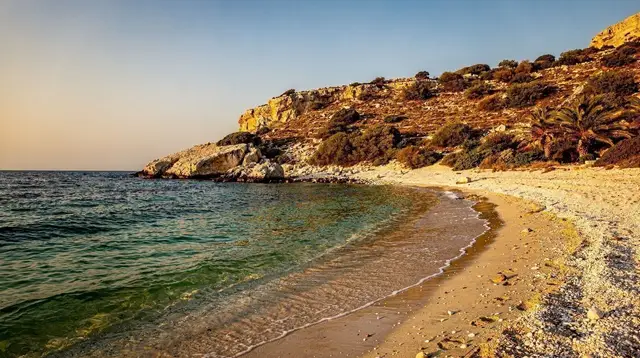
Below the caves, Matala beach is a compact curve of sand and shingle, sheltered by the cliffs on both sides and shallow enough at the shoreline to suit most swimmers. Part of the beach is organised, with rows of sunbeds and umbrellas rented out by the beach bars and tavernas along the front.
The price for a sunbed and umbrella set here runs broadly in line with organised beaches across the island: expect somewhere around 10 to 20 euros for the pair for the day, sometimes bundled with a minimum drink or food order at the taverna that operates that stretch of sand. That price is never compulsory. Greek law requires every organised beach to leave a clear, free strip along the water and an unobstructed path down to the sea, so a visitor who wants to lay a towel on the sand rather than rent furniture is always entitled to do so.
This is a right written into Greek coastal law, applied the same way at every organised beach in Crete, not a local courtesy that depends on which taverna happens to be renting the sunbeds that day. Anyone weighing the free-access rule beach by beach across the island can see the same principle set out in full in the guide to sunbeds and beach rights in Crete.
As with prices anywhere on the island, the sunbed rate and any food or drink bought on the beachfront already include Greece’s standard 24 percent VAT. Crete has never received the reduced VAT rate that applies on some smaller Aegean islands, so nothing here is quietly cheaper than the display price suggests, and there is no separate island discount to ask for. The figure on the menu or the sunbed sign is the figure you pay.
Red Beach, the quieter cove next door
A signposted path climbs the cliff at the southern end of Matala beach, past the caves, and drops down the far side to a second cove known as Red Beach for the reddish tone of its cliffs and sand. The walk takes roughly 15 to 20 minutes each way over uneven rock and loose gravel, with some scrambling near the top, so it is not a route for flip-flops or for anyone carrying much beach gear.
Red Beach has no permanent facilities of its own — no shop, no fixed sunbed operation guaranteed to be running on any given day — which is precisely why it draws people looking to get away from the organised section at Matala. There is often an informal, seasonal setup on the sand, but nothing that can be counted on outside the main summer months, so it is worth carrying water and sun protection rather than assuming a taverna will be open when you arrive.
Because the cove faces the same south-facing coastline as Matala itself, the sea and the shelter from wind are broadly similar to the main beach, just without the crowd. It suits an hour or two rather than a full day for most visitors, given the walk in and out.
Why the south coast stays calm when the north does not
Matala’s position on the Libyan Sea, facing south rather than north, is more than a geographic detail — it changes how the beach behaves through the summer. Crete runs east to west for around 260 kilometres, and the mountain spine down its centre means the north and south coasts experience the wind very differently in July and August.
The meltemi, a strong north wind that blows through those two peak months, regularly disrupts swimming conditions and boat schedules along the north coast, and cancels the crossings to Balos and Gramvousa in the west. The south coast, sheltered by the mountains, is typically far calmer during exactly the weeks the north is choppiest, which is one of the practical reasons Matala and the other Messara and Libyan Sea beaches gain visitors in high summer.
The difference between the two coasts, and how to plan around it, is covered in full in the guide to Crete in July and the meltemi, and the broader case for choosing a south-coast base over a north-coast one is set out in north coast versus south coast Crete.
Outside the meltemi months, the sea at Matala follows the same seasonal pattern as the rest of the island’s south coast: cool through May, comfortably warm from June, and at its warmest in late August and September, after which the organised sunbed operations along the beach begin to wind down for the year.
Getting to Matala
Matala sits roughly 75 kilometres south-west of Heraklion by road, a drive of around an hour and a quarter, and it is not served by a dense public transport network — a handful of seasonal KTEL coach runs connect it to Heraklion via Phaistos, but a rental car is the practical way to combine Matala with the archaeological sites and villages of the Messara in a single day. The roads in are surfaced and straightforward, unlike the dirt track out to Balos in the west, so this is an easy addition to a self-driven south-coast day.
Most visitors reach Matala as one stop within a longer loop: the Minoan palace at Phaistos and the Roman ruins at Gortyna sit a short drive inland, and Agia Galini further along the coast makes a natural second stop for lunch or an overnight. A south-coast itinerary that strings these together over several days is laid out in Crete’s south coast in six days.
Tours and day trips that include Matala
For visitors based in Heraklion or Rethymno without a rental car, an organised day trip is the more common way to see Matala, usually paired with one or two other stops in the Messara so the drive is worth the time. A boat-based half-day from the beach itself, the Matala Hippie Beach boat trip, gives a view of the caves and the cliff line from the water without the walk up to Red Beach.
From Heraklion, several coach-based itineraries combine Matala with the Roman site at Gortyna: the day trip to Matala and Komos beach pairs the caves with a second, quieter stretch of sand further along the coast, while the day trip combining Zaros, Phaistos and Matala adds the Minoan palace and a mountain village with a spring-fed lake, turning the day into a fuller loop through the Messara rather than a single beach stop.
Walkers with more time can approach Matala from the wilder side of the Messara on the Agiofarago gorge walk that ends near Matala, a route through a dry limestone canyon down to the coast that gives a very different sense of this part of Crete than the beach alone.
Where Matala fits in a south-coast day
Matala works best treated as a half-day stop rather than a full-day base: enough time to see the caves, swim off the main beach, and walk over to Red Beach if the path and the weather allow, before moving on to Phaistos, Gortyna or Agia Galini as the rest of the day’s plan. Visitors staying several nights in the south of the island, rather than passing through on a single day trip, are better placed to catch the beach in the quieter morning hours before coach groups from the north coast arrive around midday.
Matala caves and beach: common questions
Are the Matala caves natural or man-made?
They are carved into soft sandstone cliffs above the bay. Their exact original use is debated, and no single confirmed date or purpose applies to all of them, so treat any single dramatic origin story sold locally with caution.
Do I have to pay to see the caves and the beach?
The caves sit inside a small fenced archaeological area with an entrance fee. The beach itself is free to access under Greek law, though the organised part rents sunbeds and umbrellas separately.
How much do sunbeds cost at Matala?
A sunbed and umbrella set on the organised part of the beach typically runs 10 to 20 euros for the day. Greek law also requires operators to leave a free, umbrella-free strip and a clear path to the water, so a paid set is never the only way to use the beach.
Is Matala a volcanic site or a place to see dolphins?
No to both. Crete is limestone and folded rock with no volcanic activity, and boat trips along this coast go to islands and quiet coves, not to dolphin-watching grounds. Matala is a cove with caves and a beach, nothing more dramatic.
How do I get to Red Beach from Matala?
A signposted path climbs the southern cliff above Matala beach and drops down to Red Beach in roughly 15 to 20 minutes each way, over uneven rock and gravel. Sturdy sandals or shoes make it easier.
What is the best time of year to visit Matala?
Late spring and September give the calmest sea and thinner crowds. In July and August, when the meltemi wind disrupts the north coast, Matala’s south-facing position on the Libyan Sea usually stays sheltered and swimmable.
Is Matala part of a package resort strip?
No. It is a small village at the edge of the Messara plain, well south of the Hersonissos-to-Malia resort strip on the north coast, and it functions as a day-trip base rather than a large-scale resort.
Beach Tours in Crete on GetYourGuide
Verified deep-linked GetYourGuide tours. Book through these links and we earn a small commission at no cost to you.
GetYourGuide does not provide a product photo for this activity — the image shows the meeting point, photographed by us.