The south coast the meltemi doesn’t reach
Ask why choose Plakias and Damnoni over Chania, Rethymno or the Hersonissos strip, and the honest answer starts with geography, not marketing. Both sit on the Libyan Sea, on the south flank of the mountains that run the spine of the Rethymno region.
That range does real work: in July and August, when the meltemi — a strong, dry wind out of the north — turns the north coast choppy and occasionally shuts down boat trips to Balos or Chrissi, the south coast around Plakias is usually still swimmable, often flat. It is not immune to wind of its own, and a bad-weather week can still happen, but the pattern holds often enough that travellers who plan a July or August trip around calm water tend to end up looking south.
This page treats Plakias and Damnoni as one base rather than two separate stops. Plakias is the town: a long beach of coarse grey sand, a small harbour, and a seafront lined with tavernas that fill an early evening. Damnoni is a string of smaller coves a short drive or a walkable coastal path to the east, quieter, with clearer water and fewer sunbeds. Together they anchor the stretch of coast this site groups as south Rethymno, alongside Preveli and Agia Galini further along.
Getting here: the drive is part of the deal
There is no way to soften this: reaching Plakias takes longer than the map distance suggests. From Rethymno town it is roughly 40 km, but the road climbs over the foothills south of the city in a series of bends before dropping back down to the coast, and 45 to 60 minutes is a realistic driving time rather than a worst case. From Chania, add another hour.
There is no railway anywhere on Crete, so no train shortens the trip, and the KTEL coach network, which runs a genuinely useful service along the north coast highway between Chania, Rethymno, Heraklion and Agios Nikolaos, thins out sharply once you cross the mountains — a couple of buses a day in season, sometimes fewer, rather than the frequent north-coast timetable. For details on which is realistic for this trip, see our guides to renting a car in Crete, driving in Crete and KTEL buses in Crete.
Practically, that means most visitors reach Plakias by rental car, either driving down for a multi-day stay or as a long day trip from a north-coast base. A day trip is doable — the drive is under an hour each way from Rethymno — but it eats into the day, and a night or two here lets you actually settle into the slower pace rather than spend half the visit on the road.
If you would rather not drive the mountain road yourself, the Preveli Beach and Kourtaliotiko waterfalls day tour from Rethymno covers the same ground with a driver, which is worth weighing against the rental car versus organised tours trade-off for this specific corner of the island.
Plakias: the town and the beach
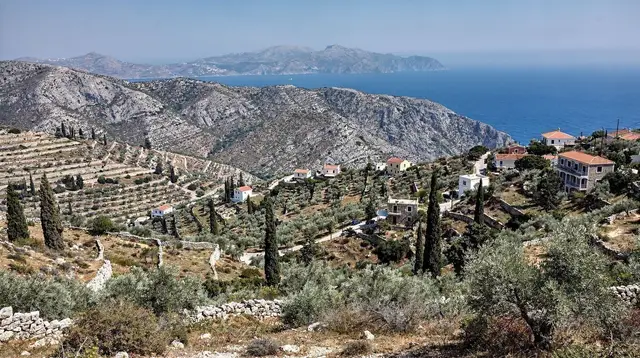
Plakias itself sits where a broad valley meets the sea, backed by bare, pale hills that turn gold in the evening light. The beach runs for well over a kilometre of coarse sand and shingle, with a section of sunbeds near the harbour and long stretches further along that stay empty even in August. The harbour still handles a handful of working boats, and the seafront promenade behind it is where the town’s daily rhythm plays out — coffee in the morning, a swim before lunch, and tavernas filling from early evening onward.
This is not a place that pretends to nightlife. A few bars keep going past midnight in peak season, and there is enough life on the seafront to not feel remote, but anyone picturing the beach clubs and late-night strips of Hersonissos, Stalida or Malia should adjust expectations now.
Plakias built its reputation among hikers finishing the E4 European long-distance path, which comes down out of the mountains here, and among travellers who simply wanted the south coast without the crowds — and it still carries that character. For a wider read on how this part of the island compares to the resort strip up north, see north coast versus south coast Crete.
Damnoni: the quieter coves
A few kilometres east of Plakias, reached by a short stretch of road or on foot along the coast path, Damnoni breaks into a handful of smaller bays rather than one continuous beach. The main cove has clear, calm water and a modest strip of sunbeds; the coves further along are smaller, some reached down steps or a short scramble, and noticeably quieter even in the busiest weeks of summer. There is far less in the way of tavernas and shops than Plakias itself, so most visitors treat Damnoni as a swimming stop rather than a base for meals — a short drive over from Plakias for a calmer few hours in the water, then back for dinner.
Between the two, the choice is really about pace within the same trip: Plakias for the harbour, the tavernas and the evening walk, Damnoni for the quietest swim of the day. Neither delivers the boat-trip spectacle of Balos or Elafonissi further west — there is no lagoon, no pink sand — but neither carries the crowds those beaches draw either.
Facilities, parking and signal on this stretch
Practical needs are covered in Plakias itself but thin out fast beyond it. The town has a pharmacy, a small medical centre for minor issues, ATMs, and two or three well-stocked mini-markets on the seafront road, plus a fuel station on the approach road — useful, since the next filling station in either direction is a genuine drive away. Damnoni has none of this: no ATM, no pharmacy, not even a permanent kiosk at every cove, so anyone spending a full day there should bring cash, water and sun cream from Plakias rather than count on finding it on the spot.
Parking is informal rather than organised. Plakias has free roadside space along the seafront and the approach road, tight in the middle of August but rarely impossible outside the first two weeks of the month; Damnoni’s coves each have a small gravel pull-in that fills early on a sunny morning, after which cars park along the verge. Mobile signal is reliable in both places — this is not a dead zone — but it can thin to a bar or two on the steps down to the smaller Damnoni coves and inside the Kourtaliotiko gorge itself, worth knowing if you are relying on a phone map to find the trailhead.
When to come, and how warm the water gets
The swimming season on this stretch runs roughly May to October, in line with the rest of Crete’s south coast. The sea itself follows a predictable curve: 21-25°C by June, climbing through the summer, and still a warm 24-27°C in September as the sea holds its heat longer than the air cools. Air temperatures in July and August regularly reach 30-35°C, and this is exactly the stretch where the south coast’s shelter from the meltemi pays off — while Chania or Rethymno’s beaches can turn choppy under the wind, Plakias and Damnoni often stay calm enough for an easy swim.
Late May, June, and September through early October are the best balance for most travellers: warm enough water, the gorges and paths still open, and noticeably fewer people on the beach than at the August peak. Winter here follows the island-wide pattern — mild but quiet, with many rooms, tavernas and rental outfits closing for the season, so this is not a year-round base the way Chania, Rethymno or Heraklion’s old towns are. For month-by-month detail, see best time to visit Crete and, if a July or August trip is set, Crete in July and the meltemi.
Two short excursions from this base
The real advantage of staying in Plakias or Damnoni, beyond the calmer water, is how close two of the south coast’s better-known stops sit to it. The Kourtaliotiko gorge, a narrow limestone cut with pools fed by a spring-fed stream, lies on the road back toward Rethymno, roughly 15-20 minutes’ drive, and makes an easy half-day walk on its own or combined with the swim at the gorge’s outlet. A short river trek through the gorge and its pools is also bookable directly, with the river trekking excursion into Kourtaliotiko gorge that departs from Plakias covering the walk without needing your own transport.
Immediately past the gorge, the road drops toward Preveli, where the Megas Potamos river meets the sea through a beach backed by one of Crete’s two groves of the endemic palm Phoenix theophrasti — the same species found at Vai in the far east. The grove burned in a 2010 wildfire and has since regrown; reaching the beach means either the steps down from the car park above or a short boat ride from the river mouth.
Several operators combine both stops from a Plakias base: Preveli beach and Damnoni excursion with boat ride takes in the palm beach and a Damnoni swim stop in one trip. For a fuller account of the palm grove and its 2010 fire, see Preveli monastery and palm beach and the Kourtaliotiko gorge walk.
Further afield, Spili — a mountain village known for its stone lion-head fountains — sits on the same road network north of Plakias and works as a coffee stop on the drive rather than a destination in its own right.
If you only have half a day here
Not every visit allows time for both the gorge and the palm beach, so it is worth arbitrating honestly rather than trying to rush both into an afternoon. Kourtaliotiko rewards walkers: the gorge is short enough to cover in under two hours round trip, and the reward is the walk itself, cool stone and running water rather than a single photograph. Preveli asks more of your time and legs — the descent to the beach and back is steeper and slower than it looks from the car park — but the palm grove and the river meeting the sea are genuinely singular; nothing else on this stretch of coast looks like it.
If the day is about the swim rather than the walk, skip both and stay local: Damnoni’s main cove gives calmer, clearer water than either the Kourtaliotiko pools or the Preveli river mouth, with far less driving. As a rough rule, choose Kourtaliotiko if you would rather walk than lie on sand, Preveli if a single striking beach matters more than saving your legs, and Damnoni if the point of the day is simply to swim without spending an hour of it in the car.
Beyond the beach: what fills a slow afternoon here
Plakias and Damnoni are not a hiking or culture hub the way Rethymno or Heraklion are — there is no old town to wander, no museum, no monastery within the town itself — and this page will not pretend otherwise. What there is, is a short list of low-key activities built around the coast and the hills behind it.
A snorkelling lesson at Damnoni’s clearer water is a reasonable way to spend a morning, with the guided snorkelling course with equipment included, run out of Plakias covering the basics for anyone who has not tried it before. Inland, the hills behind Plakias carry old farm and mule tracks that several stables use for slower-paced riding, including the horse riding beach ride along the Plakias coastline.
None of this adds up to a packed itinerary, and that is close to the point. This is a base for slow mornings on a quiet beach, a gorge walk or a palm-grove afternoon, and an early dinner on the harbour — not a place to expect the museums of Heraklion or the Venetian streets of Chania and Rethymno within reach on foot.
What surprises people, for better and worse
A few things catch first-time visitors off guard here, and it is worth naming them rather than letting the marketing photos set expectations. The main Plakias beach is coarse sand and shingle rather than the fine white sand some travellers picture from a search for a Crete beach holiday — comfortable enough barefoot once you’re used to it, but a beach mat or sandals for the shoreline are worth packing. The shelter from the meltemi is real but not absolute: a strong blow can still stir up chop on an otherwise calm week, and a handful of days each summer the south coast is not the flat water the reputation promises.
Dining is honest taverna food — grilled fish, mezze, the Cretan staples covered in our food guide — rather than a wide range of cuisines; anyone wanting variety beyond Greek and the occasional Italian menu will find the choice thinner than in Rethymno or Chania. And on still evenings, especially near the river mouths at Preveli and after a dry spell breaks, mosquitoes are enough of a nuisance that repellent is worth packing alongside sun cream — a minor point, but one the brochure photos never mention.
Where this fits in a wider Crete trip
For most first-time visitors, Plakias and Damnoni work best as two or three nights slotted into a longer loop rather than the sole base for a trip — the driving distance from the airports at Heraklion and Chania is real, and a single-base stay here would miss the old towns and Knossos entirely. It pairs naturally with time in Rethymno before or after, using the short drive over the mountains as the hinge between the two.
Our south coast itinerary builds a longer route around this stretch for travellers who want more of the Libyan coast than just Plakias, and how many days in Crete covers how a stop like this fits against the rest of the island.
The trade-off is consistent throughout: what you give up in nightlife, convenience and short driving times, you get back in a genuinely calmer sea during the exact weeks — July and August — when the north coast is at its most crowded and, under the meltemi, its most choppy. For travellers weighing that trade-off directly, things to do around Plakias and Damnoni lists the fuller range of tours and activities based here.
A few more questions
Is Damnoni’s beach sandy or pebbly?
Mixed, cove by cove. The main Damnoni beach has coarse sand and fine shingle underfoot, while the smaller coves further along run more to pebble and rock, with a few sandy patches that shift after winter storms. None of it matches the fine white sand some visitors expect from photographs, and water shoes make the entry easier at the smaller coves.
Is there an ATM, pharmacy or supermarket in Plakias?
Yes. Plakias has a pharmacy, a small medical centre for minor issues, a couple of ATMs and several mini-markets along the seafront and the approach road. Damnoni has none of this, so it is worth stocking up on cash, water and sun cream in Plakias before spending the day at the coves.