Pachnes and the White Mountains
Can you climb Pachnes without mountaineering experience?
Only with real preparation. Pachnes is 2,453 m, the highest point of the Lefka Ori, and it is an unmarked, waymarked-at-best route with no hut near the summit, no rescue infrastructure to speak of and snow lingering into May or June. Fit hikers with navigation skills and a local guide manage it in a long day; casual walkers should not attempt the summit push alone.
Can You Actually Climb Pachnes?
The honest answer is: yes, but not casually. Pachnes is 2,453 m, the highest summit in the Lefka Ori, the White Mountains that dominate the skyline behind Chania and hold snow into May or June most years. It is the second-highest point on Crete after Psiloritis, and it sits in terrain that has almost nothing in common with the coast most visitors spend their holiday on.
There is no cable car, no chairlift, no mountain railway anywhere on the island despite that late snow — Crete has no ski lift at all, a detail that surprises people who assume a peak this high must have some kind of winter infrastructure. What it has instead is a long, physically serious walking day on a route that is only partly marked, above a trailhead reached by narrow mountain roads out of Therisso.
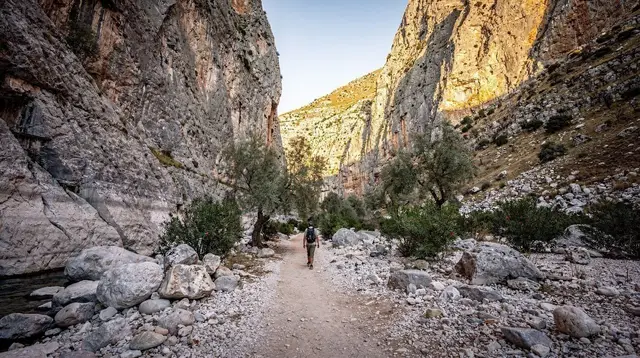
This page is written for two kinds of readers: the ones asking whether they, personally, without mountaineering experience, could stand on that summit, and the ones who are happy to admire the Lefka Ori from a lower trail, a gorge floor or a jeep track and want to know what that easier version looks like. Both answers are here, and neither pretends the mountain is softer than it is.
The Numbers: 2,453 Metres in the Lefka Ori
Pachnes is the highest point of the Lefka Ori, the White Mountains that run along the spine of western Crete behind Chania and Souda Bay. At 2,453 m it comes second only to Psiloritis (Mount Ida) at 2,456 m, the island’s overall high point further east — a gap of just three metres between the two, which is a fact Cretan guides enjoy mentioning. Where Psiloritis rises as a single, relatively accessible massif, the Lefka Ori is a whole range of folded limestone peaks and ravines, and Pachnes sits deep inside it, well back from any road.
The range holds snow longer than anywhere else on Crete. Drifts in the high gullies and on the north-facing slopes near the summit commonly last into May, and in a heavy winter into June. That late snow is part of what makes the range beautiful from below and part of what makes an early-season summit attempt genuinely hazardous — soft, unstable snow on steep ground is a different problem from the dry scree of high summer, and it is the single biggest factor in deciding whether a given week is a reasonable time to go.
Where You Start: Therisso and the Road In
Access to Pachnes begins in the Chania hinterland, through Therisso, the mountain village famous for its own dramatic gorge and its role in Cretan political history. From Therisso, unpaved and narrow paved roads climb further into the range toward the Kallergi area and the trailheads used for the Pachnes approach. These are proper mountain roads: single lane in stretches, blind bends, drops on one side and rock on the other.
Locally, drivers deal with this by pulling onto the hard shoulder to let a faster car pass — that is a courtesy gesture on a narrow road, not an invitation to overtake blind on a bend, and visiting drivers who misread it as the latter are the ones who end up in trouble. Anyone driving themselves up from Therisso should treat every blind corner as occupied, keep speed low, and use the pull-outs the way locals do: to let traffic pass, not to force a way past someone else.
There is no realistic public transport option for this stretch. The KTEL coach network, which genuinely works along the north coast corridor linking Chania, Rethymno, Heraklion and Agios Nikolaos on the VOAK highway, thins out fast once you leave that line, and it does not serve the Therisso road or the high trailheads at all. A rental car is the practical default for reaching the mountain, and drivers should confirm their contract covers the unpaved sections that some routes require — the same caveat that applies to the Balos road applies here.
a guided day through Therisso gorge that also covers the approach roads into the White Mountains is a useful way to see this stretch of road with a driver who knows it, before deciding whether to tackle it independently.
What the Climb Actually Involves
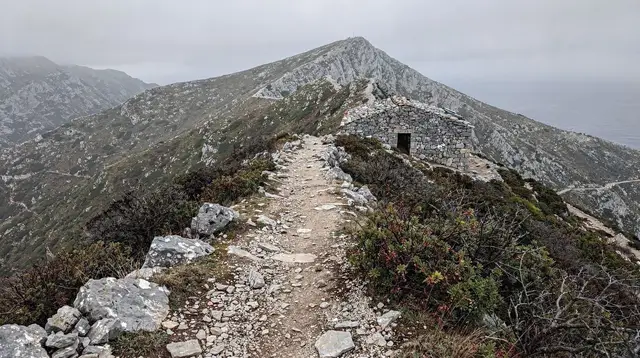
There is no shortcut to Pachnes, and no version of this page that promises one. From the usual trailheads near Kallergi or Kambi, the round trip runs roughly 9 to 11 hours, with something in the order of 1,200 to 1,400 m of ascent depending on the exact start point. The path is marked in places and absent in others; route-finding on the upper slopes, especially in poor visibility or residual snow, is a real skill the hike requires, not a formality.
None of this is technical climbing — there is no rope work on the standard route — but it is a serious mountain day: sustained ascent, loose scree near the summit, weather that can change fast at altitude even when the coast is calm, and long stretches with no phone signal and no one else around. Guides who lead this route routinely start before dawn specifically to be off the summit and descending before afternoon cloud and, in shoulder season, afternoon storms build.
a guided route that takes the White Mountains from the coast up toward the high ground gives a supported way to test the terrain with someone who reads the conditions daily, rather than finding out mid-ascent that the snow has not cleared.
For visitors who want the altitude and the panorama without committing to a full Pachnes day, Psiloritis, the island’s true high point further east, is a comparable but distinct undertaking, and the long-distance E4 trail across Crete touches the Lefka Ori on a multi-day itinerary rather than a single push to one summit.
Snow, Season, and When Not to Go
The single most important planning fact for Pachnes is the snowline, not the calendar month. In a light winter the upper slopes can be walkable by late April; in a heavy one, snow patches persist into June and can hide crevasse-like gaps between rock and ice that are dangerous to step on unroped. Guides who work the range year-round treat late June to September as the reliable window for a straightforward, snow-free ascent, with July and August adding heat rather than technical difficulty — start early, carry more water than feels necessary, and expect full sun above the treeline for most of the day.
Outside that window, the mountain is not necessarily closed, but it stops being a hike for anyone without proper judgment about snow conditions. Winter attempts belong to experienced mountaineers with the right equipment, not to a holiday itinerary. For a general sense of what each month on Crete looks like at lower elevations, see Crete weather month by month and, for the low season specifically, what actually closes in Crete over winter.
| Period | Conditions on Pachnes | Suitable for |
|---|---|---|
| November – March | Snow-covered, genuine winter mountaineering | Experienced, equipped mountaineers only |
| April – early June | Snow patches lingering, variable by year | Guided ascents, strong hikers with a local guide |
| Late June – September | Dry, scree underfoot, full sun | Fit hikers, guided or well-prepared independent parties |
| October | Transitional, early snow possible at altitude | Guided ascents recommended, watch the forecast |
If You’re Not Ready for the Summit: Alternatives
Plenty of visitors want the White Mountains experience without the 10-hour summit day, and the range gives several honest ways to get it. A guided 4x4 route climbs into the high ground for the panorama without the walking: a private 4x4 safari that reaches high ground in the White Mountains by vehicle. For something between a drive and a full ascent, a guided buggy route through the foothills adds a cultural stop: a buggy tour through the White Mountains that finishes with an olive oil tasting.
Climbers who want technical rock rather than a long approach walk can find it much closer to Chania, in the gorge itself: a guided rock climbing session in the Therisso gorge area, a route that gives real vertical exposure in a fraction of the time and with a qualified guide managing the ropes.
For a gentler day still inside the same mountain landscape, the alpine plateau and lake at Lake Kournas sit at the foot of the range and give walkers a sense of the terrain without the elevation. A guided day into the protected core of the range, below the summits but well into serious mountain country, is worth considering before any independent attempt on Pachnes itself — it shows what conditions are actually like at altitude that week, which a forecast alone cannot.
For visitors staying closer to Chania who still want the gorge scenery associated with this part of the island, Therisso gorge and the wider Akrotiri monasteries walk both sit well below the snowline year-round and need nothing beyond ordinary fitness.
Getting There and Getting Around: The Practical Reality
There is no way to soften this: reaching the Pachnes trailheads without your own transport is genuinely difficult. Renting a car is close to mandatory for independent access, and driving in Crete — particularly on mountain roads like the one out of Therisso — rewards a cautious, unhurried style. The KTEL bus network is a genuinely good option for the north coast towns, but it stops well short of the White Mountains interior, and no train exists anywhere on Crete to fill that gap.
Anyone without a car, or without confidence on unpaved mountain roads, should default to a guided tour with transfer included rather than attempting to self-drive to an unfamiliar trailhead before dawn. It removes the two hardest logistical problems — the road and the route-finding — at once.
a guided day trip into the White Mountains that includes the Kallergi refuge area is a practical middle ground: it goes deep into the range, well above the gorges, without requiring a summit-level walking day.
Before any high-mountain plan, check what to pack for Crete and safety and health in Crete — both apply doubly at altitude, where a warm coastal forecast tells you nothing about conditions 2,000 m higher. Visitors building a longer stay around the western mountains may also want the dedicated White Mountains and Sfakia in three days itinerary, which sequences the range with the villages south of it rather than treating Pachnes as an isolated day out.
Questions About Climbing Pachnes and the White Mountains
Is Pachnes hard to climb?
Yes, relative to almost anything else on the island. It is a long day, roughly 9 to 11 hours round trip, on terrain that turns to scree and, early in the season, snow near the top. There is no technical climbing on the standard route, but there is sustained elevation gain, real exposure to changeable mountain weather, and no easy bail-out point partway up.
Do I need a guide to climb Pachnes?
It is not legally required, but it is the sensible choice for anyone without prior experience in the Lefka Ori. The upper route is only partly marked, mobile signal is unreliable, and a local guide reads the snowline and the weather in a way a first-time visitor to the range cannot.
How long does it take to reach the summit?
Most guided ascents budget a full day: 9 to 11 hours of walking with around 1,200 to 1,400 m of ascent, depending on the trailhead used. It is a dedicated day, not an add-on to another activity.
When is Pachnes free of snow?
Snow can hold on the summit and in the high gullies into May, and in a heavy winter into June. Late June through September is the reliable window for a snow-free ascent; outside it, snow conditions should be checked with a local operator before committing to a summit attempt.
Can I drive close to the summit?
No. There is no road near the top of Pachnes, no cable car and no ski lift anywhere on Crete despite the snow the range holds well into spring. The nearest a vehicle gets is a trailhead well below the ridge, reached via narrow roads out of Therisso.
Is there public transport to Therisso and the trailheads?
No reliable one. The KTEL network is genuinely useful along the north coast between Chania, Rethymno, Heraklion and Agios Nikolaos, but it does not extend up the Therisso road or into the White Mountains interior. A rental car, or a guided tour with transfer, is the only practical way to reach the trailheads.
What should I pack for the climb?
Sturdy hiking boots, layered clothing for a swing of 15 to 20 degrees between the trailhead and the summit, more water than seems necessary, a headlamp for a pre-dawn start, and, in spring, either an ice axe and the skill to use it or the judgment to turn back at the snowline.
Is Pachnes suitable for beginners?
The full summit push is not a beginner hike. Beginners, families and casual walkers are much better matched to the lower trails around Therisso gorge and the Kallergi area, which offer the same mountain scenery without the altitude, the route-finding or the length of a Pachnes day.
Hiking Tours in Crete on GetYourGuide
Verified deep-linked GetYourGuide tours. Book through these links and we earn a small commission at no cost to you.
GetYourGuide does not provide a product photo for this activity — the image shows the meeting point, photographed by us.