Sitia Wine and Olive Oil Country
Is Sitia a real wine region in Crete, or just a stop near Vai beach?
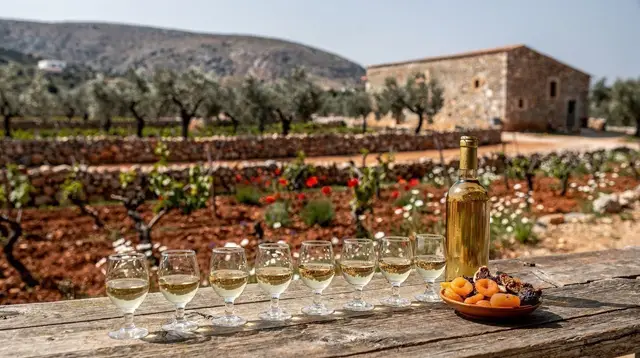
Sitia is one of Crete's established wine zones, growing the same indigenous grapes as Peza, Archanes and Dafnes further west, and it shares its agricultural land with olive groves that produce protected-origin oil. It sits about 270 km and over four hours' drive from Chania, so it is a region to plan a base around, not a detour.
A Wine Map That Doesn’t Stop at Heraklion
Most visitors who hear “Cretan wine” picture the villages just south of Heraklion — Peza, Archanes and Dafnes, where most of the island’s wineries cluster within easy reach of the airport. That geography is real, but it is only the centre of a much larger picture. Crete’s wine-growing land runs the length of the island, and its eastern edge, around Sitia, is a working part of the same story — the same indigenous grapes, grown in a different pocket of hills, far enough from the tourist centre that few visitors ever connect the two.
That distance is the point of this page. Sitia is not a satellite of Peza that happens to be further away. It is its own agricultural zone, shaped by the same volcanic-free limestone geology and Mediterranean climate that defines wine-growing across Crete, but with its own microclimate, its own terracing, and its own long relationship with both the vine and the olive tree. Understanding why Sitia counts as a wine region — and why it sits alongside an equally serious olive oil tradition and, a short drive further on, the palm forest at Vai — means starting with the grapes themselves, not the postcard.
The Indigenous Grapes Crete Grows Nowhere Else
Crete’s wine identity rests on a small set of grape varieties that are, with rare exceptions, found only here. They are not international grapes planted for market appeal; they are native varieties that Cretan farmers have propagated for generations, and they appear across the island’s wine zones including Sitia.
On the white side, four names recur: Vidiano, a variety that produces rounder, fuller-bodied whites and has become something of a flagship for Cretan wine over the past two decades; Vilana, the most widely planted white grape on the island, used for lighter and more everyday wines; Dafni, an aromatic variety with a distinctive bay-leaf note, grown in smaller quantities; and Thrapsathiri, an older variety making a comeback for its acidity and citrus character.
On the red side, three grapes dominate: Kotsifali, soft and aromatic but low in tannin, usually blended with a firmer partner; Mandilari, deeply coloured and tannic, often used precisely to give Kotsifali structure; and Liatiko, one of the oldest documented grape varieties in Greece, capable of both dry reds and traditional sweet wines, and associated historically with the island’s east.
| Grape | Colour | Typical character |
|---|---|---|
| Vidiano | White | Full-bodied, stone fruit, has become a flagship variety |
| Vilana | White | Light, high-yield, everyday drinking |
| Dafni | White | Aromatic, bay-leaf note, planted in small quantities |
| Thrapsathiri | White | Acidic, citrus-driven, an older variety in revival |
| Kotsifali | Red | Soft, aromatic, low tannin, usually blended |
| Mandilari | Red | Deep colour, high tannin, structural blending partner |
| Liatiko | Red | Ancient variety, dry or sweet styles, historically eastern |
This is the same list you would hear discussed at a winery outside Archanes or in the cellars of Dafnes. What changes at Sitia is not the grape palette but the ground it is rooted in — a more remote, less irrigated, more wind-exposed corner of the island, closer to the Aegean on one side and open to the Libyan Sea’s influence from the south.
Where Sitia Sits on Crete’s Wine and Olive Oil Map
Crete’s wine-growing areas run in a loose band from the centre of the island toward the east: Peza and Archanes closest to Heraklion, Dafnes a little further southwest, and then Sitia, well over an hour beyond Heraklion at the island’s far eastern end. All four zones grow the same core varieties, which is what allows Sitia to be discussed in the same breath as the better-known central appellations rather than as an unrelated curiosity.
What sets Sitia apart is scale and visibility. The central zone benefits from proximity to Heraklion’s airport and the density of visitors passing through — a large share of Crete’s formal wineries with regular tasting programmes are concentrated there. Sitia’s vineyards are smaller in number and spread across a quieter agricultural landscape that most travellers only see in passing, on the way to or from Vai beach or Toplou monastery. The wine is not less serious for being less visited; it is simply further from the routes most itineraries already follow.
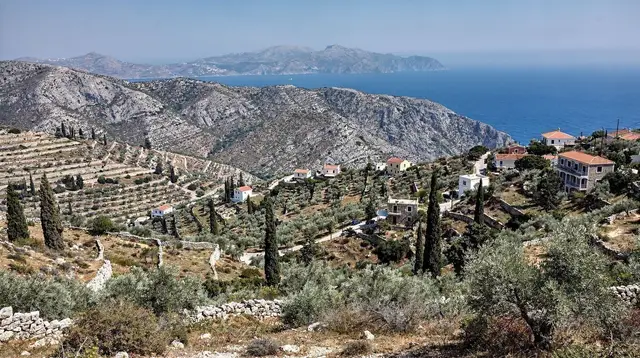
The same geography carries an equally significant olive oil tradition, and in eastern Crete the two crops share the same terraced hillsides. Olive cultivation on this scale predates organised wine tourism by millennia — Crete’s association with olive oil goes back to the Minoan period — and the Sitia area’s oil has formal recognition within Greece as a protected designation of origin product, a status tied to the specific growing conditions of this corner of the island. Groves here are worked in the same rhythm as the vineyards: terraced against the slopes, harvested by hand in the cooler months, and pressed locally rather than shipped elsewhere for processing.
Visiting this landscape means accepting it on its own terms. This page will not name specific wineries, producers or price lists, because that detail changes from season to season and a written guide that fixes it in place quickly goes stale — and worse, sends visitors toward a business that may no longer operate the way it is described. What holds steady is the agricultural geography itself: this is a working wine and olive oil region, not a curated tasting circuit built for coach parties, and it rewards visitors who treat it that way.
a private day built around Moni Toplou and a wine tasting in the surrounding countryside is one practical way to see this landscape with a local driver rather than trying to self-navigate unmarked rural roads.
The Olive Groves That Share This Ground
It is worth being precise about the relationship between wine and olive oil in this part of Crete, because the two are not run as separate industries occupying separate land. The same terraced hillsides above Sitia that carry vines also carry olive trees, often on adjoining plots worked by the same families across generations. Olive cultivation is, by volume, the larger of the two — Crete as a whole produces a substantial share of Greece’s olive oil, and the island’s diet and cuisine are built around it far more than around wine.
The Sitia area’s oil is typically extra virgin, cold-pressed, and made almost entirely from local olive varieties adapted to the region’s dry summers and rocky, well-drained soil. Harvest runs through the autumn and into early winter, later than in much of the Mediterranean, and pressing happens at local mills rather than through large-scale export processing. A tour built around a visit to a working olive grove with an oil tasting included gives a direct look at how the harvest and the pressing actually work, without requiring a rental car to find a specific address down an unmarked lane.
None of this comes with fixed prices worth quoting here — oil prices shift with each year’s harvest, and quoting a figure in a guide meant to stay useful for years risks misleading a reader who visits in a different season. What is worth knowing is that this region takes its olive oil as seriously as its wine, and that visiting one without the other misses half of what the local agricultural landscape is actually built on.
Vai: The Palm Forest at the Edge of the Same Region
A short drive from Sitia, at the very eastern tip of Crete, lies a landscape that has nothing to do with volcanic activity and everything to do with a genuine botanical rarity: the palm forest at Vai. It belongs on the same page as Sitia’s vineyards and olive groves because it sits within the same agricultural region and because so many visitors reach it by driving through the wine and olive country described above.
The palms at Vai are Phoenix theophrasti, a species endemic to Crete and found in only a small number of locations on the island. Vai holds the largest stand of them anywhere — widely described as the largest natural palm forest in Europe — a dense grove that has grown along this stretch of coast for centuries, not a planted amenity. The same species grows at Preveli on the south coast, where a smaller grove burned in a 2010 wildfire and has regrown since; Vai and Preveli are the two places on Crete where this palm survives in any real number.
Vai is a protected and fenced site, and camping is not permitted anywhere within it — worth stating plainly, because the beach’s palm-fringed setting is exactly the kind of place that invites the idea. Access is controlled, there is a seasonal charge for the car park area, and the site is managed as a day-visit destination with closing hours rather than an open beach to linger on overnight. a direct transfer from Heraklion out to Vai is a straightforward option for visitors based further west who want to see the palm forest without driving themselves the full distance.
The Distance That Shapes Every Plan Here
There is no way to write honestly about Sitia without addressing how far it actually is from the rest of Crete. From Chania in the west, the drive to Sitia covers roughly 270 km and takes over four hours, almost entirely on the island’s main coastal highway followed by a slower final stretch east of Agios Nikolaos. From Heraklion, the distance drops to a more manageable two hours or so, but it is still not a casual half-day outing.
Crete has no railway anywhere on the island, so this distance is covered by road or not at all. The KTEL coach network runs reliably along the north coast as far as Agios Nikolaos and on to Sitia, but connections thin out considerably once you move off that main route, and reaching individual wineries or olive groves by public transport is not realistic. A rental car is the practical default for exploring this region independently; travellers relying on KTEL buses will find the town of Sitia itself accessible, but the surrounding countryside far less so.
This is why Sitia rewards a specific kind of trip planning: not a detour squeezed into a west-based holiday, but a stop built into an itinerary through eastern Crete that allows two or three nights in the area, giving time to see the town, the vineyards and olive groves, Vai, and nearby Toplou monastery without a single exhausting day of driving. Trying to reach Sitia, see everything, and return to a base in Chania or Rethymno in one day is not a realistic ambition given the distances involved.
a full private day trip that combines Sitia, Vai and Toplou monastery is built around exactly this logistical reality — a single organised day that covers the region’s main points for visitors who are based in central Crete rather than staying locally.
Visiting the Region Responsibly
A few practical points are worth carrying into any visit to this corner of the island. Olive groves and vineyards here are working agricultural land, not open-access parkland — respect fencing and marked boundaries, and treat any visit to a grove or vineyard as a guided or invited one rather than a self-directed wander. At Vai, removing anything from the protected site, camping, or straying from marked paths runs against the site’s conservation status; the palm forest survives because it has been actively protected, not because it is inexhaustible.
Seasonality matters as much here as anywhere else on Crete. Olive harvest runs through autumn and early winter, when groves are at their most active but tastings and mill visits may be harder to arrange; wine tastings, where available, generally follow the same April-to-October visitor season as the rest of the island’s tourism infrastructure. Outside that window, expect a quieter, more agricultural landscape with fewer organised activities running, in keeping with how Crete’s low season affects businesses across the island, not just in the resort towns.
Finally, resist the temptation to treat this region as a quick add-on to a Vai beach day. The wine and olive oil landscape around Sitia is worth the same unhurried attention as Peza and Archanes get in the centre of the island — it simply asks for a longer drive and a base nearby to do it properly. Pairing it with a stop at Sitia town itself, with its harbour and low-key waterfront, rounds out a visit that otherwise risks becoming palm beach and vineyard with nothing connecting the two.
Sitia, Vai and Cretan Wine: Common Questions
Is Sitia actually known for wine?
Yes. The Sitia zone in the far east of Crete is one of the island’s recognised wine-producing areas, alongside Peza, Archanes and Dafnes in the centre. It grows the same indigenous Cretan grapes and has done so for centuries, though it draws far fewer visitors than the vineyards near Heraklion.
What grape varieties grow around Sitia?
The same indigenous varieties found across central Crete: Vidiano, Vilana, Dafni and Thrapsathiri for white wine, and Kotsifali, Mandilari and Liatiko for red. None of these are international grapes — they are native to Crete and rarely grown anywhere else.
Does the Sitia region also produce olive oil?
Yes, and on a larger scale than wine. The terraced hills around Sitia are planted with olive groves as part of the same agricultural landscape, and Sitia olive oil carries protected designation of origin status within Greece.
How far is Vai palm beach from Sitia town?
Vai is roughly 25 to 30 minutes’ drive from Sitia, at the eastern tip of Crete. It is easy to combine with a day spent around Sitia’s vineyards and olive groves, since both sit within the same corner of the island.
Can I camp at Vai or sleep under the palms?
No. Vai is a fenced, protected site and camping is not permitted. It is a day-visit beach with an entrance fee to the car park area during the season, and visitors are expected to leave by closing time.
Is the Vai palm forest related to the one at Preveli?
Yes. Both are stands of Phoenix theophrasti, a palm species endemic to Crete found in only a handful of places on the island. Vai is the far larger of the two and is considered the largest natural palm forest in Europe; Preveli’s grove, on the south coast, burned in 2010 and has since regrown.
Do I need a rental car to visit Sitia’s wine and olive oil area?
In practice, yes. Public coach coverage in eastern Crete thins out well before Sitia, and the vineyards, olive groves and Vai itself are spread across a rural area with no meaningful bus network between them. This is a self-drive or organised-tour region, not one to improvise without a car.
How long does it take to reach Sitia from Chania or Heraklion?
From Chania, allow about 270 km and over four hours of driving on mostly two-lane roads once you pass Heraklion. From Heraklion itself it is closer to two hours. Either way, Sitia is not a realistic day trip from the west of the island.
Wine Tasting Tours in Crete on GetYourGuide
Verified deep-linked GetYourGuide tours. Book through these links and we earn a small commission at no cost to you.
GetYourGuide does not provide a product photo for this activity — the image shows the meeting point, photographed by us.