Rethymno's Fortezza: A Fortress Built for Siege
What is the Fortezza in Rethymno, and why does it matter?
The Fortezza is the Venetian fortress that crowns the hill above Rethymno's old town, raised during Venice's long hold on Crete from 1204 to 1669. It stands as evidence that these coastal towns faced a real, sustained military threat, in an era that ended with 21 years of Ottoman siege at Candia, today's Heraklion, from 1648 to 1669. Rethymno's old town, like Chania's and Heraklion's, stays open and lived-in all year, unlike much of Crete's south coast once winter comes.
A fortress built for a siege, not a skyline
Climb the hill at the western edge of Rethymno’s old town and the Fortezza opens out in front of you: a ring of walls enclosing the high ground, with the roofs of the old town falling away on one side and open water on the other. It reads, at first, like a scenic backdrop for photographs. It was not built as one. The Fortezza is a military answer to a military problem, raised while Venice held Crete, and the question worth carrying up the hill is not “how does it look” but “what was it built to survive.”
That question has an answer written into the island’s chronology. Venice ruled Crete from 1204 to 1669, a run of more than four and a half centuries during which the Venetian era reshaped how every Cretan coastal town was laid out, defended and governed. Rethymno’s Fortezza belongs to that story, not as an isolated monument but as one node in a chain of fortifications that ran the length of the island, from Chania in the west to Heraklion in the center and on to the fortress islands of the east.
Venice, the Ottomans, and 21 years at Candia
The single fact that makes sense of every Venetian fortress in Crete, the Fortezza included, is how the Venetian period ended. In 1648 the Ottoman fleet began a siege of Candia, the Venetian name for what is now Heraklion. That siege did not end until 1669: 21 years, one of the longest sieges in recorded history, fought over a single walled port city. Ottoman rule then held Crete from 1669 until 1898.
Read backward from that fact, Rethymno’s fortress stops looking like architectural ambition and starts looking like insurance. Every Venetian stronghold on the island, from the walls that eventually failed to hold Candia to the smaller island fortresses built to control approach routes, answered to the same slow-building pressure.
Two of the clearest examples sit at opposite ends of Crete and share an exact date: Imeri Gramvousa, off the northwest tip near Balos, and Spinalonga in the Gulf of Mirabello to the east, were both built in 1579. Rethymno’s Fortezza belongs to that same defensive logic, even without a single confirmed construction date attached to it in the record — a gap worth being honest about rather than papering over with an invented year.
The pattern holds at Heraklion too. The Koules fortress still guards the old harbor there, the same harbor behind the walls that held out for 21 years against the Ottoman siege. Standing on the Fortezza’s ramparts in Rethymno, you are looking at the same design problem the Venetians solved, with varying success, all along this coast.
Rethymno’s old town: one of three, open all year
Crete’s history did not stop at Venice and the Ottomans, and neither did its town-building. What survives today is a set of three historic centers — Rethymno, Chania and Heraklion — each carrying layers of Venetian and Ottoman construction side by side, minarets next to bell towers, fortress walls next to harbor markets. All three are working towns, not preserved sets, and all three stay open and lived-in through the year. That matters more than it sounds: much of Crete’s south coast and resort strip quietens or closes for the winter, while Rethymno, Chania and Heraklion keep their museums, monasteries and old-town streets running twelve months a year.
Rethymno’s version of this old town is worth walking on its own terms, not only as a stop between the other two. A dedicated walk through Rethymno’s old town covers the streets below the Fortezza; for comparison, the equivalent walk in Chania’s old town and the Heraklion city walk show how the same Venetian-Ottoman layering plays out differently in each place.
If you are weighing which of the three deserves more of your time, a direct comparison of Chania, Rethymno and Heraklion lays out the practical differences, and a two-day plan for Rethymno gives the Fortezza and the old town room to breathe rather than squeezing them into a single afternoon.
If you only have half a day in Rethymno
A single afternoon in Rethymno is enough to see the Fortezza and get a real sense of the town, but it is not enough to do both slowly and well. If a choice has to be made, start at the Fortezza while the light is still soft and the hill is quiet — its position on high ground, away from the harbour crowds, means it never gets quite the same crush of visitors as the lanes below.
Walking it in the cooler part of the day matters more here than at Knossos or the museums, since almost none of the fortress interior offers shade. Come down afterward into the old town streets and let the walk finish at the harbour rather than start there — approaching the water after the fortress gives a better sense of scale than starting at street level.
Anyone with a full two days, rather than half of one, does not need to choose at all. A two-day plan for Rethymno already gives the fortress and the old town separate mornings, which is the easier way to see both without rushing either.
Standing on the walls: what the Fortezza actually tells you
Walk the perimeter and the fortress makes its own argument. On one side, the walls look straight down over the terracotta roofs and narrow lanes of the old town — the population the fortress existed to shelter. On the other, they face open water — the direction any threat would have come from. That sightline is the whole point of the design: a garrison on the high ground, watching both the town it protected and the sea it watched for.
It is worth resisting the urge to fill in more than that from memory or guesswork. Guidebooks and blog posts disagree on details of the Fortezza’s interior buildings, on exact dates, and on opening hours and ticket prices that shift with the season and with restoration work. None of those specifics are pinned down reliably enough here to repeat as fact, and getting them wrong is worse than leaving them out. The honest approach is to treat the walls, the views and the historical chronology as the fixed points, and to confirm anything time- or price-specific once you are in Rethymno, either at the site itself or through a guided visit.
a certified guide walking the Fortezza with you is a direct way to get that context on-site, with someone who can answer the site-specific questions a general guide like this one deliberately leaves open. For a broader introduction to the streets around it, a guided walk through Rethymno’s old town covers the Venetian and Ottoman layers below the hill in the same visit.
What to expect on the hill
A few practical points are worth knowing before the climb, even without pinning down hours or ticket prices that shift through the year. The hill is genuinely exposed: once inside the walls there is little tree cover, and a sea wind that feels pleasant from the harbour below can turn sharp and constant once you are standing in the open on the ramparts. Sturdy shoes help more than the short walk up suggests, since the paths and old paving inside the fortress are uneven in places, worn by centuries of weather rather than laid out for foot traffic.
In July and August, the same meltemi wind that closes the boats to Balos and Gramvousa reaches Rethymno too, and it is felt more on the open hilltop than in the sheltered lanes of the old town below. Visiting earlier or later in the day, rather than at midday, makes more difference here than in the streets beneath the hill.
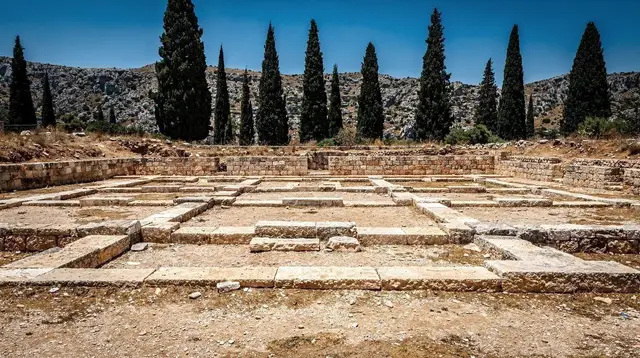
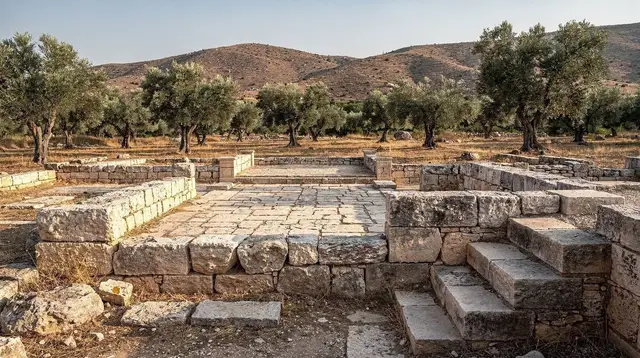
The other thing worth knowing going in: the Fortezza is not a furnished, curated interior in the way some visitors expect from photographs of the walls alone. What is actually inside is mostly open ground, standing walls, and the shell of a small number of structures, with grass growing between the stones in the quieter corners.
That is not a flaw in the site so much as a mismatch with expectation. It rewards people who come for the fortifications, the sightlines and the history rather than for room-by-room exhibits, and it can disappoint visitors expecting something closer to a palace interior. Knossos, a short drive east in Heraklion, is the closer match for that kind of visit — though it comes with its own expectation gap, since its famous frescoes are reconstructions rather than the originals.
Layers of history beyond the walls
The Fortezza is not the only place in Rethymno’s regional unit where Crete’s turbulent history is written into a building. Inland, Arkadi monastery carries its own version of the same story from a different century: in 1866, during the Ottoman siege of the monastery, its powder magazine was blown up, killing hundreds of defenders and refugees sheltering inside rather than allow their capture. It is still a working monastery today, with the same dress code visitors are asked to observe at other religious sites on the island.
The island’s twentieth century adds a further layer that touches every part of Crete, Rethymno included. The Battle of Crete began on 20 May 1941 and was the first major invasion in history carried out mainly by airborne troops.
What followed was not confined to the battlefield: Cretan civilian resistance during the German occupation is part of how families across the island, including in Rethymno’s villages, still talk about that war. None of this happened inside the Fortezza’s walls, but it happened in the same landscape the fortress was built to defend three and a half centuries earlier — a reminder that Rethymno’s history did not stop when the Ottomans left in 1898.
Rethymno’s Fortezza next to Crete’s other strongholds
Seen next to the island’s other coastal fortifications, the Fortezza’s role becomes clearer: not a one-off landmark, but one piece of a defensive network built and rebuilt across roughly four centuries of contested rule.
| Fortress | Region | What sets it apart |
|---|---|---|
| Fortezza, Rethymno | Rethymno | Hilltop fortress over the old town, part of Venice’s coastal defense network from 1204-1669 |
| Imeri Gramvousa | Chania, far northwest | Built in 1579; reached by boat from Kissamos, near Balos |
| Spinalonga | Lasithi, Gulf of Mirabello | Built in 1579; later a leper colony from 1903 to 1957 |
| Koules, Heraklion | Heraklion | Guards the harbor of Candia, which held out 21 years under Ottoman siege, 1648-1669 |
Visited together, or even just read together, these four sites turn a single fortress visit into something closer to a timeline: a defensive network built under one power, held as long as it could be, and then passed to another for over two centuries before Crete’s modern history took over.
FAQ: Rethymno’s Fortezza and its place in Crete’s history
Is the Fortezza the same thing as Rethymno’s old town?
No. The old town is the wider Venetian and Ottoman quarter of narrow streets, the harbor and the minarets below the hill. The Fortezza is the walled fortress that sits above and beside it, at the point where the old town meets the sea.
When was the Fortezza built?
It dates from Crete’s Venetian period, which ran from 1204 to 1669, as part of Venice’s wider effort to fortify its Cretan ports. There is no single confirmed construction date reliable enough to state here, so treat any specific year quoted elsewhere with caution.
Why did a town like Rethymno need a fortress at all?
Because the threat was real, not decorative. Venice held Crete against sustained pressure for over four centuries, and when that pressure finally broke through, the Ottoman siege of Candia lasted 21 years, from 1648 to 1669, one of the longest sieges in recorded history.
What happened to Rethymno after the Venetians left?
Crete passed to Ottoman rule in 1669, which lasted until 1898. The Fortezza, like the rest of the old town, carries the marks of both periods rather than a single, clean architectural style.
Is Rethymno’s old town open if I visit in winter?
Yes. Rethymno, Chania and Heraklion are the island’s three historic towns and all three stay open year-round, unlike many south-coast and resort businesses that close for the low season.
How does the Fortezza compare to Spinalonga or Imeri Gramvousa?
Both of those island fortresses date to 1579 and belong to the same Venetian defensive push along the Cretan coast, one off Chania and one in the Gulf of Mirabello to the east. The Fortezza served the same purpose on land, guarding a town rather than an approach by sea.
Can I visit the Fortezza with a guide?
Yes, guided walks of the fortress and the old town are bookable in Rethymno, which is a practical way to get the historical context on-site rather than piecing it together afterward. Opening hours and ticket prices change with the season, so confirm both locally before you plan your day around them.
Is Rethymno worth a stop next to Chania and Heraklion?
Yes, and it plays a different role than either. It is smaller and quieter than both while still carrying the same layered Venetian-Ottoman history, which makes it a natural base for a day or two between the west and the center of the island. Rounding out a Rethymno visit with a guided day trip to Arkadi monastery and Melidoni cave pairs the town’s fortress history with the inland sites that share the same centuries.
Is there shade at the Fortezza, or should I plan around the heat?
Very little. Once you are inside the walls, tree cover is minimal and the open hilltop catches both sun and wind more than the streets below. Visiting earlier or later in the day, rather than in the middle of it, makes a bigger difference here than in most of Rethymno’s old town.
Should I see the Fortezza before or after walking Rethymno’s old town?
Either order works, but starting at the Fortezza while the hill is quiet, then walking down into the old town and finishing at the harbour, tends to work better than the reverse — it gives a sense of scale to the streets below that starting at street level does not.
Museum Tours in Crete on GetYourGuide
Verified deep-linked GetYourGuide tours. Book through these links and we earn a small commission at no cost to you.
GetYourGuide does not provide a product photo for this activity — the image shows the meeting point, photographed by us.